Most lawn mowers hold between 0.25 and 2 gallons of gasoline, while riding lawn mowers commonly hold 1.5 to 3 gallons or more depending on the model.
Across the United States, homeowners use lawn mowers in many conditions, from small suburban yards to large rural properties. The amount of gas a lawn mower holds depends mainly on the mower type, engine size, and fuel tank design. A small walk-behind mower usually needs less than one gallon of fuel, while riding and zero-turn mowers require larger tanks because they cover more ground.
Knowing your mower’s fuel capacity helps you avoid unnecessary refills, prevent overfilling, and store gasoline correctly. The most accurate capacity information comes from the owner’s manual or manufacturer specifications, but typical ranges provide a useful estimate when comparing common mower categories.
A typical lawn mower holds between 0.25 and 3 gallons of gasoline depending on its category. Small push mowers designed for residential lawns usually have compact fuel tanks, while riding mowers and commercial zero-turn machines have larger tanks to support longer mowing sessions.
For most homeowners, the answer depends on the mower they own. A walk-behind mower may need only a few quarts of fuel, while a riding mower may require several gallons before reaching full capacity.
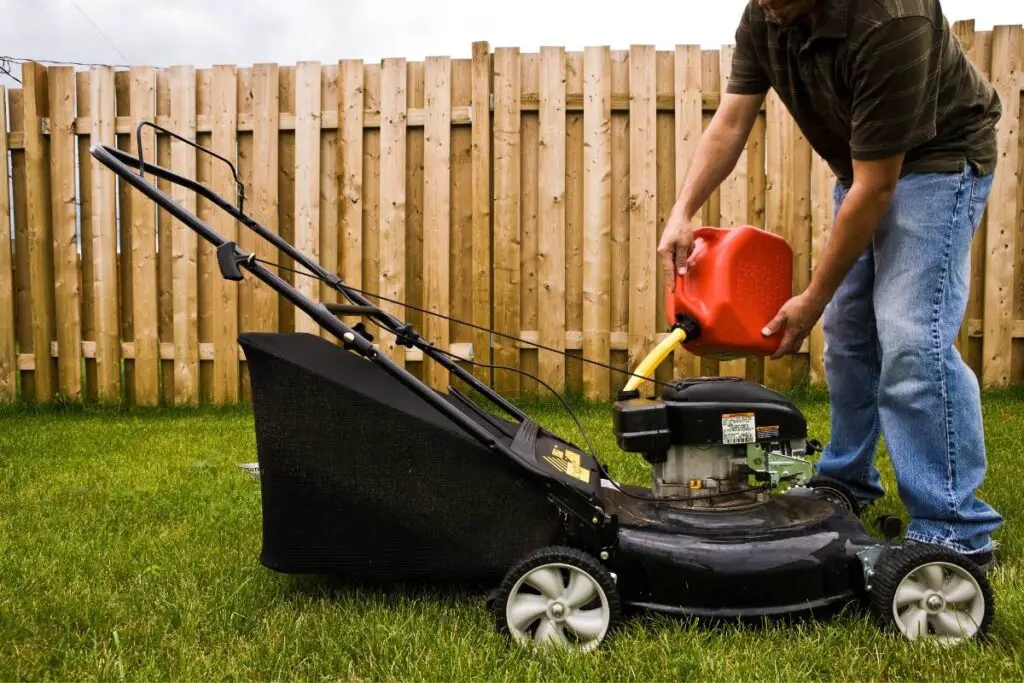
Source: mowerliving.com
Push lawn mower capacity
Most push mowers hold approximately 0.25 to 0.5 gallons of gasoline. Some larger self-propelled models may have slightly larger tanks.
Riding lawn mower capacity
Common riding mowers usually hold around 1.5 to 3 gallons of gasoline, although larger garden tractors can exceed this range.
Zero-turn mower capacity
Residential and commercial zero-turn mowers often have tanks ranging from about 2 to 5 gallons or more because they are designed for larger areas.
Why Lawn Mower Fuel Tank Sizes Are Different
Manufacturers choose fuel tank sizes based on engine requirements, mower weight, operating time, and intended use. A small push mower does not need a large tank because it typically operates for shorter periods and covers smaller areas.
Larger riding machines need more fuel capacity because their engines consume more gasoline and users often mow several acres without stopping.
Engine size
Larger engines generally consume more fuel and require larger tanks.
Mowing area
Mowers used on large properties benefit from bigger tanks to reduce refill frequency.
Average Lawn Mower Gas Tank Capacity by Type
The table below shows common fuel capacity ranges for different lawn mower categories. These numbers are general estimates because individual models vary.
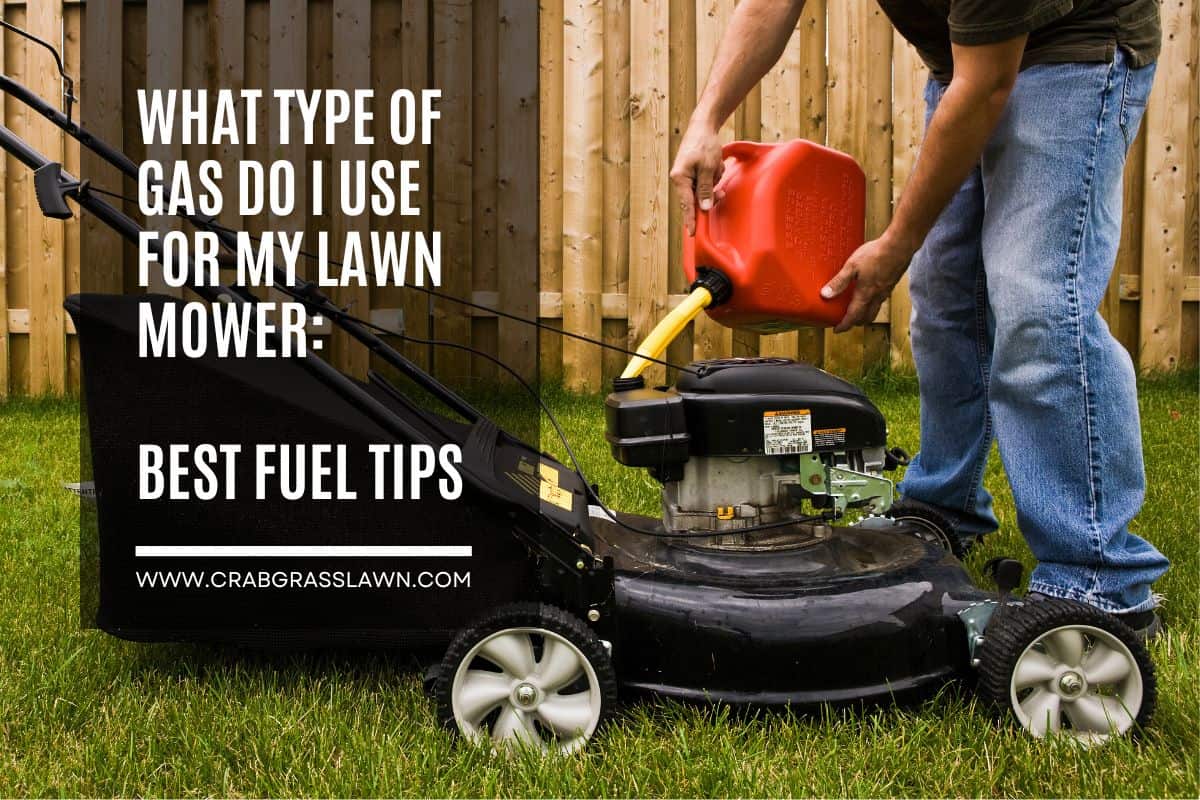
Source: crabgrasslawn.com
Walk-behind mower
Usually holds about 0.25 to 0.5 gallons of gasoline and is designed for small to medium residential yards.
Self-propelled mower
Often has a similar capacity to standard push mowers, commonly around 0.3 to 0.6 gallons.
Riding mower
Usually holds about 1.5 to 3 gallons, depending on the tractor size and manufacturer design.
The most reliable way to find your mower’s gas capacity is to check the owner’s manual. Manufacturers list the fuel tank size in gallons or liters, along with recommended fuel types.
If the manual is unavailable, the model number on the mower can often be used to locate official specifications from the manufacturer.
Check the owner’s manual
The manual provides the official fuel capacity and maintenance instructions.
Look for model information
The mower model number can help identify exact specifications.
How Long Does a Tank of Gas Last in a Lawn Mower?
A full tank of gasoline can last anywhere from about 30 minutes to several hours depending on mower type, engine load, grass conditions, and mowing speed. A small push mower may complete a typical residential yard on one tank, while a riding mower may operate for multiple mowing sessions.
Fuel consumption increases when mowing thick grass, using a larger cutting width, operating at high engine loads, or maintaining an inefficient engine.
Source: nurserylady.com
Small push mower
A quarter to half gallon tank may often last through a normal residential mowing session.
Riding mower
A larger tank can support longer mowing periods, especially on larger properties.
Maintenance effect
Clean air filters, proper oil levels, and sharp blades can help maintain efficient operation.
Estimated Fuel Use Calculation
A simple way to estimate fuel needs is to compare your mower’s tank size with its average runtime. For example, if a mower uses 0.4 gallons during a one-hour mowing session, a 0.8-gallon tank would provide roughly two hours of operation under similar conditions.
This is only an estimate because real fuel consumption changes with terrain, grass height, and mower condition.
Fuel capacity
The amount of gasoline the tank can safely hold.
Fuel consumption
The rate at which the engine uses gasoline during operation.
Common Mistakes When Filling a Lawn Mower Gas Tank
Correctly filling a lawn mower reduces the chance of fuel leaks, spills, and starting problems. Many fuel-related issues happen because users store gasoline incorrectly or fill tanks beyond their recommended level.
Gasoline should always be handled carefully and stored in approved containers away from heat sources and ignition risks.
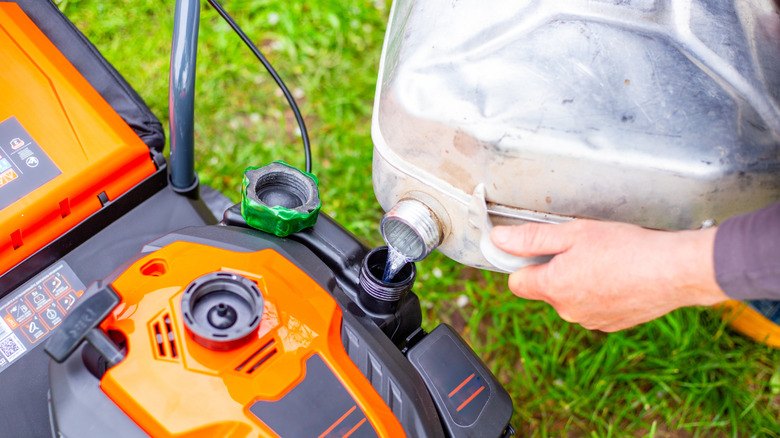
Source: hunker.com
Overfilling the tank
Leaving room for fuel expansion helps prevent spills when gasoline warms up.
Using old gasoline
Stale fuel can cause starting problems and poor engine performance.
Wrong fuel storage
Gasoline should be stored safely according to local safety guidance.
Signs Your Mower May Have a Fuel Problem
Fuel-related issues may appear as difficulty starting, uneven engine performance, stalling, or unusual odors. These symptoms can have multiple causes, so basic checks should be performed before assuming the fuel tank is the problem.
Engine will not start
Possible causes include old fuel, clogged fuel lines, or other engine issues.
Poor performance
Dirty filters, fuel problems, or maintenance issues may reduce performance.
Frequently Asked Questions About Lawn Mower Gas Capacity
Understanding your mower’s fuel capacity makes routine lawn care easier and helps you plan fuel purchases more effectively.
Source: gardentabs.com
Frequently Asked Questions
Q
How many gallons does a push lawn mower hold?
Most push lawn mowers hold about 0.25 to 0.5 gallons of gasoline. The exact amount depends on the mower model and manufacturer design.
Q
How many gallons does a riding lawn mower hold?
Most riding lawn mowers hold between 1.5 and 3 gallons of gasoline, although larger garden tractors and commercial machines may have bigger tanks.
Q
Can I fill my lawn mower gas tank completely full?
You should follow the manufacturer’s filling instructions and avoid overfilling. Leaving some space can help prevent fuel expansion and spills.
Q
How do I know my lawn mower’s exact gas capacity?
Check the owner’s manual or use the mower model number to find official specifications from the manufacturer.
Q
Does a bigger lawn mower tank mean better performance?
A larger tank mainly increases operating time between refills. It does not automatically improve engine power or cutting performance.
✦ Wrapping Up
Conclusion
Most lawn mowers hold between 0.25 and 3 gallons of gasoline, with the exact amount depending on whether the machine is a push mower, riding mower, or larger commercial model. Checking the manufacturer’s specifications is the best way to know the correct fuel capacity.
Understanding your mower’s gas tank size helps you maintain the machine, avoid fuel-related problems, and plan mowing sessions more efficiently.
💡 Key Takeaway
Find your mower’s model number or owner’s manual to confirm its exact fuel capacity before refilling or storing gasoline.
When your Toro lawn mower not starting ruins a weekend mowing plan, it can feel like your trusty machine has betrayed you. You pull the cord again and again—nothing. The good news? Most Toro mowers fail to start for simple reasons: stale fuel, a dirty air filter, a bad spark plug, or an overlooked safety…
When your lawn mower is not turning over, it can quickly turn a peaceful weekend plan into frustration. You head out to mow the yard, turn the key or pull the cord, and… nothing. No crank, no sound, sometimes just a faint click. This is one of the most common problems homeowners face during mowing…
When your Toro electric start lawn mower refuses to start, it’s easy to think the engine has failed or that something complex is wrong. But in most cases, the culprit is much simpler—the battery. The battery is the heart of your mower’s electric start system, and when it begins to fade, your reliable weekend mower…
Losing the key to your lawn mower can feel like misplacing the remote right before your favorite show starts. Everything comes to a sudden stop. Your yard is growing, the sun is out, and your Ryobi mower stands there silent because one tiny piece of plastic and metal has gone missing. This happens more often…
If your Honda lawn mower has started to lose its self-propel power, make strange grinding noises, or stall when engaging the blades, there’s a good chance your pulley is to blame. Many homeowners overlook this small metal wheel, but it plays a huge role in how smoothly your mower runs. The pulley controls how power…
Find the best drill set for carpenter with durable bits, powerful motors, and ergonomic design—compare top models and buy the perfect kit for pro woodworking.