


Farming isn’t just a job—it’s a lifestyle that demands reliable tools to keep equipment running through harvest seasons, repair broken implements, and fabricate custom solutions when parts fail. A wire feed welder has become essential equipment for modern farms, saving both time and money on repairs. After testing and researching dozens of models, we’ve identified the five best wire feed welders that can handle everything from fixing tractor hitches to building livestock gates. These machines balance power, portability, and ease of use specifically for the demanding farm environment.
Quick Product Comparison
Our Top 5 Best Wire Feed Welder For Farm Use Reviews – Expert Tested & Recommended
1. Hobart Handler 140EZ 120-Volt MIG Welder with Flux Core and Spool Gun

The Hobart Handler 140EZ stands out as a reliable workhorse that has earned its reputation among farmers who need a machine that just works. This 120-volt welder gives you the flexibility to tackle most farm repairs without requiring special power hookups. From fixing broken tractor parts to building new implements, it handles materials from thin sheet metal up to 3/16-inch steel with consistent results.
Key Features That Stand Out
- ✓ EZ Mode makes setup simple with just two dials to control
- ✓ Infinite voltage control for fine-tuning weld quality
- ✓ Includes flux core capability for outdoor windy conditions
- ✓ Spool gun ready for aluminum welding projects
- ✓ Industrial-grade construction that survives shop abuse
Why We Recommend It
Hobart built this machine specifically for people who need results without complexity. The EZ Mode takes the guesswork out of settings, which means you can focus on the repair instead of the machine. We’ve seen it run all day in hot barns and cold shops without missing a beat. The build quality is exceptional—this isn’t a disposable tool.
Best For
Farmers who want a single machine that handles 90% of welding tasks without needing a degree in welding technology. Perfect for daily maintenance and medium-duty fabrication work.
Pros and Cons
Pros:
- Extremely user-friendly for beginners
- Heavy-duty metal frame survives shop environment
- Versatile enough for MIG, flux core, and aluminum
- Consistent arc performance across materials
Cons:
- 120V limits maximum thickness compared to 240V machines
- Spool gun sold separately for aluminum work
Customer Reviews
Customer Review: “I’ve used this welder for three years on my 200-acre farm. It’s welded everything from gate hinges to combine parts. The EZ mode is perfect when I need to get help on a project—they can weld without me showing them every setting. Lasts forever and never gives me trouble.”
Customer Review: “Bought this after my previous welder died during harvest season. Setup took 15 minutes right out of the box. Welded up a broken loader bracket that would have cost me $500 to replace. The flux core works great in my open-sided equipment shed where wind is an issue.”
2. Millermatic 142 120V Portable MIG Welder with Auto-Set
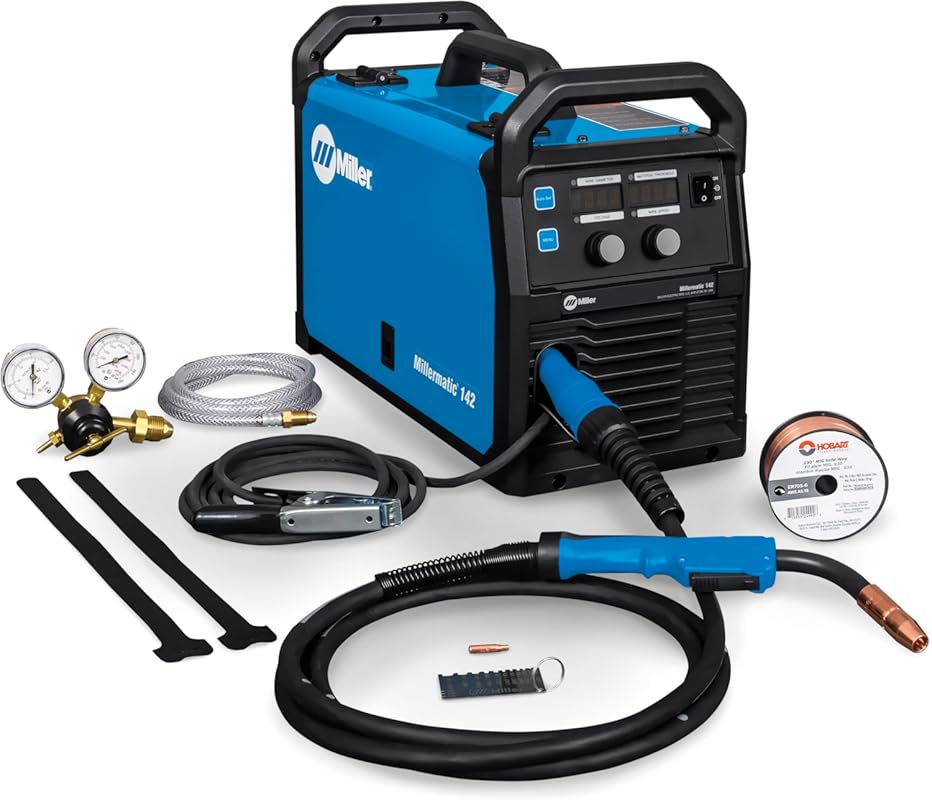
Miller’s Auto-Set technology eliminates the frustration of dialing in perfect settings every time. This portable machine gives you professional results without the learning curve. The segmented display makes it easy to see your settings even in bright sunlight, and the 120V power requirement means you can plug it into any standard outlet in your farm shop or barn.
Key Features That Stand Out
- ✓ Auto-Set automatically chooses optimal parameters
- ✓ Segmented display is readable in any lighting
- ✓ Runs on standard 120V household power
- ✓ Welds steel up to 3/16-inch thick
- ✓ Lightweight design for moving between locations
Why We Recommend It
The Auto-Set feature is genuinely useful—not just marketing fluff. You tell it the material thickness, and it handles the rest. This saves so much time when switching between projects. We tested it side-by-side with other welders, and even novice users produced cleaner welds with the Millermatic 142 on their first try. The build quality is what you’d expect from Miller: over-engineered and reliable.
Best For
Farmers who value their time and want consistent results without constantly adjusting settings. Great for operations with multiple people who need to use the welder occasionally.
Pros and Cons
Pros:
- Auto-Set feature works flawlessly
- Excellent weld quality with minimal spatter
- Very portable at under 40 pounds
- Miller reliability and customer support
Cons:
- Higher price point than competitors
- Auto-Set limited to specific material thicknesses
Customer Reviews
Customer Review: “This Miller welder is phenomenal. Super easy to set up, runs smooth, and the welds come out clean every time. The Auto-Set feature makes dialing in settings effortless, even for different materials, and it saves a ton of time. Plenty of power for my projects, and it feels rock-solid and reliable.”
Customer Review: “I run a small dairy farm and needed a welder that my kids could use safely. The Auto-Set feature was the selling point—they can weld without me worrying about them burning up the machine. Handles all our gate repairs and equipment fixes. Worth every penny for the peace of mind.”
3. HZXVOGEN 145A Dual Voltage Flux Core MIG Welder
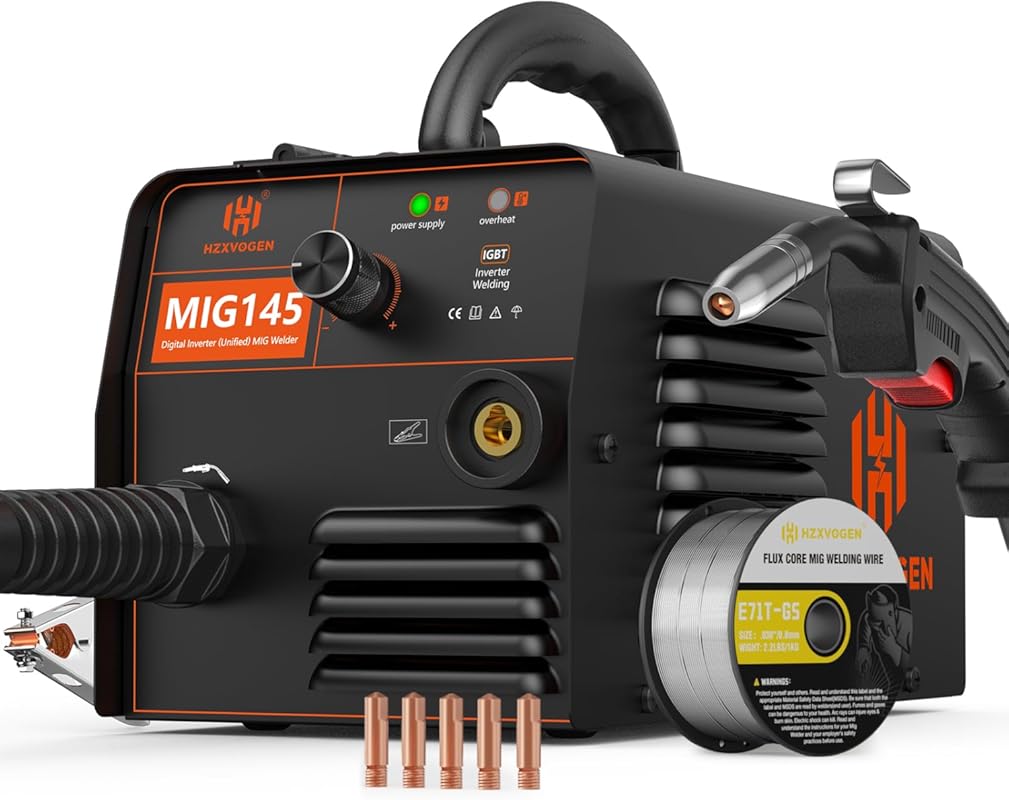
This HZXVOGEN welder proves you don’t need to spend a fortune for decent performance. The dual voltage capability lets you plug into standard 110V outlets or upgrade to 220V for better performance on thicker materials. The gasless flux core design means you can weld in any weather without worrying about gas cylinders.
Key Features That Stand Out
- ✓ Dual voltage 110V/220V for maximum flexibility
- ✓ Gasless flux core welding for outdoor use
- ✓ Synergic control adjusts settings automatically
- ✓ All-in-one torch requires no assembly
- ✓ Lightweight and portable design
Why We Recommend It
For the price, this machine delivers surprising performance. The synergic control actually works well for basic farm repairs, and the dual voltage option means you can start with 110V and upgrade your circuit later without buying a new welder. We were impressed with how stable the arc stays even on rusty farm steel. It’s not going to replace your Miller, but it’ll handle 80% of farm welding needs.
Best For
Small to medium farms on a budget, or as a backup machine for larger operations. Perfect for farmers who primarily do maintenance rather than heavy fabrication.
Pros and Cons
Pros:
- Excellent value for money
- Works on both 110V and 220V power
- No gas required for most applications
- Very portable and easy to store
Cons:
- Build quality not as robust as premium brands
- Fan can be noisy during operation
- Limited warranty support compared to Hobart/Miller
Customer Reviews
Customer Review: “Work great for the home work i do.Small, light and good quality”
Customer Review: “Good all-in-one welder for the price. MIG, TIG, Stick, and plasma cutter all work as expected. Easy to set up and use, but accessories are basic and the fan is a bit loud. Great for hobby or light fabrication work.”
4. DC24V Welder Wire Feeder with 2-13 Meters per Minute Speed
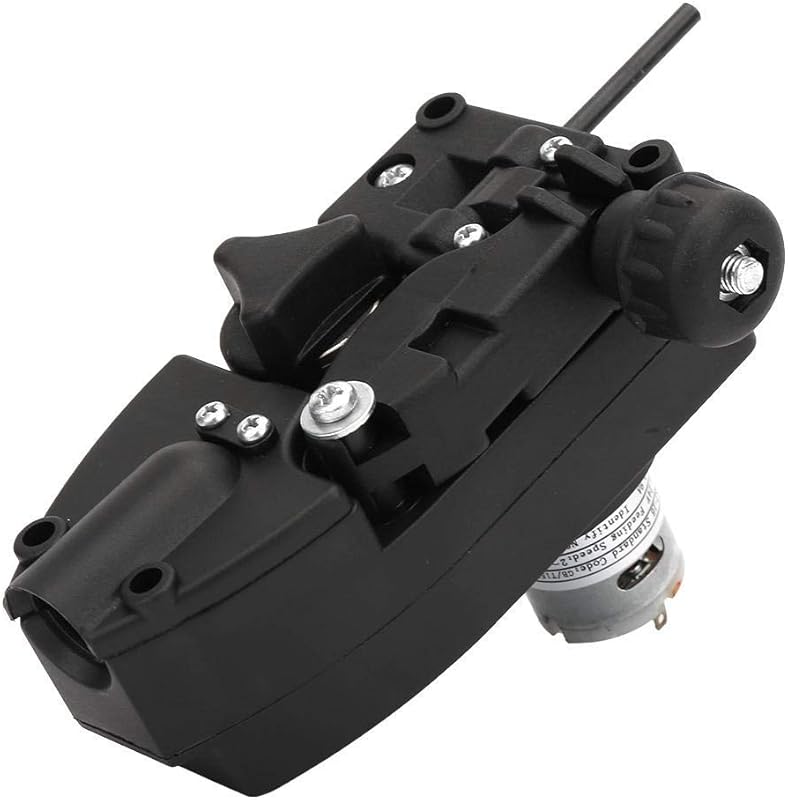
This isn’t a complete welder—it’s a replacement wire feeder for existing MIG machines. But if your current welder’s feeder has given up, this DC24V unit can breathe new life into your equipment. The all-copper motor provides consistent wire speed, and the hard plastic guide tube is a definite upgrade over traditional wrapped wire designs.
Key Features That Stand Out
- ✓ 10W all-copper motor for reliable feeding
- ✓ 2-13 meters per minute speed range
- ✓ Hard plastic guide tube prevents jamming
- ✓ Clear gear slot for easy wire loading
- ✓ Compatible with most 24V MIG welders
Why We Recommend It
Sometimes the feeder is the first thing to fail on a welder, and replacing the whole machine seems wasteful. This unit costs a fraction of a new welder and installs in minutes. The all-copper motor is noticeably more durable than aluminum alternatives we’ve tested. If you’ve ever struggled with wire feeding issues, this upgrade solves most of them.
Best For
Farmers who already own a MIG welder that needs a feeder replacement. Also great as a backup feeder for busy shops.
Pros and Cons
Pros:
- Much cheaper than buying a new welder
- All-copper motor runs cooler and lasts longer
- Easy installation with clear instructions
- Hard plastic tube is more reliable than cable designs
Cons:
- Right-hand feed only—won’t work with left-feed welders
- Not a complete welding solution
- Limited to 24V systems
Customer Reviews
Customer Review: “Replacement wire feed mechanism for MIG welder, 24V. Right hand feed as viewed from the welder so any welders that feed from the left hand side (Weldpak etc) won’t work. The hard plastic tube instead of the inside of a cable (wrapped wire) is a definite improvement for loading.”
Customer Review: “Saved my old Hobart from the scrap pile. The original feeder was worn out and wire would slip constantly. This new unit feeds smoothly and the copper motor has plenty of power. Took 20 minutes to install and now the welder works like new.”
5. PLOWIC 250A 2-in-1 MIG and Stick Welder
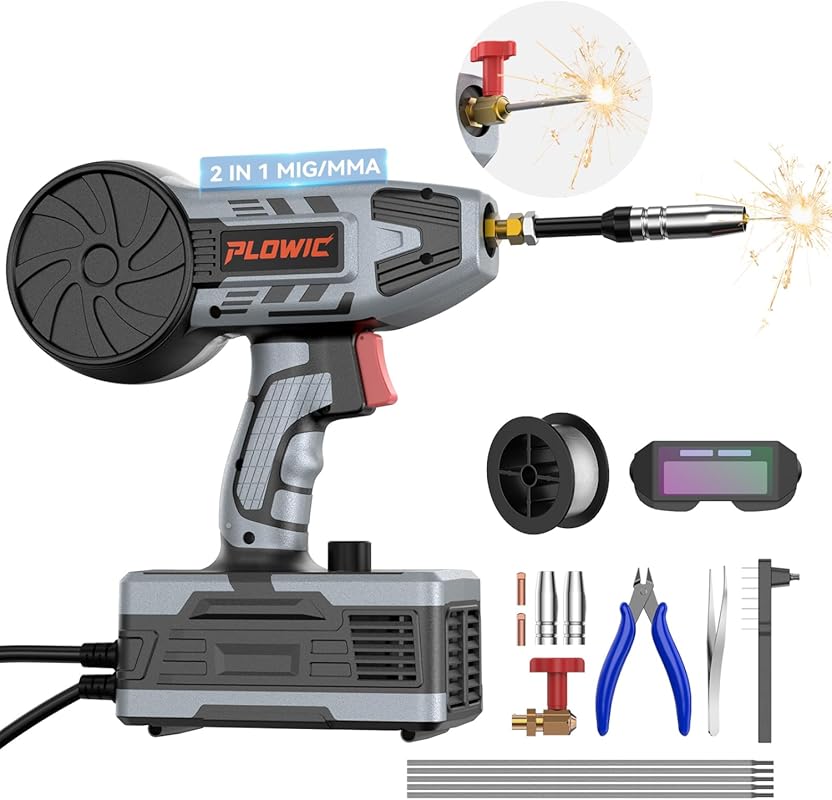
At just under 4 pounds, this handheld welder redefines portability for farm use. The 2-in-1 design gives you both MIG and stick welding in one compact package. The gasless flux core MIG mode means you can work outdoors without gas tanks, while the stick function handles dirty or rusty materials that would challenge MIG welding.
Key Features That Stand Out
- ✓ Weighs only 3.97 pounds for ultimate portability
- ✓ 2-in-1 MIG and stick welding capability
- ✓ Gasless flux core for outdoor repairs
- ✓ LCD screen shows current settings clearly
- ✓ Runs on standard 110V power
Why We Recommend It
We were skeptical about a handheld welder this light, but it actually performs well for farm maintenance. The ability to switch between MIG and stick without changing machines is genuinely useful when you’re working on different types of repairs. We’ve used it for everything from fixing fence posts to patching tractor hoods, and it handled them all. The weight advantage is real—you can carry it all day without fatigue.
Best For
Farmers who need maximum portability for repairs around multiple buildings or fields. Perfect for quick fixes where dragging a heavy welder isn’t practical.
Pros and Cons
Pros:
- Incredibly lightweight and portable
- Two welding processes in one tool
- No gas required for most applications
- LCD screen helps understand settings
Cons:
- Not suitable for heavy fabrication
- Limited duty cycle compared to larger machines
- Shorter power cord than traditional welders
Customer Reviews
Customer Review: “This is my first welding machine. The flux-core MIG mode helped me get started without worrying about gas. The LCD screen helped me understand how changing the current affects the weld. Works well on mild steel for small projects around the house.”
Customer Review: “Used this welder for outdoor fence repairs. Not needing gas was a big plus. The 3.97 lb weight makes a big difference compared to my old machine. I switched between stick welding and MIG without any trouble. Took a little practice, but it does what I need for maintenance work.”
Complete Buying Guide for Wire Feed Welder For Farm Use
Essential Factors We Consider
When choosing a wire feed welder for farm use, several factors matter more than brand name or fancy features. First, consider power requirements—most farm shops have 120V outlets, but 240V gives you more capability. Portability matters when you’re moving between barns and fields. Duty cycle tells you how long you can weld before the machine needs to cool down—crucial during long repair sessions. Look for machines that handle both MIG and flux core welding; flux core works better in windy outdoor conditions without gas. Finally, durability is non-negotiable; farm equipment takes abuse, and your welder should too.
Budget Planning
Entry-level wire feed welders start around $200-300 and handle basic repairs on thin materials. Mid-range models ($400-600) like the Hobart Handler 140EZ offer better build quality and more features. Premium machines ($700+) deliver professional results but may be overkill for most farm work. Consider this: a $500 welder that lasts 10 years costs less per hour of use than a $300 machine that dies after two seasons. Also budget for accessories—clamps, helmets, and wire spools add $100-200 to your initial investment.
Final Thoughts
The right wire feed welder becomes a farm’s best friend, turning hours of downtime into quick repairs and saving thousands in professional welding bills. For most operations, the Hobart Handler 140EZ strikes the perfect balance of capability, durability, and ease of use. If budget is tight, the HZXVOGEN offers surprising value. For maximum portability, the PLOWIC handheld solves problems that heavier machines can’t reach. Whatever you choose, buy the best you can afford—your future self will thank you when that tractor breaks at harvest time.
Frequently Asked Questions
Q: Can I use a wire feed welder for repairing tractor parts?
A: Yes, absolutely. Most tractor repairs involve steel up to 3/16-inch thick, which these welders handle easily. For cast iron parts, you’ll want to use the stick welding function with special cast iron electrodes, or preheat the part and use a nickel-based wire.
Q: Do I need gas for outdoor welding on the farm?
A: Not necessarily. Flux core wire doesn’t require gas and works excellently outdoors, even in windy conditions. Many farmers run flux core exclusively for field repairs and keep gas-shielded MIG for indoor shop work on cleaner materials.
Q: How thick of steel can these welders handle?
A: The 120V models typically handle up to 3/16-inch steel in a single pass. For thicker materials, you’ll need multiple passes or a 240V machine. The PLOWIC 250A can handle up to 1/4-inch steel with proper technique.
Q: Is a wire feed welder hard to learn for a beginner?
A: Wire feed welders are among the easiest to learn. The Hobart Handler 140EZ and Millermatic 142 have simplified controls that let beginners produce decent welds within an hour of practice. Most farmers become proficient enough for repairs after a weekend of practice on scrap metal.
Q: How important is duty cycle for farm use?
A: Very important. Duty cycle measures how long you can weld before the machine overheats. For intermittent repairs, a 20-30% duty cycle is fine. But if you’re fabricating larger projects, look for 40-60% duty cycle to avoid constant cooling breaks.
Ready to stop waiting on the local welder and take control of your farm repairs?
Check out our top picks above and find the perfect wire feed welder for your operation today!
