


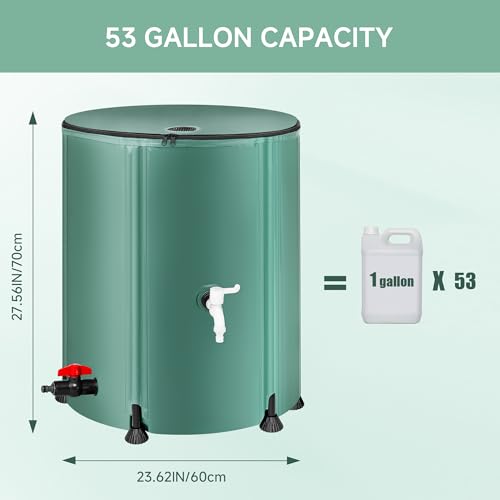
The best collapsible rain barrel combines sturdy storage, easy setup, safe drainage, and simple garden watering.
Have you ever watched good rainwater rush off your roof while your garden dries out? A collapsible rain barrel gives that water a second life. It can lower tap-water use, support flowers and vegetables, and fold away when the season ends. I reviewed these options with a practical eye, focusing on size, frame strength, fittings, overflow control, filter design, and daily use. I also considered the needs of renters, small-yard gardeners, and homeowners who want a larger water reserve without a hard plastic barrel taking up permanent space.
Collapsible Rain Barrel 53 Gallon with Filter

This 53-gallon collapsible rain barrel offers a useful middle ground for most home gardens. It has enough room to collect a meaningful amount of roof runoff, yet it does not demand the space of a large rigid tank. The listed design includes spigots, a filter, and an overflow kit, which are the parts I want to see in a ready-to-use rain collection system. Its dark exterior should also help limit light inside the tank.
The large opening and flexible body make setup fairly simple, but the ground must be level and firm. I would place it on a compact base of pavers or treated blocks so the lower spigot stays easy to reach. The filter can help keep leaves and larger debris out, although I would still use a gutter screen upstream. For many homes, this is a strong candidate for the best collapsible rain barrel because it balances capacity, portability, and daily convenience.
Pros:
- Useful 53-gallon capacity for common garden tasks
- Includes a filter for basic debris control
- Includes spigots for easier water access
- Overflow parts help direct excess rain away from the foundation
- Collapsible body stores more easily than a rigid barrel
- Dark color can reduce light exposure inside the tank
Cons:
- It needs a level, stable base to remain upright
- Flexible walls may not feel as solid as a hard plastic barrel
- Gutter screens and hose parts may still need separate adjustment
My Recommendation
I recommend this model for homeowners who want a balanced rainwater storage option for flowers, shrubs, containers, and light lawn work. It suits people who need more water than a small 25-gallon tank can hold but do not want a huge structure beside the house. The included filter and overflow kit also make it more approachable for first-time rain barrel users. As a general-purpose choice, it has the features many shoppers expect from the best collapsible rain barrel.
| Best for | Why |
|---|---|
| Small and medium gardens | Its 53-gallon size offers useful reserve water without taking over the yard. |
| First-time users | The filter, spigots, and overflow parts simplify the basic setup. |
| Seasonal storage | The collapsible design is easier to pack away than a fixed tank. |
Collapsible Rain Barrel 53 Gallon with Dual Spigots

This second 53-gallon rain barrel follows the same practical format, with a foldable water tank, filter, spigots, and overflow components. It is designed for people who want to catch roof water without committing to a bulky permanent barrel. I like this size for a patio garden, raised beds, or a short row of shrubs. It can collect enough water to make a real difference after a good storm.
Before filling it, I would inspect every connection and make sure the downspout directs water into the top screen. A collapsible tank works best when the water enters gently and the base supports the full load. Remember that 53 gallons of water weighs roughly 442 pounds, so moving the tank after filling is not realistic. This model can be a good best collapsible rain barrel pick when you value a familiar size and simple water access.
Pros:
- 53-gallon capacity fits many home garden needs
- Portable design is easier to store between seasons
- Filter helps catch larger roof debris
- Spigots make it easier to fill a watering can or connect a hose
- Overflow kit can help manage heavy rain
- Usually requires less permanent space than a rigid tank
Cons:
- It cannot be safely moved while full
- The flexible construction needs proper support underneath
- Users may need to improve the downspout connection for a snug fit
My Recommendation
This rain barrel is a sensible choice for gardeners who want a straightforward 53-gallon system. It works well for seasonal use, especially in yards where storage space matters during winter. I would choose it for watering pots, beds, and ornamental plants rather than drinking water or indoor use. If you want the best collapsible rain barrel with a familiar capacity and basic collection parts, this model deserves a close look.
| Best for | Why |
|---|---|
| Patio and raised-bed gardens | The moderate capacity gives useful water without requiring a large footprint. |
| Renters and temporary setups | You can take down the tank when you move or when the season ends. |
| Watering cans and small hoses | Spigots provide a practical outlet for routine garden work. |
Curifurn Collapsible Rain Barrel with Spigot

The Curifurn collapsible rain barrel includes the core parts I look for in a compact water catcher: a spigot, filter, and overflow kit. Its flexible format makes it easier to place in a narrow side yard or store in a shed. The design is aimed at simple rain collection rather than a complex irrigation build. That can be a benefit for anyone who wants to start saving rainwater without a long installation project.
I would pair this barrel with a clean downspout diverter and a secure base. The filter is useful, but no small filter replaces good roof and gutter care. Remove leaves from the gutter, inspect the seams, and empty the tank before freezing weather. For a modest garden, the Curifurn may be the best collapsible rain barrel because it focuses on the parts that matter most for daily use.
Pros:
- Includes a spigot for simple water release
- Filter helps reduce large debris entering the tank
- Overflow kit supports safer placement near a home
- Collapsible design saves storage space
- Suitable for small gardens and container plants
- Simple layout is approachable for new users
Cons:
- Its actual capacity may be less suitable for large gardens
- A spigot alone may not provide strong pressure for long hoses
- It still needs a firm, flat surface to prevent leaning
My Recommendation
I would choose the Curifurn for a small yard, balcony garden, or narrow space beside a garage. It is also a good fit for someone who wants an uncomplicated rain barrel with the key accessories included. Use the collected water for outdoor plants, not as drinking water, unless it receives treatment approved for that purpose. For light-duty watering and easy seasonal storage, it offers good value and may be the best collapsible rain barrel for compact spaces.
| Best for | Why |
|---|---|
| Small yards | The flexible format fits spaces where a rigid barrel may not work. |
| New rainwater users | The included filter, spigot, and overflow kit reduce the need to source parts. |
| Container plants | It provides convenient water for pots, hanging baskets, and small beds. |
132-Gallon Collapsible Rain Barrel
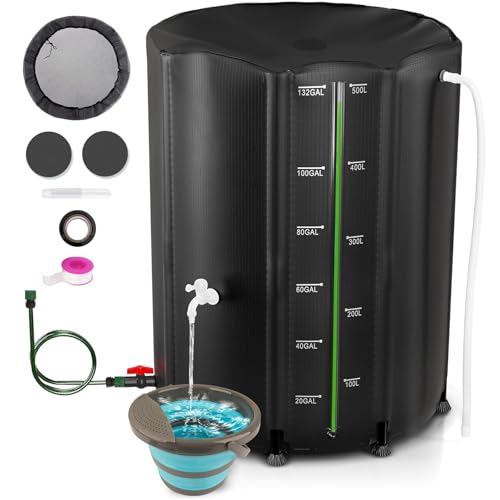
This 132-gallon collapsible rain barrel is built for gardeners who need more reserve water. Its listed 1000D PVC construction suggests a heavier outdoor material than a very light storage bag. The large capacity can help reduce how often you refill a watering can during dry spells. A mesh cover also adds a useful barrier against leaves and larger debris.
Large capacity brings a serious setup requirement. A full 132-gallon tank holds more than 1,100 pounds of water, so I would never place it on a weak deck, soft soil, or an uneven slope without checking the load. This model makes the most sense on a prepared ground base near a substantial downspout. If your garden is large, this could be the best collapsible rain barrel for reducing refill trips, but it demands the most careful placement.
Pros:
- Large 132-gallon capacity stores much more water than compact models
- 1000D PVC construction is designed for outdoor use
- Mesh cover helps keep leaves and pests away from the opening
- Collapsible body can be stored when empty
- Useful for larger beds, shrubs, and garden rows
- May reduce the need for frequent hose or tap watering
Cons:
- It needs a very strong and level base
- A full tank is extremely heavy and cannot be moved safely
- It takes more time and space to install than a 53-gallon barrel
- Large tanks can overflow quickly during intense storms without a good outlet plan
My Recommendation
I recommend this tank for serious gardeners, small homesteads, and homeowners with a broad roof area that produces plenty of runoff. It is not my first choice for a tiny patio or rental property. Before buying, measure the space, check the downspout route, and plan where overflow will go. For high-volume garden watering, it may be the best collapsible rain barrel in this group because its capacity reduces the “empty again” problem.
| Best for | Why |
|---|---|
| Large vegetable gardens | The 132-gallon tank stores enough water for repeated outdoor use. |
| Long dry periods | A larger reserve can reduce reliance on tap water between storms. |
| Prepared ground installations | A firm base can support the heavy full tank and keep it stable. |
200-Gallon Foldable Outdoor Water Tank

This foldable outdoor water tank is offered in 50-, 100-, and 200-gallon sizes, with the listed option shown as 200 gallons. That range gives shoppers more choice than a one-size barrel. The large version is aimed at garden irrigation and water storage, and it includes a faucet for access. It may suit a large garden where a small collapsible rain barrel would run dry too soon.
I would treat this as a high-capacity storage tank, not a casual patio accessory. Two hundred gallons of water weighs about 1,668 pounds, so a strong base and careful overflow plan are essential. I would also confirm the selected size before ordering, since the listing includes several capacities. For gardeners who want maximum storage in a foldable format, this may be the best collapsible rain barrel, provided the installation area can handle the load.
Pros:
- Available in several capacity choices
- 200-gallon option offers substantial water storage
- Foldable body can save space when empty
- Faucet supports simple irrigation access
- Useful for larger gardens and repeated watering
- Can reduce frequent trips to an outdoor tap
Cons:
- The 200-gallon size creates a very high ground-load demand
- Large tanks need more planning for overflow and access
- Capacity selection requires careful attention before checkout
- It may be too large for a small home garden
My Recommendation
This tank is best for experienced gardeners who understand water weight and have a proper installation site. I would consider it for a large vegetable plot, greenhouse area, or property with a strong collection point. I would not place it against a foundation without directing overflow away from the building. If you need serious storage and can support the size, it has the potential to be the best collapsible rain barrel for high-demand irrigation.
| Best for | Why |
|---|---|
| High-demand irrigation | The larger capacity supports longer watering sessions. |
| Large properties | Multiple size options let you match storage to available space. |
| Experienced users | Careful planning helps manage the weight, base, and overflow needs. |
53-Gallon Collapsible Rain Barrel in Black

This black 53-gallon collapsible rain barrel includes a spigot, filter, and overflow kit. The capacity fits the popular middle range, giving a home gardener enough room for regular plant care without creating an enormous water load. Its black finish is practical for an outdoor utility item and can blend into a garden corner. The compact storage advantage remains its main appeal over many rigid barrels.
I would use this model with a raised, stable platform that leaves room below the spigot for a watering can. The filter should be checked after storms, because a clogged screen can slow collection or cause water to spill where it should not. I also recommend emptying and drying it before freezing conditions. For ordinary flower beds and pots, this is a strong best collapsible rain barrel contender with a useful accessory set.
Pros:
- Practical 53-gallon size for routine garden watering
- Black finish suits many outdoor spaces
- Includes a spigot, filter, and overflow kit
- Collapses for easier seasonal storage
- Can be raised for easier filling of watering cans
- More manageable than extra-large tanks
Cons:
- It still weighs hundreds of pounds when full
- Flexible sides need support and careful handling
- The included spigot may not provide strong hose pressure
My Recommendation
I recommend this barrel for everyday homeowners who want a simple water-saving tool. It is a good match for container gardens, flower borders, and small vegetable beds. The included parts make it easier to start, while the 53-gallon capacity keeps the footprint reasonable. If you want a black, medium-size model with a practical balance of cost, storage, and function, this could be the best collapsible rain barrel for your yard.
| Best for | Why |
|---|---|
| Everyday home gardens | The moderate size handles regular plant watering without excess bulk. |
| Discreet placement | The black exterior can blend into a fence line or garden edge. |
| Seasonal gardeners | The foldable construction makes end-of-season storage easier. |
Japard Slim 26-Gallon Collapsible Rain Barrel

The Japard slim rain barrel is the smallest option in this review, with a listed 26-gallon capacity and a narrow 16-inch format. That slim shape can solve a common problem: there is room beside the downspout, but not enough room for a wide barrel. It includes a filter and an upgraded leak-resistant spigot according to the product description. A 26-gallon tank also creates a lower full-water load than the larger models.
I see this as a smart option for balconies with proper approval, compact patios, townhomes, and narrow side paths. It will fill faster and empty faster than a 53-gallon model, so it suits light watering rather than a large vegetable garden. Even a slim barrel needs a level base and a safe overflow route. For tight spaces, the Japard could be the best collapsible rain barrel because it solves the footprint problem first.
Pros:
- Slim 16-inch design fits narrow areas
- 26-gallon capacity is easier to manage than a very large tank
- Includes a filter for basic debris control
- Leak-resistant spigot design supports cleaner water access
- Lower weight makes placement more manageable when full
- Good fit for small patios and compact gardens
Cons:
- 26 gallons may not meet the needs of a large garden
- It may fill quickly during heavy rain and need frequent emptying
- Narrow tanks still require a flat base to prevent tipping
My Recommendation
I would choose the Japard for anyone whose main limit is space. It fits best where a standard 53-gallon barrel would block a walkway, gate, or small patio. Use it for potted herbs, flowers, and light outdoor cleaning rather than full-scale irrigation. Among compact models, it may be the best collapsible rain barrel for renters and urban gardeners who need useful storage in a small footprint.
| Best for | Why |
|---|---|
| Narrow side yards | The slim profile uses less width beside a wall or downspout. |
| Small patios | The 26-gallon size is easier to fit and manage in limited space. |
| Light garden watering | It provides enough water for pots, herbs, and small flower beds. |
How I Evaluate the Best Collapsible Rain Barrel
A rain barrel is more than a soft tank with a faucet. It must collect water, hold it without leaning, release it at a useful height, and send overflow away from the home. I look at each part as if I were setting it up in my own yard. A low price means little if the base is weak or the outlet leaks.
Capacity is the first clear difference. A 26-gallon model works for a small patio, while 53 gallons suits many normal gardens. The 132- and 200-gallon models can store far more, but they also create a much larger load. Water weighs about 8.34 pounds per gallon, so a full tank must sit on a strong, level surface.
I also check the frame and fabric. A flexible barrel should have enough support to stay upright as the water level rises. Look for reinforced seams, sturdy bands, and fittings that do not twist when you attach a hose. If the product page changes the material or size, I suggest checking the current listing before purchase.
Overflow control matters just as much as storage. A tank can fill fast during a summer storm, and water beside the foundation can cause trouble. Place the overflow outlet so water moves toward a garden bed, drain, or safe part of the yard. Never assume the included overflow hose will solve every site problem.
What Size Rain Barrel Should You Buy?
Start with your roof area and your watering goal. A small roof section can fill a 26-gallon tank in one strong storm. A larger roof can fill 53 gallons with ease. The formula is simple: one inch of rain on one square foot of roof creates about 0.6 gallons of water, before losses from splash and collection limits.
For a few pots, choose a slim or small model. For flowers, shrubs, and raised beds, 53 gallons is often a better daily size. For large vegetable gardens, a 132-gallon or 200-gallon tank may reduce refill work. Still, buy only as much capacity as your ground, downspout, and overflow plan can safely handle.
I also think about how often you can use the stored water. A barrel should empty between storms so it has room for the next one. If you have a small garden, a huge tank may remain full for too long. If you garden every day, a small tank may feel like a bucket that never quite keeps up.
How to Install a Collapsible Rain Barrel
First, clear the area below the downspout. Remove sharp stones, roots, sticks, and anything that could rub against the fabric. Build a solid base from patio blocks, compacted gravel, or another suitable surface. The base should remain level under the full weight of the tank.
Next, place the empty barrel on the base and connect the downspout or diverter. Keep the tank away from doors, crawl-space vents, and the foundation. Connect the overflow outlet before rain arrives. I prefer to test the fittings with a hose and watch for drips before trusting the first storm.
Raise the tank only if the support can carry the full load. A higher barrel gives better clearance for a watering can, but it also raises the center of gravity. Do not stack loose blocks under a full tank. Stability comes before convenience.
How to Keep Rain Barrel Water Clean
Rain barrel water is not automatically safe to drink. Roofs can collect bird waste, dust, leaves, insects, and residues from roofing materials. Use stored water for ornamental plants, lawns, and other approved outdoor tasks unless you have a tested treatment system. Keep children and pets from drinking it.
Clean gutters help more than many owners expect. Remove leaves before the rain season and inspect the inlet screen after storms. A filter catches some debris, but it cannot fix dirty roof runoff. I would also cover every opening well to reduce mosquitoes and keep animals out.
Drain and clean the barrel at regular intervals. Follow the product instructions for the fabric and fittings. In regions with freezing weather, empty the tank, dry it fully, and store it in a protected place. Ice expands, and trapped water can damage seams, valves, and hoses.
Common Mistakes to Avoid
The most common mistake is placing a full barrel on soft soil. The tank may sink on one side, which strains the frame and fittings. A level base is not a small detail. It is the foundation of safe use.
Another mistake is ignoring overflow. A barrel can collect more water than expected during a cloudburst. Direct the overflow away from walls, foundations, walkways, and areas where soil erosion may occur. If you connect two tanks, confirm that the transfer path can handle the flow.
Many users also forget that a full flexible tank should stay in place. Do not drag it across concrete or try to carry it to a new spot. Plan the location before filling it. When in doubt, empty the tank first.
Finally, do not assume every spigot fits every hose. Check the outlet size and use a suitable adapter if needed. Tighten fittings by hand first, then make small adjustments. Too much force can damage plastic threads or soft seals.
Best for Comparison
| Best for | Why |
|---|---|
| Most home gardens | A 53-gallon model offers a useful balance of capacity, price, size, and simple setup. |
| Large gardens and long dry spells | A 132- or 200-gallon tank stores more water but needs a strong, level base. |
| Small spaces | The Japard 26-gallon slim design fits narrow areas and is easier to manage. |
FAQs Of best collapsible rain barrel
Are collapsible rain barrels durable?
Many are made for outdoor use with flexible PVC or similar fabric, but durability depends on setup and care. A level base, gentle handling, and protection from sharp objects help prevent damage. Always follow the current product instructions.
How much does a full rain barrel weigh?
Water weighs about 8.34 pounds per gallon. A 26-gallon barrel weighs roughly 217 pounds when full, while a 53-gallon model weighs about 442 pounds. A 200-gallon tank can exceed 1,600 pounds before adding the tank itself.
Can I use rain barrel water on vegetables?
Use caution. Untreated roof runoff can contain dirt, bird waste, and roof residues. Many gardeners use it for soil-level watering, but you should follow local guidance and avoid using untreated water on edible leaves or produce that will be eaten raw.
Do I need a stand for a collapsible rain barrel?
You need a stable, level base. A raised stand can improve access to the spigot, but it must support the full filled weight and resist tipping. Never use loose or weak blocks under a full tank.
How do I store a collapsible rain barrel in winter?
Drain it fully, clean it, dry it, and protect it from freezing temperatures. Fold it only as the maker directs. Store the tank away from sharp tools, rodents, and direct sunlight when it is not in use.
Final Verdict: Which Should You Buy?
For most homes, I would choose the 53-gallon model with a filter, spigots, and overflow kit. It offers the best mix of capacity, storage, and daily use.
The best collapsible rain barrel is the one that fits your space and base safely. Choose small for tight yards, or large for serious irrigation needs.
