
5 Best MIG Welders For 1 2 Inch Steel 2026: Buying Guide
The FEMEROL 250A, YESWELDER 205A, and VEVOR 200A are strong picks for thick steel welding in 2026.
Welding 1/2-inch steel can expose a weak machine very quickly. Thin leads, poor duty cycle, low output, and unstable wire feed can cause cold joints and wasted time. I reviewed five multi-process MIG welders that offer useful power, dual-voltage flexibility, and practical controls for shop work, farm repairs, trailers, brackets, and heavy DIY projects. For 1/2-inch steel, you still need clean metal, correct wire, proper shielding, joint beveling, and often several passes. No compact welder should be treated as a magic one-pass solution.
See the differences between my top picks at a glance.
| Welder | Output listed | Input | Main processes | Best use | Buy |
|---|---|---|---|---|---|
| WELDPRO 140A | 140A | 110/220V | MIG, flux, lift TIG, MMA, spot | Light shop and repair work | View on Amazon |
| YESWELDER 205A | 205A | 110/220V | MIG, flux, spool gun MIG, lift TIG, stick | Best balance for thick steel | View on Amazon |
| SSimder 140A | 140A | Dual voltage | Flux, lift TIG, stick, pulse spot | Portable repair and hobby work | View on Amazon |
| FEMEROL 250A | 250A | 110/220V | Gas MIG, flux, stick, lift TIG, spot, spool gun | Highest listed MIG output | View on Amazon |
| VEVOR 200A Combo | 200A welder, 50A cutter | 110/220V | MIG, flux, TIG, MMA, plasma cutting | Multi-purpose fabrication | View on Amazon |
WELDPRO 140A MIG Welder
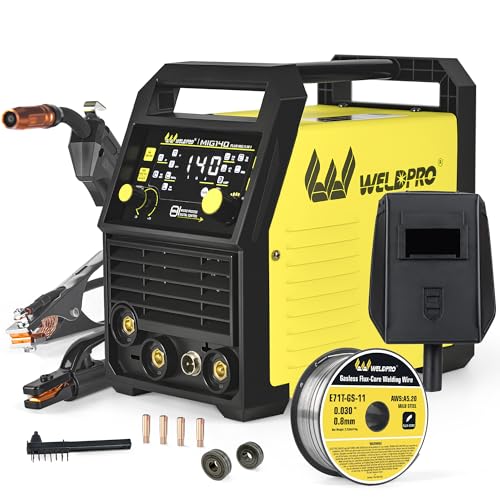
The WELDPRO 140A is a compact multi-process machine for buyers who want several welding modes in one unit. Its listed functions include synergic MIG, thickness control, gasless flux-core welding, lift TIG, MMA, and spot welding. The large LED display should make basic settings easier to read while working. Dual-voltage input also gives it more flexibility than a single-voltage hobby welder.
The 140A output suits repair work, small brackets, sheet metal, and general fabrication. It can weld thicker steel with good preparation and multiple passes, but I would not choose it as my first option for regular 1/2-inch structural work. Bevel the joint, use suitable wire, and keep an eye on heat buildup. The 2T and 4T controls may also help during longer welds by reducing the need to hold the trigger constantly.
Pros:
- Five useful welding functions in one compact machine
- 110V and 220V input for home or shop use
- Synergic and thickness-based control can simplify setup
- LED display gives clear access to welding settings
- Flux-core mode works without a gas bottle
- Lift TIG and MMA modes add repair flexibility
- 2T and 4T trigger modes can improve operator comfort
Cons:
- 140A output leaves less headroom for repeated 1/2-inch steel work
- Heavy joints may need several passes and careful joint preparation
- Buyers should confirm included accessories and duty-cycle details before ordering
What Amazon Buyers Are Saying
Buyer feedback for compact multi-process welders often centers on easy setup, small size, and the value of having MIG, flux, TIG, and stick modes together. Users who weld light repairs tend to value a digital display and dual-voltage design. The main concern to check in current reviews is whether the machine meets expectations during long, high-heat sessions. Some buyers also compare the included torch, ground lead, and consumables with what they already own, so I recommend reading the latest listing details before purchase.
My Recommendation
I recommend the WELDPRO 140A for a home user who needs a flexible repair welder more than a heavy production machine. It can handle prepared thick-steel joints, but its 140A rating makes it less comfortable for regular 1/2-inch steel fabrication. It earns a good score for versatility and simple controls, yet buyers who want more reserve power should move to the YESWELDER or FEMEROL.
| Category | Rating |
|---|---|
| MIG flexibility | 4.2/5 |
| Thick-steel capacity | 3.5/5 |
| Controls | 4.2/5 |
| Portability | 4.5/5 |
| Overall rating | 4.0/5 |
YESWELDER 205A Multi-Process Welder

The YESWELDER 205A is the most balanced choice in this group for many serious DIY users. It supports 110V and 220V power and offers MIG, flux-core MIG, spool-gun MIG, lift TIG, and stick welding. Its listed 205A output gives it more useful working range than the 140A machines. That extra headroom matters when you weld thicker sections or need more than one pass.
I like this model for buyers who work on trailers, equipment repairs, gates, frames, and farm projects. Spool-gun compatibility also gives it a path toward aluminum work, although you should confirm the correct gun, liner, consumables, and settings before starting. For 1/2-inch steel, use 220V when the circuit allows it, prepare the joint well, and follow the machine’s duty-cycle limits. A strong output rating does not replace correct technique.
Pros:
- 205A rating offers useful reserve power for thick steel
- Dual-voltage input supports both home and shop circuits
- Spool-gun MIG compatibility expands material options
- Supports gas MIG and gasless flux-core welding
- Lift TIG and stick modes help with varied repair jobs
- Good fit for trailers, frames, farm tools, and general fabrication
- More room for multi-pass work than a 140A compact welder
Cons:
- Users may need to buy a spool gun and extra accessories separately
- High-current welding may require a suitable 220V circuit
- It still needs joint beveling and multiple passes on heavy 1/2-inch steel
What Amazon Buyers Are Saying
Customer discussions around the YESWELDER 205A commonly focus on its broad process range and the benefit of moving between 110V and 220V power. Buyers who do home repairs often like the ability to use flux-core wire outdoors, while shop users value the extra output and spool-gun option. As with many budget multi-process welders, current buyers should pay close attention to wire-feed smoothness, torch connections, included leads, and performance during long welds. Reviews can vary with setup, wire type, and power supply.
My Recommendation
This is my best overall pick for most people searching for the best MIG welder for 1/2-inch steel in 2026. The 205A output gives a useful balance of power, flexibility, and price. It is not a replacement for a large industrial machine, but it is better suited to serious home fabrication than the 140A options. I would choose it for buyers who want one machine that can grow with their skills.
| Category | Rating |
|---|---|
| MIG power range | 4.6/5 |
| Thick-steel suitability | 4.5/5 |
| Process selection | 4.7/5 |
| Ease of expansion | 4.3/5 |
| Overall rating | 4.5/5 |
SSimder 140A Portable Welder

The SSimder 140A is aimed at users who value portability and simple multi-process capability. Its listed features include flux-core, lift TIG, stick, pulse spot welding, synergic control, and arc-force adjustment. The dual-voltage design makes it practical for a garage, mobile repair kit, or small work area. Its compact size should also make storage easier when the welder is not in use.
This machine makes the most sense for small repairs, body work, fence jobs, metal art, and occasional fabrication. The pulse-spot feature may appeal to auto-body and thin-metal users, while arc-force control can help during stick welding. For 1/2-inch steel, I would treat it as a portable repair tool rather than a production solution. Plan on careful fit-up, moderate bead lengths, and several passes when the joint demands deeper penetration.
Pros:
- Portable design suits mobile repair and field work
- Dual-voltage input improves location flexibility
- Synergic control can reduce setup time for new welders
- Pulse-spot mode may help with body panels and small spot jobs
- Arc-force adjustment adds control in stick mode
- Flux-core operation works without shielding gas
- Five process options cover common hobby and repair tasks
Cons:
- 140A output is limited for repeated heavy-section welding
- Small machines can need more cooling time under hard use
- Buyers should confirm torch leads, ground cable, and consumables in the box
What Amazon Buyers Are Saying
Feedback for portable welders like this often highlights easy transport, compact storage, and the usefulness of having several modes in one case. Buyers who work on fences, body panels, and small metal projects tend to value the flux and spot functions. The most important point to check in recent reviews is how the unit behaves under sustained load, since portable machines can suit occasional work better than long production runs. Setup quality, wire choice, and the electrical supply also affect the final experience.
My Recommendation
I recommend the SSimder 140A to a mobile DIY user who needs a light, flexible machine. It is a practical choice for small repairs and occasional thick-steel joints that allow multiple passes. I would not buy it as my main machine for regular 1/2-inch plate. Its value comes from portability and process variety, not maximum heat capacity.
| Category | Rating |
|---|---|
| Portability | 4.7/5 |
| Process variety | 4.3/5 |
| Thick-steel suitability | 3.4/5 |
| Control features | 4.1/5 |
| Overall rating | 4.0/5 |
FEMEROL 250A Multi-Process Welder

The FEMEROL 250A has the highest listed welding output among the machines in this review. It offers gas MIG, gasless flux-core, stick, lift TIG, spot welding, and spool-gun compatibility. The 110V/220V design gives it broad power options, while the large LED display should make the settings easier to monitor. For buyers who often weld thicker steel, that extra output creates a more comfortable power reserve.
This is the strongest conventional MIG choice in the group for demanding home fabrication. A 250A rating does not promise unlimited duty cycle, so I would still follow the manual and allow cooling time. On 1/2-inch steel, use a sound joint design, clean the surface, select the correct wire diameter, and build the weld in controlled passes. The spool-gun feature also makes the machine more appealing to users who want to work with aluminum later.
Pros:
- Highest listed output in this five-welder comparison
- Supports both gas MIG and gasless flux-core welding
- Six listed functions cover many repair and fabrication needs
- 110V and 220V input adds shop and home flexibility
- Spool-gun compatibility can support aluminum projects
- Large LED display should make settings easier to read
- Strong choice for thicker steel and multi-pass welding
Cons:
- Higher output may demand a proper 220V circuit for best results
- Accessory and spool-gun costs can raise the total price
- Users must verify duty-cycle limits before long welding sessions
What Amazon Buyers Are Saying
Buyers considering high-output multi-process welders usually focus on power, process choice, and whether the machine works well on both home and shop power. Feedback often gives special attention to the wire feeder, display, torch quality, and the ease of changing between MIG and flux-core setups. Before buying, I suggest checking the newest reviews for comments about included accessories, spool-gun support, and heat management. Real results can differ based on wire size, cable length, circuit strength, and operator technique.
My Recommendation
The FEMEROL 250A is my performance pick for buyers who want the most listed MIG output in this group. It is the best fit for frequent thick-steel repair, larger brackets, equipment work, and multi-pass fabrication. I would choose it over a 140A model when 1/2-inch steel is a regular task. Confirm the electrical requirements and included equipment before ordering.
| Category | Rating |
|---|---|
| Output reserve | 4.8/5 |
| Thick-steel suitability | 4.8/5 |
| Process range | 4.7/5 |
| Value for serious DIY work | 4.4/5 |
| Overall rating | 4.7/5 |
VEVOR 200A Plasma Cutter Combo

The VEVOR combo combines a 200A multi-process welder with a listed 50A non-contact plasma cutter. It supports CUT, TIG, gas MIG, flux MIG, and MMA welding, which gives fabricators more than a basic MIG-only machine. The listing also notes aluminum pulse MIG compatibility with a spool gun. Dual-voltage input makes the unit useful in both a home workshop and a larger garage.
This model stands out when cutting is as important as welding. You can cut plate and then weld brackets, tabs, or frames without keeping two separate machines on the bench. The 200A welding side should suit many thick-steel projects, but the actual result depends on duty cycle, wire, power, and joint preparation. Plasma cutting also needs clean air, correct consumables, and safe work habits, so buyers should budget for the full setup rather than only the machine.
Pros:
- Combines MIG welding and plasma cutting in one machine
- 200A listed welding output suits many thick-steel projects
- 50A non-contact plasma cutter adds strong fabrication value
- Supports gas MIG, flux MIG, TIG, and MMA modes
- 110V/220V input offers flexible installation options
- Spool-gun compatibility may support aluminum MIG work
- Useful choice for buyers with limited bench space
Cons:
- A combo machine can require more setup and maintenance than a welder alone
- Plasma cutting performance depends on a suitable air supply and consumables
- Users should verify duty-cycle figures for both welding and cutting modes
What Amazon Buyers Are Saying
Buyers who choose combo equipment usually like the space savings and the ability to cut and weld with one purchase. Reviews and product discussions tend to focus on ease of mode changes, torch quality, cut results, and welding stability. The most useful recent feedback will show whether users had the right air pressure, circuit, wire, and consumables. I would not judge a plasma combo only by its maximum number; the quality of setup and maintenance has a large effect on daily performance.
My Recommendation
I recommend the VEVOR combo to a fabricator who needs both cutting and welding. Its 200A welding output gives it a strong place among the best MIG welders for 1/2-inch steel in 2026, while the plasma cutter adds real value for metal projects. Choose it over the FEMEROL only if you will use the cutting function. For welding alone, the simpler FEMEROL may be easier to manage.
| Category | Rating |
|---|---|
| Welding power | 4.6/5 |
| Plasma cutting value | 4.7/5 |
| Process range | 4.8/5 |
| Workshop usefulness | 4.6/5 |
| Overall rating | 4.6/5 |
How to Choose the 5 Best MIG Welders for 1/2-Inch Steel in 2026
Choosing the right machine depends on more than the largest number on the front panel. A welder for 1/2-inch steel needs enough output, stable wire feeding, a suitable duty cycle, and a power source that matches your shop. You also need the right welding process for the job. The points below will help you compare the five models with real work in mind.
1. Match Output to Joint Thickness
Start with the actual steel thickness and joint design. A square butt joint needs less preparation than a thick corner joint, lap joint, or T-joint. For 1/2-inch steel, I look for more than the bare minimum output because extra power gives room for proper penetration and multi-pass work.
Do not assume that a 250A label means one-pass welding on every joint. Beveling, root gaps, wire size, travel speed, and heat control all matter. A 140A machine may handle a prepared repair in short passes, but a 200A or 250A machine gives more useful reserve for repeated heavy work. The YESWELDER 205A, VEVOR 200A, and FEMEROL 250A are the stronger choices here.
2. Check Voltage, Duty Cycle, and Wire Feed
Dual-voltage input helps when you move between a household outlet and a 220V shop circuit. Yet you must still use the correct breaker, plug, extension cord, and circuit size. A weak power supply can cause unstable arcs, nuisance trips, and poor results.
Duty cycle tells you how long a machine can weld within a stated test period before it needs to cool. Always read the current manufacturer data before buying. A smooth wire feeder also matters. If the wire surges, slips, or burns back into the tip, even a powerful machine becomes hard to use. Check the drive rolls, liner, torch connection, and recommended wire diameters.
3. Compare Process Range and Total Value
Gas MIG gives a clean arc in a protected indoor area. Flux-core welding works well when wind makes gas shielding difficult, but it creates more smoke and slag. Stick welding can help on dirty steel and outdoor repairs. Lift TIG gives cleaner control, but it requires more skill and usually takes longer.
Extra modes only add value when you will use them. The VEVOR combo is attractive if you also need a plasma cutter. The FEMEROL makes more sense if you want high MIG output and spool-gun compatibility. The YESWELDER offers the strongest balance for many users. The WELDPRO and SSimder suit lighter work where portability and simple multi-process features matter more than maximum heat.
Also count the price of gas, regulators, wire, contact tips, nozzles, gloves, helmet, plasma air supply, and replacement leads. A low purchase price can rise once you add the parts needed for safe and reliable work. Check warranty terms and current customer feedback as well. Product specifications and included accessories can change over time.
Final Verdict: Which Should You Buy?
For most buyers, I recommend the YESWELDER 205A as the best all-around choice. Choose the FEMEROL 250A for more output, or the VEVOR 200A combo if you also need plasma cutting.
The WELDPRO and SSimder are better for lighter, portable jobs. This guide to the 5 best MIG welders for 1/2-inch steel in 2026 favors proper setup, safe power, and multi-pass technique.
FAQs Of 5 best mig welders for 1 2 inch steel 2026
Can a 140A MIG welder weld 1/2-inch steel?
It can handle some prepared joints with multiple passes, but a 140A machine has less heat reserve. Use beveling, suitable wire, correct settings, and short controlled passes.
Which welder is best for regular 1/2-inch steel work?
The FEMEROL 250A offers the highest listed output in this group. The YESWELDER 205A is a better balanced choice for many home and small-shop users.
Is 220V necessary for welding 1/2-inch steel?
Not always, but 220V often gives a higher working range and more stable performance on thick steel. Always follow the machine manual and use a correctly rated circuit.
Should I use MIG gas or flux-core wire on thick steel?
Gas MIG can provide a clean arc indoors. Flux-core is useful outdoors or where wind may disturb shielding gas. Choose wire, polarity, and settings that match the machine and material.
Can these welders weld 1/2-inch steel in one pass?
Do not assume that. Joint shape, bevel, wire, output, and duty cycle affect penetration. Many 1/2-inch joints need preparation and more than one pass.


2 Comments