


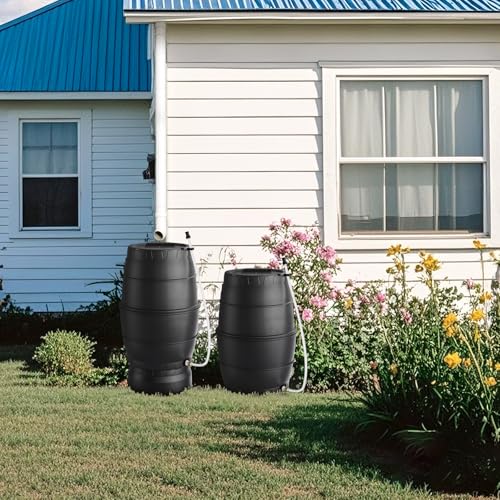
The best rain barrel without gutters is a covered, stable barrel paired with a rain diverter or simple roof catchment system.
A rain barrel can still help when your home has no gutters. You can place it below a roof edge, shed roof, awning, or rain chain and guide water into the screened opening. I focus on safe materials, a firm base, easy cleaning, overflow control, and simple watering access. The right setup turns a short storm into a small water reserve for flowers, shrubs, and lawns. It also helps reduce runoff around your home. In this guide, I review popular options and explain which one may fit your yard, roof, and watering needs best.
45-Gallon Barrel With Stand

This 45-gallon rain barrel gives you a practical starting point for roof-edge water collection. Its included stand raises the barrel, which can improve access to the spigot and make filling a watering can easier. The barrel uses BPA-free construction and includes a mesh screen to help block leaves and larger debris. For a home without gutters, I like the elevated design because you can place it under a roof drip line or near a short rain chain.
The spigot provides a simple way to draw water for flower beds, containers, and small garden tasks. An overflow valve can help direct extra water away from the barrel when a storm fills it. You should still place the unit on firm, level ground before use. A full 45-gallon barrel is heavy, so the stand and base need support that will not sink into soft soil.
Pros:
- Included stand raises the water outlet
- 45-gallon size suits many small yards
- BPA-free barrel material
- Mesh screen helps keep out leaves and insects
- Spigot supports watering cans and hoses
- Overflow valve helps manage excess rain
Cons:
- Requires a strong, level base
- May fill slowly without a large roof area
- Plastic color and finish may vary by placement and weather
My Recommendation
I recommend this model for gardeners who want a complete barrel with a stand and do not need a very large tank. It works especially well beside a shed, porch, garage, or low roof edge where you can guide water into the screened top. Among the options here, it is a strong candidate for the best rain barrel without gutters because the stand solves a common problem: a low outlet that is hard to use. Its value is best when you want easy access and a simple setup from one package.
45-Gallon Barrel With Hose

This 45-gallon rain barrel focuses on basic collection and flexible water use. It includes a mesh screen, lid, spigot, and hose, so you have several ways to manage collected water. The covered top can reduce open exposure to leaves and some pests. Without gutters, you can position it below a clean roof edge and use a short diverter, splash block, or rain chain to guide the flow.
The included hose may help you reach nearby plants without lifting a full watering can. I would use this barrel for flowers, shrubs, raised beds, and other outdoor plants rather than drinking water. Keep the lid secure and inspect the screen after windy weather. Like any full rain barrel, this unit needs a solid base and careful placement away from walkways where overflow could create a slippery surface.
Pros:
- Useful 45-gallon storage capacity
- Includes lid and mesh screen
- Spigot gives direct access to stored water
- Hose can extend watering reach
- Fits many small garden layouts
- Simple design is easy to understand
Cons:
- Needs a separate stand or raised base for easier hose use
- Roof-edge collection may need a diverter
- Full-barrel weight limits how often you can move it
My Recommendation
This barrel suits a homeowner who wants hose access without buying a large tank. It is a good match for a patio garden or a few planting beds near a shed or porch. I would choose it as the best rain barrel without gutters when the buyer values a hose and covered collection more than an included stand. It offers useful parts in one package, but plan the base and water path before the first storm.
Good Ideas Riverwalk 50-Gallon Barrel

The Good Ideas Impressions Riverwalk barrel offers 50 gallons of storage in a decorative form. That larger capacity can help you hold more water between storms, especially if you use rainwater for several beds. Its appearance may blend into a landscaped yard better than a plain utility tank. For a gutter-free home, place it below a roof edge, rain chain, or small catchment channel.
A decorative barrel can make water saving feel like part of the garden instead of an afterthought. Still, style should never replace safe setup. I would build a level base, keep the inlet clear, and check how overflow leaves the barrel during a heavy storm. The larger capacity also means more weight, so choose the final location before filling it.
Pros:
- 50-gallon capacity stores more water than many 45-gallon models
- Decorative Riverwalk appearance suits visible garden areas
- Useful for larger planting beds
- Can reduce the need for tap water during dry periods
- Works with roof edges and rain chains
- Provides a stable long-term collection point
Cons:
- Heavy when full and difficult to relocate
- May cost more than a basic utility barrel
- Gutter-free use may require extra water guidance parts
My Recommendation
I would recommend this model to homeowners who care about appearance and want a little more capacity. It is a strong choice for a front garden, patio, or landscaped side yard where a plain barrel may look out of place. It can be the best rain barrel without gutters for someone who wants storage and curb appeal in one product. Be ready to plan the base, inlet, and overflow route before installation.
FCMP Outdoor 45-Gallon Raincatcher

The FCMP Outdoor Raincatcher 4000 is a 45-gallon barrel made for outdoor plant and landscape use. It includes a hose and debris screen, which can simplify collection and watering. The black finish has a practical, low-key look that works well beside a shed or garden bed. If your house has no gutters, you can use it under a roof edge with a rain chain or add a compatible collection guide.
The debris screen is important because roof water can carry leaves, grit, and small particles. I would rinse the screen often and clean the barrel at set intervals. The hose can help direct water toward plants, but it should not sit where people can trip over it. This is a useful middle-ground option for buyers who want a known outdoor water container without moving up to a very large tank.
Pros:
- 45-gallon capacity fits many home gardens
- Includes debris screen
- Includes hose for flexible watering
- Designed for plants, gardens, and landscapes
- Black finish hides some outdoor dirt
- Compact size is easier to place than a large tank
Cons:
- Does not include a raised stand in the listed package
- May need a separate inlet guide without gutters
- Hose placement requires care around foot traffic
My Recommendation
This is a good fit for practical gardeners who want a recognized outdoor barrel with a screen and hose. I would place it near a shed, greenhouse, or side roof where a short water guide can feed the top. It may be the best rain barrel without gutters for someone who wants a balanced mix of capacity, simple parts, and a modest footprint. Add a stable platform if you want easier access to the lower outlet.
Rain Barrel Diverter Kit With Hole Saw

This product is a rain barrel diverter kit rather than a storage barrel. It is designed for rectangular downspouts and may help send roof water toward a barrel or container. The package includes a hole saw set, which can reduce the need to buy a separate cutting tool. A diverter matters because it helps control the water path instead of letting rain splash randomly from the roof edge.
For a home with no gutters, this kit is most useful when you have a downspout, partial drainage system, or a place where water already gathers. It will not create a complete collection system by itself. Measure the water outlet and container opening before cutting anything. I also suggest checking the seal after installation and planning an overflow route before the next heavy rain.
Pros:
- Designed for rectangular downspouts
- Includes a hole saw set
- Can help guide water into many container types
- May avoid full downspout removal during setup
- Useful for custom rainwater systems
- Can improve water control near a barrel
Cons:
- It is not a rain barrel or storage tank
- Requires careful measuring and cutting
- May not fit every downspout shape or size
My Recommendation
I recommend this diverter for a hands-on homeowner who already owns a barrel or wants to turn a clean plastic container into a collection tank. It is not the best rain barrel without gutters by itself, but it can be the key connection part in a custom setup. Choose it when your roof water has a defined outlet that matches the kit. If your home truly has no downspout, use a rain chain or roof-edge channel instead.
WADEO Downspout Diverter Kit

The WADEO diverter kit is made for 2-by-3-inch or 3-by-4-inch downspouts. Its brown color may blend with some exterior trim and drainage parts. This product helps route water, but it does not hold water on its own. It can support a barrel system when your roof has a compatible downspout or when you are adapting a partial gutter arrangement.
Size is the main detail to check before ordering. A diverter that does not match the downspout can leak, fit poorly, or fail to move water as expected. I would measure the outside dimensions and inspect the connection point first. For a gutter-free design, pair the diverter with a short channel, rain chain, or roof-edge collector that brings water to the barrel inlet.
Pros:
- Fits common 2-by-3-inch downspouts
- Also supports 3-by-4-inch downspouts
- Brown color can blend with some outdoor finishes
- Helps direct water into a storage barrel
- Useful for custom rain collection projects
- Can reduce uncontrolled water splash near foundations
Cons:
- Not a storage barrel
- Requires a compatible downspout or drainage path
- Incorrect measurements can lead to poor fit
My Recommendation
This kit is best for a homeowner who understands downspout sizes and wants a cleaner water path. It can support the best rain barrel without gutters when the home has a partial drainage system or a custom roof collector. I would not buy it as a stand-alone solution. Instead, pair it with a screened barrel, firm base, and overflow hose so the whole system works as one.
100-Gallon Collapsible Rain Barrel

This 100-gallon collapsible rain barrel offers much more storage than the standard 45- or 50-gallon options. Its collapsible form may help when you need seasonal storage or want to reduce its footprint when empty. Large capacity works best when you have a broad roof, frequent rain, or several garden beds to water. You can use a roof edge, rain chain, or custom channel to guide water into the tank.
Large flexible tanks need careful setup. Choose a level location without sharp stones, sticks, or roots that could stress the material. A full 100-gallon tank is extremely heavy, so treat the first placement as permanent during the wet season. I would also check the inlet screen, seams, and overflow path often, especially after strong wind or a long dry spell.
Pros:
- Large 100-gallon storage capacity
- Collapsible design can save space when empty
- Useful for larger gardens and dry periods
- Can reduce repeated trips to an outdoor tap
- Works with many custom roof collection methods
- Good option for seasonal water storage
Cons:
- Needs a very stable and smooth base
- Full tank is too heavy to move safely
- Large capacity may be excessive for a small roof area
My Recommendation
I recommend this tank for gardeners who need serious storage and have enough roof area to fill it. It can be the best rain barrel without gutters for a larger lot, greenhouse, community garden, or long planting bed. It is less suitable for a tiny patio or a place with little rainfall. Before buying, confirm the footprint, water path, overflow plan, and ground strength.
FCMP Raincatcher 4000 Flat-Back Barrel

The FCMP Raincatcher 4000 provides 50-gallon storage in a flat-back shape. That design can sit closer to a wall, shed, fence, or other vertical surface than a round barrel. It includes side spigots, a mesh screen, an overflow hose, and a linking kit. For a home without gutters, the flat back can make it easier to place the barrel beside a roof edge while leaving more space in a narrow path.
The linking kit may help you connect barrels later if your water needs grow. Side spigots can offer more than one access point, depending on how you arrange the unit. I would still keep the barrel on a stable base and direct overflow away from the foundation. The mesh screen needs regular cleaning because a blocked screen can slow collection and create standing water on the roof side.
Pros:
- 50-gallon water storage
- Flat-back design saves space along walls
- Includes mesh screen
- Includes overflow hose
- Includes linking kit for future expansion
- Side spigots offer flexible water access
Cons:
- May need a separate inlet guide without gutters
- Requires careful wall and foundation placement
- Linked barrels need extra space and level support
My Recommendation
This is my top choice for narrow side yards and buyers who may expand later. Its flat-back body, overflow hose, and linking kit give it more layout flexibility than a basic barrel. For many homes, it is the best rain barrel without gutters because it can sit neatly near a wall and adapt to a growing garden. I would choose it when space matters as much as capacity.
How to Choose the Best Rain Barrel Without Gutters
Buying a rain barrel without gutters takes a little more planning than buying a normal downspout model. The barrel is only the storage part. You also need a clean way to move water from the roof edge into the opening. A good setup acts like a small stream: the roof gathers water, the guide leads it, and the barrel stores it.
Start With the Roof Edge
Look at where rain falls from the roof. A clean roof edge, porch roof, shed, carport, or greenhouse can all provide water. Avoid places where runoff crosses dirty pavement, treated wood, or areas with oil and chemicals. Rainwater collected from a roof should support outdoor plants, not drinking or cooking.
A rain chain can guide water downward with less visual clutter. A short plastic channel can also carry water from the drip edge to the barrel. Keep the path sloped enough for water to move, but do not create a sharp bend that causes splash and waste.
Choose the Right Capacity
A 45- or 50-gallon barrel works well for many small gardens. It is easier to place than a 100-gallon tank, yet it can provide several watering sessions. A 100-gallon tank makes more sense when you have a large roof, many plants, or a dry climate with occasional heavy storms.
More capacity is not always better. A full 50-gallon barrel weighs about 417 pounds because one gallon of water weighs roughly 8.34 pounds. A full 100-gallon tank can weigh more than 800 pounds before you add the tank itself. That weight calls for a strong base and a final location you can trust.
Look for a Screen and Secure Cover
A mesh screen helps block leaves, twigs, and some insects. A cover also limits access to the stored water. The U.S. Environmental Protection Agency and many local extension services recommend careful rain barrel maintenance to reduce debris and standing water. Screen openings should stay clear, and the tank should not create a place where mosquitoes can breed.
Inspect the cover after storms. A loose lid can blow away, while a blocked screen can slow water entry. I prefer a design that makes the screen easy to remove and clean without taking apart the whole barrel.
Plan the Overflow Before Filling
Every barrel needs an overflow plan. Heavy rain may fill a tank faster than you expect. Direct extra water toward a planted bed, gravel area, or safe drainage point. Keep overflow away from the home foundation, basement window, and walking path.
An overflow hose is helpful, but the hose must have a clear downhill route. If it rises, bends sharply, or ends in a low spot beside the wall, water can pool. Test the path with a bucket before a major storm.
Use a Stable Base
A level base improves safety and helps the barrel drain through its spigot. A compact paver pad, sturdy platform, or other load-rated surface may work better than loose soil. Do not place a full barrel on a weak shelf, rotting deck board, or soft lawn.
Raise the barrel only as high as needed. A higher stand can improve water pressure and watering-can access, but it also raises the center of gravity. Keep the barrel steady and prevent children from climbing on it.
Check Local Rules and Water Safety
Rainwater rules can differ by state, county, and city. Some areas limit collection size or require overflow controls. Check local guidance before installing a large system. Also, never assume collected water is safe to drink.
Use stored rainwater on ornamental plants, trees, shrubs, and lawns. For edible crops, follow local extension guidance and avoid spraying water directly onto leaves or produce. Do not use rain barrel water for bathing, pets, or household plumbing unless a properly designed and approved treatment system supports that use.
Best Uses for a Gutter-Free Rain Barrel
A barrel without a gutter connection works best when the collection area is close and easy to guide. Place one below a small porch roof to water hanging baskets. Set one near a shed to support herbs and flowers. You can also use a rain chain beside a patio barrel for a quiet, attractive water path.
These systems are especially useful for container gardens. Container plants dry out faster than plants in the ground, so a nearby water source saves time. A hose or spigot can make a small barrel feel like an outdoor tap, but check the flow before planning to irrigate a large lawn.
Rain barrels also reduce some runoff. They cannot solve every drainage problem, but they can hold part of a storm’s water and release it later through normal garden use. Think of them as a small sponge beside the house, not a complete flood-control system.
Best for
| Best for | Why |
|---|---|
| Small yards and simple roof-edge collection | The 45-gallon barrel with stand offers useful capacity, raised access, a screen, and an overflow valve. |
| Narrow side yards | The FCMP Raincatcher 4000 uses a flat-back shape and includes an overflow hose and linking kit. |
| Large gardens and seasonal storage | The 100-gallon collapsible tank holds much more water and can be stored with less bulk when empty. |
FAQs Of best rain barrel without gutters
Can I use a rain barrel without gutters?
Yes. Place it under a roof edge, shed roof, awning, or rain chain. Use a short channel or diverter to guide water into the screened opening. Make sure the barrel has a safe overflow route.
What is the best way to collect rainwater without gutters?
A rain chain, roof-edge channel, or simple sloped guide can move water into the barrel. The best method depends on your roof shape and the barrel location. Keep the collection path clean and avoid runoff from dirty surfaces.
How large should a rain barrel be?
A 45- or 50-gallon model suits many home gardens. Choose a 100-gallon tank when you have a larger roof, more plants, and a strong place to keep the full tank. Capacity is useful only if you can safely support and manage it.
Is rain barrel water safe for vegetables?
Rain barrel water is not drinking water. Local extension guidance may allow use on edible plants, but avoid spraying the water onto leaves or produce. Use clean collection surfaces, maintain the screen, and wash harvested food well.
How do I stop mosquitoes in a rain barrel?
Use a tight cover and intact mesh screen. Remove leaves and standing water near the barrel. Empty or use the stored water regularly, and follow local public health advice if mosquito problems continue.
Final Verdict: Which Should You Buy?
For most homes, I would choose the FCMP Raincatcher 4000 for its flat-back shape, 50-gallon size, screen, overflow hose, and linking kit. It is a strong best rain barrel without gutters for narrow spaces and future expansion.
Choose the stand model for easy spigot access, the 100-gallon tank for large gardens, and a diverter only when you need a custom water path. A stable base, clean screen, and safe overflow matter as much as the barrel itself.
