
How Do Robot Lawn Mowers Work: Complete Guide
A robot lawn mower is a battery-powered machine that cuts grass on its own. In a typical U.S. yard, it uses boundary wires, satellite signals, or onboard sensors to stay within the mowing area. It cuts a small amount of grass at a time, returns to a charging station when the battery is low, and resumes the job later.
Unlike a riding mower, a robot mower does not usually collect grass. Its small blades trim the tips of grass blades and leave the fine clippings on the lawn. This process, called mulching, can reduce the need to bag clippings.
Robot lawn mowers work best when the lawn has a clear border, manageable slopes, and few obstacles. They are less suitable for yards with steep hills, deep holes, loose gravel, standing water, or many separate grass areas.

What Is a Robot Lawn Mower?
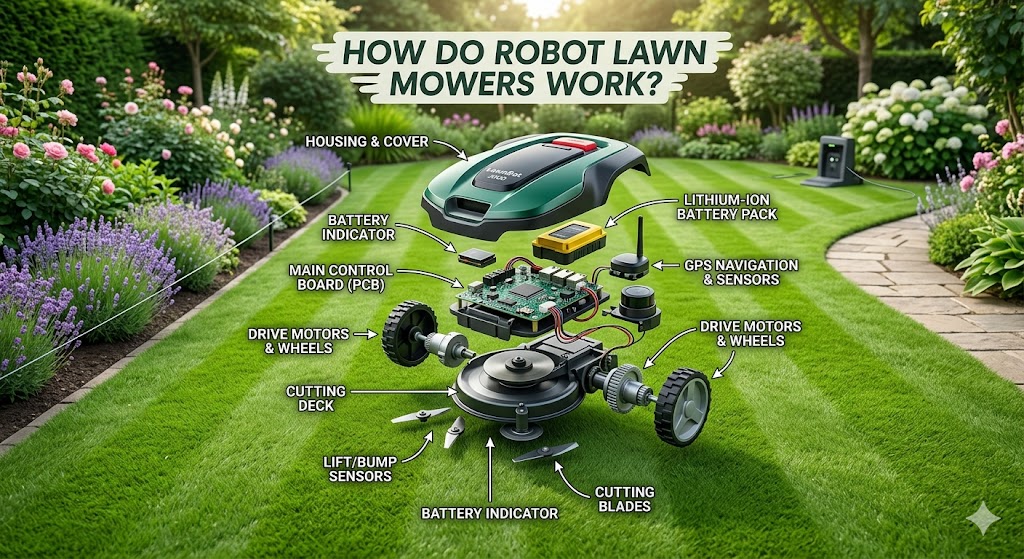
A robot lawn mower is an autonomous outdoor machine that plans and performs lawn-cutting tasks with limited human control. It combines a mower deck, electric motor, battery, sensors, software, and a charging system.
Most models include these parts:
- Cutting system: Small rotating blades trim the grass.
- Drive motors: Separate motors move the mower and help it turn.
- Battery: A rechargeable lithium-ion battery powers the mower.
- Control board: The onboard computer manages movement, cutting, charging, and safety.
- Boundary system: A wire, satellite map, or sensor system marks where the mower may travel.
- Sensors: Lift, tilt, collision, rain, wheel, and obstacle sensors support safe operation.
- Charging station: The mower returns here when it needs power.
- Mobile app or control panel: The owner sets schedules, zones, cutting height, and other controls.
The exact design varies by brand and model. Some robot mowers need a physical perimeter wire. Others use GPS, real-time kinematic positioning, cameras, radio beacons, or a combination of technologies.
A robot mower is not the same as a remote-controlled mower. A remote-controlled mower depends on a person to steer it. A robot mower follows programmed instructions and makes many movement decisions by itself.

How Does a Robot Lawn Mower Navigate?
A robot lawn mower navigates by combining a virtual or physical boundary with position data and sensor feedback. It does not simply “know” where the grass is. The mower must first identify the permitted mowing area.
Boundary-wire navigation
Many robot mowers use a low-voltage boundary wire placed around the lawn’s edge. The wire creates an electromagnetic signal that the mower detects.
During installation, the wire usually runs:
- Around the outside edge of the lawn
- Around flower beds and trees
- Around ponds, pools, and other hazards
- Along the edge of drop-offs
- Across narrow areas that the mower should not enter
The charging station sends a signal through the wire. When the mower approaches the boundary, its control system detects the signal and changes direction.
The wire does not normally act like a fence that physically stops the mower. It works more like an invisible line that tells the mower where it may travel.
A boundary wire also helps the mower find its charging station. Many systems use a guide wire or a special return signal to lead the mower back to the dock.
GPS and RTK navigation
some wire-free robot mowers use satellite positioning. Higher-end models may use RTK, or real-time kinematic positioning. RTK improves location accuracy by comparing satellite signals with correction data from a fixed reference station or network.
This can let the owner draw a digital map in an app instead of burying a boundary wire. The mower then compares its current location with the stored map.
Satellite-based systems have limits. Trees, tall buildings, steep terrain, and poor signal conditions can reduce accuracy. A mower may also need a clear view of the sky or a strong connection to its positioning service.
Camera and visual navigation
Camera-based models use images to identify grass, hard surfaces, objects, or lawn edges. Software interprets those images while the mower moves.
A camera may help the mower recognize:
- People and pets
- Garden beds
- Walkways
- Toys and tools
- Driveways
- Lawn edges
Camera navigation can reduce the need for boundary wire, but it is not a guarantee that the mower will identify every object. A small wire, dark hole, wet leaf pile, or low object may still cause trouble.
Sensor-based movement
Robot mowers also use short-range sensors. These may include:
- Bump sensors: Detect contact with an object.
- Lift sensors: Stop the blades when the mower is lifted.
- Tilt sensors: Stop operation when the mower tilts beyond a safe limit.
- Wheel sensors: Detect wheel rotation and slipping.
- Ultrasonic or radar sensors: Detect objects before contact.
- Rain sensors: Delay mowing in wet conditions on models that support this feature.
- Inertial sensors: Track changes in direction and movement.
No single sensor does every job. The mower combines several signals to decide whether to continue, turn, stop, or return to its dock.
How Does a Robot Mower Cut Grass?
A robot mower cuts grass with a rotating blade disc or several small blades mounted below the deck. The blades trim only a small amount from the top of the grass during each pass.
Most robot mowers use a mulching system. Instead of collecting grass, they leave tiny clippings on the lawn. These clippings can break down and return some nutrients to the soil when mowing conditions are suitable.
The mower’s cutting height is usually adjustable. A higher setting may be better for:
- New lawns
- Hot, dry weather
- Shaded grass
- Cool-season grass during summer stress
- Lawns that have grown too tall
A lower setting may suit some lawns, but cutting too much at once can stress grass. A robot mower is designed for frequent trimming, not for clearing an overgrown lawn.
For example, if grass grows to 4 inches and the mower is set to cut at 2 inches, it may struggle or leave an uneven result. It is better to cut tall grass with a standard mower first, then use the robot mower for regular maintenance.
Random, systematic, and mapped mowing patterns
Older or basic models may use a random pattern. The mower moves forward until it reaches a boundary or obstacle, then turns at a new angle. Over repeated mowing sessions, this can cover the full lawn.
More advanced models may mow in lanes, sections, or mapped patterns. A systematic pattern can produce a more even appearance and may reduce missed strips.
A mapped mower may divide the yard into zones. You can then assign different schedules to the front yard, side yard, or back yard. This is useful when areas have different grass types, sun levels, or mowing needs.

How Does a Robot Lawn Mower Know When to Recharge?
A robot mower monitors its battery level while it works. When the charge reaches a programmed threshold, it stops cutting and returns to the charging station.
The return process may use:
- The boundary wire
- A guide wire
- A radio signal
- GPS or RTK positioning
- A stored digital map
- A combination of these methods
At the station, metal contacts or another charging connection transfers power to the mower. The charging time depends on battery size, charger output, temperature, and model design.
After charging, the mower may resume the same task. A mapped mower can often return to the zone or position where it stopped. A basic mower may leave the station and follow its normal movement pattern.
The mower’s daily coverage depends on more than battery capacity. Important factors include:
- Lawn size
- Grass density
- Slope
- Number of obstacles
- Travel speed
- Cutting height
- Weather
- How often the mower must return to charge
A mower advertised for a certain lawn size may need to run for many hours each day to maintain that area. Coverage ratings are not always a promise that the mower will finish a tall or complex lawn in one short session.

What Happens When a Robot Mower Meets an Obstacle?
When a robot mower detects an obstacle, it may stop, slow down, turn, or notify the owner. The response depends on the sensor system and the object’s size, height, color, and location.
A bump sensor may react only after light contact. A camera, radar, or ultrasonic sensor may detect an object before contact. However, no consumer robot mower should be treated as fully aware of everything in its path.
Before each mowing session, remove items such as:
- Children’s toys
- Dog toys
- Garden hoses
- Small tools
- Clothing
- Sports equipment
- Fallen branches
- Cords
- Loose stones
Keep pets and children away from the mower while it operates. A robot mower may be quieter than a gas mower, but its blades still present a cutting hazard.
Many models stop their blades when lifted or tilted. This safety feature helps reduce risk, but it does not make hands-on contact safe. Turn the mower off and follow the owner’s manual before cleaning, inspecting, or changing blades.

Can Robot Lawn Mowers Handle Hills and Uneven Ground?
Robot mowers can handle some slopes, but every model has a stated maximum gradient. The safe limit depends on the mower’s drive system, tire grip, surface condition, and direction of travel.
A slope listed in degrees is not the same as a slope listed as a percentage. The basic relationship is:
Slope percentage = vertical rise ÷ horizontal run × 100
For example, a hill that rises 1 foot over a horizontal distance of 10 feet has:
1 ÷ 10 × 100 = 10% slope
The same slope is about 5.7 degrees. Always compare your lawn with the unit used in the mower’s specifications.
Wet grass, loose soil, leaves, and mud reduce traction. A mower that handles a dry slope may slip on the same hill after rain.
Watch for these problem areas:
- Slopes near retaining walls
- Sharp changes in grade
- Soft soil
- Exposed roots
- Deep wheel ruts
- Drainage channels
- Edges beside ponds or steps
Do not rely on the mower’s ability to detect a fall. Use a boundary wire, virtual exclusion zone, or physical barrier where a mistake could cause injury or equipment damage.

How Do You Install and Set Up a Robot Lawn Mower?
Setup usually involves placing the charging station, defining the mowing area, setting the cutting schedule, and testing the mower.
1. Inspect the lawn
Walk the full area and identify:
- Grass boundaries
- Narrow passages
- Slopes
- Obstacles
- Low branches
- Drops and steps
- Areas that stay wet
- Separate lawn sections
Fill holes and remove loose objects before installation.
2. Place the charging station
Put the charging station on a stable, level surface with enough open space for the mower to approach and leave. The manual may specify clearance in front of and beside the dock.
The station normally needs a suitable outdoor electrical connection. Use only the power supply and weather protection approved for that model. Do not use damaged cords or improvised wiring.
3. Install the boundary system
For a wire-based mower, secure or bury the boundary wire according to the instructions. Keep the wire at the correct distance from edges, walls, beds, and drop-offs.
For a wire-free mower, map the lawn from the app or control panel. Walk or drive the mower around the permitted zone if the system requires a mapping pass.
4. Create exclusion zones
Mark places the mower must avoid. These may include:
- Vegetable gardens
- Pools
- Pet areas
- Tree roots
- Gravel
- Decorative stone
- Play equipment
- Steep edges
5. Set the schedule
Choose mowing times that fit your household. Avoid times when children or pets use the yard. Some owners schedule mowing during daylight because objects are easier to see and yard activity is easier to monitor.
Follow local noise rules and the manufacturer’s weather guidance.
6. Test the boundary and return path
Watch the first few mowing runs. Confirm that the mower:
- Stays inside the intended area
- Reaches all zones
- Avoids hazards
- Returns to the dock
- Stops when lifted
- Does not cross paths or driveways unexpectedly
Fix the layout before leaving the mower unattended.

How Much Maintenance Does a Robot Lawn Mower Need?
A robot mower needs regular cleaning, blade checks, software updates, and seasonal care. It usually needs less routine labor than a gas mower, but it is not maintenance-free.
After mowing or as needed
Check the underside for:
- Packed grass
- Mud
- Twigs
- Stones
- Damaged blades
- Blocked wheels
Turn the mower off before inspection. Remove the battery or use the shutdown process stated in the manual.
Do not spray water into the charging contacts, electronics, motor housing, or other areas not approved for washing.
Blades
Dull or damaged blades can tear grass instead of making a clean cut. Replace or rotate blades only as the manual permits, and use the correct replacement parts.
Wear cut-resistant gloves when handling blades. Disconnect power before touching the cutting system.
Boundary wire
If a wire-based mower stops working, inspect the wire for:
- Cuts
- Loose connectors
- Animal damage
- Landscaping damage
- Corrosion
- Changes caused by edging or digging
A boundary-wire break can stop navigation even when the mower and battery are healthy.
Battery and winter storage
Lithium-ion batteries perform best when stored and charged within the temperature range in the manual. In cold regions of the United States, owners often store the mower and charger indoors during freezing weather if the manufacturer recommends it.
Do not store a damaged or swollen battery. Contact the manufacturer or a qualified service provider for safe handling.

What Are the Advantages and Limits of Robot Lawn Mowers?
Robot lawn mowers can reduce routine mowing work, but they do not fit every yard.
| Feature | Practical benefit | Main limitation |
|---|---|---|
| Automatic scheduling | Cuts grass without a person pushing a mower | Requires setup and monitoring |
| Battery power | Produces no tailpipe emissions during use | Needs charging and battery replacement over time |
| Mulching | Avoids collecting and hauling clippings | Does not remove leaves or long grass |
| Quiet operation | Usually creates less disturbance than a gas mower | Still has moving blades and motor noise |
| Frequent cutting | Keeps grass at a steady height | Performs poorly on severely overgrown lawns |
| App control | Allows zone and schedule changes | May depend on Bluetooth, Wi-Fi, cellular service, or a cloud account |
| Boundary wire | Gives a clear mowing limit | Installation takes time and wire can be damaged |
| Wire-free mapping | Can simplify some installations | Satellite and camera systems have environmental limits |
A robot mower may be a good fit for a relatively open lawn that needs frequent maintenance. It may be a poor fit for a yard with many small grass islands, rough terrain, heavy leaf fall, or frequent foot traffic.
It also does not replace every lawn-care tool. You may still need a string trimmer for edges, a mower for tall grass, and a rake or blower for leaves.

Are Robot Lawn Mowers Safe?
Robot lawn mowers include safety systems, but safe use still depends on installation and supervision. Read the manual before operation, especially for blade access, slopes, charging, children, pets, and rain.
Key safety practices include:
- Keep children away from the mower while it runs.
- Keep pets away until you know how they react to it.
- Remove toys, tools, cords, and branches.
- Do not carry the mower while the blades are active.
- Shut it down before cleaning or clearing a jam.
- Keep hands and feet away from the cutting deck.
- Do not modify the battery, charger, software, or safety switches.
- Keep the charging station and electrical connections protected as directed.
- Inspect the mower after striking a hard object.
- Stop using it if the battery is swollen, hot, leaking, or damaged.
Some models include theft alarms, PIN locks, GPS tracking, and app alerts. These features may help recover a mower, but they do not replace physical security or supervision.
Safety requirements and product designs can change. For U.S. owners, check the current product manual, recall notices from the U.S. Consumer Product Safety Commission, and applicable electrical certification information before purchase.

Why Is a Robot Lawn Mower Not Working Correctly?
Start with the simplest and safest checks. Do not open the battery or electrical system unless the manufacturer or a qualified technician directs you to do so.
| Symptom | Possible causes | First checks |
|---|---|---|
| Mower will not start | Empty battery, schedule disabled, safety lock active | Charge it, check the schedule, read the display |
| Mower leaves the lawn | Wrong boundary layout, damaged wire, poor positioning data | Inspect the map or wire and test the boundary |
| Mower misses strips | Random pattern, blocked zone, poor coverage settings | Adjust the schedule, zone settings, or map |
| Mower gets stuck | Mud, slope, hole, roots, narrow passage | Improve the surface and create an exclusion zone |
| Mower will not dock | Station blocked, poor guide signal, uneven approach | Clear the path and check station placement |
| Grass looks torn | Dull or damaged blades, mowing too low | Inspect and replace blades as directed |
| Mower stops in rain | Rain sensor or weather protection setting | Check the manual before overriding the setting |
| App cannot connect | Bluetooth, Wi-Fi, cellular, or account issue | Move closer, check permissions, and verify service |
If the mower repeatedly fails in the same location, change the site rather than repeatedly restarting the machine. A small landscape adjustment or exclusion zone may solve the cause.
Contact the manufacturer or an authorized repair provider when the problem involves smoke, heat, battery damage, repeated electrical errors, or a safety feature that does not work.
How Should You Choose a Robot Lawn Mower?
Choose by lawn conditions rather than by advertised maximum area alone. Measure the actual grass area and examine the parts that create difficulty.
Consider these questions:
-
How large is the lawn?
Include only the grass area the mower must cut. -
Does the lawn have slopes?
Compare each slope with the manufacturer’s rated limit and account for wet conditions. -
Do you want boundary wire or wire-free mapping?
Wire can take more installation work but offers a clear physical reference. Wire-free systems may simplify setup but depend on signal quality and mapping accuracy. -
How many zones are there?
A mower with zone management may work better for front, side, and back lawns. -
Are there pets or children?
Look for suitable safety controls, but plan to manage yard access during operation. -
What happens to leaves and debris?
Robot mowers generally cut grass. They do not replace seasonal leaf cleanup. -
What service is available?
Check warranty terms, blade availability, battery replacement, repairs, app support, and local service options. -
Will the mower work without a subscription?
Some features may depend on cellular data, cloud services, or a paid plan. Verify current terms before buying.
The best match is usually the mower that can safely handle the yard’s shape, slope, grass area, and obstacles—not simply the model with the largest marketing number.

Frequently Asked Questions
Do robot lawn mowers work in the rain?
Some models can operate in light rain, while others return to the dock when a rain sensor detects moisture. Wet grass can reduce traction and cause clippings to collect beneath the deck. Follow the exact weather instructions for your model.
Do robot lawn mowers cut in a straight line?
It depends on the model. Basic machines may move in changing directions. Mapped models may follow parallel lanes or planned paths. A systematic pattern can make coverage more predictable.
Can a robot lawn mower cut wet grass?
Some can, but wet conditions may cause slipping, clogging, poor cutting, and soil damage. If the manual recommends avoiding wet grass, use the rain or weather pause feature.
Will a robot mower cut the edge of the lawn?
Many models use an edge-cutting mode, but no mower reaches every edge perfectly. Walls, fences, curbs, and beds may still require trimming with a string trimmer.
Can a robot mower go over a driveway?
Some systems can cross a driveway when the route is mapped or protected by the correct boundary setup. Do not assume that every mower can safely cross concrete, gravel, or a public walkway. Check the model’s instructions and protect people from moving equipment.
How long do robot mower batteries last?
Battery life depends on charge cycles, heat, storage, use, and maintenance. The exact replacement interval varies by model and cannot be predicted from lawn size alone. Check whether the battery is replaceable and what replacement service costs.
Do robot lawn mowers attract thieves?
They can be stolen if left unsecured. Use a PIN, alarm, GPS or cellular tracking where available, and a secure charging location. These features vary by model and may require an active account or service plan.
Key Takeaways
- A robot lawn mower uses sensors, software, batteries, and a boundary system to cut grass without constant steering.
- Boundary wire, GPS, RTK, cameras, and guide signals are the main navigation methods.
- The mower usually cuts small amounts of grass often and leaves the clippings as mulch.
- It returns to its charging station when the battery is low, then resumes according to its programming.
- Setup quality matters. Slopes, holes, wet ground, obstacles, and poor boundaries can cause failures.
- Keep children, pets, hands, and loose objects away from the mower while it operates.
- A robot mower reduces routine cutting work but does not replace edging, leaf cleanup, or mowing severely overgrown grass.
Conclusion
Robot lawn mowers work by repeating a simple cycle: define the safe area, detect position and obstacles, trim a small amount of grass, return to charge, and resume the schedule. The machine’s performance depends on the quality of its navigation system and the condition of the lawn.
Before buying one in the United States, measure the lawn, check slopes, identify hazards, and compare boundary-wire and wire-free systems. After installation, watch the first few runs and correct problem areas early. A well-prepared yard gives the mower the best chance to work safely and consistently.
Sources and further reading
- U.S. Consumer Product Safety Commission — Product safety information and recalls
- UL Standards & Engagement — Safety standards information for consumer and electrical products
- ANSI — U.S. standards and conformity information
- Manufacturer owner’s manual for the exact robot mower model — Installation limits, slope ratings, weather rules, battery care, and safety procedures


