How Heavy Is A Zero Turn Lawn Mower: Weight Guide
A zero-turn lawn mower usually weighs 500 to 1,500 pounds in the United States. Most residential models weigh about 500 to 800 pounds, while larger commercial mowers often weigh 800 to 1,500 pounds or more.
The exact weight depends on the mower’s engine, deck size, frame, fuel tank, seat, tires, and optional equipment. A 42-inch residential mower may weigh less than 600 pounds, while a 72-inch commercial mower can exceed 1,300 pounds.

Zero-Turn Mower Weight by Type
The mower’s class gives the best starting estimate. Residential, prosumer, commercial, and stand-on models use different frames and parts, so their weights can vary widely.
| Zero-turn mower type | Common weight range | Typical use |
|---|---|---|
| Small residential | 400–600 lb | Small to medium home lawns |
| Standard residential | 550–800 lb | Larger residential properties |
| Prosumer or heavy-duty residential | 650–950 lb | Frequent home or light commercial use |
| Commercial zero-turn | 800–1,300 lb | Lawn-care businesses and large properties |
| Large commercial model | 1,100–1,600+ lb | Wide mowing decks and long work hours |
| Stand-on mower | 700–1,200 lb | Commercial mowing and tight areas |
These are useful planning ranges, not exact specifications. The manufacturer’s product page or owner’s manual is the final source for a specific mower.
A small mower with a 42-inch deck may weigh more than expected if it has a heavy steel frame. In the same way, two 60-inch mowers can have very different weights because of their engine size, suspension seat, fuel tank, and deck design.

How Much Does a Residential Zero-Turn Mower Weigh?
Most residential zero-turn mowers weigh 500 to 800 pounds. Smaller models with 34- to 42-inch cutting decks can weigh around 400 to 600 pounds. Larger residential models with 48- to 60-inch decks often weigh between 600 and 850 pounds.
For example, a typical homeowner mower may include:
- A stamped or fabricated steel deck
- A two-cylinder gasoline engine
- A welded or formed frame
- Two drive wheels and front caster wheels
- A fuel tank
- A padded seat
- Electric clutch and battery
- Rollover protection on some models
A mower with a fabricated deck often weighs more than a similar mower with a stamped deck. Fabricated decks use thicker steel and may resist impacts better, but the added metal increases total weight.
Electric residential zero-turn mowers may also weigh more than gasoline models. Battery packs add substantial mass, although the exact difference depends on the battery capacity and frame design.

How Heavy Is a Commercial Zero-Turn Mower?
Commercial zero-turn mowers commonly weigh 800 to 1,300 pounds. Large models with 60- to 72-inch decks, suspension seats, heavy frames, and high-capacity fuel tanks can weigh 1,400 pounds or more.
Commercial mowers are heavier because they are built for long operating hours and repeated use. Common weight-adding features include:
- Reinforced steel frames
- Heavy-duty fabricated decks
- Larger engines
- Larger hydraulic pumps and wheel motors
- Suspension seats
- Larger fuel tanks
- Wider tires
- Rollover protection systems
- Bumpers and rear discharge equipment
- Collection systems or baggers
Commercial weight is not always a disadvantage. A heavier mower may feel more stable and can deliver a smoother ride over uneven ground. However, it can also leave deeper tire marks on soft soil and requires a trailer, ramp, and towing vehicle with enough capacity.

What Makes a Zero-Turn Mower Heavier?
Several parts determine the final weight of a zero-turn mower. The engine and deck often have the largest effect, but optional equipment can add hundreds of pounds.
Engine and fuel system
A larger engine usually adds weight. Commercial engines also may have stronger mounting systems and larger cooling components.
Fuel adds weight as well. Gasoline weighs about 6.3 pounds per gallon. A mower with a 10-gallon tank can carry roughly 63 pounds of fuel when full, before accounting for the tank itself.
This means a specification may show a dry or shipping weight that is lower than the mower’s ready-to-use weight.
Cutting deck
The cutting deck can be one of the heaviest parts of the mower. A 60-inch fabricated deck generally weighs more than a 42-inch stamped deck.
The deck’s weight can also affect:
- Ground pressure
- Transport weight
- Trailer payload
- Ramp strength
- Maneuverability on soft ground
Frame and hydraulics
A commercial frame may use thicker steel and stronger welds. Hydrostatic transmissions also include pumps, wheel motors, hoses, and mounting hardware. These parts provide independent control of the drive wheels but add weight compared with simpler riding mower systems.
Seat and suspension
A basic seat is relatively light. A suspension seat with springs, shock absorbers, armrests, and a tall back can add noticeable weight. It may improve comfort, but it also changes the transport weight.
Attachments
A grass catcher, rear bagger, mulch kit, striping roller, sprayer, or collection system adds weight. A large powered collection system may add more than 100 pounds, depending on its design.
Dry Weight, Shipping Weight, and Operating Weight
The number listed on a product page may not represent the mower’s weight during use. Always identify which type of weight the specification describes.
Dry weight
Dry weight normally means the mower without fuel. The exact definition can vary by manufacturer. Some listings may also exclude accessories or removable equipment.
Shipping weight
Shipping weight may include the mower, packaging, pallet, crate, and other shipping materials. It can be higher than the mower’s actual operating weight.
Operating weight
Operating weight is the most useful number for trailer selection. It should represent the mower as it will be transported, including fuel and permanently installed equipment.
For a safe estimate, use:
Operating weight = listed mower weight + fuel + attachments + loose equipment
If the manufacturer does not define the listed weight, assume the number may not include every item used during transport.
Why the difference matters
Suppose a mower has a listed dry weight of 700 pounds. Add:
- 50 pounds of gasoline
- 100 pounds for a bagger
- 25 pounds of tools and spare parts
The transport load becomes about 875 pounds. That difference can affect the trailer’s payload, ramp rating, tires, and towing safety.
How to Find the Exact Weight of Your Zero-Turn Mower
Use the manufacturer’s documentation before relying on a retailer listing or an online estimate.
-
Find the model and serial number.
The model number is usually printed on the frame, under the seat, near the engine, or on a product label. -
Open the official product page.
Look for “Specifications,” “Dimensions,” “Weight,” or “Technical data.” -
Check the owner’s manual.
The manual may define whether the listed number includes fuel, the deck, rollover protection, or other equipment. -
Look for the exact deck size.
A 48-inch version may weigh less than the 60-inch version of the same mower. -
Add installed accessories.
Include a bagger, mulch plate, rear hitch, suspension seat, lights, and other permanent equipment. -
Add fuel and transport items.
Include fuel if the mower will be loaded with a full or partly full tank. -
Confirm the result with a scale if necessary.
A certified vehicle scale or equipment scale gives the most reliable real-world number.
Do not use the engine’s horsepower as a substitute for weight. Horsepower describes engine output, not the mass of the complete mower.

What Size Trailer Do You Need for a Zero-Turn Mower?
A small utility trailer may carry a residential zero-turn mower, but the trailer must support the mower’s full transport weight and provide enough room for safe loading.
For example, a hypothetical load might include:
| Item | Weight |
|---|---|
| Zero-turn mower | 750 lb |
| Fuel | 40 lb |
| Bagger | 100 lb |
| Tools and spare equipment | 60 lb |
| Total load | 950 lb |
The trailer’s usable payload must exceed 950 pounds. Do not confuse payload with the trailer’s gross vehicle weight rating, or GVWR.
A trailer’s payload is generally calculated as:
Payload = trailer GVWR − empty trailer weight
If the trailer has a 2,000-pound GVWR and weighs 700 pounds empty, its rated payload is about 1,300 pounds. The 950-pound example would fit within that rating, assuming the tires, axle, floor, ramps, and hitch are also suitable.
Leave a practical margin instead of loading right up to the rating. Equipment weight can be uncertain, and tools or accessories are easy to overlook.
Trailer features to check
Before transporting a zero-turn mower, verify:
- Trailer payload rating
- Axle rating
- Tire load rating
- Ramp capacity
- Deck and floor strength
- Tie-down points
- Hitch and vehicle towing capacity
- Overall trailer width
- Legal lighting and safety requirements in your state
The mower should be centered over the axle area and secured with rated tie-down straps. Follow the mower and trailer manufacturer’s instructions.
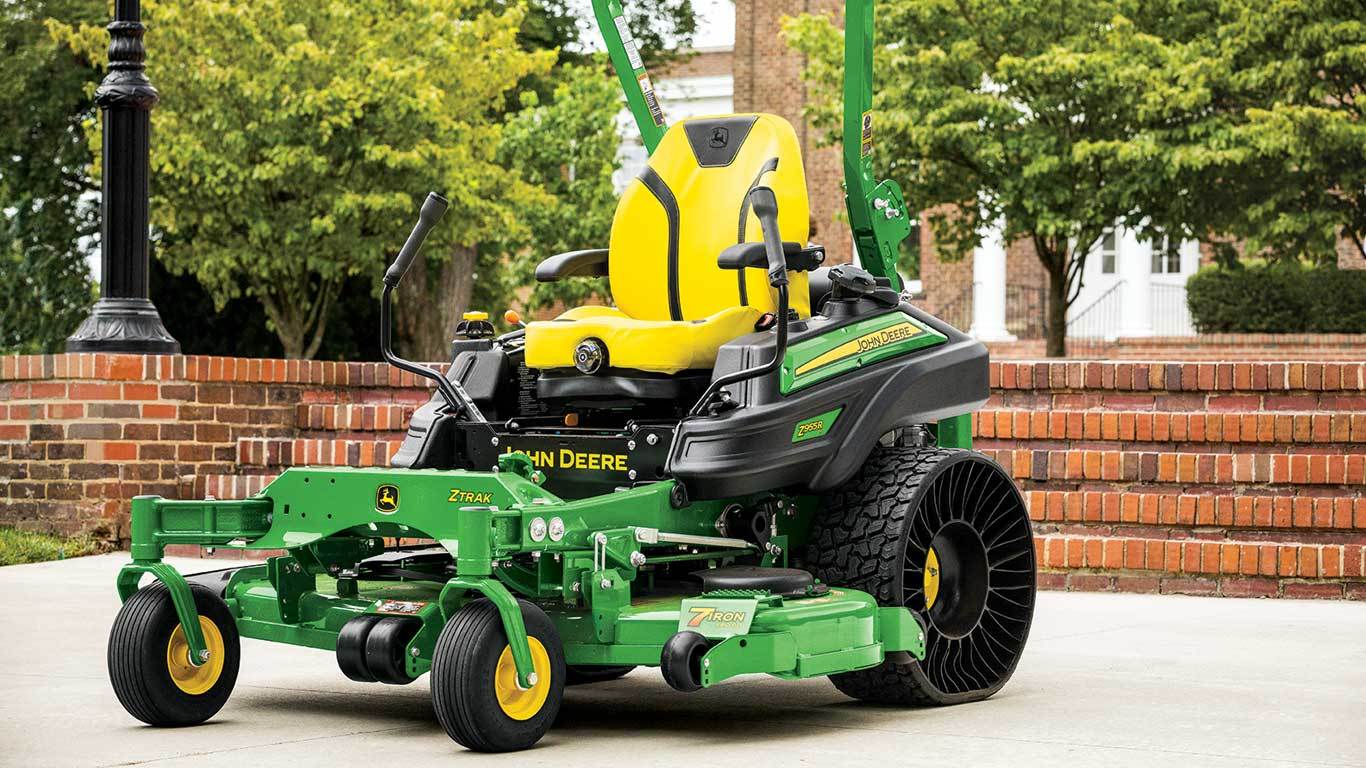
Can You Lift a Zero-Turn Mower?
A zero-turn mower weighing 500 pounds or more should not be lifted by hand. Even several people cannot safely control a heavy mower during a lift, especially on uneven ground.
Use equipment designed for the load, such as:
- A mower lift with a suitable weight rating
- A service jack approved for the mower
- A vehicle or equipment hoist
- A loading ramp rated for the mower
- A professional equipment service
Before lifting, park on a firm, level surface. Turn off the engine, remove the key, set the parking brake, and follow the service manual. Block the wheels if the manual calls for it.
Never place any part of your body under a mower supported only by a hydraulic jack. Use approved stands or mechanical supports before working underneath the machine.
Avoid lifting a mower with a front-end loader, tractor bucket, or improvised chain setup unless the equipment and lifting method are approved for that task. A mower can shift suddenly because its weight is not evenly distributed.

Does More Weight Mean a Better Zero-Turn Mower?
More weight does not automatically mean a better mower. It creates trade-offs.
A heavier zero-turn mower may offer:
- More stability on some slopes
- Better traction in some conditions
- A stronger frame
- A heavier cutting deck
- A smoother feel over small bumps
But added weight can also cause:
- More soil compaction
- Deeper tire marks
- Greater difficulty when loading
- Higher trailer requirements
- More fuel use in some designs
- Increased damage if the mower is driven on unsuitable ground
Weight should be considered with deck design, tire size, hydraulic system, center of gravity, and intended terrain. A lighter mower may be easier to transport and better suited to a residential lawn. A heavier commercial mower may make sense for daily use on large, open properties.

Is a Zero-Turn Mower Heavier Than a Lawn Tractor?
Many zero-turn mowers weigh about the same as comparable lawn tractors, but the answer depends on the models being compared.
A basic lawn tractor may weigh 400 to 600 pounds. A residential zero-turn mower may weigh 500 to 800 pounds. Larger lawn tractors with heavy frames, four-wheel drive, front blades, or collection systems can weigh more than a small zero-turn mower.
Zero-turn mowers often concentrate much of their weight near the rear drive wheels. Lawn tractors distribute weight differently and may include a front engine, transmission, steering system, and hood.
The practical difference is not just total weight. Tire placement and weight distribution affect traction, turning, slope behavior, and ground pressure.

Does Deck Width Affect Mower Weight?
Yes, deck width often affects weight, but it is not the only factor. A wider deck usually contains more steel and may require a stronger frame, larger spindles, and more support hardware.
Typical trends include:
- 34- to 42-inch decks: usually lighter
- 48- to 54-inch decks: moderate weight
- 60-inch decks: often much heavier
- 72-inch decks: usually found on heavier commercial machines
Deck construction matters just as much as width. A thick fabricated 48-inch deck may weigh more than a lighter stamped 54-inch deck.
If transport space is limited, measure the mower’s full width, not only the cutting width. Include the discharge chute, side guards, and any attachments.

Common Mistakes When Estimating Zero-Turn Mower Weight
The most common mistake is using the advertised weight without checking its definition. Avoid these errors:
- Treating dry weight as ready-to-transport weight
- Forgetting the fuel load
- Ignoring a grass catcher or bagger
- Comparing different deck sizes as if they were the same model
- Confusing shipping weight with mower weight
- Using horsepower to estimate total weight
- Overlooking ramps and trailer equipment
- Assuming a larger trailer rating makes every loading method safe
- Placing a heavy mower on a weak utility trailer
- Working under a mower supported only by a jack
When the exact weight is unknown, use the highest manufacturer-listed figure for the model and add a safety margin. If the mower will be transported regularly, verify the complete loaded combination rather than estimating from memory.

Quick Weight Guide
Use this guide for early planning:
- Under 500 pounds: small residential machines
- 500 to 800 pounds: common residential zero-turn mowers
- 800 to 1,100 pounds: heavy residential and smaller commercial models
- 1,100 to 1,500 pounds: large commercial machines
- Over 1,500 pounds: specialized or heavily equipped commercial configurations
These ranges are not a replacement for the model’s specification. They help you choose what to check, especially when planning a trailer or ramp.
Frequently Asked Questions
How heavy is a 42-inch zero-turn mower?
A 42-inch residential zero-turn mower often weighs about 450 to 650 pounds. The exact number depends on the deck material, engine, frame, fuel tank, and seat.
How heavy is a 60-inch zero-turn mower?
A 60-inch zero-turn mower commonly weighs 700 to 1,200 pounds. Residential models are usually near the lower end, while commercial models with fabricated decks and heavy frames can be much heavier.
Can a half-ton pickup tow a zero-turn mower?
A half-ton pickup can often tow a trailer carrying a zero-turn mower, but the safe limit depends on the truck, trailer, hitch, payload, tongue weight, and local rules. Check the truck’s owner’s manual and the trailer’s loaded weight before towing.
How much does a zero-turn mower weigh with a bagger?
A bagger may add roughly 50 to more than 150 pounds, depending on its size and construction. Add the bagger’s listed weight to the mower’s transport weight.
Does a full gas tank add much weight?
Yes. Gasoline weighs about 6.3 pounds per gallon. A 10-gallon tank can add about 63 pounds when full, in addition to the tank and fuel system.
What is the best way to weigh a zero-turn mower?
A vehicle scale or equipment scale is the most reliable option. Weigh the mower in the same condition in which it will be transported, including fuel, attachments, and tools.
Conclusion
Most zero-turn lawn mowers weigh 500 to 1,500 pounds, with residential models commonly falling between 500 and 800 pounds. Commercial machines are often heavier because they use stronger frames, larger decks, bigger engines, and more durable hydraulic systems.
For transport or lifting, do not rely on a general estimate. Find the exact model specification, determine whether it lists dry or operating weight, add fuel and attachments, and check the full capacity of the trailer, ramps, tie-downs, and towing vehicle.