
How Do Electric Lawn Mowers Work: Simple Guide
Introduction
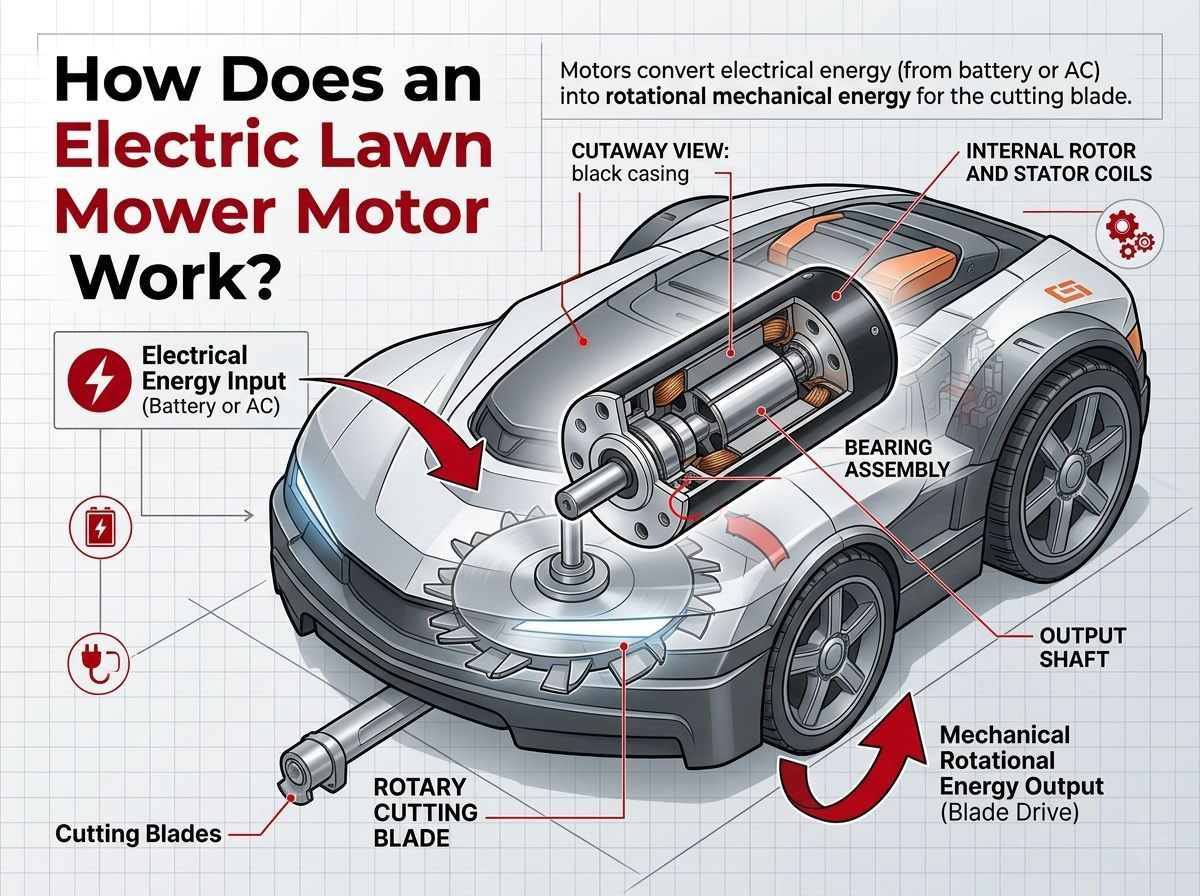
For homeowners in the United States, an electric lawn mower cuts grass with a spinning blade powered by electricity instead of gasoline. Electricity comes from either a rechargeable battery or a wall outlet. That power moves through a controller to an electric motor, which turns the blade beneath the mower deck.
Battery mowers store energy in lithium-ion battery packs. Corded mowers draw power through an outdoor extension cord. Both types use the same basic cutting process, but they differ in range, runtime, weight, noise, and maintenance.

Quick Answer: How Does an Electric Lawn Mower Work?
An electric lawn mower works in five basic stages:
- Electrical power enters the mower. A battery supplies direct current, or a cord supplies alternating current from a household outlet.
- A safety system allows the mower to start. The operator usually holds a bail bar, safety handle, or power button.
- A controller sends power to the motor. The controller manages speed and protects the motor and battery from overload.
- The motor spins a blade. The blade rotates at high speed under the mower deck.
- The deck directs the cut grass. Grass may discharge from the side, collect in a bag, or return to the lawn as mulch.
The mower does not usually use electricity to “cut” grass directly. Instead, electricity creates motion. The spinning blade supplies the cutting force.
Main Parts of an Electric Lawn Mower
The major parts are similar across most battery and corded models, although design details vary by brand and model.
Battery or power cord
A battery-powered mower uses one or more rechargeable battery packs. Most modern cordless mowers use lithium-ion cells because they store a large amount of energy in a fairly small package.
A corded mower uses a power cable connected to an outdoor electrical outlet. The cable carries electricity to the mower while it runs. The mower cannot travel beyond the safe working length of the cord.
Battery management system
Battery models often include a battery management system, or BMS. This system monitors factors such as:
- Cell voltage
- Pack temperature
- Charging status
- Current draw
- Overload conditions
The BMS can reduce or stop power when the battery becomes too hot, too cold, deeply discharged, or otherwise unsafe. The exact protections depend on the battery design.
Motor
The motor changes electrical energy into rotational movement. Electric lawn mowers commonly use one of two motor designs:
- Brushed motors: Use brushes and a commutator to send electricity to the spinning part of the motor.
- Brushless motors: Use electronic controls instead of physical brushes.
Brushless motors are common in newer cordless mowers. They can reduce mechanical wear and allow electronic control of motor speed. A brushless design does not make every mower more powerful or more durable by itself. The battery, motor size, software, blade, deck, and overall build also matter.
Electronic controller
The controller acts as the mower’s power manager. It regulates how much electricity reaches the motor and may respond to changing grass conditions.
For example, when the blade meets thick or wet grass, the motor may slow. The controller can increase current briefly if the battery and system allow it. This feature is sometimes called automatic load sensing or torque management.
More power is not free. Higher motor output uses more battery energy and can shorten runtime.
Blade and mower deck
The blade is attached to the motor shaft or to a spindle driven by the motor. As it spins, its sharpened edge cuts grass blades.
The mower deck surrounds the blade and helps control airflow and grass movement. Its shape affects:
- Cutting quality
- Mulching performance
- Bag filling
- Noise
- Resistance to clogging
- Safety around the blade
Some electric mowers use a single blade. Wider models may use two blades or a different cutting system.
Safety controls
Most walk-behind electric mowers include controls that stop the blade when the operator releases the handle or bail bar. Some models also require a key, button, or battery switch.
These controls help prevent accidental starts. They do not make the mower safe to service while connected to power. Always remove the battery or unplug the cord before clearing a blockage, inspecting the blade, or performing maintenance.

How a Battery-Powered Electric Mower Works
A battery mower stores electrical energy before you begin mowing. The battery sends power to the controller, which delivers it to the motor as needed.
When you press the start button and hold the safety control, the controller checks the start conditions. If the system detects a valid command, it energizes the motor. The motor then spins the blade.
The motor may draw more current in tall or dense grass. It may draw less current on short, dry grass. This is why two mowing sessions of the same length can use different amounts of battery power.
What happens during charging?
A charger converts household AC power into the type of DC power the battery needs. It also controls the charging rate and stops or reduces charging when the battery reaches its designed charge level.
A typical charging cycle includes:
- The charger checks the battery.
- The charger supplies current at a controlled rate.
- The battery voltage rises.
- The charger reduces current near full charge.
- The system ends or maintains the charge according to its design.
Use the charger specified for the battery. A charger that fits the connector may still be electrically incompatible.
Why battery voltage matters
Battery voltage describes the electrical pressure available to the motor system. Common residential mower platforms in the United States include nominal ratings such as 18, 20, 36, 40, 56, and 60 volts. These ratings are not always measured in the same way, so voltage alone does not prove that one mower is stronger than another.
Battery capacity is often listed in amp-hours, or Ah. A rough energy estimate is:
Watt-hours = volts × amp-hours
For example, a hypothetical 40-volt, 5-Ah battery contains about:
40 V × 5 Ah = 200 Wh
Actual usable energy will be lower or different because of voltage behavior, electronic limits, temperature, battery age, and the mower’s load.
Why runtime changes
A battery mower may run for less time when:
- Grass is tall or wet
- The cutting height is too low
- The blade is dull
- The deck is clogged
- The operator travels slowly through heavy growth
- The battery is cold, hot, old, or partly worn
- Self-propelled drive is active
- The lawn includes slopes or rough ground
Manufacturers’ runtime estimates usually depend on stated test conditions. They are not a guarantee for every yard.
How a Corded Electric Lawn Mower Works
A corded mower receives electricity continuously from an outlet. The current travels through the extension cord to the mower’s motor and control system.
The motor converts that electrical energy into blade rotation in the same general way as a battery mower. The main difference is the power source. A corded model does not need battery charging, but it must remain connected to the outlet.
Why extension cords matter
Use an outdoor-rated extension cord with the length and wire size recommended in the mower’s manual. A cord that is too long or too small can cause voltage drop, excess heat, weak performance, or nuisance trips.
Keep the cord behind you and away from the blade. Plan the mowing route before starting. Never mow over the cord, and stop immediately if the cord becomes damaged.
A ground-fault circuit interrupter, or GFCI, is commonly used for outdoor electrical equipment. A GFCI can reduce shock risk by interrupting power when it detects an imbalance. It does not repair a damaged cord or make unsafe use acceptable.
Corded versus battery-powered mowers
| Feature | Battery mower | Corded mower |
|---|---|---|
| Energy source | Rechargeable battery | Outdoor electrical outlet |
| Runtime | Limited by battery charge | Continuous while connected |
| Range | Limited by battery and yard size | Limited by cord length and outlet access |
| Noise | Usually lower than gas models | Usually lower than gas models |
| Maintenance | Battery care and blade service | Cord inspection and blade service |
| Main risk | Damaged battery or improper charging | Cord damage, cuts, and electrical shock |
| Best fit | Small to medium yards within battery range | Small yards near a suitable outlet |
Neither type is automatically right for every U.S. yard. A corded mower may work well for a small, open lawn. A battery model may be easier when trees, beds, fences, or distant areas make cord management difficult.

How the Blade Cuts Grass
The blade cuts grass through a combination of sharp edges and airflow. As it spins, the blade moves through the grass at high speed. The cutting edge severs the leaf.
Many mower blades also create airflow. That airflow can lift grass upright, move clippings through the deck, and help fill a collection bag. A mulching blade and deck may keep clippings circulating so they are cut into smaller pieces.
A blade that is dull, bent, cracked, or badly balanced can reduce cutting quality. It may leave torn-looking grass, create vibration, clog the deck, or increase motor strain.
The mower’s cutting height also affects performance. Cutting too much grass at once increases the load. In overgrown areas, raising the deck and making more than one pass can reduce strain.
Does an Electric Mower Use More Power in Thick Grass?
Yes. Thick, tall, wet, or dense grass generally places more load on the blade and motor. The controller may respond by drawing more current to maintain blade speed.
This affects both performance and runtime. A mower that works well on regularly cut, dry grass may slow down in heavy growth.
For better results:
- Mow when grass is dry, when practical.
- Keep the blade sharp.
- Avoid cutting more than about one-third of the grass height in one pass.
- Raise the deck for very tall grass.
- Clean packed clippings from the underside after disconnecting power.
- Slow down rather than forcing the mower through dense areas.
Some battery mowers automatically adjust motor output. This can help preserve blade speed, but it cannot overcome every limitation in battery capacity, motor design, or blade condition.

What Is the Difference Between Electric and Gas Lawn Mowers?
Electric mowers use an electric motor. Gas mowers use an internal combustion engine that burns gasoline to create mechanical power.
Electric mowers usually have fewer routine service tasks. They do not need engine oil, spark plug replacement, fuel storage, or carburetor service. They still need blade care, deck cleaning, wheel inspection, and other normal maintenance.
Gas mowers may offer longer continuous operation because refueling takes less time than charging in many situations. They can also be useful for large properties or heavy grass, depending on the model. Electric models often offer simpler starting and lower operating noise.
The better choice depends on the lawn, available storage, outlet access, mowing schedule, and willingness to manage batteries or gasoline.
How Much Does It Cost to Run an Electric Lawn Mower?
The electricity cost is usually estimated with this formula:
Operating cost = energy used in kilowatt-hours × electricity price per kilowatt-hour
For a hypothetical example, assume:
- A mower uses 0.8 kWh for one complete mowing session.
- The local electricity price is $0.18 per kWh.
The energy cost would be:
0.8 kWh × $0.18 = $0.144
That is about 14 cents for the electricity used in that example. It does not include battery replacement, charger losses, equipment cost, maintenance, or utility fees.
To estimate energy use from a battery, divide watt-hours by 1,000. A 200-Wh battery contains about 0.2 kWh before accounting for charging losses and usable-capacity limits.
Actual cost varies by local electricity rates and mowing conditions. Check your utility bill for the applicable residential rate.
Electric Lawn Mower Safety
Electric lawn mowers can reduce some hazards linked to gasoline, but they still contain a fast-spinning blade and may involve electrical risks.
Follow the operating manual and these basic precautions:
- Read the mower and battery instructions before use.
- Keep children and other people away from the mowing area.
- Wear sturdy, closed-toe shoes and eye protection.
- Inspect the lawn for rocks, sticks, wire, toys, and other objects.
- Remove the battery or unplug the mower before cleaning or servicing.
- Never place hands or feet near the blade.
- Do not bypass the safety handle, key, switch, or interlock.
- Keep battery packs dry unless the manufacturer states otherwise.
- Charge batteries with the approved charger in a dry, ventilated area.
- Stop using a battery that is swollen, cracked, leaking, unusually hot, or damaged.
- Do not use a damaged extension cord.
- Keep corded mower cables away from water, traffic, and the cutting path.
- Store batteries according to the manufacturer’s temperature and charging guidance.
For electrical safety information, consult the U.S. Consumer Product Safety Commission and the mower manufacturer’s current manual. Local electrical requirements may also apply to outdoor outlets and GFCI protection.

Electric Lawn Mower Maintenance
Electric mowers need less engine maintenance than gas mowers, but they are not maintenance-free.
After each mowing session
- Turn off the mower.
- Remove the battery or unplug the power cord.
- Wait for the blade to stop completely.
- Inspect the deck and wheels.
- Remove grass buildup with a suitable tool.
- Check the blade for damage.
- Store the battery and mower as directed by the manufacturer.
Do not spray water into the motor, battery compartment, controller, or electrical connections unless the manual specifically allows it.
Blade maintenance
A sharp, balanced blade helps the motor work efficiently and improves the cut. Follow the manual for blade removal, sharpening, replacement, and tightening torque.
If the mower vibrates after blade service, stop using it. A bent blade, incorrect installation, damaged adapter, or imbalance may be the cause.
Battery maintenance
Battery life depends on use, heat, storage, charging habits, and cell design. Keep the battery clean and dry. Store it in the temperature range stated by the manufacturer, and do not leave it in a hot vehicle.
Never open a sealed battery pack. Internal lithium-ion cells can create fire, chemical, or electrical hazards if damaged.
Common Electric Mower Problems and Fixes
The mower will not start
Check the following in order:
- Confirm that the battery is inserted correctly or the cord is connected.
- Charge the battery if its indicator is low.
- Insert the safety key if the mower uses one.
- Hold the required safety handle or bail bar.
- Check for a blocked blade only after removing power.
- Look for warning lights or error codes.
- Try an approved battery if the manual permits that test.
If the mower still will not start, stop troubleshooting if wiring, the controller, or the battery appears damaged. Use the manufacturer’s service process.
The mower stops during use
A stop may result from overload, overheating, low battery charge, a blocked blade, or a safety control being released.
Disconnect power before checking the blade or deck. Allow the mower and battery to cool. If the problem keeps returning on normal grass, the mower may need professional inspection.
The mower leaves uncut strips
Possible causes include:
- Dull or damaged blade
- Deck set too high or too low for the grass
- Overlapping passes too little
- Mowing too fast
- Wet or flattened grass
- Motor speed dropping under heavy load
- Uneven wheels or deck
Begin with the blade and cutting height. Replace a damaged blade rather than trying to straighten it unless the manufacturer specifically permits repair.
Runtime is shorter than expected
Check the grass conditions, blade sharpness, deck buildup, self-propelled drive, battery age, and storage temperature. Published runtime figures may use light grass and ideal conditions.
A battery that suddenly loses most of its normal capacity, becomes hot, swells, or shows physical damage should not be used.

How to Choose the Right Electric Lawn Mower
Choose based on the lawn and work pattern, not voltage alone.
| Your situation | Features to consider |
|---|---|
| Small lawn near an outlet | Corded mower, suitable extension cord, GFCI-protected outlet |
| Small to medium lawn | Battery mower with enough usable runtime |
| Large lawn | Larger battery platform, spare battery, or multiple battery packs |
| Tall or dense grass | Strong load handling, adjustable deck, sharp durable blade |
| Slopes or frequent self-propelled use | Drive system, traction, and extra battery capacity |
| Tight storage area | Foldable handle and removable battery |
| Wet climate or frequent damp mowing | Clear water-resistance guidance and careful storage |
| Need for quiet operation | Electric motor, while still checking local quiet-hour rules |
A mower with a larger cutting width may finish sooner, but it can also weigh more and require more motor power. A self-propelled mower reduces pushing effort but uses additional energy.
Before buying, confirm battery compatibility within the manufacturer’s platform. Batteries from different brands are generally not interchangeable, even when their voltage ratings look similar.
Key Takeaways
- Electric lawn mowers use electricity to spin a cutting blade.
- Battery models store energy in rechargeable packs; corded models draw power from an outlet.
- A controller manages motor speed, current, and safety functions.
- Thick, wet, tall grass and self-propelled drive can reduce battery runtime.
- Blade sharpness and deck cleanliness affect cut quality and energy use.
- Remove the battery or unplug the mower before clearing clogs or servicing the blade.
- Choose a mower based on lawn size, grass conditions, terrain, outlet access, and battery needs.
Frequently Asked Questions
Do electric lawn mowers need oil?
No. Electric mowers do not use engine oil because they do not have gasoline engines. They still need blade maintenance, deck cleaning, wheel checks, and other service listed in the manual.
Can an electric mower cut wet grass?
Some models may operate in damp conditions, but wet grass increases clogging, slipping, cutting difficulty, and electrical risk. Follow the manufacturer’s instructions and avoid mowing in unsafe conditions. Never expose a battery or charger to water unless the product is specifically designed for it.
How long does an electric lawn mower battery last?
There are two different meanings of battery life. A charge may last long enough for one mowing session, depending on the mower and conditions. The battery pack itself may remain useful through many charge cycles, but capacity gradually declines with age, heat, use, and storage. The manufacturer’s warranty and battery-care instructions provide the most relevant limits.
Are electric lawn mowers cheaper than gas mowers?
They may cost less to operate because they do not require gasoline or engine oil, but the total cost depends on the mower price, battery packs, electricity rate, maintenance, and eventual battery replacement. Compare the full ownership cost rather than fuel cost alone.
Can an electric mower mulch leaves?
Many models can mulch leaves when fitted with the correct blade or plug and used under the conditions stated in the manual. Heavy leaf buildup can overload the mower. Make shallow passes and stop if the deck clogs.
Why does my electric mower smell hot?
A hot smell may come from a blocked deck, overloaded motor, slipping belt, damaged wiring, or an overheating battery. Turn the mower off, disconnect power, and let it cool. Do not continue using it if the smell returns, smoke appears, or a battery is swollen or damaged.
Conclusion
Electric lawn mowers work by sending electrical power from a battery or outlet through a control system to an electric motor. The motor spins a blade, while the deck manages airflow and grass clippings.
Their simple power system removes many gas-engine tasks, but performance still depends on blade condition, grass height, battery capacity, mower design, and safe operation. Start by measuring your lawn, checking access to an outlet, and estimating how much runtime you need. Then choose a mower and battery system that match those real conditions rather than relying on voltage or advertised runtime alone.


