
How To Manage Cord On An Electric Lawn Mower: Easy Tips
In U.S. yards, the safest way to manage an electric lawn mower cord is to keep the cord behind you and behind the mower at all times. Use a sound outdoor-rated extension cord, connect it to a GFCI-protected outlet, secure it to the mower’s cord retainer, and mow in a pattern that moves away from the outlet. Never let the mower cross over the cord.
Key Takeaways
- Use the cord size and length listed in your mower manual.
- Choose an extension cord marked for outdoor use.
- Plug the mower into a GFCI-protected outlet.
- Keep the cord behind the mower and away from the blade.
- Use the mower’s cord retainer or strain-relief hook.
- Mow away from the outlet, then work back without crossing the cord.
- Stop and unplug the mower before clearing grass, checking the blade, or moving the cord.
- Replace cords with cuts, crushed areas, exposed wires, loose plugs, or heat damage.
Why Cord Management Matters
Cord management prevents three main hazards: cutting the cord, tripping over it, and damaging the mower or outlet. A moving blade can slice through an extension cord in less than a second. This can cause a shock, a short circuit, fire, or damage to the mower.
The cord can also wrap around the mower wheels. If that happens, the mower may pull the cord toward the blade. A loose cord may also catch on shrubs, fences, play equipment, or your feet.
A corded mower has a simple working path:
- The wall outlet supplies power.
- The extension cord carries power to the mower.
- The mower’s motor turns the blade.
- The cord must stay behind the operator and mower during use.
The cord retainer does not hold the full weight of the cord. It reduces strain at the mower plug and helps stop the plug from pulling apart. You still need to guide the cord as you mow.

What You Need Before You Start
Gather the correct cord and inspect the mowing area before connecting power.
Use the Right Extension Cord
Check the mower manual first. It should list the approved cord length and wire size. Wire size is shown as AWG, or American Wire Gauge. A lower AWG number means a thicker wire.
A longer cord causes more voltage drop. A thin cord can also heat up when it carries the mower’s load. The result may be weak cutting power, a warm plug, nuisance breaker trips, or motor damage.
Many corded mowers use a 12- or 14-gauge outdoor extension cord, but this is not a universal rule. Follow the mower maker’s instructions. Do not choose a cord based only on the plug shape.
Look for these markings:
- Outdoor use
- Suitable voltage
- Cord length
- AWG or wire gauge
- A recognized safety mark, such as UL, ETL, or CSA, when available
Do not connect multiple extension cords to reach the lawn. Use one cord of the proper length when possible.
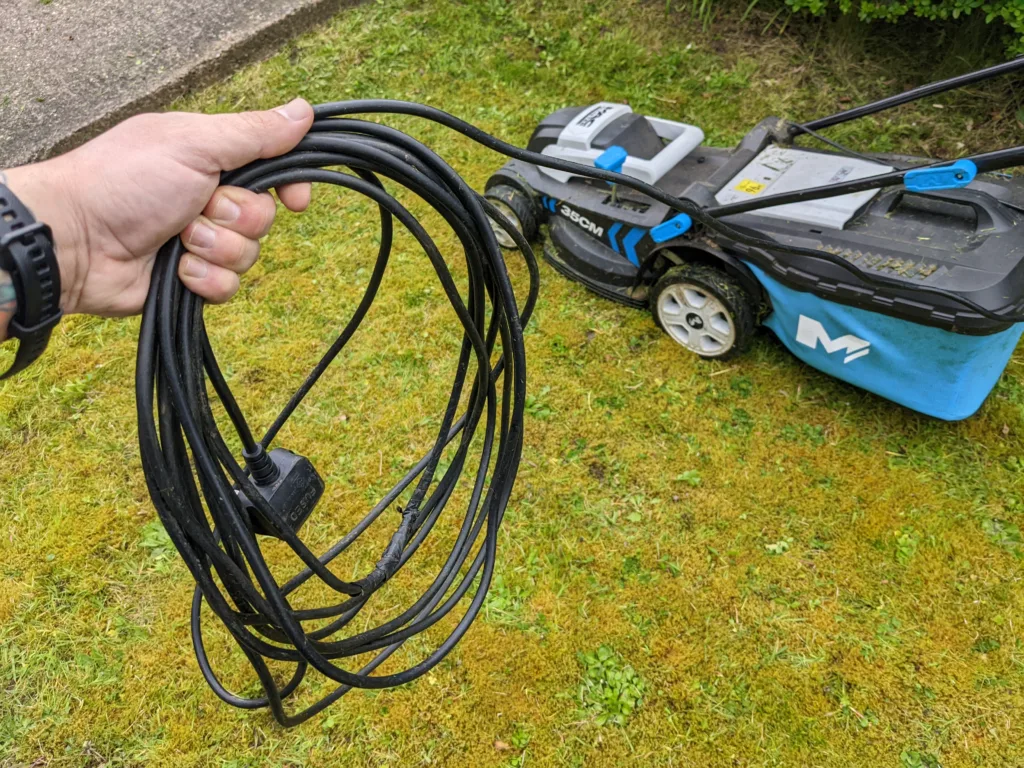
Check the Cord and Plugs
Unplug the cord before inspecting it. Look for:
- Cuts or cracks in the jacket
- Flattened or crushed sections
- Exposed wire
- Burn marks
- Melted plastic
– Loose plugs - Bent prongs
- Corrosion or water inside a connector
Replace a damaged cord. Tape is not a safe repair for a power cord used with a mower.
Confirm GFCI Protection
Use a ground-fault circuit interrupter, or GFCI, for outdoor power. A GFCI can shut off power when it detects current flowing along an unintended path.
The protection may come from:
- A GFCI outlet
- A GFCI circuit breaker
- A portable GFCI device
Press the Test button before mowing. The power should shut off. Press Reset to restore power. If the GFCI will not reset, stop using the setup and find the cause.
Keep plug connections away from standing water, wet soil, sprinklers, and rain. A GFCI reduces risk, but it does not make a damaged cord safe.
Clear the Mowing Area
Remove toys, hoses, branches, stones, and other objects. Move items that may catch the cord. Check the planned route for:
- Fences
- Trees
- Garden beds
- Slopes
- Drainage areas
- Pools and ponds
- Paths and driveways
A clear route makes it easier to keep the cord behind the mower.
How to Manage a Cord While Mowing
Follow this sequence each time you use a corded electric mower.
1. Start Near the Outlet
Place the mower near the outdoor outlet. Keep the mower switched off. Lay the extension cord on the ground in the direction of the first mowing pass.
Do not place the cord across the path you plan to cut. Plan the route before plugging in.
2. Connect the Cord Correctly
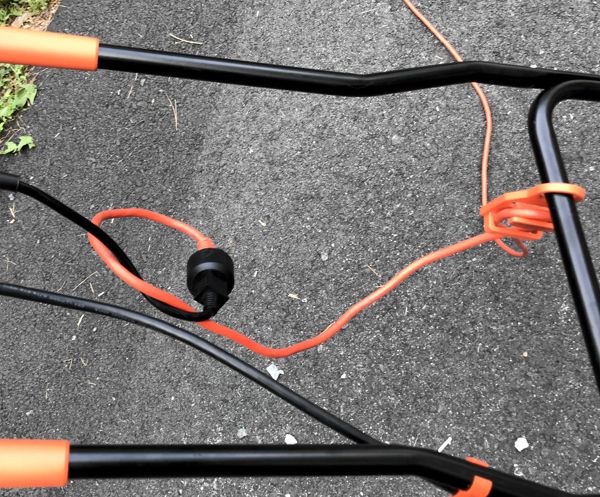
Insert the extension cord into the mower plug. Use the mower’s cord retainer, hook, or strain-relief loop.
Most retainers work by forming a small loop in the extension cord. The loop sits in the hook near the handle. This helps prevent the mower plug from being pulled apart.
Do not force a plug into the retainer. If the cord does not fit, read the mower manual.
3. Keep the Cord Behind You
Hold the mower handle with both hands when the mower is running. The cord should trail behind your body and the mower.
As you move forward, check that the cord follows the same cleared path. Do not allow it to pass beside the mower deck. Do not pull it toward the blade.
A useful rule is simple: the mower should always move away from the cord, not toward it.
4. Mow in Straight, Out-and-Back Passes
Begin at the outlet and mow toward the far edge of the lawn. Then turn and make the next pass back toward the outlet, keeping the cord in the uncut or already cleared area behind you.
A common safe pattern looks like this:
- Start beside the outlet.
- Mow straight away from the outlet.
- Turn at the far end.
- Mow back on the next parallel strip.
- Keep the cord behind the mower.
- Repeat until the section is complete.
The exact pattern depends on the outlet location and lawn shape. The goal is to avoid crossing the cord.
5. Make Wide Turns
Do not spin the mower around sharply over the cord. At the end of each pass, turn in a wide arc. Watch the cord as the mower changes direction.
If the cord becomes tight, stop the mower. Unplug it before moving the cord by hand.
6. Stop Before Crossing a Cord
If the cord blocks your path, switch off the mower and unplug it. Move the cord to a safe position. Reconnect it only after the mower is clear.
Never lift the front of a running mower to move it over the cord. Never drag the mower across the cord.
7. Disconnect Power Before Any Check
Turn off the mower and unplug the extension cord before you:
- Remove packed grass
- Inspect the blade
- Clear a blockage
- Adjust the height
- Move the mower
- Pick up the cord
- Leave the mower unattended
The motor may stop while the blade can still move for a short time. Wait until all movement stops.

The Best Mowing Pattern for Cord Control
The best mowing pattern keeps the cord on one side of the mower and behind the operator. For most rectangular U.S. lawns, straight passes are easier to manage than random turns.
For a Rectangular Lawn
Start at the side closest to the outdoor outlet. Mow toward the opposite edge. Turn and return along the next strip.
This pattern limits sharp turns. It also lets you see where the cord lies.
For an L-Shaped Lawn
Divide the lawn into two smaller sections. Mow one section at a time. Move the cord to the new starting area only when the mower is unplugged.
Do not stretch the cord diagonally across the center of the lawn. That creates a trip hazard and increases the chance of crossing it.
For a Small, Irregular Lawn
Use short, straight passes. Keep the mower close to the open path. If the cord must cross a route, stop and reposition it first.
A simple route is safer than trying to reach every corner from one outlet.
For Slopes
Mow across the face of a slope when the mower manual allows it. This can reduce the chance of losing control. However, the correct direction depends on the mower type, slope, and manufacturer instructions.
Do not use a corded mower on a slope where you cannot control the mower or keep the cord behind you. Wet grass makes slopes more dangerous.
Common Cord Problems and Safe Fixes
Use the symptom to guide your first check. Always disconnect power before touching the cord or mower.
| Symptom | Likely causes | Safe first action |
|---|---|---|
| Mower will not start | Tripped GFCI, loose plug, damaged cord, mower switch issue | Unplug the mower, reset the GFCI, and inspect the cord |
| Mower stops during cutting | Cord pulled loose, overload, blocked blade, tripped breaker | Switch off, unplug, and check the cord and blade area |
| Motor sounds weak | Cord too long, cord too thin, low outlet voltage, packed grass | Use the cord listed in the manual and clear grass only when unplugged |
| GFCI trips often | Moisture, damaged cord, mower fault, overloaded circuit | Stop using the setup and inspect or repair it |
| Plug feels hot | Loose connection, damaged plug, undersized cord, overload | Unplug immediately and replace or repair the faulty part |
| Cord keeps entering the blade area | Poor mowing path, loose retainer, sharp turns | Stop, unplug, secure the retainer, and change the route |
| Cord gets caught on objects | Clutter, shrubs, fence posts, or poor route | Unplug and clear the path before restarting |
Do not keep resetting a breaker or GFCI without finding the cause. Repeated trips can signal a damaged cord, wet connection, motor fault, or overloaded circuit.
If the plug or cord becomes hot, stop using it. Warmth can result from a poor connection or excessive electrical resistance. A hot plug is not normal mower operation.

Cord Storage and Care After Mowing
Good storage helps prevent damage before the next use.
- Turn off and unplug the mower.
- Disconnect the cord from the outlet.
- Check the cord for cuts, heat marks, and crushed areas.
- Wipe off dirt and moisture with a dry cloth.
- Coil the cord in loose loops.
- Store it in a dry, shaded place.
- Keep it away from fuel, sharp tools, heat, and direct sun.
Do not wrap the cord tightly around the mower handle. Tight bends can damage the conductors near the plug.
Do not leave the cord outdoors on wet ground. Do not store it while wet in a sealed box or bag. Let it dry first.
Hang the cord on a broad hook or place it in a loose coil. Avoid small nails, sharp hooks, or tight knots.
Corded Mower Safety Mistakes to Avoid
Avoid these common errors:
Using an Indoor Extension Cord
Indoor cords may not have the insulation needed for outdoor use. They may also lack the right grounding and abrasion protection.
Choosing a Cord Only by Length
A long cord is not automatically suitable. The wire gauge, mower load, and manufacturer limit all matter.
Crossing the Cord “Just Once”
One crossing can be enough to damage the cord. Stop and move it instead.
Mowing Wet Grass
Wet grass can increase slipping risk and expose electrical equipment to moisture. Follow the mower manual and avoid mowing when the grass, ground, cord, or connections are wet.
Pulling the Cord to Move the Mower
Pulling can loosen the plug or damage the cord near the connection. Move the mower by its handle after disconnecting power.
Using a Cord With a Damaged Ground Pin
Never remove the grounding pin to fit an outlet. Do not use an adapter that defeats the grounding system.
Leaving the Mower Plugged In
Unplug the mower when it is not in use. This is especially important before cleaning, transport, storage, or maintenance.
Using a Portable Generator Carelessly
A generator can create special grounding and connection risks. Follow the generator and mower instructions. Never operate a generator in a garage, shed, or other enclosed space because of carbon monoxide.

When to Replace the Cord or Call for Repair
Replace the extension cord when it has exposed wire, deep cuts, melted areas, damaged plugs, or repeated overheating. Use a new cord that matches the mower manual.
Have the mower checked by a qualified repair professional if:
- A known-good cord does not solve the problem
- The GFCI trips with the mower alone
- The motor smells burned
- The plug or mower socket is loose
- The mower sparks
- The motor runs only when the cord is moved
- The blade or motor stops under light grass loads
- The housing has impact damage
Do not open the mower housing unless the manufacturer specifically allows owner service and you can safely complete the work. Electrical repairs can leave hidden shock or fire risks.

Corded Versus Cordless Electric Mowers
A corded mower can work well when the lawn is small and the outlet is close. It avoids battery charging and battery replacement. Its main drawback is cord control.
A cordless mower removes the cutting hazard from a trailing cord. It also requires battery charging and battery care. Runtime depends on the battery, grass height, moisture, mower setting, and cutting conditions.
Choose a corded mower when:
- The lawn is small or simple in shape
- A suitable outdoor outlet is nearby
- You can keep the cord behind the mower
- You do not mind planning the mowing route
Consider a cordless mower when:
- The lawn has many obstacles
- You must cross paths or narrow areas
- The outlet is far away
- Cord control would be difficult or unsafe
Neither type removes the need for safe operation. A cordless mower still has a moving blade and needs the same shutoff and maintenance care.

Frequently Asked Questions
Can I use any extension cord with an electric lawn mower?
No. Use an outdoor-rated cord with the wire size and maximum length listed in the mower manual. A cord that is too thin or too long can cause voltage drop and heat.
Should the cord go in front of or behind the mower?
The cord should stay behind the mower and behind the operator. It must remain away from the blade and wheels.
Can I mow over the cord if the mower is switched off?
Do not do this. The cord may still be connected to power, and the mower could start unexpectedly if the controls are engaged. Unplug the mower before moving it over or near the cord.
Why does my electric mower keep tripping the GFCI?
Possible causes include moisture, a damaged cord, a faulty mower, a blocked blade, or an overloaded circuit. Stop using the mower if the GFCI trips repeatedly. Do not bypass the GFCI.
Is a 12-gauge cord better than a 14-gauge cord?
A 12-gauge cord has thicker conductors and may handle greater loads or longer runs than a 14-gauge cord. It is not automatically the correct choice for every mower. Follow the mower manufacturer’s cord chart.
How should I store an electric mower cord?
Unplug it, inspect it, dry it, and coil it loosely. Store it indoors or in a dry protected area away from heat, sharp tools, fuel, and direct sunlight.
U.S. Safety Sources
The following sources provide general electrical and outdoor equipment guidance. Your mower manual remains the primary source for the mower’s cord size, length, operating limits, and maintenance instructions.
- U.S. Consumer Product Safety Commission: Extension Cord Safety
- U.S. Consumer Product Safety Commission: Outdoor Safety
- Occupational Safety and Health Administration: Electrical Safety
- National Electrical Code information from the National Fire Protection Association
Conclusion
Manage an electric lawn mower cord by planning the route before you start. Use the correct outdoor extension cord, connect through GFCI protection, secure the cord to the mower retainer, and keep the cord behind the mower.
The safest rule is easy to remember: stop and unplug before you move the cord. If the cord, plug, outlet, or mower shows damage or overheating, do not continue mowing until the problem is corrected.


