
How To Mow A Lawn With A Corded Mower: Easy Guide
A corded electric mower can cut a small or medium U.S. lawn well when you plan the route, use the right outdoor extension cord, and keep the power cord behind the mower at all times. Mow only in dry conditions, inspect the mower and cord first, and unplug the mower before clearing grass or working near the blade.
This guide explains how to mow safely and evenly with a corded mower, including cord setup, mowing patterns, slope safety, extension-cord selection, and common problems.

What You Need Before You Start
Gather the mower, its power cord, a compatible outdoor-rated extension cord, and basic safety gear. Read the mower manual before the first use because cord size, cutting height, controls, and approved accessories vary by model.
You will usually need:
- A corded electric mower
- A heavy-duty, outdoor-rated extension cord
- A properly grounded outdoor outlet
- A ground-fault circuit interrupter (GFCI)-protected outlet or portable GFCI
- Closed-toe shoes with good traction
- Eye protection
- Gloves for moving sticks and debris, but not while touching the blade
- A lawn rake or bag for loose debris
- A cord storage hook or reel
Check the mower’s nameplate and manual for its current rating. The manual should also state the approved extension-cord length and wire size.
Choose the Right Extension Cord
Use only a cord marked for outdoor use. Look for a label such as W, W-A, or wording that clearly says “outdoor use.” The cord must have three conductors and a grounding plug unless the mower manufacturer specifically provides another approved design.
A long, thin cord can cause voltage drop. This may make the mower run weakly, heat the cord, or trip the circuit. Use the manufacturer’s cord chart whenever possible. As a general rule, a shorter, heavier cord is better than a long, light cord.
Do not connect multiple extension cords to reach the lawn. A single cord of the correct length reduces connection points and trip hazards.
Inspect the Equipment
Before plugging in the mower, check:
- The power cord for cuts, crushed areas, exposed wires, or loose plugs
- The extension cord for damage, heat marks, or worn insulation
- The mower housing for cracks
- The blade for bends, cracks, or heavy wear
- The wheels for loose parts
- The discharge guard and grass bag for proper installation
- The air vents for packed grass or dirt
Do not use a damaged cord or mower. Tape is not a safe repair for a cut or crushed power cord.
How to Set Up the Corded Mower
Set up the mower at the outlet and plan your route before starting the motor. The main goal is to keep the cord on the part of the lawn you have already cut, away from the mower’s wheels and blade.
Follow these steps:
-
Remove people, pets, toys, stones, sticks, and garden tools from the lawn.
A mower can throw objects at high speed. -
Check the grass and ground conditions.
Avoid mowing wet grass, standing water, mud, or ground with poor traction. -
Place the mower near the outlet.
Leave enough cord length to reach the far edge of the mowing area without pulling the plug tight. -
Connect the extension cord to the mower’s power cord.
Use the mower’s cord-retention hook or connector lock. This helps prevent the plugs from separating. -
Plug the extension cord into the GFCI-protected outdoor outlet.
Do not force a plug into an outlet or remove the grounding prong. -
Lay the cord along the planned route.
Keep it away from walkways, driveways, gates, and other places where someone could trip. -
Start the mower only when the blade area is clear.
Keep both hands on the controls as required by the manual.
Do not leave a plugged-in mower unattended. Unplug it when you stop for a break, move it across a hard surface, or inspect the blade area.

How to Mow a Lawn With a Corded Mower
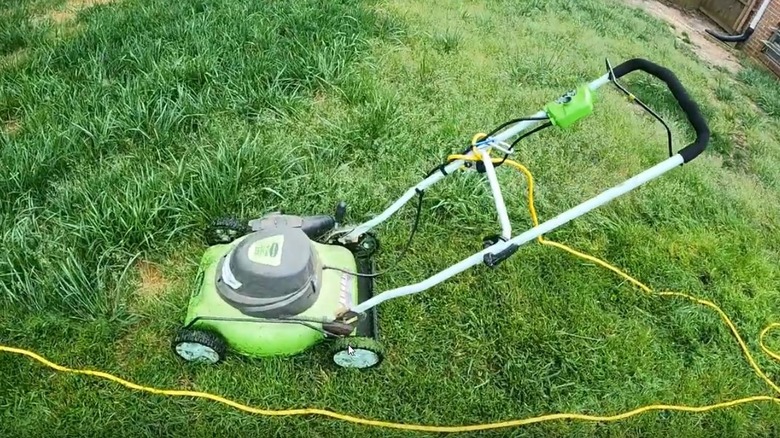
The safest method is to begin near the outlet and mow in straight, overlapping passes. Keep the cord behind you and on the side of the lawn that is already cut.
1. Start at the Farthest Practical Edge
Begin near the outlet, then move toward the far edge of the lawn while keeping the cord behind the mower. Your exact starting point depends on the outlet location and the shape of the yard.
Do not pull the mower farther than the cord can safely reach. If the cord becomes tight, stop the mower, unplug it, and move the connection point. Never jerk the mower or stretch the cord until the plug is under tension.
2. Keep the Cord on the Cut Side
If you mow in rows, keep the cord behind the mower and place it on the side where you have already cut. This simple habit prevents the mower from crossing over the cord.
A useful pattern is:
- Mow one straight strip.
- Turn at the end.
- Move over by a few inches.
- Mow back in the opposite direction.
- Repeat until the section is complete.
Make wide, controlled turns. Avoid sharp turns that can pull the cord into the mower’s path.
3. Overlap Each Pass
Overlap each pass slightly so that narrow strips of grass do not remain between rows. The amount of overlap depends on the mower deck and wheel path. A small overlap is usually enough.
Walk at a steady pace. Pushing too fast can leave uncut grass, while forcing the mower through thick grass can make the motor slow down.
4. Use the Correct Cutting Height
Set the cutting height before you begin. The correct height depends on the grass type, season, shade, and local climate.
A useful rule is to remove no more than about one-third of the grass blade during one mowing session. Cutting much more can stress the lawn and leave large clumps. If the grass is very tall, raise the deck and make a second cut later rather than forcing the mower through all of it at once.
Do not scalp the lawn by setting the deck extremely low. Short grass can expose soil, dry out faster, and become more vulnerable to heat and weeds.
5. Slow Down in Heavy Grass
If the motor slows, the mower sounds strained, or the blade begins to stall, stop pushing forward. Let the blade clear the grass, then continue at a slower pace.
If the mower continues to struggle:
- Raise the cutting height.
- Check whether the grass is wet.
- Inspect the underside after unplugging the mower.
- Clear packed grass from the deck.
- Check the blade for damage or dullness.
- Confirm that the extension cord matches the manual’s requirements.
Never reach under the mower while it is plugged in.
6. Change Directions When Needed
Mowing in the same direction every time can make grass lean and create visible wheel tracks. For a healthier appearance, change the mowing direction from one session to the next.
For example, alternate among:
- North to south
- East to west
- Diagonal passes
Do not change direction if doing so would place the cord in front of the mower. Cord control comes first.
7. Finish Around Edges
A mower may not reach the full edge of a fence, wall, tree bed, or garden border. Use a trimmer or hand tool for those areas, following its safety instructions.
Keep the mower away from drop-offs, retaining-wall edges, ponds, and unstable borders. The mower can lose balance if one wheel leaves a firm surface.

How to Handle the Cord During Mowing
Cord management is the main difference between using a corded mower and using a battery or gas mower. Treat the cord as part of the mowing plan, not as an item to drag behind you at random.
Keep these rules in mind:
- Keep the cord behind the mower.
- Keep it on the already cut side.
- Do not mow across the cord.
- Do not place the cord near the discharge opening.
- Do not let the cord pass under the deck.
- Do not pull the mower by the cord.
- Do not carry the mower while it is plugged in.
- Keep the cord away from hot surfaces, oil, sharp edges, and standing water.
- Disconnect the cord before crossing a driveway, sidewalk, or other hard surface.
If the cord moves in front of the mower, stop immediately. Release the mower control, wait for the blade to stop, unplug the cord, and reposition it.
A Simple Route Example
Suppose the outdoor outlet is at the back of the house. Start near that outlet and mow the nearest strip first. Work outward in long rows while keeping the cord behind you.
When you reach the far edge, turn back along the next strip. The cord should follow the cut area rather than crossing the uncut grass. If the yard shape forces the cord across an uncut section, stop and create a different route before continuing.

How to Mow Slopes With a Corded Mower
Slope safety depends on the mower type, the slope angle, the grass condition, and the manufacturer’s instructions. Read the manual before mowing any incline.
For a walk-behind mower, mowing across a gentle slope is often more stable than walking straight up and down. This reduces the chance of slipping toward the mower. However, do not use this method if it would cause the cord to cross the mower’s path.
Avoid mowing a slope when:
- The grass is wet
- The soil is soft or muddy
- You cannot keep firm footing
- The mower manual prohibits the slope
- The mower feels difficult to control
- The cord would lie downhill in the mower’s path
- There is a drop-off, ditch, wall, or other hazard nearby
Never mow toward a steep drop-off. Keep both hands on the mower and move slowly. If you lose footing, release the mower control and step away from it. Do not try to hold onto a moving mower.

What to Do When the Mower Stops or Trips the Outlet
A mower that stops can have several causes. Start with the safest checks and never work near the blade while the mower is connected to power.
If the Motor Stops Suddenly
- Release the mower control.
- Unplug the extension cord from the outlet.
- Disconnect the mower from the extension cord.
- Wait for all moving parts to stop.
- Check for packed grass, a stick, or another blockage.
- Inspect the cord and plug for damage.
- Check the outlet and GFCI.
- Let the motor cool if it feels hot.
- Restart only after correcting the cause.
Do not repeatedly reset the outlet without finding the reason. A repeated trip can indicate an overload, damaged cord, wet connection, blocked blade, or mower fault.
If the Mower Runs Weakly
Weak power often points to a long or undersized extension cord, a low-voltage circuit, wet or heavy grass, a packed deck, or a dull blade.
Try the following:
- Use a shorter or heavier outdoor-rated cord approved by the manual.
- Raise the cutting height.
- Mow when the grass is dry.
- Reduce your walking speed.
- Clean the underside after unplugging.
- Have the blade sharpened or replaced if the manual permits it.
If the cord or plug becomes hot, stop using the mower. Unplug it and inspect the equipment. A warm connection can signal a poor connection or excessive electrical load.
If the Mower Vibrates
Stop mowing and unplug the mower. Excess vibration may result from a bent blade, loose blade hardware, debris under the deck, or a damaged mower part.
Do not keep mowing to see whether the vibration disappears. Have the mower inspected if you cannot identify and correct the problem using the manual.

How to Clean and Store a Corded Mower
Clean the mower after unplugging it and confirming that the blade has stopped. Remove grass from the deck, wheels, discharge opening, and air vents with a brush or cloth.
Do not spray water into the motor, switch, plug, or electrical connections. Do not turn the mower upside down unless the manual gives a safe procedure. Some models should be tilted only in a specified direction to prevent fluid or debris from entering the motor.
For storage:
- Unplug the mower and extension cord.
- Let the mower cool.
- Coil the cord loosely without sharp bends.
- Store the cord indoors or in a dry, protected place.
- Keep the mower away from rain and snow.
- Store it where children cannot reach the controls.
- Do not hang the mower by its electrical cord.
- Check the blade and hardware before the next use.
Follow the manual for blade sharpening, lubrication, and replacement. If the blade is cracked, badly bent, or loose, do not operate the mower.
Common Corded Mower Mistakes
Avoiding a few common errors makes corded mowing safer and easier.
Mowing Wet Grass
Wet grass can clog the deck, reduce traction, and expose electrical equipment to moisture. Wait until the lawn and surrounding area are dry.
Using an Indoor Extension Cord
Indoor cords may not have the outdoor insulation and construction needed for lawn equipment. Use an outdoor-rated cord that meets the mower manual’s size and length requirements.
Running Over the Cord
Even a brief contact with the blade can damage the cord and create a shock hazard. Keep the cord behind the mower at all times.
Pulling the Mower by the Cord
The cord can separate from the plug or suffer internal damage. Pull and guide the mower by its handle.
Cutting Too Much Grass at Once
Very tall grass can overload the motor and leave wet clumps. Raise the deck and cut in stages if necessary.
Mowing Without Clearing the Lawn
Stones, wire, toys, and branches can become dangerous projectiles. Walk the area first and remove anything the blade could strike.
Reaching Under a Plugged-In Mower
The blade can move unexpectedly on some models. Unplug the mower before removing grass, checking the blade, or adjusting the deck.
Using a Damaged Cord
Do not use a cord with exposed conductors, cuts, melted areas, loose plugs, or crushed insulation. Replace it.

Corded Mower vs. Battery Mower: Which Is Better for Your Yard?
A corded mower can suit a yard with a nearby outdoor outlet and a simple layout. It does not need battery charging or fuel, but the cord limits movement and requires careful route planning.
| Factor | Corded electric mower | Battery electric mower |
|---|---|---|
| Power source | Outdoor outlet and extension cord | Rechargeable battery |
| Main limit | Cord length and cord placement | Battery run time and charging |
| Setup | Requires cord routing | Requires charged battery |
| Yard layout | Best with a clear route | Better for complex layouts |
| Maintenance | Low, but cord inspection matters | Low, with battery care |
| Noise and exhaust | Low noise and no direct exhaust | Low noise and no direct exhaust |
| Key safety issue | Avoiding cord contact and trips | Battery, blade, and charging safety |
The better choice depends on the yard. A corded mower may work well for a compact, open lawn. A battery mower may be more practical where trees, beds, gates, or separate lawn sections make cord control difficult.

Signs You Mowed Correctly
Your mowing job is likely on track when:
- The grass has an even height.
- There are no uncut strips between passes.
- The lawn has few or no clumps.
- The mower did not struggle or overheat.
- The cord remained behind the mower.
- No cord, plug, or outlet became hot.
- The lawn surface was not torn or scalped.
- The mower deck and wheels are free of packed grass.
- The grass looks upright rather than heavily flattened.
A small amount of grass clippings is normal. If clumps cover the lawn, mow more often, wait for dry conditions, raise the deck, or slow your pace.
Frequently Asked Questions
Can you mow wet grass with a corded electric mower?
No. Wait until the grass and ground are dry. Wet conditions can reduce traction, clog the mower, and increase the risk associated with electrical equipment.
Can you use any extension cord with a corded mower?
No. Use an outdoor-rated, grounded extension cord that matches the mower manufacturer’s required wire size and maximum length. A cord that is too long or too light may cause voltage drop and overheating.
How do you keep the mower from running over the cord?
Keep the cord behind you and on the side of the lawn that you have already cut. Mow in straight, overlapping rows and stop immediately if the cord moves in front of the mower.
Should the cord be plugged into a GFCI outlet?
Use a GFCI-protected outdoor outlet or portable GFCI, and follow local electrical requirements and the mower manual. A GFCI can help reduce shock risk by interrupting power when it detects an imbalance, but it does not make damaged equipment safe.
How often should you mow?
Mow when the grass needs it rather than following one fixed calendar. Cut no more than about one-third of the grass height at a time. Growth rate changes with grass type, rainfall, temperature, and season.
What should you do if the mower keeps tripping the outlet?
Stop using it and unplug it. Check for wet conditions, a blocked deck, a damaged cord, an undersized extension cord, or an overloaded circuit. If the problem continues after safe checks, have the mower or electrical circuit inspected by a qualified professional.
Key Takeaways
- Use a dry lawn, outdoor-rated extension cord, and GFCI-protected outlet.
- Check the mower, blade, plug, and cord before every use.
- Plan a route that keeps the cord behind the mower.
- Never mow across, over, or near the cord.
- Mow slowly in straight, overlapping passes.
- Cut no more than about one-third of the grass height at once.
- Unplug the mower before clearing grass or inspecting the blade.
- Stop using the mower if the cord becomes damaged or hot.
Conclusion
To mow a lawn with a corded mower, plan the route from the outlet, choose the correct outdoor extension cord, and keep that cord behind the mower on the cut side. Work only in dry conditions, use steady overlapping passes, and unplug the machine before clearing blockages or checking the blade.
Before your next mowing session, read the mower manual, test the GFCI, inspect the cord, and walk the lawn to remove objects that could become hazards.


