
How To Remove Lawn Mower Deck For Cleaning: Easy Guide
Removing a lawn mower deck for cleaning is one of the best ways to stop thick grass, mud, and clippings from building up under the machine. A clean deck helps air move around the blade and can make mowing feel smoother. It also gives you a clear view of the blade, belt, pulleys, rust, and other parts that are easy to miss from above.
The job is different for a push mower, self-propelled mower, riding mower, and zero-turn mower. Some walk-behind mowers do not need full deck removal at all. Many riding mowers do, especially when you need to clean the top of the deck, change the belt, sharpen blades, or inspect the deck wheels. This guide explains how to remove a lawn mower deck safely, what tools you need, and when it is better to hire a repair shop.

Quick answer: the safest way to remove a mower deck
The safest way to remove a lawn mower deck is to park the mower on a flat surface, shut off the engine, let hot parts cool, disconnect the spark plug wire or remove the battery, and follow the owner’s manual for belt and linkage removal. Lower the deck, remove the pins or bolts that hold it to the frame, slide it out carefully, and clean it with a plastic scraper, brush, and low-pressure water if the manual allows it.

For a riding mower or zero-turn mower, plan on 30 to 90 minutes for the first attempt. A walk-behind mower deck may stay attached during cleaning, but the mower must be tipped only in the direction listed in the manual. Never reach under a mower with the spark plug connected or the battery installed.
Know which mower deck you have
A mower deck is the metal or plastic housing around the cutting blade or blades. It directs grass clippings and protects the operator from the spinning blade. The removal process depends more on mower design than on engine size.
Walk-behind push and self-propelled mowers
Most push mowers and self-propelled mowers have a fixed deck. The deck is part of the main mower body, so it is not usually designed for quick removal. “Self-propelled” means the mower uses engine or battery power to turn its wheels while you guide it.
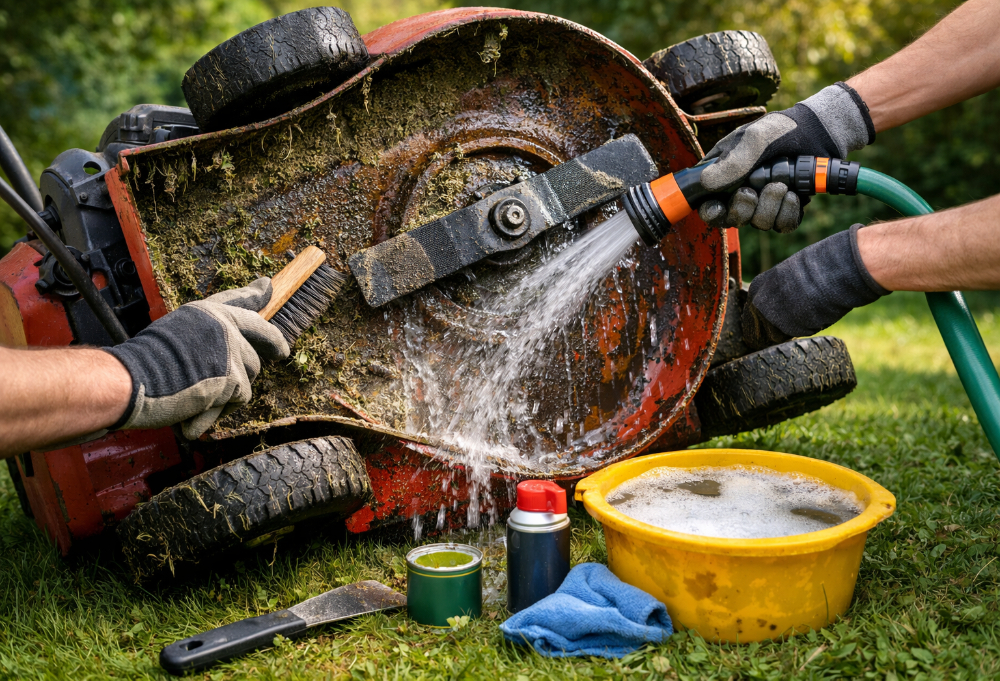
For these mowers, cleaning often means disconnecting the spark plug or battery, tipping the mower safely, and scraping the underside. Gas mowers should usually be tipped with the air filter and carburetor side facing up. Check your manual first. Oil or fuel can move into places that cause hard starting.
Riding mowers
A riding mower has a removable cutting deck under the operator’s seat. It may have one, two, or three blades. The deck connects to the frame with pins, clips, hangers, rods, and a belt.
A riding mower deck is often easier to remove than it looks. The challenge is remembering the belt path and the order of the clips. Take clear photos before removing anything. A phone camera can save you from guessing later.
Zero-turn mowers
A zero-turn mower uses two drive levers and can turn within its own length. Its deck often has several hangers and a large drive belt. It may be heavy, wide, and harder to slide out than a lawn tractor deck.
Zero-turn decks suit large, open yards with few obstacles. They are not ideal for every homeowner, senior, or small storage shed. If you cannot safely lift or slide the deck, ask another adult for help or use a repair shop.
Electric and battery mowers
Battery mowers use a battery pack instead of gasoline. Remove the battery before service. Do not assume the mower is safe just because the motor is quiet. A battery-powered blade can start if the safety key, switch, or battery remains connected.
Corded mowers need extra care. Unplug the power cord and keep it well away from water. A corded mower can suit a small yard near an outlet, but it is not a good choice for deck cleaning in wet conditions.
The chart below shows the usual approach for each mower type.
| Mower type | Usual deck-cleaning method |
|---|---|
| Push or self-propelled | Keep the deck attached and clean from below after removing power |
| Riding mower | Lower, disconnect, and slide the deck out from the side |
| Zero-turn mower | Follow the manual for belt release, hanger removal, and safe deck access |
| Robotic mower | Remove the battery or charging connection and follow the model’s service steps |
The main takeaway is simple: riding and zero-turn decks are built for removal, while walk-behind decks often are not. If the manual does not show deck removal, do not force bolts or bend the frame.
Tools and materials you will need
The best tools are basic hand tools, not high-power equipment. You need enough to remove clips and bolts without rounding them. You also need safe cleaning tools that will not gouge the deck or damage wiring.

Basic tool list
Gather the tools before you begin. This keeps the mower from sitting half apart while you search for a socket or replacement clip.
| Tool or material | Why you may need it |
|---|---|
| Owner’s manual | Shows belt routing, deck pins, torque, and lifting points |
| Socket set and ratchet | Removes blade, hanger, and guard bolts |
| Combination wrenches | Helps reach nuts in tight spaces |
| Pliers or needle-nose pliers | Removes cotter pins and retaining clips |
| Work gloves | Protects hands from sharp steel and blade edges |
| Safety glasses | Blocks dirt, rust, and grass from your eyes |
| Plastic scraper | Removes packed clippings without deep scratches |
| Stiff nylon brush | Cleans dried grass and mud |
| Wooden block | Stops a blade from turning during blade work |
| Drain pan or cardboard | Catches loose dirt, oil, or water |
| Phone or masking tape | Marks belt routes and connector locations |
You may also need penetrating oil for rusty fasteners, a torque wrench for blade bolts, a small wire brush, and a deck support stand. Do not use a jack or stand unless it is rated for the mower’s weight.
Cleaning supplies
A mild dish soap solution can help remove oily grass. A garden hose may work on a steel deck after the deck is removed, but use low pressure. Avoid spraying sealed bearings, electric connectors, control panels, or the engine.
Do not use a pressure washer on a mower deck unless the manufacturer clearly allows it. High-pressure water can force grit past seals and push moisture into bearings. It can also remove paint and speed up rust.

A clean bucket, old towels, and a small amount of rust-inhibiting spray can help finish the job. Keep sprays away from belts and pulleys. A slippery belt can jump off during mowing.
Safety and preparation before removal
The first step is not removing a bolt. It is making the mower unable to start. Blades can coast after shutdown, and some machines can start if a control is moved while power remains connected.

Make the mower safe
Follow this order unless your manual gives a different procedure:
- Park on a flat, firm surface.
- Set the parking brake.
- Turn off the engine.
- Remove the ignition key.
- Let the engine, muffler, and deck cool.
- Disconnect the spark plug wire on a gas mower.
- Remove the battery and safety key on an electric mower.
- Close the fuel valve if the mower has one.
- Keep children and pets away.
- Read the deck-removal section in the manual.
Push the disconnected spark plug wire away from the plug so it cannot touch the terminal. On some engines, it is wise to disconnect the negative battery cable as well. Never rely only on the ignition key.
⚠️ Safety Warning: Wear safety glasses, hearing protection when using power tools, closed-toe shoes, and work gloves. Clear sticks and stones first. Never work under a raised mower that is supported only by a jack.
Check the ground and weather
A dry, level driveway or garage floor works best. Wet grass can make the mower slide. A slope increases the risk of a rollaway mower or falling deck.
Do not clean a gas mower near an open flame, water heater, cigarette, or space heater. Never refuel a hot engine. Store gasoline only as local rules and the fuel container label allow.
Take photos and label parts
Take photos from both sides of the mower before removing the deck. Include the belt route, spring locations, wire clips, and the position of each hanger.
Place pins and washers in small bags. Label them “front,” “left,” and “right.” Many clips look similar but are not interchangeable. A few minutes of labeling can prevent an hour of trial and error.
How to remove a riding mower deck
The general process below applies to many lawn tractors, but the exact pin locations vary. Use your model manual for the final order. Some decks come out from the left side. Others need the mower driven over a ramp or lifted with approved equipment.

1. Set the deck to its lowest height
Move the cutting-height lever to the lowest setting. This takes tension off some lift parts and creates more room for removal.
Some models need the deck raised first to release a belt keeper. Do not guess. Look for the decal or manual diagram that shows the correct position.
2. Remove the mower deck drive belt
The deck belt transfers engine power to the blade pulleys. It may be called a PTO belt or deck belt. On many lawn tractors, you must release the belt from the engine pulley before removing the deck.
Place the transmission in neutral and set the parking brake. If the manual says to disengage the PTO, do so with the engine off. Remove belt guards only if needed, and keep each screw in a labeled container.
Never pry a belt off a pulley with a screwdriver while the engine is running. Turn a pulley by hand only after all power is disconnected. Watch your fingers near pinch points.
3. Disconnect the front link
The front link supports the front of the deck. It may use a retaining clip, washer, and pin. Remove the clip with pliers, then slide out the pin.
Support the deck with one hand or a low platform before pulling the pin. A deck can drop suddenly when the last support is removed.
4. Remove the rear suspension arms
Most riding mower decks have rear hangers on both sides. Remove the retaining clips and washers, then pull out the support pins.
Keep the left and right hardware separate. If a pin is stuck, apply penetrating oil and wait a few minutes. Do not hammer hard against a thin deck bracket.
5. Disconnect the lift rod and anti-sway bar
The lift rod connects the deck to the height lever. Some decks also have an anti-sway bar that keeps the deck stable as you turn.
Remove the clips and slide the rods free. Take another photo before moving them. Bent rods, missing washers, and loose clips can cause an uneven cut after reassembly.
6. Slide the deck out
Move the deck slowly from under the mower. Turn the steering wheel if the front wheels block the path. Keep your fingers away from the space between the deck and mower frame.
A 42-inch deck may be manageable for one strong adult, but a 48- or 54-inch deck can be awkward and heavy. Get help instead of dragging it across your feet or dropping it on its edge.
7. Place the deck on a stable work surface
Set the deck on a workbench, sawhorses, or a clean section of driveway. Keep the blade side facing up only if the deck is stable. Do not balance it on a narrow edge.
If you plan to remove blades, use a wooden block to stop rotation. The blade edge may still be sharp even when it looks dull.
8. Clean the underside and top
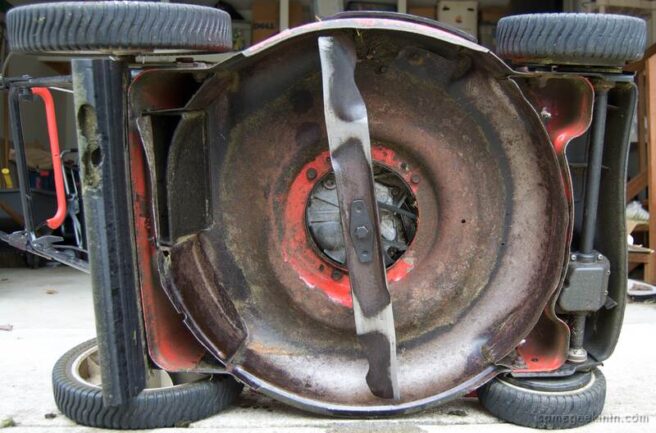
Scrape off thick grass first. Work from the outside toward the center. Use a nylon brush for dried clippings around the blade spindles and discharge chute.
Rinse with low pressure if allowed by the manual. Dry the deck fully before inspecting it. Water left around spindle bearings can lead to noise and early wear.
9. Inspect the deck
Look for cracks near the spindle mounts, rust holes, bent edges, loose pulleys, and worn belt keepers. Check the blade bolts, spindle housings, idler pulley, and deck wheels.
Grass buildup can hide a small crack. A damaged deck may vibrate, cut unevenly, or throw debris. Do not weld a load-bearing area unless you understand the repair and the metal condition.
10. Reinstall the deck
Slide the deck back under the mower. Reconnect the rods and hangers in reverse order. Install every washer and retaining clip.
Route the belt exactly as shown in your photos and manual. Make sure the belt sits inside or outside each guide as designed. A belt in the wrong position can rub, jump off, or fail quickly.
Set the deck height, engage and disengage the PTO by hand if the manual permits, and check that the blades turn freely. Reconnect the spark plug wire or battery only after all tools are clear.
How to clean a walk-behind mower deck
Most walk-behind mower decks stay attached. Cleaning one is still useful, but tipping the mower the wrong way can cause engine trouble.

Prepare a gas push mower
Remove the spark plug wire and key. If the mower has a fuel shutoff, close it. Emptying the fuel tank is safer if the manual recommends tipping or if the tank is full.
Check the air filter and carburetor location. Many gas mowers should be tipped with the carburetor and air filter facing upward. This helps reduce the chance of oil or fuel entering the filter and intake.
Tip the mower carefully
With help, tilt the mower only as far as needed to reach the underside. Do not place your hands near the blade. Use a wooden block to prevent the blade from turning if the manual allows blade service in that position.
Some modern mower manuals recommend lifting the front instead of laying the mower on its side. Follow the exact instruction for your model.
Scrape, brush, and rinse
Use a plastic scraper for heavy clumps. A stiff nylon brush works well around the blade adapter and deck edges. Avoid using a metal chisel, which can create deep grooves where wet grass later sticks.
If the mower has a washout port, connect a garden hose only as directed. A washout port is designed to send water under the deck while the blade spins, but it does not replace normal scraping. Never stand near the discharge opening during this process.
Dry and protect the deck
Let the mower dry in a well-ventilated place. Wipe water from the deck and check the blade for nicks. A light coat of mower-deck protectant can help clippings release, but do not spray the blade edge, belt, brake parts, or electrical parts.
Clean the air filter area before reconnecting the spark plug. If the filter is wet or dirty, service it according to the manual.
Cleaning and inspection checklist
Cleaning is more than removing green material. It is a chance to find parts that may fail during the next mowing session.

| Inspection point | What to look for |
|---|---|
| Deck shell | Cracks, rust holes, dents, and sharp bent edges |
| Blades | Nicks, bends, heavy wear, and loose mounting bolts |
| Spindles | Side-to-side play, rough turning, or grinding noise |
| Belt | Fraying, glazing, cracks, and loose fit |
| Idler pulley | Wobble, noise, or a seized bearing |
| Deck wheels | Uneven wear, loose bolts, or broken brackets |
| Discharge chute | Packed grass, cracks, and a damaged guard |
| Washout port | Blockage or a missing cap |
Takeaway: blades, belts, and spindle bearings often wear before the deck shell does. Replace parts by the exact model number, not by appearance alone.
Check blade condition
A mower blade should have a solid shape without a large bend or deep crack. Small nicks can sometimes be sharpened. A bent blade should be replaced rather than hammered straight.
Do not sharpen a blade while it is attached to the mower. Remove it, clamp it firmly, and keep the original balance. An unbalanced blade can create vibration that damages spindle bearings.
Check the belt and pulleys
A belt with shiny sides may be slipping. Cracks, missing ribs, frayed edges, or a strong burnt smell are signs to replace it. Confirm the belt part number in the manual.
Spin each pulley by hand. It should turn without grinding. A pulley that wobbles or stops quickly may need service.
Look for rust and deck damage
Surface rust can often be brushed away and sealed with touch-up paint. Deep rust around spindle mounts or hanger brackets is more serious.
A deck that flexes, leaks light through a hole, or has a broken weld may be unsafe. A local mower shop can tell you whether repair is sensible or whether a replacement deck is more practical.
Common mistakes and how to avoid them
Most deck-removal problems come from rushing, poor labeling, or using the wrong support. The table below covers mistakes that affect first-time homeowners and experienced DIY users alike.

| Common mistake | Better approach |
|---|---|
| Working with the battery or spark plug connected | Disconnect power before touching the deck |
| Forgetting the belt path | Photograph and draw the route first |
| Using a pressure washer | Use a scraper, brush, and low-pressure water |
| Supporting the mower on unstable blocks | Use approved stands or a firm work surface |
| Mixing clips and washers | Label parts by location |
| Pulling a stuck pin with extreme force | Apply penetrating oil and check for tension |
| Replacing a blade by appearance | Match the exact part number and rotation |
| Tilting a gas mower the wrong way | Follow the manual’s tipping direction |
| Reusing damaged retaining clips | Install new clips when they are bent or loose |
The biggest lesson is to remove tension before force. If a pin will not move, another rod, belt, or bracket may still be holding pressure against it.
How long the job takes and what it costs
A first-time deck removal often takes 45 to 90 minutes on a riding mower. An experienced owner may finish in 20 to 45 minutes when the fasteners are clean and the manual is clear.
| Job level | Typical time | Likely cost |
|---|---|---|
| Basic cleaning with deck attached | 20–40 minutes | Little or no cost |
| Riding mower deck removal and cleaning | 45–90 minutes | Cleaning supplies or shop labor |
| Cleaning plus blade service | 60–120 minutes | Blades, hardware, or sharpening |
| Rust, belt, or spindle repair | 1–3 hours | Parts plus possible shop labor |
The cost rises when bolts are seized, the belt is damaged, or the deck has hidden cracks. Cleaning yourself can save labor money, but only if you can support and reinstall the deck safely.
When should you remove the deck?
You do not need to remove the deck after every mowing session. A quick scrape after dry mowing may be enough for a small yard. Full removal makes more sense when you need access to parts or when buildup is thick.

Remove the deck for cleaning when:
- Grass forms a hard layer that blocks the discharge path.
- You need to sharpen or replace multiple blades.
- The mower vibrates during operation.
- The deck belt slips or squeals.
- A spindle makes a grinding sound.
- You need to inspect rust near blade mounts.
- The mower cuts lower on one side.
- The deck must be painted or repaired.
- Wet grass has dried into a thick mat.
- You are preparing the mower for long-term storage.
Wet climates and heavy, fast-growing turfgrass create more buildup. During drought, dry dust may collect around the spindle and belt area instead. Both conditions justify regular inspection.
Cleaning schedule by yard and mowing conditions
The right schedule depends on grass, soil, and weather. A small suburban yard with dry turf needs less deck cleaning than a large yard cut after spring rain.

| Yard condition | Suggested cleaning habit |
|---|---|
| Small, dry lawn | Brush or scrape after several mowing sessions |
| Thick cool-season grass | Inspect the deck every one to two weeks |
| Wet or humid climate | Clean sooner after mowing wet clippings |
| Sandy soil | Check blades and spindles often for wear |
| Hilly lawn | Inspect deck hardware for vibration and impact |
| Large acreage | Remove and service the deck several times per season |
Never mow wet grass on a slope. Wet turf can reduce traction, and a riding mower can slide or overturn. Waiting for dry conditions protects both the lawn and the operator.
Beginner tips for easier deck removal
A first deck-removal job feels like a puzzle because the parts are hidden under the mower. Break it into small steps.

Use the manual and a phone
Search the manual for “mower deck removal,” “PTO belt,” “deck suspension,” and “blade service.” A parts diagram can show where each washer and clip belongs.
Take a photo before and after every major step. If a spring moves, photograph its old position. This habit helps new homeowners and family members who are helping an older mower owner.
Work from the outside in
Clean the deck edges first. Then clear the discharge chute. Finish around the blade spindles. This keeps loose grass from falling back into areas you already cleaned.
Do not chase a spotless finish if the deck is structurally sound. The main goals are open airflow, visible parts, and safe operation.
Use a support, not your body
A deck can weigh more than it appears. Use a low platform, sturdy sawhorses, or a manufacturer-approved deck support. Ask for help with wide decks.
A senior homeowner may be able to handle the photos, labels, and light cleaning while another person handles lifting. That is a smart division of work, not a failure.
Check deck level after reassembly
After reinstalling the deck, measure the blade tips according to the manual. A level deck helps keep the cut even. Check tire pressure too, because unequal tire pressure can look like a deck problem.
For lawn striping, the mower must be stable and the deck must be set correctly. Striping is the visible pattern made when grass blades bend in different directions. It does not fix an uneven deck.
When a professional should handle the job
Deck removal is a reasonable DIY task when the mower is supported well and the fasteners are accessible. It is not worth risking an injury to save a repair fee.

Call a repair shop if:
- The deck is too heavy for you to move safely.
- The mower has a hydraulic lift or complex electronic controls.
- A spindle housing is cracked.
- A blade bolt will not release.
- The deck frame is badly rusted.
- The mower was in a rollover or major impact.
- You cannot identify the correct belt route.
- You lack a safe lift or support stand.
- The engine or fuel system also needs repair.
A professional can also check blade balance, spindle runout, deck level, and belt tension. For a high-value zero-turn mower, proper service may cost less than damage caused by an incorrect repair.
Storage and environmental care
Clean the deck before storing the mower for a long period. Dried clippings hold moisture against steel and can speed up rust. Store the mower in a dry shed or garage with room around the deck and engine.
For gas mowers, follow the manual on fuel draining or fuel stabilizer. A fuel stabilizer helps reduce fuel breakdown during storage, but it does not repair old gasoline. Store fuel only in an approved container and follow local fire rules.
For battery mowers, remove the battery and store it as the manufacturer directs. Do not leave lithium-ion batteries in extreme heat, freezing conditions, or direct sun. Recycle old batteries at a designated drop-off site.
🌿 Eco or Disposal Note: Do not pour gasoline or oil onto soil or down a drain. Take old fuel and oil to a household hazardous-waste site. Recycle lithium-ion batteries through an approved program, and donate or recycle usable mowers when replacement makes more sense than repair.
What to do if the mower still cuts poorly
A clean deck helps, but it cannot solve every cutting problem. Cutting height, blade sharpness, tire pressure, grass moisture, and mower speed also matter.
If the mower leaves strips of uncut grass, inspect the blades first. A dull or bent blade is common. If the cut is lower on one side, check tire pressure and deck level.
If the mower clumps grass, the turf may be wet, the deck may be packed, or the mower may be moving too fast. Mulching means cutting clippings into small pieces so they return to the lawn. A mulching kit, correct blade, and dry grass are needed for that system to work as designed.
Side discharge sends clippings through a chute. A grass catcher collects them. Neither system works well when the chute or deck is blocked.
Affiliate disclosure
This article may contain affiliate links. If you buy a product through one of these links, we may earn a commission at no extra cost to you. Product prices, specifications, compatibility, and availability can change. Confirm the mower model, deck size, belt type, blade number, battery voltage, and replacement part number on the product page and in the owner’s manual before buying.
FAQs
Q: Can I remove a lawn mower deck without a lift?
A: Many riding mower decks can slide out after the mower is parked on a flat surface and the deck is lowered. You may not need a lift, but you still need a safe way to support the deck. Never place your body under a mower supported only by a jack.
Q: Do I need to remove the deck to clean a riding mower?
A: Not for light cleaning. You can scrape some buildup from the underside while the deck remains attached. Remove it when you need to clean the top, inspect the belt, service the spindles, sharpen several blades, or repair rust.
Q: How do I clean a push mower deck without removing it?
A: Disconnect the spark plug wire or remove the battery. Follow the manual for tipping direction, then scrape grass with a plastic tool and brush the deck with a nylon brush. Use low-pressure water only if the manual allows it.
Q: Can I pressure-wash a mower deck?
A: It is usually better to avoid a pressure washer. High-pressure water can damage bearings, seals, paint, belts, and electrical parts. A scraper, brush, mild soap, and low-pressure rinse are safer choices.
Q: Which way should I tip a gas lawn mower?
A: The correct direction varies. Many models should be tipped with the air filter and carburetor facing upward, but your owner’s manual is the final authority. Tipping the wrong way can move oil or fuel into the filter and intake.
Q: Why will my mower deck belt not come off?
A: The belt may still have tension, a belt keeper may be blocking it, or the deck may not be in the required height position. Check the manual and inspect all pulleys before using force. Never work near the belt with the engine, spark plug, or battery connected.
Q: How often should I clean under my mower deck?
A: Check it every few mowing sessions and clean it whenever grass begins to form a thick layer. Clean sooner when mowing wet grass, dense turf, or in a humid climate. A quick inspection after each long mowing session can prevent bigger problems.
Q: Is it safe to hose off a battery mower?
A: Do not spray a battery mower unless the manufacturer allows it. Remove the battery first and keep water away from switches, charging ports, connectors, and the motor housing. Wipe the machine with a damp cloth when the manual does not approve rinsing.
Q: Should I sharpen the blades while the deck is off?
A: You can, if the blade is removed safely and the manual allows it. Wear gloves, secure the blade, preserve its cutting angle, and check its balance. Replace a bent or cracked blade instead of trying to reshape it.
Q: How do I know if my mower deck is damaged?
A: Look for cracks, rust holes, bent edges, loose spindle mounts, and strong vibration. Uneven cutting, repeated belt failure, and grinding noises can also point to deck or spindle trouble. Stop using the mower if a structural part is unsafe.
Q: Can a senior homeowner remove a mower deck?
A: Some seniors can manage the labeling, photos, and light cleaning, but deck lifting may require help. Wide riding mower decks are heavy and awkward. A family member or repair shop should handle the lifting when balance, grip, or back strength is limited.
Q: Is deck cleaning worth doing on a small lawn?
A: Yes. A small yard may need less frequent cleaning, but buildup can still hide blade damage and rust. A push mower owner can often clean the deck in less than half an hour without full deck removal.
Q: What should I do with old mower oil and gasoline?
A: Take them to a local household hazardous-waste site or an approved recycling center. Never pour them into soil, storm drains, or household trash. Check city, county, and state disposal rules before transport.
Conclusion
The best way to remove a lawn mower deck is to slow down, disconnect all power, photograph the belt and hardware, and follow the exact manual for your model. Riding mower and zero-turn decks are usually made for removal, while push mower decks often stay attached for cleaning.
A clean deck makes inspection easier. It can help you find a dull blade, worn belt, rusty spindle mount, or blocked discharge chute before the problem grows. Use simple tools, support heavy parts safely, and ask for help when the deck is too large or the repair feels uncertain.


One Comment