


Fertilizer spreaders are essential tools for keeping lawns healthy and green. They evenly distribute fertilizer, seeds, and other lawn treatments, which helps plants grow strong by giving them the nutrients they need. Using a spreader saves time and effort compared to applying fertilizer by hand, making lawn care more efficient.
Riding lawn mower spreaders connect directly to your mower, allowing you to cover large areas quickly. These spreaders come in different sizes and designs, from tow-behind carts to hopper attachments. They are built to hold enough material for bigger yards and provide a steady, uniform spread as you drive.
When choosing a fertilizer spreader for a riding lawn mower, it’s important to consider hopper size, spreading width, and ease of attachment. Durability and weather resistance matter because these tools are used outdoors and often stored outside. The control of spread rate also affects how evenly fertilizer is applied, which impacts lawn health.
We tested several fertilizer spreaders made for riding mowers to find the best options that balance capacity, performance, and ease of use.
Best Fertilizer Spreaders for Riding Lawn Mowers
We have tested and reviewed the top fertilizer spreaders designed for riding lawn mowers. Our list includes durable, easy-to-use models that help cover large areas quickly and evenly. This guide will help you find the right spreader for your lawn care needs.
Agri-Fab 130 lb Tow-Behind Spreader

We recommend this spreader if you want a solid, easy-to-use tool that handles fertilizer or seed well for medium-sized lawns.
Pros
- Large 130 lb hopper covers half an acre without refilling
- Smooth ride on 13” pneumatic tires, even on bumpy ground
- Flow control rod adjusts settings easily from the mower seat
Cons
- Assembly can be tricky and time-consuming
- Some parts feel sharp and require careful handling
- Gear mechanism may need occasional attention to avoid sticking
The Agri-Fab spreader feels sturdy and well-built when attached to our mower. The hopper holds plenty of material, reducing stops for refills. Rolling it across different terrains showed the tires handle bumps well, which kept the spread consistent.
Adjusting the flow from the tractor seat is convenient and smoother than many spreaders we’ve tried. It gave us good control over how much fertilizer we spread. However, putting it together took longer than expected because some parts didn’t align easily and sharp edges made assembly uncomfortable.
We noticed the gear area needs periodic checking to prevent it from binding. If well maintained, it runs smoothly. Overall, it’s a reliable choice for someone needing a durable and effective spreader for average lawn sizes.
Agri-Fab 85 lb. Tow Broadcast Spreader
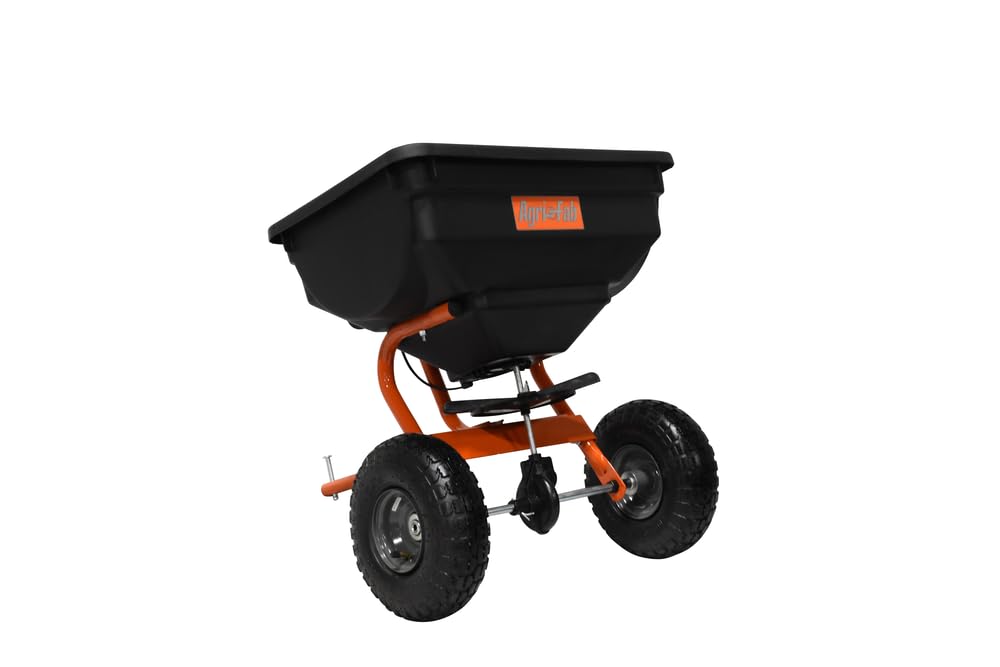
This spreader works well for small to medium yards and offers solid control for even spreading when towing behind a riding mower.
Pros
- Holds a good amount of fertilizer (85 pounds) which means fewer refills
- Smooth ride thanks to 10-inch pneumatic tires on varied terrain
- Cable flow control lets us start and stop spreading without getting off the mower
Cons
- Assembly takes some time and can be tricky without careful patience
- Gearbox can sometimes stick and cause uneven spreading
- Hopper accessories, like the cover and grate, are extra and not included
We appreciated the large hopper that lets us cover about a quarter-acre in one go, reducing trips back to refill. The pneumatic tires make towing smooth, even on bumpy lawn patches. It is sturdy and feels built to last.
The cable flow control stands out because it allows easy control from the driver’s seat. We didn’t have to stop or get off the riding mower to start or stop spreading. This saved a lot of time and hassle compared to manual levers.
Assembly is not instant; plan on spending some time putting it together. Instructions are helpful but it helps to take your time. The metal parts are strong but watch for sharp edges during setup. Overall, it’s a practical, reliable option for lawn care when matched with the right tractor.
Agri-Fab 110 lb Tow-Behind Spreader

This spreader is a solid choice for those wanting an easy-to-use, durable tool to cover medium-sized lawns efficiently.
Pros
- Easy to adjust flow control from the mower seat
- Sturdy build with pneumatic tires that handle rough terrain well
- Large hopper lets us cover a lot before refilling
Cons
- Assembly can be tricky and time-consuming
- Some parts have sharp edges that require care during setup
- Gear mechanism may stick if not maintained properly
We found the Agri-Fab Tow-Behind Spreader to be practical in everyday lawn care. The 110-pound hopper is large enough to minimize refilling on average yards near 1/3 acre. It hooks up quickly to most mowers thanks to the universal hitch.
Using the flow control lever while sitting on the mower made spreading fertilizer or seed feel smooth and precise. The pneumatic tires rolled well, even on bumpy ground, preventing tipping or bouncing that smaller spreaders sometimes cause.
The biggest drawback was the initial assembly, which took longer than expected and required careful handling because of some sharp metal edges. Also, the gear system responsible for the spreader’s rotation needed occasional checks to avoid sticking, especially after heavy use or debris buildup. Overall, it feels like a reliable tool once properly set up.
Agri-Fab Tow-Behind Spreader

This spreader is decent for moderate use, but some parts felt less sturdy than we expected for the price.
Pros
- Easy to assemble with clear parts
- Controls are reachable from the mower seat
- Spread pattern covers a good width (up to 10 feet)
Cons
- Some plastic parts seem fragile
- Close/open lever can be hard to adjust
- Not ideal for very large lawns or heavy-duty use
Putting the spreader together took us about 20 minutes and was mostly straightforward, though the instructions needed a couple of looks to figure out. Once hooked up, it towed smoothly behind our mower. The 85-pound hopper was just the right size for small to medium lawns without constant refills.
The spread width works well for fertilizer and salt, giving an even distribution. However, we noticed the control lever for opening and closing the chute wasn’t as smooth or robust as hoped. It sometimes sticks, and the plastic housing on the gearbox feels like it could break if handled roughly.
Overall, this Agri-Fab model fits casual or light use. If your lawn is big or you want something heavy duty, you might want to consider other options. But for average lawn care, it gets the job done without much hassle.
Chapin 8622B Tow-Behind Spreader

This spreader is a solid choice for those who want easy control and less waste when spreading fertilizer on rough terrain.
Pros
- Stops spreading automatically when you stop moving, saving product
- Holds a large amount of fertilizer in a rust-proof hopper
- Wheels handle uneven ground well without tipping
Cons
- Assembly can be tricky and unclear
- Not for use with salt, sand, or lime products
- Occasionally, the impeller can get stuck or stop working
We liked how the Chapin 8622B saves us from constantly reaching back to turn it off when stopping. This feature keeps us from wasting fertilizer and helps avoid patchy spots in the lawn. The hopper size lets us cover a big area in one go, which is convenient for larger yards or farm fields.
The wheels roll smoothly over rough patches and hills, making it easier to manage without worrying about tipping. The frame feels sturdy and well-made, which adds to our confidence that it can take on tough outdoor conditions.
However, putting it together took more effort than we expected because the instructions weren’t very clear. We also learned it’s important not to use it with sand or salt since the mechanics can’t handle those materials well. Sometimes the impeller jammed, forcing us to check and clean it before continuing.
Overall, this spreader works well for spreading a variety of fertilizers on big, uneven lawns or acreage when used properly.
Scotts EdgeGuard DLX Spreader

This spreader works well for medium-sized yards and helps us apply fertilizer without wasting product on paths or driveways.
Pros
- Easy to use right out of the box
- EdgeGuard stops spread on unwanted areas
- Holds a lot of fertilizer or seed before refilling
Cons
- Handle height might be short for taller users
- Feels a little light, so can tip if full and on uneven ground
- Not the best choice for very large lawns
We liked that the Scotts EdgeGuard DLX came mostly assembled, which saved time before getting started. When we rolled it across our lawn, the fertilizer spread evenly, and the EdgeGuard feature really kept the product off sidewalks and flower beds. This helped reduce waste and kept clean edges.
The hopper design and agitator moved the product smoothly. This meant fewer clumps and more consistent coverage compared to spreading by hand. Adjusting the dial was easy and allowed us to change the spread rate depending on what we were applying.
The only downsides we noticed were the handle being a bit short for someone taller than 5’8” and the unit feeling a little unsteady when fully loaded on rough surfaces. Still, it’s solid for average-size lawns, and storing it in a garage or shed is simple thanks to the compact size.
Scotts EdgeGuard Mini Spreader

This spreader is a solid choice for smaller yards and offers reliable, easy-to-control fertilizer application with great edge protection.
Pros
- Easy to use right out of the box
- EdgeGuard feature stops product from spilling onto sidewalks
- Compact size with fold-down handle for storage
Cons
- Handle might feel short for taller users
- Not the best option for large lawns
- Lightweight design can feel a bit unstable
We liked that the Scotts EdgeGuard Mini came fully assembled, which saved us time before starting our lawn work. The dial is simple to adjust, and we appreciated how smoothly the fertilizer flows thanks to the dual-bladed agitator inside.
The EdgeGuard helps keep product off driveways and flower beds, which makes the spreader less wasteful and more precise. The size fits well for smaller lawns, covering about 5,000 sq. ft., so it’s a good pick if you don’t need something huge.
Storage was easy with the fold-down handle, meaning it didn’t take up much space in our garage. The only downside was that the handle felt a bit short, so it might not be the most comfortable for everyone. Overall, it gets the job done well for everyday lawn care.
Yard Commander Spreader

This spreader offers solid performance and durability for those needing an affordable option with good coverage on uneven ground.
Pros
- Large hopper holds a lot of material
- Strong aluminum gears provide smooth spreading
- Tires handle rough terrain well
Cons
- Assembly instructions can be confusing
- Some gear parts have slight play affecting spread accuracy
- Plastic hopper cover feels cheap
We found the Yard Commander easy to tow behind the mower, and the 125-pound hopper carried enough fertilizer to treat a large lawn without refills. The frame feels tough thanks to its powder-coated steel, so it should last through multiple seasons.
Adjusting the drop rate was smooth with the lever, letting us control how much material spilled evenly across the yard. The cast aluminum gears ran quietly and held up under normal use.
The spreader rolls nicely over bumpy spots with its big pneumatic tires. Assembly was manageable but not very straightforward. The plastic cover is helpful in light rain but seems less durable. Overall, this unit balances cost and function well for most home users.
Agri-Fab Zero Turn Electric Spreader

This spreader works well for basic fertilizer tasks but has some fit and durability issues we noticed.
Pros
- Large 125 lb rustproof hopper keeps working without rust.
- Spread width up to 12 feet covers ground quickly.
- Controls on the mower seat help adjust flow easily.
Cons
- Motor struggles when hopper is full, slowing spread.
- Hard to mount on some zero-turn mower models without mods.
- Some quality control problems with scratched or damaged parts on delivery.
We found the spreader easy to attach and use once it was mounted correctly. The hopper size means fewer refills, which adds to productivity. The electric motor keeps the spreading even at higher speeds, but it sometimes slowed down when the hopper was full.
Mounting was a challenge. It didn’t fit perfectly on all zero-turn brands we tried. Some users may need custom mounts or extra work to get it solid and secure. The cable controlling the hopper sometimes bent, making it difficult to open or close.
Overall, this product can be useful if you have a compatible mower and don’t mind some setup work. Its ability to cover a large area fast is helpful, but be aware of some durability and fitment issues based on our use.
Craftsman 110lb Tow Broadcast Spreader

This spreader works well for medium-sized lawns but has some drawbacks in build quality and assembly.
Pros
- Covers about one-third of an acre with a single fill
- Large pneumatic tires make it easy to tow over different ground
- Adjustments can be made smoothly from the tractor seat
Cons
- Assembly is time-consuming and a bit tricky
- Plastic parts may break under heavy use
- Actual hopper capacity feels smaller than advertised
We found this Craftsman spreader effective for spreading fertilizer and seed across medium-sized yards. Its 110-pound hopper and 10-foot spread width helped us cover a good chunk of ground without refilling too often. The big tires rolled smoothly, even on uneven patches.
On the downside, putting it together took us longer than expected. The instructions could be clearer, and some parts require care to avoid damage. We noticed certain plastic components felt less durable, which might be a concern for frequent use.
Despite these issues, this spreader offers useful features like the steel rod flow control, allowing us to adjust the rate easily from the seat. It’s a practical choice if you want a solid spreader that fits most riding mowers and need to cover moderate areas without hassle.
Buying Guide
When choosing a fertilizer spreader for our riding lawn mower, we need to think about a few key features. First, the spread width is important. A wider spread means less time covering the lawn, but it must still match the size of our yard.
Next, consider the hopper capacity. A larger hopper means fewer refills, which is helpful for big lawns. However, a very large hopper might be heavy and harder to handle.
Material and build quality are also important. We want a spreader made from rust-resistant metal or strong plastic to last through different weather conditions.
We should check how the spreader attaches to the mower. Some models fit on the back, while others hook to the side or front. It’s best to pick one that matches our mower’s design for easy use.
Also, look for easy controls. A simple lever or dial to adjust the fertilizer flow helps us spread evenly.
Here’s a quick table to help us compare features:
| Feature | What to Look For |
|---|---|
| Spread Width | Fits lawn size, wider covers faster |
| Hopper Capacity | Matches lawn size, not too heavy |
| Material | Rust-resistant metal or durable plastic |
| Attachment Type | Compatible with our mower |
| Controls | Easy adjustment for even spreading |
By focusing on these points, we can find a spreader that works well with our riding lawn mower.
FAQs
How effective are fertilizer spreaders for riding lawn mowers?
We find that fertilizer spreaders designed for riding mowers give even and consistent coverage. This helps the grass get the right nutrients, improving lawn health.
Are these spreaders safe to use around children and pets?
Yes, they are generally safe when used correctly. We recommend following the fertilizer manufacturer’s guidelines and keeping children and pets away during application.
What size area can a riding mower spreader cover?
Most models cover between 5,000 to 20,000 square feet per fill. This depends on the spreader size and the type of fertilizer used.
How often should we maintain our fertilizer spreader?
Regular cleaning after each use is important. We should also check for rust, loose parts, and clogged spreader holes to keep it working well.
How do fertilizer spreaders compare to hand spreaders?
Riding mower spreaders cover more ground faster and with less effort. We find them more efficient for medium to large lawns compared to hand spreaders.
Can we use fertilizer spreaders for pest control?
Some spreaders can apply pest control granules, but we need to confirm the model supports this. Always use the right product and follow safety rules.
What should we do if the spreader clogs or jams?
Stop using it immediately. Clearing the blockage manually and checking the user manual for troubleshooting help usually fixes the issue.
Conclusion
Fertilizer spreaders for riding lawn mowers make lawn care easier and more efficient. They help us apply fertilizer evenly, which improves the health and look of our grass. Using the right spreader keeps our lawn green without wasting fertilizer.
Safety is important when using these tools. Good spreaders reduce dust and particle drift. This protects us, our family, and the environment.
Many models are eco-friendly, helping us care for the earth while keeping our yard healthy. They use materials and designs that lower waste and support responsible lawn care.
Choosing a reliable, well-built spreader suits our long-term needs. It saves time and money by working properly year after year. We should pick one that fits our mower and lawn size for best results.
By investing in a quality fertilizer spreader, we take control of lawn care. Our yards will benefit from balanced feeding and safer application. Let’s choose the right tool now and enjoy a healthier, greener lawn all season.
