


The best garden hose holder keeps your hose neat, dry, easy to reach, and safe from damaging ground contact.
A long hose can turn a tidy yard into a tangled trap. It kinks near the faucet, collects mud, and becomes hard to coil after watering. A good garden hose holder solves that daily problem with a steady place to store the hose. I compared stand, wall-mount, basket, and spike-style designs for strength, capacity, setup, and ease of use. The right pick depends on your hose length, soil, wall space, and need for extra tool storage.
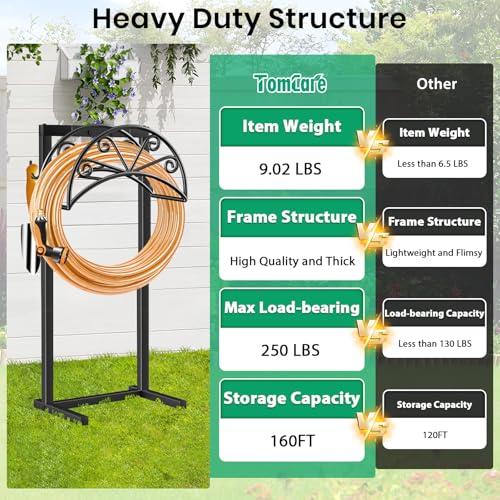
TomCare Heavy-Duty Hose Holder Stand

The TomCare garden hose holder uses four ground spikes to stay firm in soil. Its stand-style frame is made for outdoor use and can hold up to 160 feet of hose, depending on hose thickness. The open design lets you lift the hose from several angles instead of pulling it through a narrow reel. That makes it useful beside a garden bed, shed, or outdoor faucet.
I like the simple layout because it has fewer parts to jam or break. The four spikes spread the load across the ground, which helps reduce leaning when the hose is full of water. It is best placed in packed soil rather than loose mulch or very soft ground. As with any open hose stand, a careful coil still matters if you want the hose to stay neat.
Pros:
- Four spikes provide strong support in firm soil
- Large stated capacity for long garden hoses
- Open frame makes the hose easy to lift and replace
- Does not need wall drilling or anchor bolts
- Compact footprint works well near garden beds
- Simple design has few moving parts to maintain
Cons:
- Needs suitable soil for the spikes to hold well
- Does not provide automatic hose retraction
- Loose coils may spread outside the frame
For a homeowner who wants a basic, sturdy storage point, this is a strong choice. I would use it for a standard 50- to 100-foot hose and leave extra room for wide or thick hose walls. The frame also keeps much of the hose off wet grass, which can slow dirt buildup and help protect the lawn. It offers the practical feel many buyers expect from the best garden hose holder without the cost or upkeep of a mechanical reel.
Heavy-Duty Metal Hose Holder With Hooks
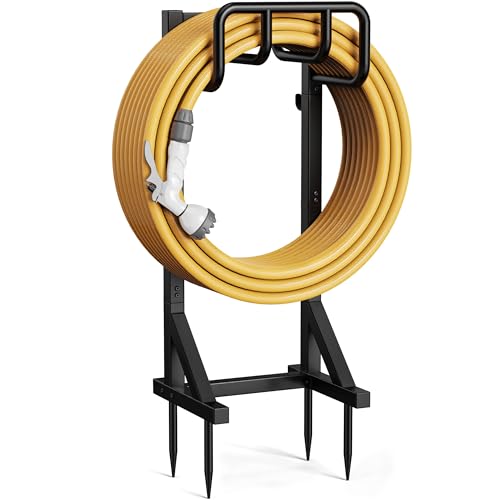
This freestanding metal hose holder adds tool hooks to its hose storage area. The extra hooks can hold a hand sprayer, pruning shears, gloves, or other small yard tools. Its stable base gives it a different feel from a spike-only stand, since it can sit on a hard surface such as a patio or driveway. The design is made for outdoor hose storage and offers space for a long hose.
The main benefit is organization in one small spot. Instead of leaving a nozzle on the ground or carrying tools back to the shed, I can keep common items near the faucet. The frame should work best on a level surface, and its base may need more care on uneven soil. Buyers should also check the included hardware and finish from time to time, since outdoor metal can show wear in wet or salty air.
Pros:
- Tool hooks add useful storage beside the hose
- Freestanding design can work without wall mounting
- Metal frame offers good support for daily use
- Works well near patios, sheds, and outdoor faucets
- Keeps small watering tools in one easy-to-find place
- Open storage makes the hose simple to remove
Cons:
- Needs a fairly level surface for the best stability
- May take more floor space than a wall hanger
- Open storage still requires manual coiling
This model is a smart match for gardeners who value tool storage as much as hose storage. I especially like it for a patio garden, where spikes cannot enter the ground. The hooks turn unused frame space into a small work station, which can save time during quick watering jobs. If your main goal is a clean, organized area, this could be the best garden hose holder for a hard-surface location.
Freestanding 160-Foot Black Hose Holder

This black freestanding garden hose holder focuses on simple capacity and easy placement. It is listed to hold up to 160 feet of hose, so it suits large yards and longer hose runs. The reel-style frame gives the hose a defined storage zone without requiring a wall or post. Its black finish also blends into many garden settings without drawing much attention.
A freestanding frame can be helpful when you rent a home or do not want to drill into siding. I would place this holder on a firm, level area close to the faucet, then guide the hose around the frame in broad loops. That method reduces sharp bends and makes the next use less frustrating. The holder does not wind the hose by itself, so a few extra seconds of hand coiling will improve the result.
Pros:
- Large listed capacity suits long hoses
- Freestanding setup avoids wall installation
- Black finish fits many outdoor spaces
- Defined frame helps keep coils off the ground
- Useful for renters and changing garden layouts
- Simple form is easy to understand and use
Cons:
- Requires manual winding after each use
- May move if placed on a slick or uneven surface
- Long, heavy hoses may need careful balancing
I recommend this option to people who want capacity without a complex reel mechanism. It is also a good fit for a side yard where a wall mount would be awkward. The best garden hose holder should make storage feel easier, and this one does that with a direct, low-maintenance layout. Keep the hose evenly balanced on the frame to help prevent tipping and uneven stress.
Xeapoms Hose Holder With Basket and Hooks
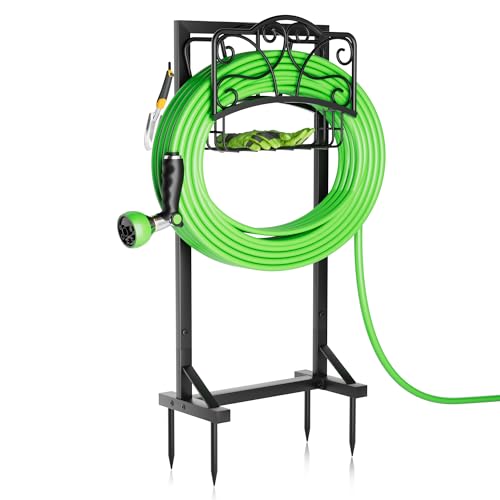
The Xeapoms hose holder combines a hose frame, storage basket, and tool hooks. Its stated capacity reaches 160 feet, giving it room for many common residential hoses. The basket can hold small watering items, gloves, or fittings that otherwise tend to disappear in the grass. This makes the unit more than a hose hanger; it works as a small outdoor storage station.
The basket is the feature I notice most because it solves several little problems at once. I can keep a spray nozzle, plant ties, and hand tools close to the water source rather than in a distant shed. The freestanding format also gives renters more freedom than a wall-mounted product. Like other metal outdoor holders, it deserves a quick check for dirt, standing water, and finish wear after wet seasons.
Pros:
- Basket stores small garden items in one place
- Tool hooks make nozzles and hand tools easy to reach
- Large listed capacity fits long hoses
- Freestanding frame needs no permanent wall holes
- Helps create a tidy watering station
- Open design allows simple hose access
Cons:
- Basket may collect leaves and rainwater
- Takes more space than a basic hose hanger
- Manual coiling is still required
This is one of my favorite choices for a busy family yard or community garden. It gives each small accessory a home, which helps prevent clutter from spreading around the faucet. I would call it the best garden hose holder for buyers who want storage value rather than only a place to hang a hose. It is especially helpful when several people share the same watering area.
Metal Wall-Mounted Garden Hose Holder

This wall-mounted metal holder is designed for homes with a strong mounting surface. It keeps the hose lifted from soil, grass, and standing water while using very little floor space. The fixed position can make the faucet area look cleaner, especially beside a garage, shed, or exterior wall. Its open form also lets you remove the hose without dealing with a winding crank.
A wall hanger works best when the mounting point is close to the faucet and strong enough for the hose load. I would use proper anchors for the wall material and avoid attaching a heavy, full hose to weak siding alone. Mounting height matters too: place it high enough to clear the ground, but low enough for easy lifting. When installed well, this type of holder feels stable and keeps the yard free of a bulky stand.
Pros:
- Saves ground space in small yards
- Keeps the hose raised away from mud and grass
- Good match for garages, sheds, and solid walls
- Simple open shape has no crank to maintain
- Lets users pull the hose out from several directions
- Can create a clean, permanent hose station
Cons:
- Requires drilling and suitable mounting hardware
- Not ideal for weak siding or temporary locations
- Does not retract or guide the hose automatically
I would choose this model for a homeowner who wants a low-profile storage solution. It is also a strong pick for a narrow side passage where a freestanding stand would block walking space. For the best garden hose holder results, install it into a solid surface and keep the hose coil balanced. A good mount can outlast a portable stand, but poor installation can reduce stability.
GAVISCITY Heavy-Duty Hose Holder Stand

The GAVISCITY hose holder is a freestanding metal hanger with tool hooks and a listed capacity of 151 feet. Its frame gives a long hose a clear storage path without taking over the whole yard. The hooks add room for a spray head, gloves, or a small hand tool. It is built for outdoor use and offers a useful mix of capacity, access, and organization.
The slightly lower capacity claim than some 160-foot models is not a concern for most homes. Actual capacity depends on hose diameter, coil size, and how tightly the hose is placed. I would rather see a hose sit without sharp bends than force every inch onto a crowded frame. The holder should serve well beside a lawn faucet, especially when the user wants quick access and simple cleanup.
Pros:
- 151-foot listed capacity suits many large hoses
- Tool hooks improve organization near the faucet
- Freestanding design avoids wall damage
- Metal frame offers a firm storage structure
- Open hanger allows fast hose removal
- Useful for lawns, beds, and outdoor work areas
Cons:
- Capacity varies with hose size and coil shape
- Needs a level spot for the best balance
- Requires hand coiling after use
This holder is best for practical gardeners who want a clean setup without a bulky reel. The hooks give it more daily value than a bare frame, while the freestanding design keeps installation simple. I see it as a balanced contender for the best garden hose holder title, especially for medium and large residential yards. It offers useful features without asking the buyer to manage gears, springs, or a crank.
Qatsrin Super Stable 160-Foot Hose Holder

The Qatsrin hose holder is made for buyers who place stability high on their list. Its stated 160-foot capacity gives it room for long hoses used around lawns, flower beds, and larger lots. The freestanding form can be positioned where the watering work happens, without permanent installation. Its black look keeps the design quiet beside most outdoor structures.
Stability matters because a hose pulls hard when it catches on a plant or corner. A stable holder helps keep the coil in place instead of sliding across a patio or falling into a bed. I would still place it on a firm, level surface and avoid dragging a full coil sideways. Good hose habits will protect both the holder and the hose from needless strain.
Pros:
- Designed with stability as a main goal
- 160-foot listed capacity handles long hose runs
- Freestanding setup allows flexible placement
- Black finish suits many outdoor areas
- Open frame makes the hose easy to access
- No wall drilling is needed
Cons:
- May need a hard, level surface for best results
- Does not wind the hose automatically
- Large hose coils can still be heavy to move
I recommend the Qatsrin to anyone tired of a hose holder that shifts during use. It is a good fit for a wide yard, driveway edge, or patio where a steady freestanding frame is useful. Among the models reviewed, it has a clear appeal for buyers who value capacity and support over extra storage features. It may be the best garden hose holder for a long hose used often in one main area.
VyGrow Hose Holder With Four Spikes

The VyGrow garden hose holder uses four spikes and a detachable storage frame. The spike design lets the holder anchor directly into soil, which can be useful in lawns and planting beds. Its listed capacity supports long hoses, while the detachable construction may make moving or storing the unit easier. The black frame has a simple outdoor look and does not need a wall or concrete pad.
Four contact points can make a real difference in soft outdoor ground. I would press the spikes into firm soil and avoid locations with buried irrigation lines, electrical wires, or tree roots. The stand should remain more secure when the hose is pulled in a straight line rather than sharply sideways. Before winter, I would remove it from wet soil if freezing conditions could push or damage the metal.
Pros:
- Four spikes help anchor the holder in soil
- Detachable design may simplify moving and storage
- Large listed capacity suits long hoses
- Good choice for lawns and garden beds
- No wall drilling or patio hardware is needed
- Open frame makes access quick and simple
Cons:
- Cannot anchor well in concrete or hard paving
- Care is needed around buried utility lines
- Manual coiling remains part of the cleanup routine
This model suits gardeners who want their holder planted near the work area. It is especially useful when the faucet sits beside a lawn or soft garden border. I would choose it over a wall mount when the hose location changes from season to season. For soil-based storage, the VyGrow can be the best garden hose holder for buyers who want firm anchoring and easy relocation.
My Recommendation
After comparing all eight models, I would pick the TomCare stand for the best balance of capacity, simple setup, and ground support. Its four spikes give it a practical advantage in firm soil, and its open frame is easy to use. For a patio or driveway, the metal holder with tool hooks is more suitable because it does not depend on soil. If storage space matters most, the Xeapoms basket model adds the most useful daily organization.
Choose a wall-mounted model when floor space is tight and you have a strong mounting surface. Choose a spike model when you want firm placement beside a lawn or bed. For a long hose and a stable freestanding setup, Qatsrin is a sensible option. The best garden hose holder is not always the largest one; it is the model that matches the surface, hose weight, and way you water.
| Best for | Why |
|---|---|
| Firm soil and long hoses | TomCare and VyGrow use four spikes for strong ground support. |
| Patios and hard surfaces | The metal holder with tool hooks offers freestanding storage without digging. |
| Small tools and busy watering areas | Xeapoms adds a basket and hooks for nozzles, gloves, and garden tools. |
How to Choose the Best Garden Hose Holder
Start with the hose, not the holder. Check the hose length, outside diameter, and weight when full of water. A holder rated for 160 feet may hold less if your hose is thick, reinforced, or stiff. Capacity numbers are useful guides, but they are not always equal across brands.
Next, check the surface where the holder will sit. Spike stands need soil that can grip the posts. Freestanding bases work better on level patios, decks, and driveways. Wall mounts need a solid surface and suitable anchors. A beautiful holder in the wrong location is like a shoe in the wrong size: it may look right, but it will not feel right.
Freestanding Versus Wall-Mounted Storage
Freestanding holders are flexible. I can move them when I change a bed or repair a faucet. They also work well for renters who cannot drill into a wall. Their weak point is movement, especially on smooth surfaces or when a heavy hose pulls from the side.
Wall-mounted holders save floor space and keep the hose off the ground. They can make a narrow passage easier to walk through. The trade-off is permanent installation. Before drilling, confirm the wall material, use the right anchors, and avoid mounting only to thin siding.
Why Hose Support Matters
A hose left in a tight pile can develop sharp bends and kinks. Those bends can make watering slow and place stress on the hose wall. A broad holder supports a gentler coil and keeps the hose away from wet soil. The U.S. Environmental Protection Agency also encourages efficient outdoor water use, so reducing leaks and wasted spray is a smart part of hose care.
Storage also protects the yard. A hose across a walkway can become a trip risk. A hose left in grass can hide beneath leaves or catch a mower blade. I always shut off the water at the source, drain pressure from the line, and coil the hose before placing it on the holder.
Metal Finish and Outdoor Care
Many outdoor hose holders use painted or coated metal. A finish can slow rust, but no coating makes metal invincible. Scratches, trapped moisture, fertilizer dust, and salty air can speed corrosion. Wipe away mud and let the holder dry when possible.
Do not leave a full hose hanging in a way that strains one small point. Spread the coil across the frame. In cold areas, drain the hose before freezing weather and store it where ice cannot form inside the fittings. These small habits can extend the life of both the hose and the best garden hose holder.
How to Coil a Garden Hose Correctly
First, turn off the faucet and open the nozzle to release pressure. Walk the hose out in a straight line when space allows. Then form wide loops instead of tight circles. Keep the loops even and avoid twisting the hose as you place it on the holder.
If the hose has a strong memory from its packaging, warm weather can make it easier to shape. Never force a cold, stiff hose into a tiny coil. A broad frame helps, but good technique matters just as much. The goal is a calm, smooth coil that can come off the holder without a fight.
Checking Product Claims
Capacity, rust resistance, and stability claims can vary by seller and use. I treat listed capacity as a guide rather than a promise for every hose. A 100-foot lightweight hose and a 100-foot heavy-duty hose do not place the same load on a frame. Buyers should read current product details, check dimensions, and review the mounting or assembly notes before ordering.
It also helps to inspect customer photos for real placement ideas. Look for signs of leaning, crowded coils, sharp edges, or a base that does not fit the stated use. Product photos show the ideal setup, while user experience can reveal how the holder behaves after rain and repeated pulling. This approach leads to a more informed purchase.
FAQs Of best garden hose holder
What is the best garden hose holder for a large yard?
A sturdy freestanding holder with a large listed capacity is a good choice for a large yard. TomCare, Qatsrin, and similar 160-foot models suit long hoses. Pick a location near the faucet and coil the hose evenly to reduce pulling strain.
Are wall-mounted hose holders better than freestanding models?
Neither style is always better. A wall mount saves space and stays fixed, while a freestanding model is easier to move and install. Choose based on your wall strength, yard layout, and need for flexibility.
Can a garden hose holder prevent kinks?
A holder can reduce kinks by supporting a broad, even coil. It cannot fix a hose that is twisted or sharply bent during use. Release water pressure, straighten the hose, and avoid tight loops during storage.
Do metal hose holders rust outside?
Outdoor finishes can slow rust, but scratches and trapped moisture may still cause corrosion. Keep the holder clean, avoid standing water, and inspect damaged areas. Drain and store the hose during freezing weather.
How much hose can a holder really store?
The real amount depends on hose diameter, stiffness, and coil width. A listed 160-foot capacity may be lower with a thick commercial-style hose. Leave some room rather than forcing an overcrowded coil onto the frame.
Final Verdict: Which Should You Buy?
The TomCare is my top pick for the best garden hose holder because its four spikes, simple frame, and large capacity suit many yards. Choose Xeapoms for tool storage, or the wall model for tight spaces.
Match the holder to your surface and hose size. With proper coiling and care, any of these garden hose holders can keep outdoor storage neat, safe, and ready for the next watering job.
