
How To Choose A Riding Lawn Mower: Smart Buying Guide
The best riding lawn mower for a U.S. property depends on four things: yard size, terrain, mowing obstacles, and storage space. For a mostly open lawn, a lawn tractor may offer the best balance of cost and utility. For many trees, beds, and tight turns, a zero-turn mower can save time. For smaller lots, a rear-engine rider may be easier to store and control.
Before you compare brands, measure the land you mow, check your slopes, and decide whether you need only a mower or a machine that can also tow, bag, plow, or handle other yard work.

Start With Yard Size and Mowing Time
Yard size is the first filter when choosing a riding lawn mower. A riding mower often makes sense when a push mower takes too long, but the right deck size depends on the shape of the property.
The mowing area, rather than the total lot size, is what matters. A half-acre property may include a house, driveway, garden, woods, and other areas that do not need mowing.
Estimate the area you actually mow
You can make a useful estimate with this simple method:
- Measure the length and width of each large grass area.
- Multiply length by width.
- Add the areas together.
- Subtract patios, sheds, beds, ponds, and other obstacles.
For example, a rectangular lawn that is 200 feet long and 100 feet wide has:
200 × 100 = 20,000 square feet
That equals about 0.46 acre, because one acre contains 43,560 square feet.
Use deck width as a starting point
A wider deck can reduce mowing time, but only if the mower can fit between trees, gates, and other obstacles.
| Mowed area | Common starting point | Main trade-off |
|---|---|---|
| Under 0.5 acre | Push mower, battery mower, or small rear-engine rider | A riding mower may be more machine than you need |
| About 0.5 to 1 acre | 30- to 42-inch deck | Compact and easier to store |
| About 1 to 2 acres | 42- to 48-inch deck | Good balance of speed and access |
| About 2 to 4 acres | 48- to 54-inch deck | Faster on open ground but less nimble |
| More than 4 acres | 54-inch or larger deck, or a commercial-style mower | Needs more storage, service, and transport planning |
These are planning ranges, not strict rules. A yard with many trees can take longer than a larger, open field. A narrow gate may rule out a deck size that would otherwise fit the property.
Estimate mowing time
A simple planning formula is:
Estimated hours = area ÷ (mowing width × ground speed × efficiency factor)
Use consistent units. For example, a 42-inch deck is 3.5 feet wide. Actual mowing is slower than the mower’s maximum speed because you must turn, overlap passes, slow near trees, and empty a bagger.
A practical efficiency factor might range from 0.5 to 0.8 for a typical residential yard. This is an estimate, not a manufacturer rating.
A 42-inch mower traveling at 4 miles per hour may cover a useful amount of open lawn. In a yard with fences, trees, and tight corners, the real output can be much lower. This is why a smaller deck can sometimes finish sooner than a wider deck that requires repeated maneuvering.
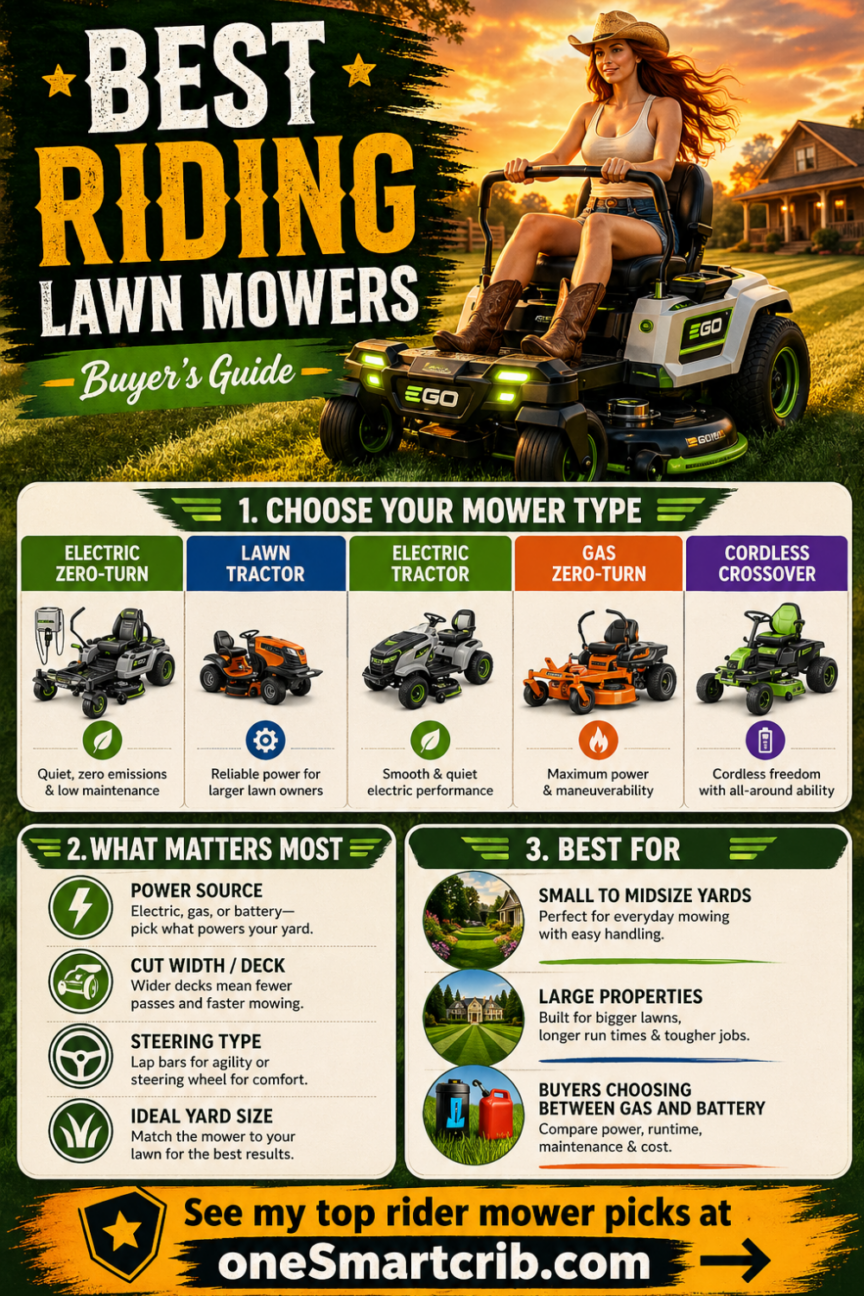
Match the Mower Type to Your Property
The main riding lawn mower types are rear-engine riders, lawn tractors, garden tractors, and zero-turn mowers. Each type solves a different problem.
Rear-engine riding mowers
Rear-engine riders place the engine behind the driver and usually have a smaller deck. They are often suited to smaller lawns where storage space and simple handling matter.
Choose one when:
- Your lawn is fairly flat.
- You need a compact machine.
- You have narrow paths or a small storage shed.
- You do not need heavy towing or snow work.
Their limits can include slower mowing, less power for heavy attachments, and fewer comfort features. Check the turning radius and deck width before buying.
Lawn tractors
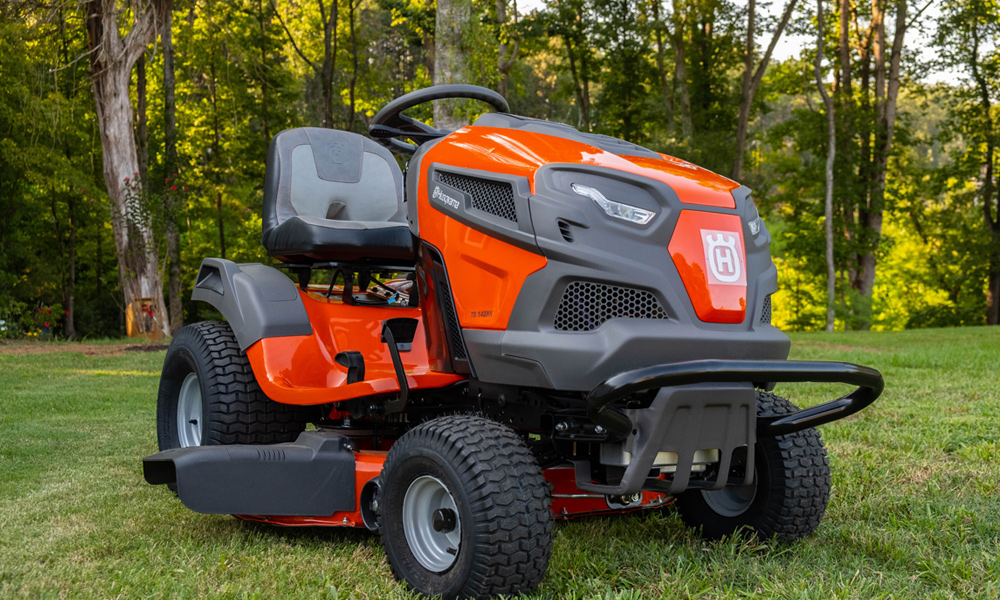
Lawn tractors are the common all-purpose choice for many U.S. homeowners. They usually have a front-mounted engine, a mid-mounted cutting deck, and a steering wheel.
A lawn tractor may fit if you need to:
- Mow roughly half an acre to several acres.
- Tow a light cart or spreader.
- Use a grass bagger.
- Add a snow blade or other approved attachment.
- Drive over a mix of open lawn and moderate obstacles.
A lawn tractor is often easier to use on gentle slopes than a zero-turn mower, but the exact limit depends on the model and its manual. Never assume that a tractor is safe on every hill.
Garden tractors
Garden tractors are heavier and built for more demanding work than many lawn tractors. They may have stronger frames, larger tires, more robust transmissions, and better support for approved attachments.
Consider one when you need to:
- Tow heavier loads within the manual’s limits.
- Use ground-engaging equipment.
- Clear snow with a compatible attachment.
- Work on a larger property.
- Operate for longer periods each season.
The extra size and weight can increase cost, fuel use, storage needs, and damage to soft ground. A garden tractor is not automatically the best mower for a normal suburban lawn.
Zero-turn mowers
Zero-turn mowers use two independently controlled drive wheels. This lets the mower turn around its own footprint and cut closely around many obstacles.
A zero-turn mower can be a strong choice when:
- The lawn is large and mostly open.
- You have many trees or landscape beds.
- Fast turning will reduce repeated passes.
- You are comfortable learning lap-bar or steering controls.
A zero-turn mower may be a poor match for steep slopes, rough ground, narrow paths, or frequent towing. Many models have different slope limits and operating rules. Read the owner’s manual before buying, especially if the property has hills.
Electric riding mowers
Battery-powered riding mowers can reduce fuel storage, engine oil changes, and tailpipe emissions during use. They can also be quieter than gas models.
Their key question is not only “How long does the battery last?” It is whether the mower can finish your full job under your conditions.
Check:
- Rated mowing area per charge.
- Battery size and replacement cost.
- Charge time.
- Performance in thick or wet grass.
- Cold-weather storage rules.
- Whether the battery and charger remain covered by the warranty.
- Available electrical service for charging.
Manufacturers often state run time under test conditions. Tall grass, wet grass, slopes, high blade settings, and frequent turns can reduce actual coverage.
Walk-behind alternatives
A riding mower is not always the best answer. A walk-behind mower may be better for a small, steep, or highly divided yard. It also costs less to store and may reduce the risk of a large machine damaging narrow areas.
The best riding lawn mower is the one that fits the work. Bigger is not always faster.

Check Terrain, Slopes, and Ground Conditions
Terrain should affect the mower type more than a sale price or advertised deck size. A mower that works well on flat Kentucky turf may not be the right choice for a sloped property in Pennsylvania, Oregon, or western North Carolina.
Measure slopes safely
Do not drive a mower onto a slope just to test it. You can estimate a slope from a safe location with a slope gauge, level, or phone tool, but confirm the result with the mower’s manual.
Manufacturers often state slope limits in degrees or percentages. These units are not the same:
- 10 degrees is about an 18% grade.
- 15 degrees is about a 27% grade.
The conversion is approximately:
Percent grade = tangent of the angle × 100
Slope guidance varies by mower type and model. A manual may also specify whether to travel across a slope or straight up and down. Follow the model’s instructions rather than applying a general rule from another mower.
Watch for more than steepness
A mild slope can still be hazardous if it has:
- Wet grass
- Loose soil
- Gravel
- Hidden holes
- Tree roots
- Ditches
- Drop-offs
- Poor traction
- A sharp turn at the bottom
The U.S. Consumer Product Safety Commission advises riders to follow the manufacturer’s instructions, keep children away from riding mowers, and use care around slopes and obstacles. The operator’s manual is the controlling safety document for the machine.
If a property has steep or uneven sections, consider leaving those areas to a walk-behind mower or a professional service.
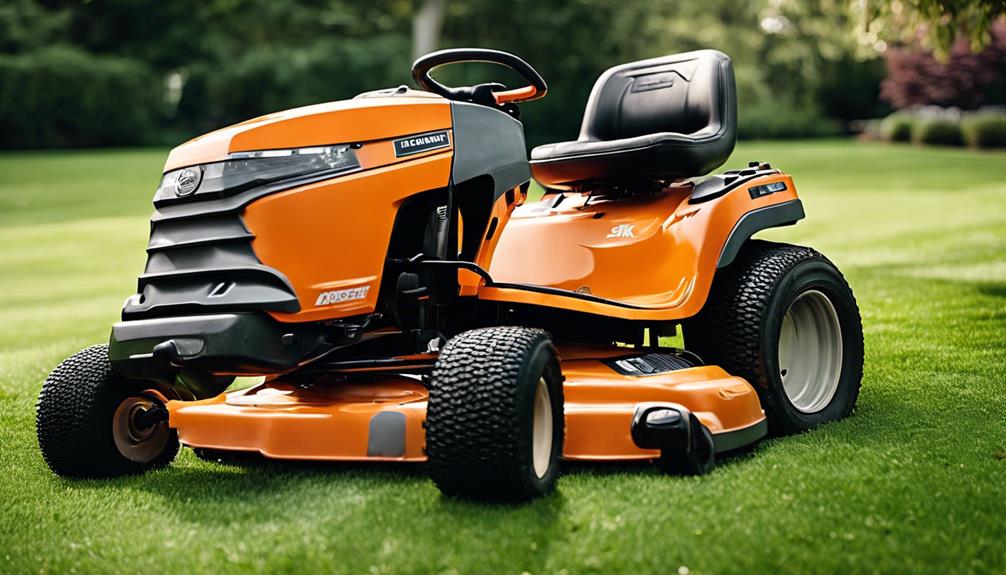
Choose the Right Cutting Deck
The deck determines how much grass the mower cuts in one pass. It also affects access, storage, transport, and the finish around obstacles.
Stamped versus fabricated decks
A stamped deck is formed from a single sheet of steel. It is common on residential lawn tractors and may be lighter and less expensive.
A fabricated deck is built from welded steel sections. It may be heavier and more resistant to hard use, but it can cost more and add weight.
Neither design guarantees a better cut. Cut quality also depends on blade condition, deck level, tire pressure, ground speed, grass height, and whether the deck is clean.
Side discharge, mulching, and bagging
Most riding mowers discharge grass from the side unless fitted with a mulching kit or bagger.
- Side discharge is usually the fastest option.
- Mulching returns finely cut grass to the lawn when conditions are suitable.
- Bagging gives a clean appearance but adds stops, weight, and purchase cost.
Wet or overgrown grass can clog decks and reduce cut quality. Follow the mower manual and local lawn practices. Some communities also have rules for yard waste and grass clippings.
Check deck adjustment
Look for a deck that is easy to level and clean. A mower that requires difficult service may be neglected, which can lead to an uneven cut.
Ask these questions before purchase:
- Can the deck be removed without special tools?
- Are replacement blades easy to find?
- Is the deck wash port approved for that model?
- Can you inspect the blades safely?
- Does the mower offer a clear height range?
- Does the deck lift easily for transport or service?
Never place hands near the blades. Turn off the engine, remove the key, disconnect the spark plug wire on applicable gas models, and follow the manual before cleaning or servicing.

Compare Engine, Transmission, and Drive System
The engine and drive system affect speed, hill performance, service life, and repair cost.
Engine size is not the only measure
Engine power should match the deck and working conditions. A larger engine may help with tall grass, slopes, towing, or heavy attachments, but it can also add cost and fuel use.
Avoid choosing by horsepower alone. Compare:
- Engine design and displacement
- Cooling system
- Manufacturer support
- Oil and filter access
- Warranty terms
- Parts availability
- Recommended fuel
- Service intervals
For gasoline models, use the fuel grade and storage method listed in the manual. Gasoline left in a small engine can cause starting problems, especially when it degrades or absorbs moisture.
Hydrostatic transmissions
A hydrostatic transmission uses fluid power instead of a traditional gear-shift system. It usually allows smooth speed control with a pedal or lever.
Benefits may include:
- Easy direction changes
- Smooth control near obstacles
- Less shifting
- Convenient speed adjustment
Hydrostatic systems still need proper care. Follow the manufacturer’s service schedule and do not tow beyond the stated limit.
Manual and automatic gear systems
Some smaller or older riding mowers use gear transmissions. They may cost less or appeal to buyers who prefer a simple mechanical layout, but they can require more shifting and clutch work.
The best choice depends on how often you mow and how much maneuvering your yard requires. For many residential buyers, ease of speed control matters more than the transmission label.
Front-wheel, rear-wheel, and zero-turn drive
A tractor’s drive wheels affect traction and turning. Larger rear tires can help on some lawns, but tire size does not remove slope hazards.
Zero-turn models require separate control of the drive wheels. Practice in a clear, flat area before mowing near trees, ponds, roads, or drop-offs. A zero-turn mower can turn sharply, but a sharp turn at speed can damage turf or reduce stability.

Evaluate Comfort, Controls, and Visibility
Comfort is not a luxury if you mow for several hours. Poor posture, vibration, glare, or hard-to-reach controls can make a routine task tiring and less safe.
Sit on the mower before buying and check:
- Seat adjustment
- Legroom
- Steering or lap-bar position
- Pedal location
- View of the deck edges
- Access to the fuel tank or charging port
- Ease of starting
- Parking brake position
- Control labels
- Vibration at the seat and controls
A high-back seat may improve support, but padding alone does not show whether the seating position fits you. Try the mower with both feet and hands in the normal operating position.
Check safety features
Look for documented safety systems such as:
- Operator-presence controls
- Blade engagement controls
- Parking brake interlocks
- Reverse-mowing controls
- Roll-over protection where applicable
- Seat belts where specified
- Headlights for low-light visibility
Safety interlocks are not features to bypass. If a switch fails, stop using the mower until it is repaired.
Mow only when you can see the ground clearly. Keep bystanders, children, and pets away from the work area. Wear sturdy shoes, eye protection, and hearing protection when the manual recommends it.
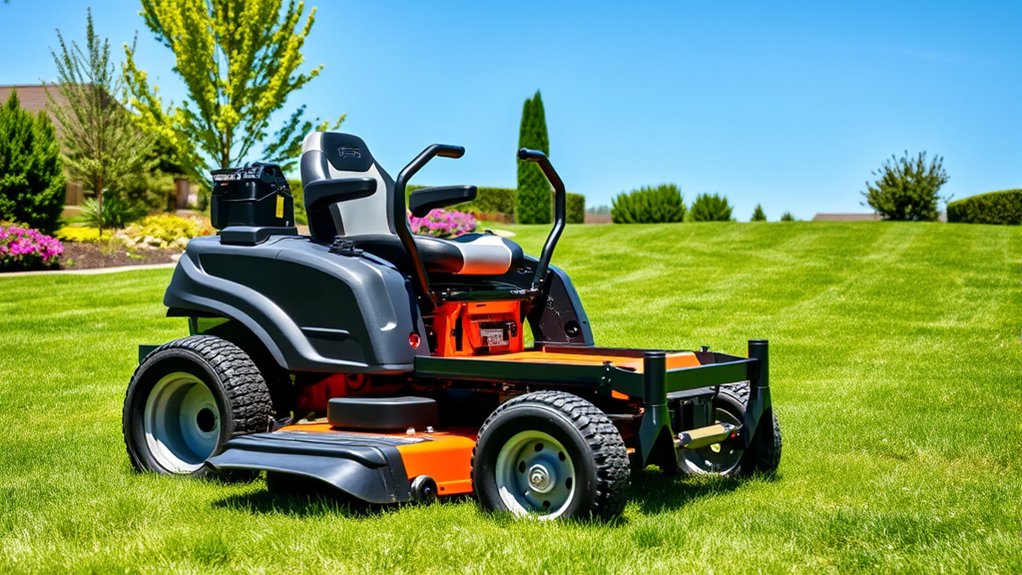
Account for Storage, Transport, and Attachments
A riding lawn mower needs a dry, secure storage location. Measure the full path from the driveway to the storage area, not just the shed door.
Check:
- Door width and height
- Turning space
- Ramp strength
- Floor load capacity
- Ventilation for gasoline storage
- Charger location for battery models
- Space for a bagger or snow equipment
- Access for maintenance
A mower that barely fits may become difficult to use. Leave room to open the hood, remove the battery, check tire pressure, and clean the deck.
Choose attachments with care
Common attachments include:
- Grass baggers
- Tow-behind carts
- Spreaders
- Dethatchers
- Aerators
- Snow blades
- Snow throwers
Attachments are not universal. Verify compatibility with the exact mower model, deck size, hitch design, electrical system, and transmission rating.
Do not assume that a lawn tractor can safely tow a heavy load because it has a hitch. The manual should state towing limits and operating conditions.
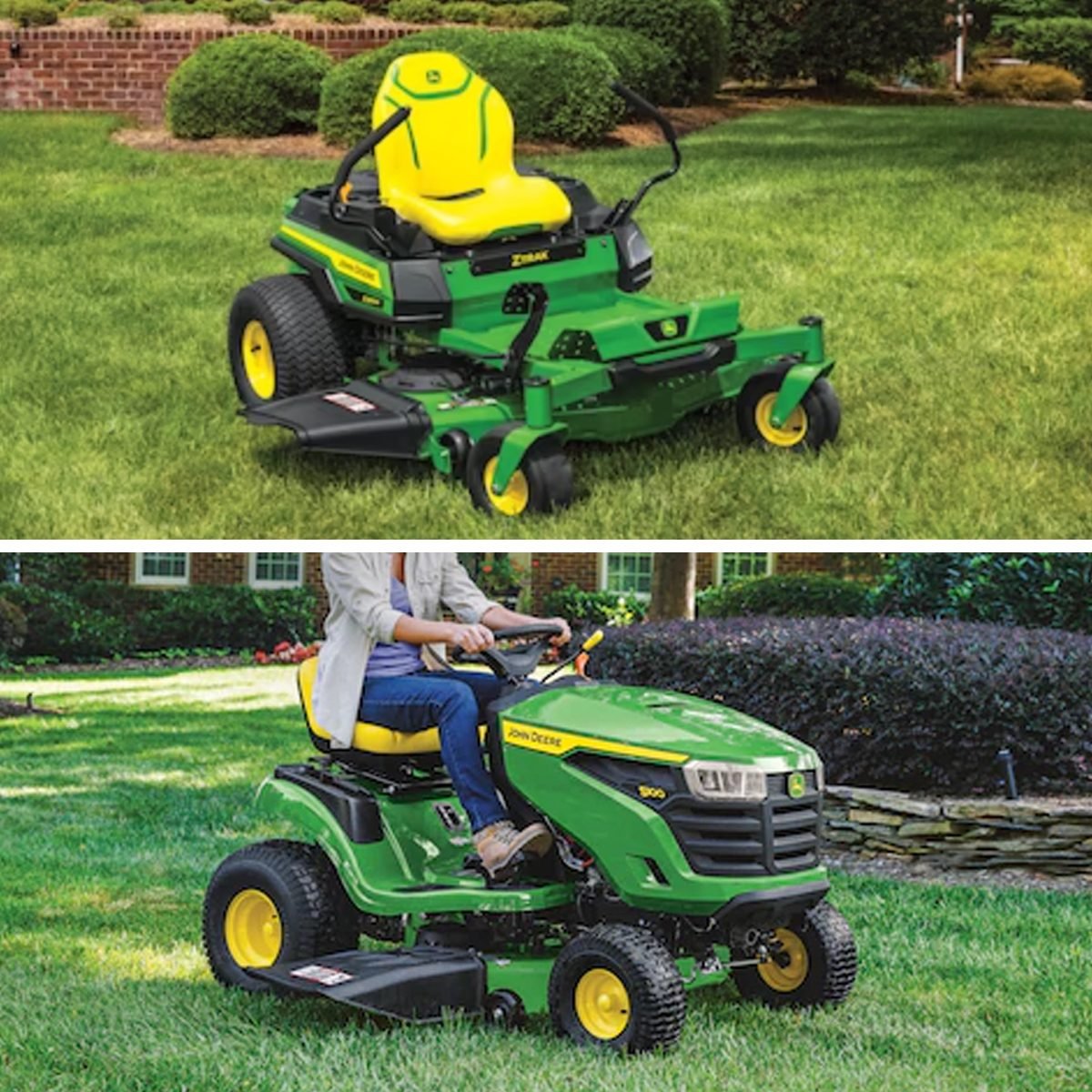
Compare Total Cost, Not Just the Purchase Price
The lowest sticker price may not be the lowest cost over several years. Include the cost of fuel or electricity, maintenance, blades, belts, tires, batteries, storage, and repairs.
A simple ownership estimate is:
Annual cost = energy + routine maintenance + wear parts + storage or service costs
For a gas mower, energy cost depends on fuel use and local fuel price. For an electric mower, include electricity and eventual battery replacement. Battery replacement cost can materially change the long-term value of an electric model.
Before buying, check:
- Length and coverage of the warranty
- Who performs warranty repairs
- Local dealer support
- Availability of belts, blades, filters, and batteries
- Cost of a replacement battery
- Service intervals
- Whether attachments are included or extra
- Return and delivery terms
A nearby service center may be more valuable than a small difference in engine size. Parts support also matters when a mower is several years old.

Use This Step-by-Step Buying Process
Follow this order to narrow your choices without relying on a brand name first.
Step 1: Measure the mowing area
Record the approximate acreage, narrowest gate, steepest slope, and number of obstacles.
Step 2: Remove unsuitable mower types
Exclude models that are too wide for your access route, exceed the slope guidance, or cannot fit your storage space.
Step 3: Select a mower category
Choose among a rear-engine rider, lawn tractor, garden tractor, zero-turn mower, electric rider, or walk-behind mower.
Step 4: Set a practical deck width
Choose the widest deck that can move safely through gates and around the areas you mow. A wider deck is useful only when it saves passes.
Step 5: Decide what else the machine must do
List towing, bagging, mulching, snow removal, and other needs. Confirm each attachment for the exact model.
Step 6: Inspect the operator station
Sit on the mower. Test the controls with the engine off when possible. Make sure you can see the deck and reach all controls without leaning.
Step 7: Check service support
Find the nearest authorized service location and price common wear parts. Ask how batteries, belts, blades, and warranty repairs are handled.
Step 8: Read the manual before paying
Download the owner’s manual if available. Check slope limits, fuel or charging rules, towing limits, maintenance, storage, and transport instructions.
Step 9: Compare the full cost
Add the mower, deck, bagger, charger, battery, delivery, ramps, fuel, and service items. Compare complete setups rather than base prices.
Common Buying Mistakes to Avoid
Several mistakes can lead to a mower that is hard to use or expensive to maintain.
Buying the widest deck that fits the budget
A wide deck may not fit through the gate or around trees. Measure first.
Choosing a zero-turn mower for steep ground
Zero-turn mowers are excellent on many open lawns, but their slope limits and traction vary. Read the manual and consider a tractor or another mowing method for difficult slopes.
Ignoring the storage route
A mower may fit inside the shed but fail at the door, ramp, or turn into the parking space.
Comparing only horsepower
Power does not tell you how well a mower turns, climbs, cuts, rides, or handles service.
Assuming electric means maintenance-free
Electric models avoid engine oil and some fuel-related maintenance, but they still need blade care, tire checks, deck cleaning, battery care, and electrical system support.
Using a tractor as a universal utility vehicle
Towing and attachments have limits. Stay within the manual’s rated capacity and never carry passengers unless the mower is designed and approved for them.
Skipping a manual review
The owner’s manual contains the model-specific rules that generic buying advice cannot provide. Read it before purchase, not after a problem occurs.

Best Mower Choice by Yard Type
Use this guide as a starting point:
- Small, flat suburban yard: Consider a rear-engine rider or a walk-behind mower.
- Open lawn of about 0.5 to 2 acres: A lawn tractor with a 42- to 48-inch deck may fit.
- Large, open lawn with many obstacles: Consider a zero-turn mower if the terrain and training needs are suitable.
- Property with moderate slopes: A lawn tractor may offer more familiar control, but verify the manual’s slope guidance.
- Property with heavy towing or snow work: Consider a garden tractor or a tractor specifically approved for those attachments.
- Quiet operation and no gasoline storage: Consider an electric riding mower after checking real mowing area, charging, and battery cost.
- Steep, rough, or divided terrain: A riding mower may not be the safest choice for every section. Use a walk-behind mower or hire a professional for difficult areas.

Frequently Asked Questions
What size riding mower do I need for 1 acre?
A 42- to 48-inch deck is a common starting range for one acre, but the best size depends on obstacles, gates, slopes, and storage. An open acre can support a wider deck. A tree-filled acre may be easier with a smaller deck or zero-turn design.
Is a lawn tractor or zero-turn mower better?
A lawn tractor is often more versatile for light towing and varied residential use. A zero-turn mower can reduce mowing time on large, open lawns with many obstacles. Terrain, slope, comfort with the controls, and attachment needs should decide the choice.
Are riding lawn mowers safe on hills?
They can be safe only within the limits set by the exact model and its manual. Wet grass, loose soil, holes, and sharp turns increase risk. Never use a general slope number from another mower as permission to operate on your property.
How long should a riding lawn mower last?
Service life varies with design, workload, storage, maintenance, and repair support. Regular oil or battery care, clean decks, sharp blades, correct tire pressure, and prompt repairs can help. A neglected mower may develop costly problems much sooner.
Should I buy a gas or electric riding mower?
Gas models can be practical for long mowing sessions, remote properties, and quick refueling. Electric models can reduce engine maintenance and noise but require adequate battery capacity, charging time, and a plan for battery replacement. Compare the complete ownership cost for your mowing area.
Can I use a riding mower to plow snow?
Only if the mower and snow attachment are designed and approved for that use. Check the manual, attachment compatibility, traction requirements, and any required tire chains or weights. Do not improvise a blade or exceed the machine’s limits.
Final Recommendation
To choose a riding lawn mower, begin with the property rather than the brand. Measure the grass area, gates, slopes, obstacles, and storage route. Then select the mower type, deck width, power system, and attachments that match those facts.
For many U.S. homeowners, a lawn tractor is the most flexible general-purpose option. A zero-turn mower can be better for fast work on a large, open lawn. A rear-engine rider may suit a compact property, while a garden tractor fits heavier towing and attachment needs. When terrain or safety limits do not fit a riding mower, a walk-behind mower or professional service may be the better choice.
The final step is simple: read the exact owner’s manual, confirm service support, and compare the full cost before you buy.


