


Top 10 Robotic Mower Rain Sensors & Smart Weather Solutions
Rain sensors are the unsung heroes of automated lawn care. Whether you’re using a robotic lawn mower or a traditional irrigation system, these clever devices prevent wasteful watering and protect your equipment from wet conditions. For robotic mowers specifically, rain sensing is a critical safety feature that stops mowing during precipitation, preventing clumping, soil compaction, and potential damage. In this roundup, we’ve tested and ranked the best rain sensors and weather-aware devices that work with or complement robotic mowing systems. From dedicated wireless sensors to smart soil monitors, these products help maintain a healthy lawn while saving water and energy.
Quick Product Comparison
Our Top 10 Robotic Mower Rain Sensor Reviews – Expert Tested & Recommended
1. Orbit 57069N Rain and Freeze Sensor for Sprinkler Controllers – Automatically Stops Watering During Rain or Freezing Conditions

The Orbit 57069N is a rugged, reliable rain and freeze sensor that works with most sprinkler controllers, including many robotic mower systems that integrate with irrigation setups. Its weather-resistant design and simple installation make it a top pick for anyone wanting automatic watering interruption during rain or freezing temperatures. The water-absorbing disks expand when wet, triggering your controller to pause operations—perfect for protecting both your lawn and equipment.
Key Features That Stand Out
- Compatible with most 24V AC irrigation controllers, including many robotic mower systems
- Dual-function: detects both rainfall and freezing temperatures
- Easy installation with included mounting bracket and wire
- Adjustable rainfall sensitivity (1/8″ to 3/4″)
- Weather-resistant construction for year-round outdoor use
Why We Recommend It
This sensor is a workhorse—simple, effective, and built to last. We love that it’s both a rain and freeze sensor, giving you year-round protection. The installation is straightforward, and it integrates seamlessly with many systems. For robotic mower owners who also have irrigation or want an external weather sensor, this is a versatile and affordable choice.
Best For
Homeowners with existing irrigation systems who want reliable rain and freeze detection, and robotic mower users looking to add weather-based automation to their setup.
Pros and Cons
Pros:
- Extremely reliable and durable in all weather conditions
- Dual rain and freeze protection in one device
- Simple, no-fuss installation with clear instructions
- Adjustable sensitivity lets you customize for your climate
Cons:
- Wired design may limit placement options compared to wireless
- Doesn’t connect directly to all robotic mower models without adapter
- No smartphone integration—basic on/off functionality only
Customer Reviews
Customer Review:
Work great, when it rains enough for my setting the lawn sprinklers Do Not come on. Easy to install just follow the easy well written instructions ! 😎 Saves water when it rains !
Customer Review:
Works as advertised , cost effective way to save water and not over water after rain.
2. RainBird RSD WR2 Hygroscopic Disc Replacement for Wireless Rain Sensors – Repair or Replace Sensor Discs Easily
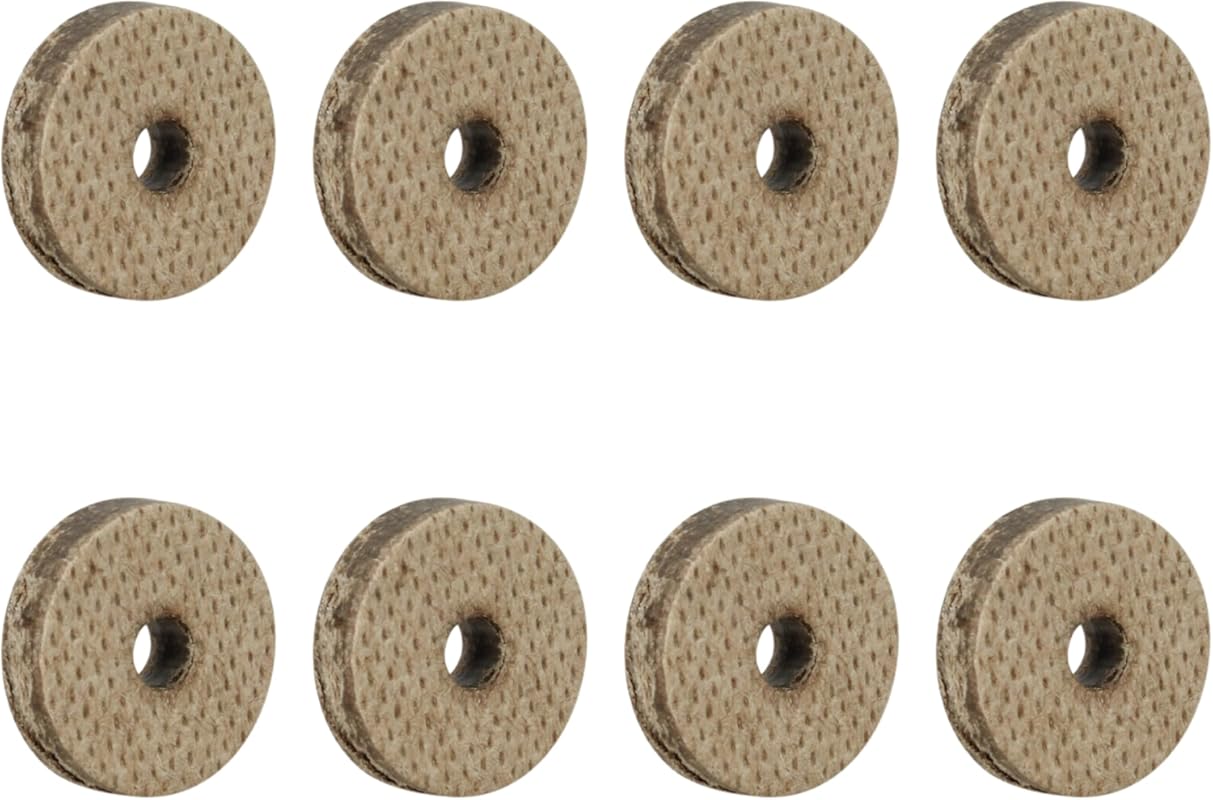
These replacement hygroscopic discs are designed specifically for RainBird’s RSD and WR2 wireless rain sensor systems. Over time, the discs can wear out or lose sensitivity, but instead of replacing the entire sensor, you can simply swap in these new discs. It’s an eco-friendly and cost-effective solution that extends the life of your existing wireless rain detection setup—ideal for robotic mower systems that use compatible sensors.
Key Features That Stand Out
- Direct replacement for RainBird RSD and WR2 wireless sensor discs
- Extends sensor life without full unit replacement
- Hygroscopic material expands quickly when exposed to moisture
- Pack of discs ensures you have spares on hand
- Maintains original sensor accuracy and response time
Why We Recommend It
We appreciate products that reduce waste and save money. These discs let you maintain your existing wireless rain sensor rather than buying a new one. The installation is simple—just open the sensor housing and replace the old discs. For anyone with a RainBird wireless system (common in many robotic mower integrations), this is a must-have maintenance item.
Best For
Owners of RainBird RSD or WR2 wireless rain sensors who need to restore sensor performance without replacing the entire unit.
Pros and Cons
Pros:
- Extremely affordable way to rejuvenate an old sensor
- Easy DIY replacement—no tools or expertise needed
- Keeps your existing sensor calibrated and working perfectly
- Reduces electronic waste compared to full replacement
Cons:
- Only compatible with RainBird RSD/WR2 models—not universal
- Doesn’t fix other potential sensor issues (battery, housing cracks)
- Discs can become brittle over time if stored improperly
Customer Reviews
Customer Review:
Did the job as I needed to replace the originals after 5 years
Customer Review:
Worked fine . Used to repair rain detector for irrigation system
3. RAINPOINT WiFi Soil Moisture Sensor – Wireless Soil Tester Compatible with TTV103WRF, TTV203WRF Timers and TWG004WRF Hub
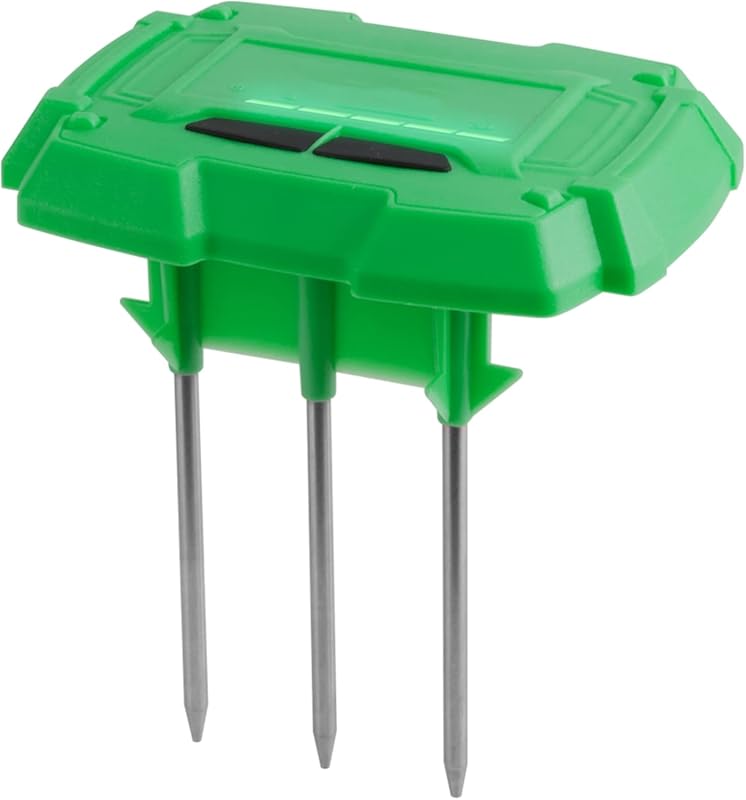
This smart soil moisture sensor goes beyond simple rain detection by measuring actual ground moisture levels. It connects via WiFi to the RainPoint app, allowing you to monitor soil conditions in real-time and set automated watering schedules based on precise data. While designed for the RainPoint timer system, its data can inform robotic mower operations—avoiding mowing when soil is too saturated. The 10-day history tracking helps you understand your lawn’s watering needs.
Key Features That Stand Out
- Measures both soil moisture percentage and temperature
- Wireless WiFi connectivity with smartphone app
- 10-day data history with graphical trends
- Automatically controls compatible RainPoint timers
- Long battery life with low-power design
Why We Recommend It
We love this sensor because it gives you actual soil data, not just rain detection. For robotic mower owners, knowing soil moisture helps prevent mowing in conditions that could damage grass or compact soil. The app integration is slick, and the ability to set custom thresholds (like “don’t water above 60% moisture”) makes it smarter than basic rain sensors. At this price, it’s a fantastic value for data-driven lawn care.
Best For
Tech-savvy gardeners who want detailed soil moisture data to optimize both irrigation and robotic mowing schedules.
Pros and Cons
Pros:
- Provides real-time soil moisture and temperature data
- App integration with customizable thresholds
- Long wireless range and reliable connectivity
- Great value for the amount of data it provides
Cons:
- Requires RainPoint hub/timer for full automation
- Soil probe must be placed in representative area
- App could be more intuitive for beginners
Customer Reviews
Customer Review:
I can not give enough praise to rainpoint for their wifi watering system.. This soil moisture sensor integrated effortlessly with the wifi water timer and the app.. It connected instantly on the first attempt and the connection is solid as a rock.. It has not disconnected one time.. I was able to program it using the app to turn on the garden irrigation system when the soil moisture level falls below 30% and it will turn off the irrigation system when the moisture level reaches 60%.. You can also program it to turn the water timer on and off based on soil temperatures if you’d like.. With the app, you can see real time soil moisture levels and soil temperatures.. It also plots all of that data for the last 10 days onto a nice little line graph.. It works so well that I just ordered a second soil sensor so that I will have one to control each zone of my wifi water timer.. This system changed the game for me.. No more guessing when to water the garden.. With this system the soil in my garden will always stay within the optimal moisture parameters for whatever crops that I’m growing.. I highly recommend this watering system..
Customer Review:
I really have no idea what the 1-star reviews are about. From the time the Amazon box arrived until the sensor was connected and displaying data took less than 10 minutes and it has been running for weeks without interruption. It’s about 100′ from the valve and the gateway device and connectivity hasn’t been a problem.The soil moisture values compare favorably with a different handheld meter I have, and the temp matches another thermometer +/- a degree or two. Programming the sensor for the desired soil level wasn’t hard if you read the directions and it’s been working correctly, delaying watering as long as the soil moisture is above the preset level.This is a great addition to my garden and drip irrigation system.
4. Hunter WRCLIK Rain Clik Wireless Rain Sensor – Auto Shutoff, Easy Mounting, Compatible with Irrigation Controllers
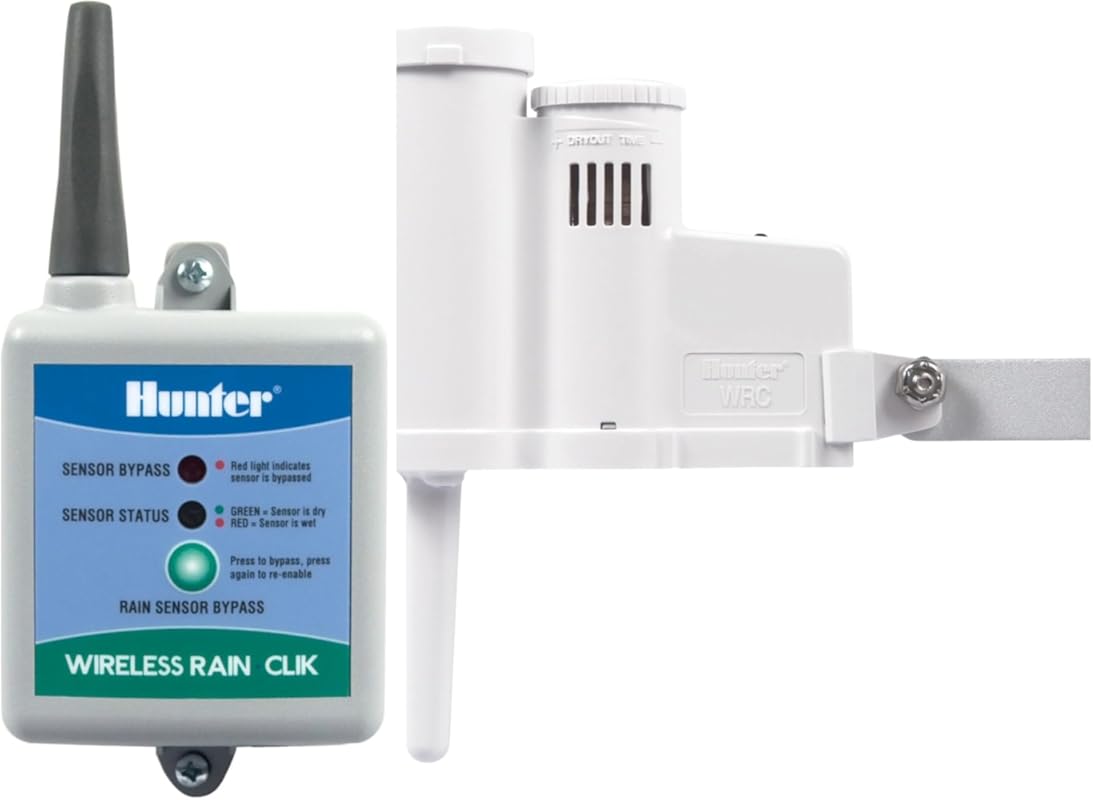
The Hunter WRCLIK is a wireless rain sensor that automatically shuts off your irrigation (or connected robotic mower system) when it detects rain. Its wireless design means no digging or trenching for wires—just mount it somewhere exposed to the sky (eaves, fence, or gutter) and pair with your controller. The sensor resumes normal operation once the drying cycle completes, making it a hands-free solution for water conservation.
Key Features That Stand Out
- Fully wireless—no power or communication wires needed
- Quick-pair technology for easy controller integration
- Adjustable rainfall sensitivity (1/8″ to 1″)
- Multiple mounting options (wall, eave, gutter)
- Low battery indicator and long battery life
Why We Recommend It
This sensor is incredibly user-friendly. The wireless setup is a game-changer—you can place it exactly where it needs to be without running wires across your yard. It pairs quickly with Hunter and many third-party controllers. For robotic mower users, if your mower’s base station supports external sensors, this could integrate nicely. The reliability and ease of use make it a top pick for hassle-free rain detection.
Best For
Anyone wanting a wireless, no-fuss rain sensor that works with a variety of irrigation and robotic mower controllers.
Pros and Cons
Pros:
- Truly wireless installation—mount anywhere with sky exposure
- Fast, simple pairing process with compatible controllers
- Durable construction that withstands all seasons
- Adjustable sensitivity for different rainfall amounts
Cons:
- Higher price than basic wired sensors
- Battery replacement needed every 1-2 years
- May require additional adapter for some robotic mower brands
Customer Reviews
Customer Review:
This rain sensor was easy to install and works great! I took it down for the winter with the irrigation system off, but don’t dread putting it back up on the gutter when we start the system up in the spring.
Customer Review:
Prevents overwatering and soil erosion by deactivating sprinkler during heavy rain fall.Easy to install and test.Operates flawlessly
5. Rain Bird CPRSDBEX Wired Rain Sensor with Mounting Bracket and Wire – Reliable Rain Detection for Irrigation Systems
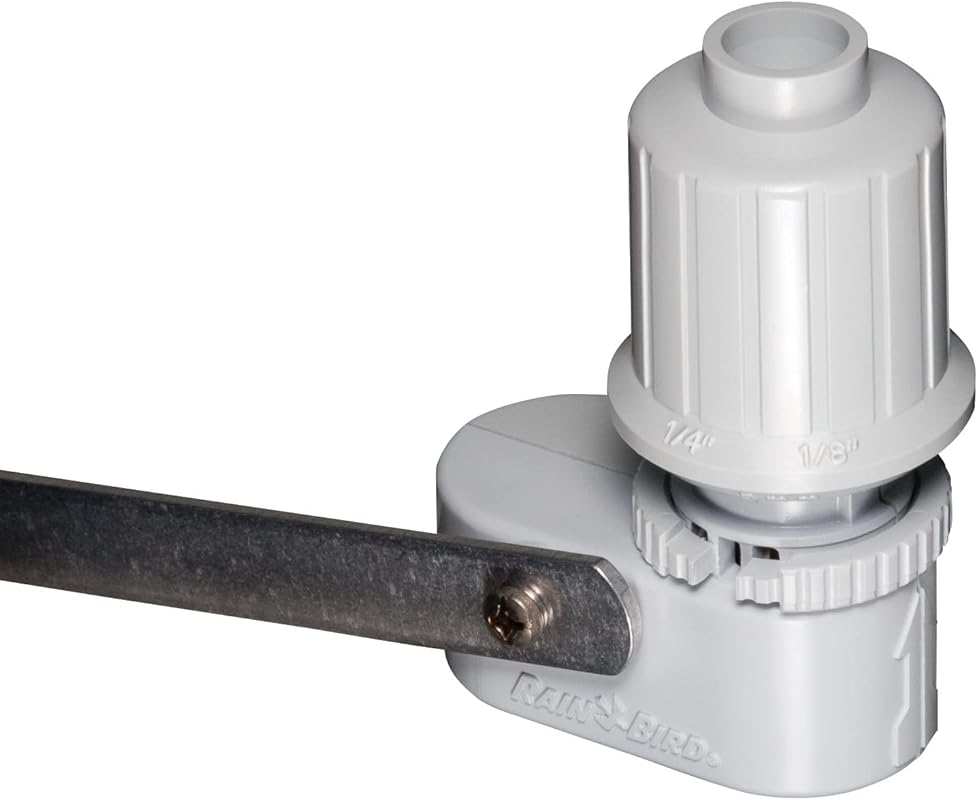
Rain Bird’s CPRSDBEX is a classic wired rain sensor that’s been a industry standard for years. It uses a hygroscopic disc that expands when wet, breaking an electrical circuit to stop irrigation. The included mounting bracket and wire make installation straightforward, and the adjustable dial lets you set the rainfall threshold from 1/8 inch to 3/4 inch. It’s a no-nonsense, reliable workhorse for any irrigation system, including those integrated with robotic mowers.
Key Features That Stand Out
- Proven hygroscopic disc technology for reliable rain detection
- Adjustable rainfall threshold (1/8″ to 3/4″)
- Includes mounting bracket and 25-foot wire
- Side vent ring for faster drying after rain
- Compatible with most 24V AC irrigation controllers
Why We Recommend It
Sometimes the simplest solution is the best. This wired sensor has no batteries to replace and no wireless pairing—just connect two wires to your controller and mount it. It’s incredibly reliable and has been used by professionals for decades. For robotic mower setups that have a wired sensor input, this is a plug-and-play solution that won’t fail.
Best For
Homeowners and professionals who want a simple, wired rain sensor with no batteries and proven long-term reliability.
Pros and Cons
Pros:
- No batteries required—truly maintenance-free
- Extremely reliable with simple mechanical operation
- Adjustable sensitivity via easy-turn dial
- Very affordable upfront cost
Cons:
- Requires running a wire from controller to sensor location
- Fixed location once wired—less flexible than wireless
- Discs may need replacement every few years in harsh climates
Customer Reviews
Customer Review:
Works perfectly with the rain bird ESPTM2 eight station controller. It’s easy to set up and mount and connect to the controller.
Customer Review:
Wish it would rain more so I could be sure it works… LOL!! It has rained a few times but it was downpours so I can’t say the adjustment works but I am sure it is fine. Easy install and good quality. I like it.
6. Rainbird Wireless Rain and Freeze Sensor System with Controller Interface – Includes 1 Sensor for Automatic Irrigation Shutoff
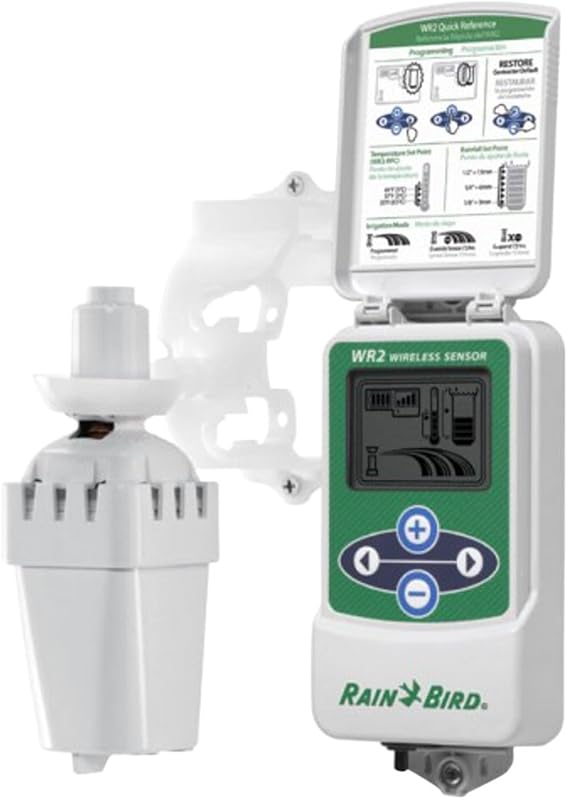
This Rainbird system combines both rain and freeze detection in one wireless sensor. It’s designed to integrate with Rainbird and many other irrigation controllers, automatically shutting down watering when rain is detected or temperatures approach freezing. The wireless design eliminates the need for wiring between the sensor and controller, and the install kit includes everything needed for mounting and setup.
Key Features That Stand Out
- Dual-function: rain and freeze detection in one unit
- Wireless communication up to 1,000 feet line-of-sight
- Adjustable rainfall threshold (1/8″ to 1/2″)
- Freeze shutoff adjustable from 33°F to 41°F
- Low battery indicator and long battery life
Why We Recommend It
We like this all-in-one solution because it handles two critical weather conditions. The wireless setup is convenient, and the long range means you can place the sensor in the optimal location (like under a tree canopy) without worrying about wire runs. For robotic mower systems that support external sensors, this provides both rain and temperature protection—important for avoiding mowing during frost conditions.
Best For
Users in climates with variable weather who want both rain and freeze protection without running wires.
Pros and Cons
Pros:
- Combines rain and freeze detection—great value
- Long wireless range for flexible placement
- Adjustable settings for both rain and temperature
- Reliable performance with quick response time
Cons:
- Not compatible with all Rainbird smart controllers (check model compatibility)
- Batteries need replacement every 1-2 years
- Higher cost than single-function sensors
Customer Reviews
Customer Review:
Worked seamlessly with my Toro controller. Install and setup was straight forward.Price was at the upper end of what I would pay.Had our first rainfall today and the unit worked flawlessly.
Customer Review:
Fully compatible with my Rainbird STP6PL irrigation controller. Easily installed and setup. Comes with everything needed to have success. Seems to be made from quality materials. World peace for sure was facilitated.
7. HiLetgo LM393 Rain Drops Sensor Module – Weather Moisture Monitor with Nickeled Plate, 3.3-5V for Arduino Projects
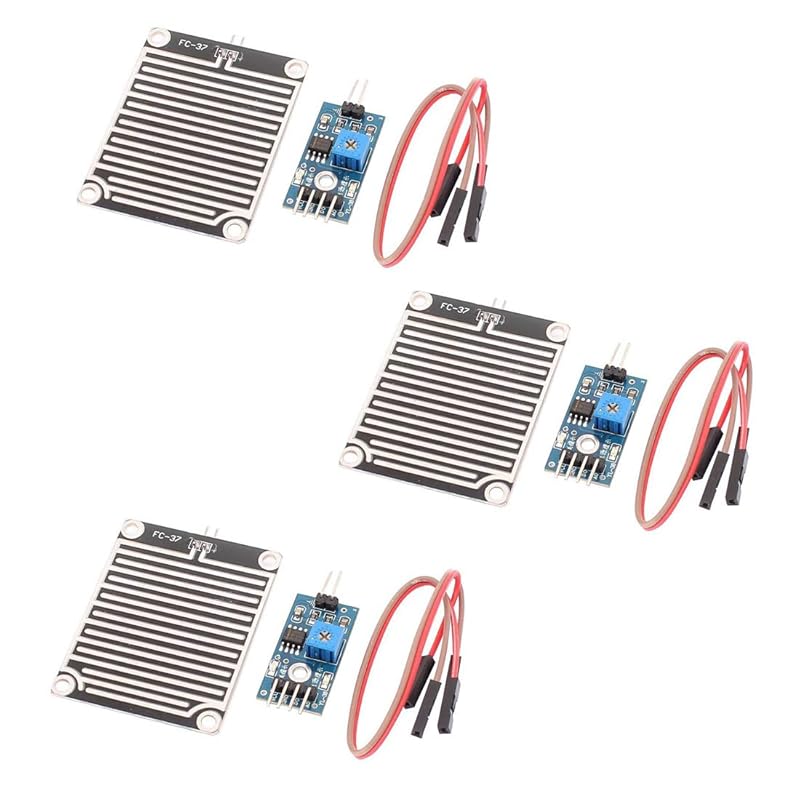
This is a DIY electronics module that detects rain through conductivity across a nickel-plated board. It’s not a plug-and-play rain sensor for commercial systems, but rather a component for hobbyists and makers. With both digital and analog outputs, it can be integrated into custom Arduino or Raspberry Pi projects—perfect for building your own robotic mower rain detection system or weather station.
Key Features That Stand Out
- Conductivity-based rain detection on nickel-plated board
- Both digital (rain/no-rain) and analog (moisture level) outputs
- Wide voltage range (3.3V-5V) for compatibility
- Separate sensor board and control board for flexible installation
- Comes as a 3-pack for multiple projects or redundancy
Why We Recommend It
For the tinkerer who wants to build a custom robotic mower or add rain sensing to an existing DIY project, this module is fantastic. It’s inexpensive, easy to interface with microcontrollers, and the analog output gives you granular control over sensitivity. While not for everyone, it opens up possibilities for smart weather automation that commercial sensors can’t match.
Best For
DIY enthusiasts, Arduino/Raspberry Pi hobbyists, and makers building custom robotic mowers or weather monitoring systems.
Pros and Cons
Pros:
- Extremely affordable—3 modules for the price of one commercial sensor
- Analog output allows adjustable sensitivity in software
- Simple to integrate with any microcontroller project
- No proprietary protocols—full control for developers
Cons:
- Requires programming and electronics knowledge
- Not weatherproofed—needs protective housing for outdoor use
- No certification for commercial irrigation systems
- Board can corrode over time if not maintained
Customer Reviews
Customer Review:
I picked up this 3-pack to tinker with a weather station project, and I’m genuinely impressed by the simplicity of the technology here. It’s fascinating that this little board can detect moisture just by measuring conductivity across the nickel-plated sensing plate—so basic, yet so effective.Using this with an Arduino was completely seamless. You get both digital (for a simple rain/no-rain signal) and analog (for moisture level) outputs, which gives you a ton of flexibility. Setup was just power, ground, and one signal pin; the whole thing took about five minutes.If you’re into DIY electronics, these modules are cheap, super easy to integrate, and they work right out of the box. A great little component for any moisture-sensing project.
Customer Review:
I’m building out a complete DIY wifi enabled weather station. This is one of the many sensors involved in the project and will provide one more data point. The product was shipped quickly and worked right out of the box. Not necessarily a multi-buy product, but if you’re looking for a good quality rain sensor for your DIY project, this is a good one.
8. M800Plus Cordless Robot Lawn Mower – GPS Navigation, APP Control, 4.0Ah Battery, Covers 1/5 Acre with Obstacle Avoidance
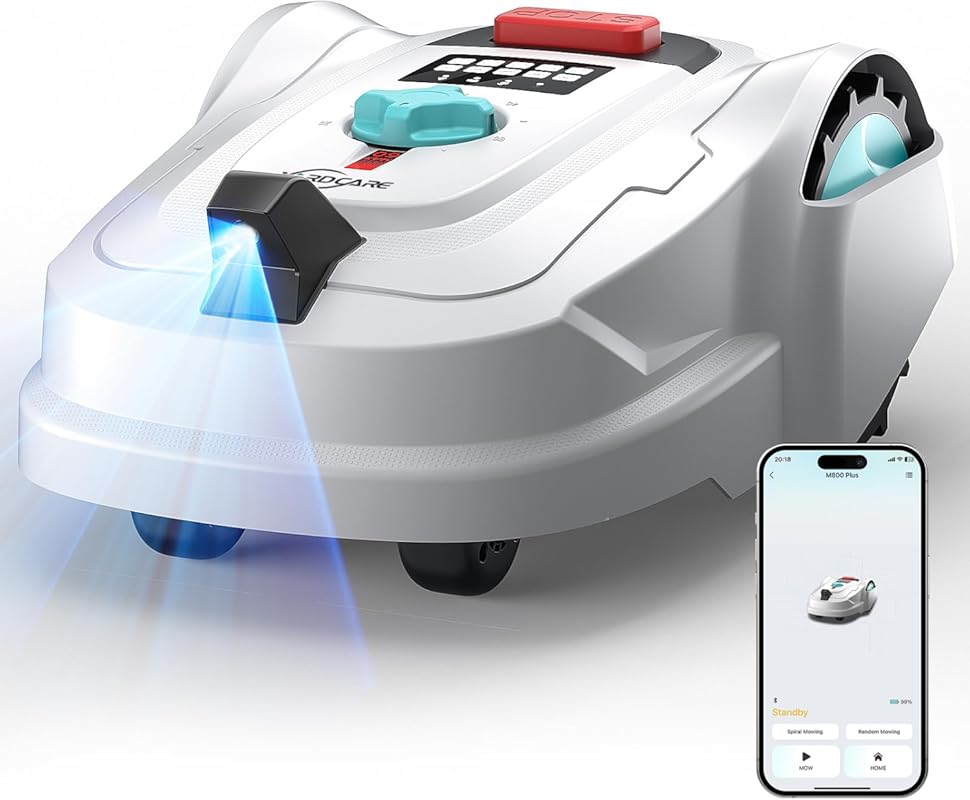
The M800Plus is a full-featured robotic lawn mower that includes built-in rain sensing as part of its weather protection system. While not a standalone rain sensor, it’s worth mentioning in this roundup because it demonstrates how modern robotic mowers integrate weather awareness. The mower has rain sensors that automatically stop operation during precipitation, and users can set rain delay timers in the app. It’s a complete solution for hands-free lawn care with intelligent weather response.
Key Features That Stand Out
- Built-in rain sensors that pause mowing during precipitation
- Adjustable rain delay timer (up to 24 hours) via app
- GPS navigation for efficient, systematic mowing patterns
- AI-powered obstacle avoidance with 135° camera
- Handles slopes up to 35% and complex terrain
Why We Recommend It
This mower represents the state-of-the-art in robotic lawn care, where rain sensing is just one part of a smart system. The integration is seamless—no extra sensors to buy or install. The app gives you control over rain sensitivity and delay times, which is more flexible than many standalone sensors. For anyone shopping for a robotic mower, having reliable built-in weather protection is essential, and the M800Plus delivers.
Best For
Homeowners with medium-sized yards (up to 1/5 acre) who want a complete robotic mower solution with intelligent weather sensing and no need for external sensors.
Pros and Cons
Pros:
- All-in-one solution—no external rain sensor needed
- App-based control over rain sensitivity and delays
- Excellent navigation and obstacle avoidance
- Handles challenging terrain and slopes well
Cons:
- Higher upfront cost than standalone sensors
- Rain sensor calibration not user-serviceable
- Requires WiFi for full app functionality
- Battery life may require mid-day charging in large yards
Customer Reviews
Customer Review:
I’m incredibly impressed with this robotic lawn mower! The visual navigation technology is a game changer—it easily detects and distinguishes lawn grass, making mowing both efficient and effortless. The obstacle avoidance system works flawlessly; it smoothly navigates around objects, and the collision sensors ensure it quickly adjusts its path if it bumps into anything.I also love the adjustable cutting height feature. The manual knob makes it simple to set the perfect grass length for my yard, and the results are always neat and even. It works best on clear-boundary lawns, and I appreciate the flexibility of placing it manually in any spots it might miss.Overall, this mower has taken the hassle out of lawn care and given me beautifully maintained grass with minimal effort. A fantastic investment for anyone looking to simplify their yard work!
Customer Review:
After testing this for nearly two months, I’m finally ready to share my thoughts. I previously tried two other robotic mowers, both more expensive and feature-rich on paper, but both ended up being returned because they just didn’t perform in reality.I chose the M800Plus for two main reasons: first, it’s for my fully fenced backyard, and second, about 40% of that yard has a 20-degree slope. After researching countless reviews, I decided on this model, and I can honestly say it’s been the best choice so far—especially considering the price.It offers easy installation, a reliable return-to-base function, and great cutting power. The app is also very simple and user-friendly. It might skip the fancy bells and whistles, but it stands out as a top-tier budget option—consistently reliable and impressively affordable.
9. Rain Bird WR2RFC48 Rain/Freeze Sensor Combo with 48-Hour Hold – Wireless Sensor for Irrigation Controllers
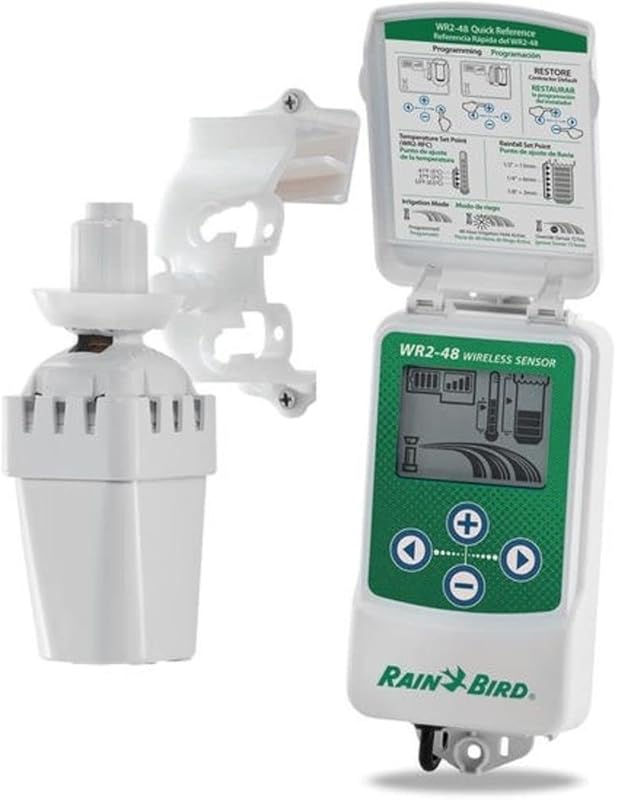
This Rain Bird combo sensor offers both rain and freeze detection with the convenience of wireless communication. The standout feature is the 48-hour hold function, which keeps your irrigation (or connected system) off for a full two days after rain stops—perfect for areas with slow-drying soil or for meeting local water conservation mandates. It’s a robust, professional-grade sensor that’s also suitable for integration with robotic mower systems that accept sensor inputs.
Key Features That Stand Out
- Combined rain and freeze detection in one wireless unit
- 48-hour rain hold feature for extended wet conditions
- Adjustable rainfall threshold (1/8″ to 1/2″)
- Freeze protection down to 33°F (adjustable)
- Long wireless range (up to 1,000 feet)
Why We Recommend It
The 48-hour hold is a game-changer for water conservation and preventing overwatering after prolonged rain. We’ve seen too many systems restart too soon, leading to soggy lawns. This sensor keeps things off until conditions are truly suitable. The wireless design and dual-functionality make it a premium choice, and it’s built to last with commercial-grade components.
Best For
Areas with heavy or prolonged rainfall, or regions with strict water usage regulations that require extended rain delays.
Pros and Cons
Pros:
- 48-hour rain hold prevents premature restarting
- Dual rain and freeze protection
- Wireless for easy installation anywhere
- Commercial-grade durability and reliability
Cons:
- Premium price point
- Hold time not adjustable below 48 hours
- Battery replacement required periodically
Customer Reviews
Customer Review:
Bought this is my new Rain Bird wireless controller. Linked up super easily. Like that it has a freeze sensor as well. Colorado weather changes within minutes so it’s nice to know this will shut down the system if it reaches unsafe temperatures. Happy with the purchase.
Customer Review:
Great replacement for original wireless rain sensor. Easy installation and works as advertised.
10. ECOVACS Goat Robot Lawn Mower Garage – Protective Storage Station for Your Robotic Mower, Weather-Resistant Design
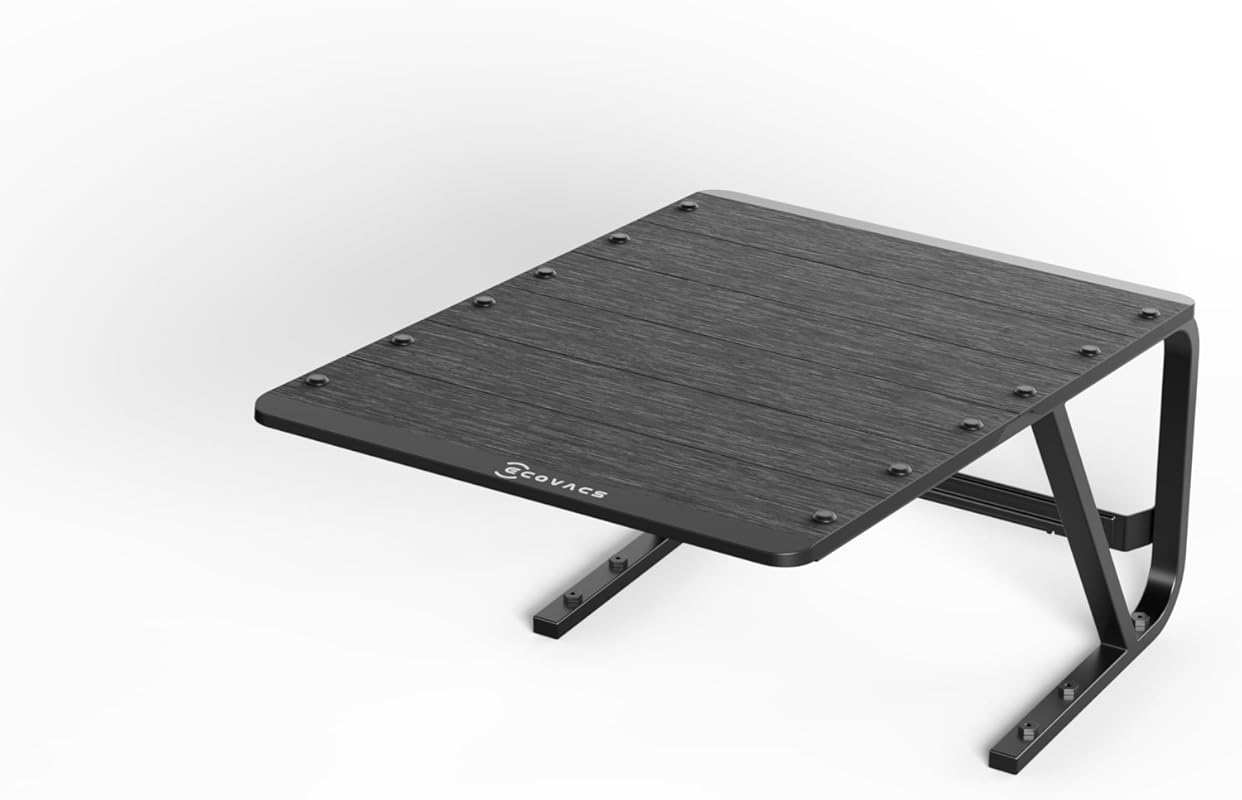
While not a rain sensor itself, this garage is an essential accessory for robotic mower owners, especially those concerned about weather protection. Designed specifically for ECOVACS GOAT O&A series mowers, this weather-resistant station provides safe storage when the mower is not in use. It shields the mower from rain, snow, and UV exposure, complementing the mower’s built-in rain sensors by offering physical protection during extended inclement weather.
Key Features That Stand Out
- Weather-resistant design protects from rain, snow, and sun
- Specifically designed for ECOVACS GOAT O1000 RTK, A2500 RTK, A3000 LiDAR models
- Provides secure docking and charging station
- Elevated base keeps mower off wet ground
- Easy access for mower to exit and return autonomously
Why We Recommend It
Even the best robotic mowers with rain sensors benefit from physical protection during storms or winter. This garage ensures your investment is shielded from the elements when not mowing. It’s especially valuable in regions with harsh winters or intense sun. For ECOVACS GOAT owners, it’s the perfect way to extend your mower’s lifespan and maintain performance year after year.
Best For
ECOVACS GOAT robotic mower owners in areas with extreme weather (heavy rain, snow, intense sun) who want to protect their mower when not in use.
Pros and Cons
Pros:
- Excellent weather protection for the mower
- Integrates seamlessly with GOAT mowers for automatic docking
- Keeps mower clean and out of sight
- Durable, all-weather construction
Cons:
- Only compatible with specific ECOVACS GOAT models
- Requires flat, stable surface for installation
- Additional cost on top of mower purchase
- May require anchoring in high-wind areas
Customer Reviews
Customer Review:
The media could not be loaded. After mowing my own lawn for 20 years, I’m finally taking a break.This mower is not just plug in and run. It takes some setup but this mower does a great job as long as you take the time to set it up correctly.I’ve run this mower 4x in my backyard and am pretty happy with it overall.SETUPSo there is a little bit of setup and planning required to set up this mower. The app will walk you through setup step-by-step which makes it easy. Essentially you leave this mower docked outside all the time. There are some screws to secure the dock to the yard, or you could dock it on concrete if it can drive easily to the yard or there is a small ramp.After that the satellite sensor needs to be plugged in and run to the halfway point in the yard. At first I was worried about the mower running over the cable but there are hooks to secure it low to the ground and out of the way so the mower can go over it in the yard without any issues. I made the decision to put the sensor up when I’m not using it, but that is a personal preference.SETUP IMPORTANT NOTESI had a few issues that I had to go back and fix before it mowed without missing spots. Map well, ensure the satellite sensor is not leaning, and my personal recommendation: Set the mower speed to Delicate, not Quick). Also, it isn’t going to tear through really tall grass, so make sure it is at a reasonable height before expecting it to keep your yard looking great. Since there is only one sessor I haven’t tried running it in my front yard too, but I suspect you would need to map the front and back all at once then split it into sections.MAPPINGTAKE YOUR TIME MAPPING. I used the manual mapping (although there is an auto-map function) and ended up doing it again after rushing it the first time. It recommends leaving space between the fence when mapping, but I’ve found that staying right up against the edge of the yard works best. You don’t have to have it right next to the yard since you can drive it to the starting point when mapping but it will need a clear path from the dock to the yard.I have some holes in my yard it got stuck in and was able to add “no-go” areas after the mapping was complete. You can either mark it directly on the map through the app, or even drive the mower to the no-go area manually. You can also split the yard into sections, mark sidewalks, etc. which will help with mowing large areas, certain sections, or generally scheduling mowing.MOWINGAfter fixing the issues mentioned above it did a fantastic job mowing my yard. I didn’t turn it over until the 4th run of mowing my backyard and realized the blades are small but VERY sharp, so be careful. This makes the mower extremely quiet to the point where I wasn’t sure if the blades were running until I saw the mowed grass behind the robot. You still need a weed-eater for edges against the fence and stuff like that (which is to be expected since you do that with a normal mower too.) I expected to have some issues with wet grass, but it did a surprisingly good job, although I don’t plan to run it right after rain. There is a setting to delay running until 3 hours after rain which is nice for scheduled tasks.APPThe app is helpful for setup, seeing the areas that have been mowed, etc. There are not a ton of settings, but there are some helpful things like auto-resume, obstacle avoidance sensitivity (flat ground, normal, high grass) and mowing direction. You can set it to mow along exact boundaries or edge mowing if you don’t map exactly it will get closer to edges (do not recommend it if you don’t have a fence separating your neighbors yard). There are also sensors for rain and pets that will automatically stop it.There are some extra settings that I don’t use but are nice to have like an anti-theft alarm and adding the location to Google maps.Overall this is a great little lawnmower compared to others that are 2x or 3x the price. It isn’t perfect and takes some time to set up but is worth it once it is up and running!
Customer Review:
The media could not be loaded. It’s been 3 weeks since I took delivery, and I’ve run it nearly every 3 days just to keep the grass consistent.After over a year of deliberation and research (and getting the grass to grow after a new build), it was time to buy a robot mower. I looked at every robot mower I could find and even watched over the last year as more than one startup failed. Even today, I wonder if the market has “settled”, and I think there may still be more robot mower companies than will survive over the next few years, but I am hopeful that ECOVAC is in for the long haul. ECOVAC has a few mower sizes, but for my sized yard the A3000 and the A2500 were the contenders. I opted for the A3000 to avoid the need for the RTK base station or the need to locate the base station where it would be ensured to get the satellites needed – There just wasn’t a good out-of-the-way spot with a good sky view and easy access to power (in spite of the generously long power cables).Our lot is a little over one-half acre and flat to gentle slope, and for the purposes of mowing, broken into four areas (see map picture). The front has a narrow strip on the west side that runs alongside the driveway and garage, up to a gate to the back. This gently slopes to the street, but part of it is a cliff to the neighbor’s yard, bordered with a concrete surface about 1 ft wide. The larger part of the front yard is gently sloping to the street with what is effectively a no-curb transition to the street and wraps around the house on the east side. Alongside the house is another gate from front to the backyard, which is fully fenced in. The fourth area is behind the backyard where the city has a large utility right-of-way, which is adjacent to another street. Unlike the front yard, the stretch of yard along this street is about 18-inche wide and about an 18-inch steep drop to the street.Key factors I considered included: lot size – cutting time, 2/4 wheel / tracks, cutting blade type, RTK antenna vs none, other online reviews, and absolutely no perimeter ‘wire’.Out of the box experience=========================I don’t have much to say about the grand opening of a packaging box. From my side, I see no need to praise a super fancy “experience” box that you throw away. That said, everything was well packed and came out easily – even w/o paying attention to the instructions. Assembly was easy as most things were completely obvious, and I only reviewed the guide to ensure I did not miss any important steps.Locating the Docking Station============================I had a couple of preferred places to choose from, one with a very convenient electric outlet, but crowding a walkway, and another that wasn’t in a walkway but without convenient power. I chose the latter as the walkway is used a lot. And the long power cord (on each side of the power brick) was generously long – so much of it coiled up. The place I chose puts the dock on a concrete pad (so the stakes used to drill into the ground to hold it in place could not be used). I actually haven’t done anything yet (after 3 weeks) – but have thought about laying down a bead of silicon caulking to stick the docking station down (see picture). The other aspect about the chosen location – it might not conform to the guide for the open space on 3 sides. But as I’ve watched it work its docking magic, it always succeeds.Mapping each Area=================I started with the auto-mapping option. In the fully fenced in area, it might have succeeded just fine, but the grass was quite tall. I had ignored the instructions recommending mapping after mowing the old-fashioned way, which would give the mower a better view of the terrain. With the tall grass, it occasionally wanted to take a diversion around one spot or another. I did try some manual intervention to back it to correct it, but in the end, I just mapped it all manually and I think I came out with a better map. And with three areas that had no clear boundary with the neighbor’s yard, I think I made the right call.The area behind the backyard fence was the next challenge, and I’ll admit, I struggled here for a couple of reasons. Taking the second challenge first – setting up a path to this area was a struggle. I guess I didn’t practice the path procedure enough to have it work well for me. Back to the first challenge, my concern was about how busy this street is. The steepest part of my yard is also the last stretch alongside the street. I wanted to manually map above that roll-off area (aka ‘small cliff’) so the mower wouldn’t find itself playing frogger in the traffic. I’ll just run the weed whacker on that edge from time to time, as grass doesn’t even grow there very well. Even my walk-behind often tried to tip over on that edge.There was one other problem – after I mapped the backyard, and the area behind the fence, the app “joined” those two areas. But I wanted them kept separate. I added a boundary where the fence was, but that didn’t seem to convince the app that these were two areas, so I added a second boundary nudged over just a tiny bit and then called the narrow strip down the middle a no-go zone. The vision system would have kept it from hitting the fence anyway – so really this was a small inconvenience in the mapping.Mowing Performance==================But what about the mowing performance? I can say it is doing great!I mentioned the grass was quite tall to begin with and even setting it up to the maximum height, it was still “work”. The main area of the backyard required a charge cycle about 1/2 way through it, and because the grass was so tall, it left wind rows. I changed the mowing direction and immediately ran it again, and that helped, knocking down the wind rows. But after the first week of keeping the grass at a shorter height, running it every few days, all evidence of that is gone, and it is doing a fine job.Even the area behind the fence is working well. The first few times I worried about it – so parked a lawn chair where I could just sit back and watch. Cars whizzing by as it drives toward the street, turning where I put the manual boundary. I’ve begun to trust it well enough to not have to sit and watch. But it does make some odd turns, like it is unsure which way to go – and this isn’t so comfortable to watch – and hoping it doesn’t make a bad move and end in the street.Once I got the lawn under control, it mows the full backyard in a single charge. And it mows the two areas in the front on a single charge. I have to open the gate for it to get outside the backyard, and I’ve usually better things to do that wait on it, so I generally just mow one area at a time, manually starting it. With this usage pattern, it always gets a chance to top off its charge.When it is mowing alongside the fence, it does a great job of hugging it pretty close, dodging out just a hair to swing around each fence post and then tucking back in along the panel sections.Connectivity============Some have expressed challenges with Wi-Fi connectivity, but for me, it has surpassed my expectation. My signal isn’t very strong at the extremes of my yard, and yet when sitting in the house, I not only see it moving on the phone-app map, but I can pull the video stream too, and it comes out quite clean – until just after dusk when it is quite grainy – but I easily forgive that. I didn’t expect that much reach, and that’s in all directions around the house, yard, and fence.Cleanup=======I don’t have much to say about this, it is water resistant, and I’ve hit it with a garden hose both topside and bottom side to keep it clean. With two dogs, the wheels needed a bit of additional attention – but all in all it was easy to clean.What could it do better?========================I’d like it to drive into the corners better. It cuts the corners, perhaps so it doesn’t have to back up. And some of the corners are not really corners – like a couple of areas bounded on three sides: a fence, the house, and a window well, or another spot between two window wells. Each is an area large enough for it to easily go into, if it backed out. I hope a future firmware update will give it that capability. And in two other corners, one is a 90-degree corner, and the other is even sharper – again if it could go into the corner and back out before making the turn that would reduce the trimming on my part.I’d also like to see it do a better job alongside the patio pavement. In the videos it will overlap the driveway and grass, and that is basically what I want here. But I haven’t figured out how to convince it to do so, so it leaves a narrow grass strip.I’d like to see it improve in some turning actions. It is kind of like an indecision when making a 180 turn (see the video). Most of the time it does this well, just a simple turn to run the other direction on the next track. But there are times when it just doesn’t seem to know which way to turn, so it turns partway one way and then spins the other way before it figures out how to finish the turn. When that’s alongside the street, especially the busy street, it is a bit disconcerting. I’d really like it to make those turns more consistently.Straight lines are quite good, but it’s like it ‘drifted’ a little over several days. Lines that were pretty much perfectly parallel to a fence were later on a few degrees off. The lines were still straight and parallel, so I’m confused on that. I did check how I had it set – and only to change directions weekly and not with any fractional angle.I would like more flexibility in the direction – sure, I can pick just about any direction, but there’s two settings I’d like to change – one is in the area alongside the busy street, I’d like to set it to always mow that area parallel to the street – it won’t worry me (or passing drivers) so much like when it headed straight for the street. And two, I’d like it to change directions more often than weekly. If each area could have independent settings for direction, change in direction, and how frequently, I think that would take care of this want.Automated gate opening/closing would be a great feature. I also recognize the difficulty of that with different gate styles, sizes, weights, and more. And of prime importance, it cannot let the dogs out. An alternative, in my case, would be automated garage door opening – I have an electric garage door at the front and the back and there’s a clear path between the two. This would have the convenience of the mower dock being in the garage (out of weather etc) and it would take the path it needed. But this doesn’t solve the escaping dog problem.Summary=======It’s only been three weeks since the A3000 appeared at my doorstep, but in that time it has performed very well. I’d say it has exceeded my expectation. This growing season is winding down, so it won’t have too many more weeks before I move it into the garage for the winter. I’ll need to read about the best practice for winter storage (in the garage, unplugged, ok, or does it need to be plugged in to keep the battery warm and healthy, and since I didn’t stake the dock, will I have to map again next spring). I also didn’t get the garage, but I’m thinking of picking one up over the winter.The bottom line – This is a premium mower, but that comes at a premium price. I’ve been watching the market for well over a year, and while I have had only a brief hands-on with one other brand, I’ve read about them all, watched numerous videos, evaluated their yards vs mine, and ultimately, I selected the ECOVACS Goat A3000, and I’m happy with that choice. From my side – recommended.
Complete Buying Guide for Robotic Mower Rain Sensor
Essential Factors We Consider
When choosing a rain sensor for your robotic mower or irrigation system, focus on compatibility, power source, and placement flexibility. Wired vs. wireless is a primary decision—wired sensors are more reliable and battery-free but require trenching; wireless offers easy installation but need battery changes. Rainfall sensitivity adjustment lets you customize for your climate—some areas need light rain detection, others only heavy downpours. For robotic mowers, ensure the sensor can communicate with your mower’s control system, either directly or through a compatible interface. Durability matters too—look for UV-resistant housings and corrosion-proof materials. Finally, consider extra features like freeze protection or smart home integration if they fit your needs.
Budget Planning
Rain sensors range from $20 for basic wired models to $150+ for advanced wireless combos with extended holds. For robotic mower integration, budget $50-$100 for a quality wireless sensor that pairs well with your system. If you’re building a DIY solution with modules like the HiLetgo, costs can be under $15 but require programming time. Remember that some high-end robotic mowers include built-in rain sensing, so you might not need an external sensor at all. Factor in any needed adapters or interface modules for compatibility.
Final Thoughts
A good rain sensor is a small investment that pays off in water savings, equipment protection, and lawn health. For most robotic mower owners, a wireless sensor like the Hunter WRCLIK or Rain Bird WR2RFC48 offers the best balance of ease and reliability. If you have a compatible system, the Orbit 57069N remains a timeless, budget-friendly workhorse. And if you’re tech-inclined, smart soil sensors like the RAINPOINT provide deeper insights. Match the sensor to your mower’s capabilities and your local weather patterns for the smoothest, most efficient automated lawn care.
Frequently Asked Questions
Q: Can I use a standard irrigation rain sensor with my robotic mower?
A: It depends on your mower’s design. Some cordless robotic mowers have a dedicated sensor input that accepts the same 24V AC signals as irrigation controllers. Others require a proprietary wireless sensor or don’t support external sensors at all. Check your mower’s manual for compatibility before purchasing.
Q: How do I install a wireless rain sensor for my robotic mower?
A: Mount the sensor in an open area exposed to the sky, away from trees or overhangs that could block rain. Pair it with your controller following the manufacturer’s instructions—usually involves putting both devices in pairing mode. Place the sensor within the specified wireless range (typically 500-1,000 feet). Test by simulating rain (spraying water on the sensor) to ensure it triggers a shutdown.
Q: Do robotic mowers need rain sensors if they have weather apps?
A: Yes, because weather apps rely on internet forecasts, which may not reflect hyperlocal conditions. A physical rain sensor on your property detects actual precipitation at your mower’s location, providing immediate, reliable response. Many modern mowers use both—app forecasts for scheduling and physical sensors for real-time interruption.
Q: What’s the difference between a rain sensor and a soil moisture sensor?
A: Rain sensors detect precipitation in the air/on the sensor surface, triggering immediate shutdown. Soil moisture sensors measure water content in the ground, which is better for irrigation scheduling but has a delay—soil stays wet after rain stops. For robotic mowers, rain sensors are more responsive to current conditions; soil sensors can complement them by preventing mowing on saturated ground even without recent rain.
Q: How long do rain sensor batteries last?
A: Most wireless sensors use lithium batteries that last 1-3 years depending on model and climate. Some report battery life in the app. Wired sensors like the Orbit 57069N have no batteries. For Husqvarna robotic mowers with proprietary wireless sensors, check the manual for specific battery replacement intervals.
Conclusion: Stay Dry, Mow Smart
Rain sensors are a small but mighty addition to any automated lawn care setup. Whether you’re protecting a virtual boundary robotic mower or a traditional sprinkler system, these devices prevent waste, protect your equipment, and keep your grass healthier. Our top pick, the Orbit 57069N, offers unbeatable reliability and dual rain/freeze protection at a great price. For wireless convenience, the Hunter WRCLIK is a breeze to install. And if you want smart soil data, the RAINPOINT WiFi sensor delivers impressive insights.
Remember that many modern robotic mowers already include built-in rain sensing, so check your mower’s features before buying an external sensor. But if you need to add or upgrade weather protection, any of these top 10 products will serve you well. Choose based on your compatibility needs, preferred power source, and budget.
Ready to upgrade your lawn care?
Click the “Check Price on Amazon” buttons above to see the latest deals and availability. Most of these sensors are in stock and ready to ship, so you could be enjoying smarter, weather-aware mowing within days!
