How Much Does An Electric Riding Lawn Mower Cost: Prices
In the United States, an electric riding lawn mower usually costs about $2,500 to $7,000 before tax, delivery, and accessories. Basic electric lawn tractors often fall near $2,500 to $4,000, while larger models and electric zero-turn mowers commonly cost $4,000 to $7,000 or more.
A complete purchase may cost more than the mower alone. Homeowners may also need a charger, delivery, a spare battery, a storage solution, or electrical work. Even so, an electric riding mower can cost less to run than a gas model because it uses no gasoline or engine oil and needs less routine service.

Electric Riding Mower Prices in the United States
The mower type has the greatest effect on price. Electric lawn tractors are often the least expensive riding models. Zero-turn mowers usually cost more because they use larger cutting decks, stronger drive systems, and more complex steering controls.
| Electric riding mower type | Typical U.S. price range | Best fit |
|---|---|---|
| Entry-level electric lawn tractor | $2,500–$3,500 | Small to medium lawns |
| Mid-range electric lawn tractor | $3,500–$5,000 | Larger residential lawns |
| Electric zero-turn mower | $4,000–$7,000 | Open lawns and faster cutting |
| Premium electric zero-turn mower | $7,000–$12,000+ | Large properties and heavy use |
| Used electric riding mower | $1,500–$6,000+ | Buyers willing to check battery health |
These are practical retail estimates, not fixed prices. A sale, local dealer promotion, delivery fee, or battery package can change the final amount. Prices also vary by state, dealer, deck size, battery capacity, and warranty coverage.
What is included in the advertised price?
Most new electric riding mowers include the mower and its main traction battery. Some include a charger, while others list the charger separately. Read the product page and owner’s manual before comparing prices.
Check whether the quoted price includes:
- The main battery or battery pack
- A compatible charger
- A grass-catching bagger
- Mulching blades or a mulch plug
- Delivery and assembly
- Battery and mower warranties
- Local sales tax
- Disposal of an old mower
A mower advertised at $3,000 may be a better value than one priced at $2,700 if the first model includes a charger, delivery, and a longer battery warranty.

What Makes an Electric Riding Lawn Mower More Expensive?
Battery capacity, cutting width, drive design, and build quality are the main price drivers. A mower with a larger battery can often cover more ground per charge, but the added cells increase the purchase price and replacement cost.
Battery size and runtime
Battery capacity is often shown in kilowatt-hours, or kWh. A larger battery stores more energy. It may also support a wider deck or longer mowing session.
Manufacturers may report runtime under set conditions, such as flat grass, a specific blade speed, and a stated mowing load. Real runtime can be lower when:
- Grass is wet or tall
- The deck is set low
- The yard has slopes
- The operator uses a high blade-speed setting
- The battery is cold or aged
- The mower carries a heavy load
Do not compare runtime claims without checking the test conditions. A mower that runs for two hours in light, dry grass may run for much less time in thick spring growth.
Cutting deck width
a wider deck can reduce mowing time, but it often raises the price.
Common residential deck sizes include:
- 30 to 36 inches: Tight yards and narrow gates
- 42 to 48 inches: Typical suburban lawns
- 50 to 60 inches: Large, open properties
A wider deck is not always better. Measure gates, storage doors, bridges, and narrow lawn paths before buying. A 54-inch mower is of little use if it cannot reach half the yard.
Lawn tractor or zero-turn design
An electric lawn tractor uses a steering wheel and behaves much like a traditional riding mower. It may be easier for new operators to learn and can suit yards with trees, garden beds, and narrow areas.
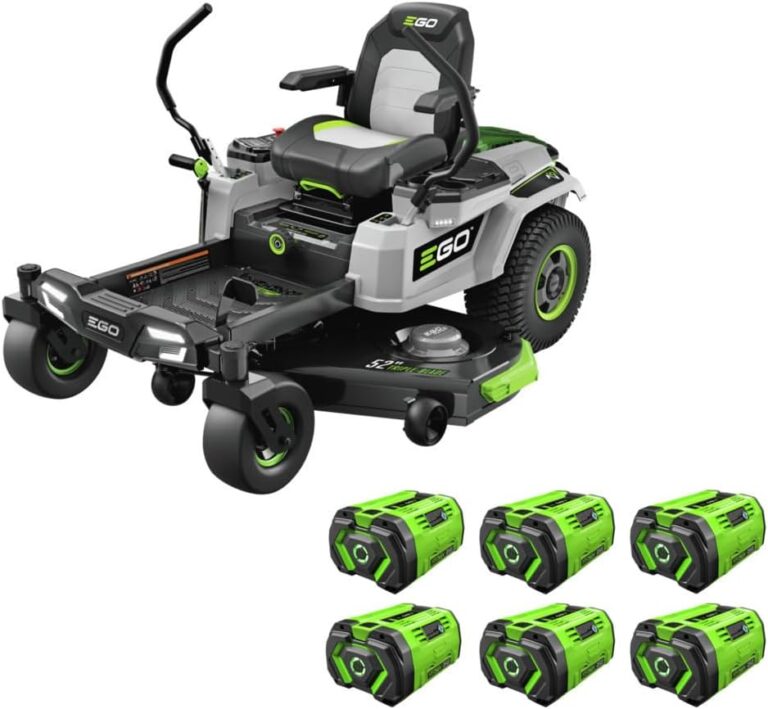
A zero-turn mower uses two drive wheels and separate control levers. It can turn around nearly in place and may cut open lawns quickly. Zero-turn models often cost more and may be less comfortable on steep slopes or uneven ground.
Motor, frame, and drive system
The motor itself is only one part of the cost. A mower with a strong frame, heavy deck, serviceable wheels, and a well-supported drive system may cost more up front.
Look for clear specifications for:
- Motor warranty
- Battery warranty
- Deck material
- Maximum slope rating
- Drive system warranty
- Replacement battery availability
- Local repair support
A low price is less useful if the battery or control system is hard to replace.

How Much Does It Cost to Run an Electric Riding Mower?
Electric riding mower charging usually costs well under $1 per full charge for many residential models. The exact amount depends on battery size, local electricity rates, charging losses, and how often the mower is used.
Use this formula:
Charging cost = battery capacity in kWh × local electricity rate × charging loss factor
A charging loss factor of about 1.10 to 1.20 can be used for a rough estimate. It accounts for energy lost during charging.
Hypothetical charging example
Suppose a mower has a 10-kWh battery and electricity costs $0.18 per kWh:
- Battery energy: 10 kWh
- Electricity rate: $0.18 per kWh
- Charging loss factor: 1.15
10 × $0.18 × 1.15 = $2.07 per full charge
This example is not a universal cost. Many smaller batteries will cost less to charge. Some larger mowers may cost more.
To estimate yearly charging cost, multiply the cost of one full charge by the number of full charge cycles used each year. If the mower uses half a charge for each cut, two mowing sessions equal about one full cycle.
Electric versus gas operating costs
Gas mowers have fuel, oil, filters, spark plugs, belts, and engine service costs. Electric mowers remove most of those engine-related expenses.
Electric mower costs can include:
- Electricity
- Blade sharpening or replacement
- Tire replacement
- Drive belt or gearbox service, depending on design
- Battery replacement after years of use
- Charger replacement
A gas mower may be cheaper to buy in some cases. An electric mower may be cheaper and simpler to operate over time. The better value depends on purchase price, annual mowing hours, local fuel and electricity rates, and battery life.
Battery replacement cost
The battery is the most expensive long-term part of many electric riding mowers. A replacement pack may cost roughly $1,000 to $4,000 or more, depending on the brand, voltage, capacity, and mower size.
This is a wide range because battery designs are not standardized. Some lawn tractors use modular packs. Others use a large built-in pack that must be replaced as one unit.
Before buying, find out:
- Whether the manufacturer sells replacement batteries.
- The current replacement price.
- Whether an authorized dealer can install the pack.
- The length and terms of the battery warranty.
- Whether the battery can be removed for indoor storage.
- Whether the company still supports the model.
Do not assume that every lithium-ion battery will last the same amount of time. Heat, deep discharge, long storage at full charge, and heavy use can affect battery aging.

Total Cost of Ownership: A Simple Five-Year Example
The purchase price does not tell the full story. A five-year estimate can show whether a higher-priced mower fits your use.
Consider this hypothetical example:
| Cost item | Electric mower | Gas mower |
|---|---|---|
| Purchase price | $4,500 | $3,500 |
| Charging or fuel over five years | $300 | $1,200 |
| Routine service over five years | $400 | $1,000 |
| Battery replacement | $0 in this example | Not applicable |
| Estimated five-year total | $5,200 | $5,700 |
This example is for comparison only. It does not predict the cost of any particular model. The electric mower costs more at the start, but lower energy and service costs narrow the gap.
A different result is possible if the electric mower needs a replacement battery during the five-year period. The gas mower may also need a costly repair, such as a transmission, carburetor, or engine component.
A better way to compare models
Use the same ownership period for both machines. Include:
- Purchase price
- Sales tax
- Delivery and setup
- Charger
- Fuel or electricity
- Maintenance
- Battery replacement
- Storage needs
- Expected resale value
Then divide the estimated total by the number of years you expect to own the mower.
Estimated annual cost = total ownership cost ÷ years of use
This figure will not be exact, but it makes different purchase prices easier to compare.
Are Electric Riding Mowers Worth the Higher Upfront Cost?
An electric riding mower may be worth the price for homeowners who mow often, want lower noise, or prefer to avoid gasoline and engine maintenance. It may be less attractive for very large properties if the available battery cannot cover the full lawn in one session.
Electric models may make sense when:
- Your lawn is within the mower’s rated cutting area.
- You have a safe, dry place to store and charge the mower.
- Your electrical service can support the charger.
- Local dealers can service the mower.
- You plan to keep it for several years.
- You value quieter operation and fewer engine parts.
A gas mower may still be practical when:
- You mow very large acreage.
- You need to work far from a charging location.
- You use the mower for long commercial shifts.
- The local dealer network does not support electric models.
- The purchase budget is limited.
- You regularly mow steep or rough ground outside the electric model’s rating.
Electric does not mean maintenance-free. Blades still need care, tires can lose air, and the deck must be cleaned according to the manual. Battery equipment also needs protection from water, extreme heat, and improper storage.

Extra Costs to Include in Your Budget
The mower price is only the first line on the receipt. Add these possible costs before deciding what you can afford.
Charger
Some models include a charger. Others require a separate charging unit. A faster charger may cost more but can reduce downtime.
Check the charger’s:
- Voltage and amperage
- Indoor or outdoor rating
- Required outlet
- Cord length
- Charging time
- Compatibility with the mower battery
Do not use a charger that the manufacturer has not approved.
Delivery and assembly
Large riding mowers may require freight delivery or dealer assembly. Delivery and setup can add hundreds of dollars, especially when the mower is purchased online.
Ask who will:
- Unload the mower
- Assemble the seat and controls
- Install the steering wheel
- Check tire pressure
- Test the cutting deck
- Explain charging and storage
Bagger and attachments
A grass bagger, snow blade, cart, spreader, or tow-behind attachment may cost extra. Confirm that the mower can power or safely tow the attachment.
Attachments can also reduce runtime by adding weight or increasing load on the motor.
Electrical work
Most home chargers use a standard outlet, but some charging systems may need a dedicated circuit. Have a licensed electrician check the installation if the manual calls for new wiring or if the outlet is outdoors.
Never use a damaged cord, overloaded outlet, wet extension cord, or improvised adapter.

How to Choose the Right Price Range
Start with the lawn, not the advertised discount. The least expensive mower that meets your property’s needs is often the best value.
For lawns under about one-half acre
A small electric riding mower may be enough if the terrain is fairly open. A 30- to 42-inch deck can work well for many compact properties. Check the mower’s minimum turning space and battery coverage.
For lawns around one-half to two acres
A mid-range lawn tractor or zero-turn mower may be more suitable. Battery capacity becomes more important, especially if the grass grows fast or the lawn has slopes.
For larger properties
Focus on usable runtime, charge time, battery replacement cost, and service support. A mower that needs several charges to finish the lawn may create more frustration than savings.
Manufacturers use different definitions for acres per charge. Treat the advertised number as a starting point, not a guarantee.
For sloped land
Read the manual’s slope limits before buying. Riding mowers can become unstable on slopes, especially during turns or when grass is wet.
A zero-turn mower is not automatically safer on hills. Its steering design may improve maneuverability on flat ground but can require careful operation on slopes. Follow the manufacturer’s instructions and avoid any terrain outside the stated limits.

Buying Tips That Can Prevent Expensive Mistakes
Use a written checklist before paying. It can reveal costs that are easy to miss on a product page.
Check battery and charger compatibility
Some brands use different battery systems for handheld tools and riding mowers. Do not assume that a battery from a string trimmer will fit a riding mower.
Confirm the exact model number for the mower, battery, and charger.
Read the warranty terms
A warranty may cover the mower for one period and the battery for another. Look for exclusions related to:
- Commercial use
- Water damage
- Improper storage
- Unauthorized repairs
- Normal capacity loss
- Consumable parts
A warranty is useful only if you know who provides service and where repairs are handled.
Check local service support
Ask nearby dealers whether they service the exact model. Online-only support may be acceptable for some buyers, but major battery, drive, or electronic repairs can require trained technicians.
Measure your property
Measure:
- Narrow gates
- Storage doors
- Mower paths
- Turning areas
- Bridges
- Slopes
- Charging locations
Also check the mower’s width with the discharge chute installed. The total width may be greater than the deck width.
Inspect a used mower carefully
For a used electric riding mower, ask for:
- The purchase date
- Original receipt
- Battery service history
- Charge time
- Cutting runtime
- Warranty transfer rules
- Error codes
- Charger model
- Reason for sale
Test the mower under load if possible. A short ride around a driveway may not show a weak battery. A battery that drops quickly under cutting load may need replacement.

Common Mistakes to Avoid
Comparing only the sticker price
A low price may exclude the charger, delivery, bagger, or battery. Compare the complete ready-to-mow cost.
Trusting maximum runtime without conditions
Runtime depends on grass, slope, blade speed, temperature, and operator habits. Use the manufacturer’s estimate as a range.
Ignoring battery replacement
The battery can be the largest future expense. Find its replacement price before buying the mower.
Storing the mower in poor conditions
Do not leave the mower or battery exposed to rain, extreme heat, or freezing conditions unless the manufacturer allows it. Follow the manual’s storage charge instructions.
Using the mower outside its limits
Do not exceed the rated slope, towing weight, cutting height, or operating conditions. Keep people and pets away from the cutting area.
Assuming quieter means risk-free
Electric motors are quieter than gas engines, but blades, wheels, and moving parts remain dangerous. Remove the key, stop the blades, and follow the manual before cleaning or servicing.

Frequently Asked Questions
How much does a cheap electric riding lawn mower cost?
A basic new electric riding mower commonly costs around $2,500 to $3,500 in the United States. A used model may cost less, but battery condition can change the true value. Always price a replacement battery before buying used.
Do electric riding mowers save money?
They can save money on fuel and routine engine service. The savings may be reduced by a higher purchase price or a future battery replacement. Compare the expected five-year cost rather than only the price at checkout.
How long does an electric riding mower battery last?
Battery life varies by chemistry, usage, storage, heat, and charging habits. Many batteries are designed for repeated seasonal use, but manufacturers differ in their warranties and capacity claims. Ask for the battery warranty and replacement price for the exact model.
Can an electric riding mower cut one acre on one charge?
Some can, but the answer depends on battery size, deck width, terrain, grass height, and the manufacturer’s test conditions. A flat, dry lawn may require less energy than a sloped lawn with thick grass. Choose a model with reserve capacity rather than relying on a best-case runtime claim.
Does an electric riding mower need a special outlet?
Some models charge from a standard household outlet, while others may need a dedicated circuit. Follow the owner’s manual. If new wiring is needed, use a qualified electrician.
Are electric riding mowers safe on hills?
Only within the slope limits listed in the manual. Wet grass, side hills, sharp turns, and uneven ground can increase the risk of losing control. Never assume that a zero-turn model is safe on every slope.
Conclusion
The typical U.S. cost of an electric riding lawn mower is $2,500 to $7,000, with premium zero-turn models reaching $12,000 or more. The right budget depends on deck width, battery capacity, lawn size, terrain, warranty, and local service support.
For a fair comparison, calculate the full ready-to-mow price and estimate five-year ownership costs. Before buying, confirm the mower’s real-world coverage, charger requirements, replacement battery price, storage conditions, and slope rating.