
How To Choose The Right Size Lawn Mower: Easy Guide
Choosing the right lawn mower size starts with your mowable lawn area, not the total size of your property. A small, level U.S. yard with gates and flower beds may need a 20-inch push mower. A half-acre open lot may be easier with a 42-inch riding mower. Large American properties may benefit from a wider riding mower or zero-turn mower.
The best choice also depends on slopes, trees, garden beds, storage space, grass height, and how often you mow. A larger deck can reduce mowing time, but it may be harder to steer, store, transport, and use safely.
This guide explains how to choose the correct mower size, deck width, mower type, and power source for your yard.

Quick answer: Match mower size to mowable lawn area
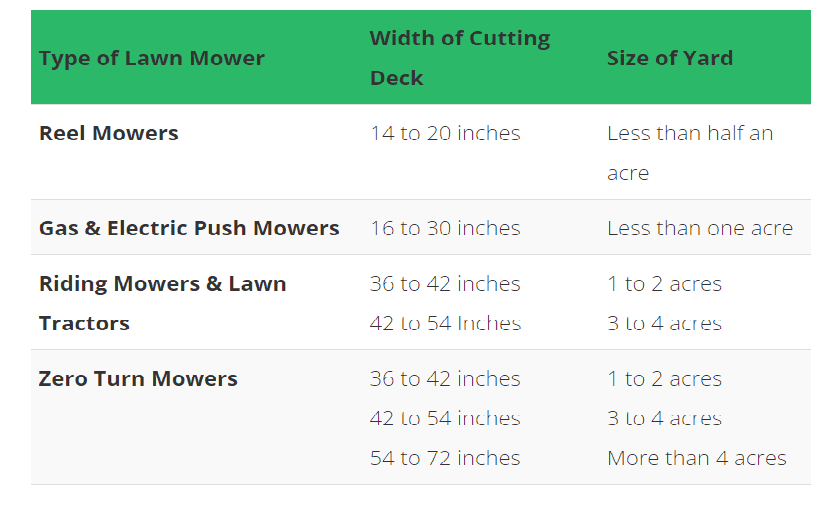
Use this table as a starting point. The ranges are practical guidelines, not strict rules.
| Mowable lawn area | Usually suitable mower | Common deck or cutting width |
|---|---|---|
| Under ¼ acre | Push or self-propelled mower | 18–22 inches |
| ¼ to ½ acre | Self-propelled mower or small riding mower | 21–42 inches |
| ½ to 1 acre | Riding mower or lawn tractor | 38–48 inches |
| 1 to 2 acres | Lawn tractor, garden tractor, or zero-turn mower | 42–54 inches |
| More than 2 acres | Larger riding mower or zero-turn mower | 48–72 inches |
These ranges assume a reasonably clear lawn. A flat, open half-acre can suit a riding mower. A half-acre with narrow gates, steep slopes, and many trees may be easier with a walk-behind mower.
For most U.S. homeowners, the main decision is simple:
- Choose a walk-behind mower for smaller yards and tight spaces.
- Choose a self-propelled mower when the lawn has slopes or the mower feels heavy to push.
- Choose a riding mower when mowing takes a long time or the lawn is about ½ acre or larger.
- Choose a zero-turn mower for large, open yards with many obstacles and few steep slopes.
Do not buy the widest mower that fits your budget. Buy the widest mower that fits your lawn, storage area, gates, terrain, and skill level.
Measure the lawn before choosing a mower
Measure the area that you actually mow. Do not use your full lot size if your property includes a house, driveway, patio, pool, woods, or other areas that do not need cutting.
Find the mowable area
For a simple rectangular lawn:
Length × width = square feet
For a square lawn:
Side length × side length = square feet
Then convert square feet to acres:
Square feet ÷ 43,560 = acres
Example calculation
Suppose a lawn is 120 feet long and 80 feet wide:
- 120 × 80 = 9,600 square feet
- 9,600 ÷ 43,560 = about 0.22 acre
That yard falls under ¼ acre. A push mower or self-propelled mower will usually be more practical than a riding mower.
For an irregular lawn, divide the space into smaller rectangles. Measure each section, calculate its area, and add the results. You can also use a property map or a measuring feature in a mapping app, but check the result against the areas you can actually mow.
Measure gates, paths, and storage areas
A mower may fit the lawn but fail at the gate or shed door. Measure:
- The narrowest gate opening
- Shed or garage doors
- Walkways and bridges
- Trailer ramps, if you will transport the mower
- Turning space near fences and landscaping
Add clearance for your hands, wheels, discharge chute, and any side attachments. A mower deck that is nearly as wide as the gate can be difficult to move without scraping posts.

Choose the right mower type for your yard
Mower type affects size, control, speed, maintenance, and price. Deck width matters, but it should not be the only factor.
Push mowers
Push mowers work well for small, mostly level lawns. They are often easier to store and turn than riding mowers. They also avoid the fuel, battery, and maintenance needs of a ride-on machine.
A push mower is a good fit when:
- The lawn is under about ¼ acre
- The terrain is fairly level
- You can comfortably push the mower
- The yard has narrow areas or many obstacles
- Storage space is limited
A smaller mower may require more passes, but it can save space and improve control around trees and beds.
Self-propelled mowers
A self-propelled mower drives its wheels while you guide it. This can help on slopes, thick grass, and larger walk-behind lawns.
Choose one when:
- Pushing a mower causes strain
- The lawn has hills
- You mow more than a small city lot
- The mower is heavy, especially a battery model
- You need better control on uneven ground
Self-propelled drive does not make a mower safe on every slope. Follow the owner’s manual. Many walk-behind mower manuals advise mowing across a slope rather than straight up and down, but the exact limit depends on the model and terrain.
Riding lawn mowers and lawn tractors
A riding mower can reduce physical effort and mowing time on larger lawns. Lawn tractors often support accessories such as baggers, carts, snow blades, and tow-behind tools.
A riding mower may suit you when:
- The lawn is about ½ acre or larger
- You have enough room to store it
- The yard has broad, open sections
- You want to reduce walking time
- You need to tow approved lawn attachments
Lawn tractors usually have a front-mounted engine and a steering wheel. They can be useful for mixed mowing and yard work. Their turning radius may be wider than that of a zero-turn mower.
Zero-turn mowers
Zero-turn mowers use two independent drive wheels to turn tightly. They can save time on large, open lawns with trees, beds, and other obstacles.
A zero-turn mower may be a good choice when:
- The lawn is large and mostly open
- You need to mow around many obstacles
- Fast turning matters
- You have enough storage space
- You understand the controls and slope limits
Zero-turn mowers are not automatically the best choice for hills. Their steering system can make them difficult to control on slopes. Read the manufacturer’s slope guidance before buying, and avoid using any mower beyond its stated limits.
Robotic lawn mowers
Robotic mowers are a separate category. They are sized by their rated mowing area, not just cutting width. Their suitability depends on the boundary system, charging setup, yard shape, slopes, narrow passages, and weather limits.
A robotic mower can make sense when:
- You prefer frequent light mowing
- The lawn has a clear boundary
- You can install and maintain the boundary system
- The yard is within the mower’s rated area
- The terrain meets the manual’s limits
Do not compare a robotic mower’s rated acreage directly with a riding mower’s deck size. They use different mowing methods and schedules.

Select the correct cutting width
The cutting width, also called deck width, is the width of grass cut in one pass. A wider deck can reduce the number of passes, but it also increases mower size and may reduce maneuverability.
Common walk-behind widths range from about 18 to 22 inches. Riding mower decks often range from about 38 to 54 inches. Larger commercial-style machines may be wider.
Wider is not always better
A wide deck works best on a broad, open lawn. It may be a poor choice if your yard has:
- Narrow gates
- Small lawn strips
- Tight corners
- Closely spaced trees
- Raised beds
- Slopes or rough ground
- Limited storage
A 54-inch deck may cut a large open area quickly, but it cannot enter a 40-inch gate. You may still need a second mower or a string trimmer for the areas it cannot reach.
Use a simple time estimate
You can estimate mowing capacity with this formula:
Acres per hour = deck width in feet × speed in miles per hour × hours × efficiency ÷ 8.25
The efficiency factor accounts for overlap, turns, obstacles, slopes, and empty travel. A clear lawn may have better efficiency than a complex lawn.
Hypothetical example
A 42-inch deck is 3.5 feet wide. At 4 miles per hour for one hour, with an estimated 65% field efficiency:
3.5 × 4 × 1 × 0.65 ÷ 8.25 = about 1.1 acres per hour
This is a planning estimate, not a guaranteed mowing time. Wet grass, tall grass, hills, trees, and frequent stops can reduce actual output.

Consider lawn shape, obstacles, and turning space
The shape of your lawn can matter as much as its size. A narrow or fragmented yard may favor a smaller mower even when the total area is large.
Open lawns
Open lawns have few obstacles and long mowing runs. They benefit most from wider decks and riding mowers.
Lawns with trees and beds
Many obstacles increase turning time. A zero-turn mower may help on a large, flat lawn. On a small lawn, a compact walk-behind mower may offer better control and less storage trouble.
Narrow sections
Measure the narrowest section of grass. The mower must fit through it without hitting fences, walls, trees, or beds. If the mower deck fits but the wheels or discharge chute do not, the machine is still too large.
Uneven lawns
Uneven ground can cause scalping, where the blade cuts into high spots and leaves low spots uncut. A smaller, lighter mower may follow the ground more easily. A larger deck can bridge dips and rise over high spots, but it may also be harder to control.
Walk the lawn before shopping. Look for hidden rocks, holes, exposed roots, drainage dips, and soft soil. These features can change the best mower size.

Account for slopes and safety
Slope safety can change the mower choice completely. A mower that works well on flat ground may be unsuitable on a steep hill.
Before buying, check:
- The slope limits in the owner’s manual
- Whether the model is designed for hillside mowing
- Your ability to stop and control the mower
- The risk of sliding toward a ditch, road, pond, or wall
- Whether wet grass makes the surface slippery
- The location of overhead and ground-level hazards
The U.S. Consumer Product Safety Commission advises keeping hands and feet away from moving blades, clearing the mowing area of objects, and using care around slopes and drop-offs. Read the exact safety instructions for your mower because controls and limits vary.
General safety habits include:
- Mow only when you have good traction.
- Wear sturdy, closed-toe shoes and eye protection.
- Keep children and bystanders away from the mowing area.
- Stop the engine or remove the key before clearing a blockage.
- Disconnect the battery or spark plug as directed before service.
- Never carry passengers unless the mower is designed for them.
- Do not defeat an operator-presence control or other safety device.
- Avoid mowing backward unless the mower’s design and manual allow it.
If your lawn has steep slopes, erosion, drop-offs, or poor traction, ask a qualified local lawn-care professional to assess the safest method.
Choose between gas, battery, and corded electric power
Power source affects mower weight, noise, runtime, maintenance, and operating range. It does not replace the need to choose the correct deck size.
Battery mowers
Battery mowers can work well for small and medium lawns. They are often quieter at the point of use and do not require gasoline storage. Runtime depends on battery capacity, grass height, moisture, cutting height, temperature, terrain, and mower load.
Check:
- Rated mowing area or runtime
- Battery cost and charging time
- Whether the battery works with other tools
- Availability of replacement batteries
- Storage temperature requirements
- Weight of the battery and mower
Do not compare battery voltage alone. Voltage is not a complete measure of runtime. Watt-hours, battery capacity, mower load, and cutting conditions matter more.
Gas mowers
Gas-powered mowers can suit larger lawns and heavy grass. They can run continuously as long as you have fuel, but they need fuel handling, oil service, air-filter care, spark-plug care, and seasonal storage.
Follow the engine maker’s rules for fuel type, storage, oil, and maintenance. Never refuel a hot engine. Store fuel only in an approved container and in a safe location.
Corded electric mowers
Corded mowers can work for small yards near a suitable outdoor outlet. The cord limits range and requires constant attention. Keep the cord away from the blade and follow the mower’s electrical safety instructions.
A corded mower is usually a poor fit for a large, divided, or wooded yard.

Match mower size to storage, transport, and maintenance
Measure storage space before buying. A riding mower may need more room than expected because of its length, steering clearance, discharge chute, and access path.
Think about:
- Garage or shed door width
- Ceiling height and overhead doors
- Room to turn the mower
- Battery charging space
- Fuel storage rules
- Trailer size and ramp capacity
- Space for attachments
- Access for cleaning and service
A large mower can also be harder to load, repair, or move when it will not start. If you do not have a safe place to store a riding mower, a walk-behind model may be the better long-term choice.
Maintenance needs also increase with machine size and complexity. Riding and zero-turn mowers have more tires, belts, pulleys, steering or drive parts, and service points than basic push mowers.

Use this mower-size decision process
Follow these steps in order.
1. Measure the mowable area
Calculate the lawn area in square feet or acres. Remove the house, driveway, patio, garden, woods, and other non-grass areas.
2. Measure the tightest access point
Check gates, shed doors, paths, and storage areas. The narrowest point sets a hard size limit.
3. Assess the terrain
Mark slopes, rough ground, wet areas, holes, roots, and drop-offs. Safety and control come before mowing speed.
4. Count obstacles
Note trees, beds, fences, play equipment, ponds, and landscape borders. More obstacles increase the value of maneuverability.
5. Estimate mowing time
Use deck width, speed, and a realistic efficiency factor. If the estimate seems too long, consider a self-propelled or riding mower. If the mower will sit unused for much of the year, avoid buying far more capacity than you need.
6. Select the mower class
Use the smallest class that can complete the job safely and comfortably:
- Small, level lawn: push mower
- Hilly or tiring walk-behind lawn: self-propelled mower
- Medium to large open lawn: riding mower
- Large, open lawn with many obstacles: zero-turn mower
- Small, bounded lawn with frequent mowing preference: robotic mower
7. Confirm the model’s limits
Read the manual before purchase. Check slope limits, deck dimensions, battery range, attachment limits, discharge options, and required maintenance.
A successful choice should let you reach every mowing area, maintain control on the terrain, store the mower safely, and finish the job without excessive strain.
Common lawn mower sizing mistakes
Choosing by total property size
A one-acre property may have only 8,000 square feet of grass. Size the mower for the grass, not the deeded lot.
Buying the widest deck available
A wide deck can save passes but may not fit gates or tight spaces. It can also make trimming and turning harder.
Ignoring slope limits
A riding mower is not automatically safer or easier on hills. Read the model’s slope guidance and avoid wet or slippery conditions.
Treating battery voltage as runtime
A higher voltage number does not by itself prove longer runtime. Compare rated area, battery capacity, included batteries, and replacement cost.
Forgetting grass height and mowing frequency
Tall or wet grass places more load on the mower. Cutting regularly and using the correct mowing height can reduce strain. Never remove more than the mower and grass conditions allow in one cut.
Failing to plan for discharge and cleanup
Check whether the mower side-discharges, bags, mulches, or supports a rear discharge. A bagger can add weight and storage needs.
Buying without checking service support
Ask whether replacement blades, belts, batteries, filters, and other parts are available in your area. A lower purchase price may not mean a lower ownership cost.

Frequently asked questions
What size mower do I need for a ½-acre lawn?
A ½-acre lawn often suits a self-propelled mower or a small riding mower. Choose the riding mower if the area is open and mowing takes too long by hand. Choose the walk-behind mower if the lawn has tight gates, many obstacles, or steep sections.
Is a 42-inch mower big enough for 1 acre?
A 42-inch mower can handle 1 acre, but mowing may take longer than with a wider deck. It can be a sensible choice when the lawn has narrow sections or many obstacles. A 48- to 54-inch deck may reduce time on a broad, open acre.
What mower is best for a hilly yard?
The best choice depends on the slope and the mower’s manual. A self-propelled walk-behind mower may offer good control on moderate slopes. Riding and zero-turn mowers require special care because sliding or loss of control can be dangerous. Do not exceed the manufacturer’s slope limit.
Should I choose a push mower or self-propelled mower?
Choose a push mower when the lawn is small and level and you can move the machine comfortably. Choose self-propelled drive when the lawn has slopes, thick grass, or enough area to cause fatigue. Self-propelled does not mean maintenance-free or safe on every hill.
How much wider should a mower be than a gate?
The mower must be narrower than the gate’s usable opening, with enough clearance to pass without hitting posts. Measure the mower at its widest point, including the discharge chute and any side attachments.
Final recommendation
Choose a mower by working through four limits: mowable area, access width, terrain, and storage. Then select the smallest mower class that can handle the work without excessive time or physical strain.
For most U.S. yards under ¼ acre, start with a 20- to 22-inch push or self-propelled mower. For open lawns around ½ acre or more, compare riding mower options. For large, flat, obstacle-filled lawns, a zero-turn mower may save time. For steep or complicated yards, prioritize control and safety over deck width.
Before purchasing, measure your lawn and gates, read the mower manual, and confirm the model’s slope, battery, storage, and maintenance requirements.


