
How To Choose A Self Propelled Lawn Mower: Easy Guide
Introduction
Choosing a self-propelled lawn mower in the United States starts with your yard, not the mower aisle. A small, flat suburban lawn may need only a light front-wheel-drive mower. A sloped yard, thick grass, or frequent wet mowing may call for rear-wheel drive, all-wheel drive, or a stronger battery or gas model.
The best mower is the one that matches your lawn size, terrain, grass type, storage space, and comfort. Before you compare brands, measure the work the mower must do. Then compare drive type, power source, cutting width, controls, maintenance, safety features, and long-term cost.

Quick Answer: What Should You Look For?
Choose a self-propelled mower by checking these factors in order:
- Yard terrain: Select front-wheel drive for mostly flat lawns, rear-wheel drive for slopes and hills, and all-wheel drive for demanding or uneven ground.
- Power source: Choose battery power for lower routine maintenance and quieter use. Choose gas for long mowing sessions, heavy grass, and quick refueling.
- Mower weight: A lighter mower is easier to turn and store. A heavier mower may track better but can be harder to push when the drive is off.
- Cutting width: A wider deck cuts more grass per pass but can be harder to maneuver around trees, beds, and narrow gates.
- Drive controls: Look for variable-speed control, an easy-to-reach bail, and a comfortable handle.
- Bagging and mulching: Confirm that the mower includes the discharge, bagging, and mulching equipment you plan to use.
- Service and storage: Check battery availability, replacement parts, warranty terms, winter storage needs, and local repair support.
For most homeowners, a variable-speed rear-wheel-drive mower is the safest general choice for a yard with mild slopes. A front-wheel-drive battery mower often suits a small, flat lawn with many obstacles. A gas rear-wheel-drive mower remains useful for large yards and dense grass.
Match the Mower to Your Yard
Your lawn’s shape and surface should decide the mower’s drive system and size. Walk the yard before shopping and note hills, tight turns, gates, roots, wet areas, and places where you must lift or reverse the mower.
Front-wheel drive
Front-wheel-drive mowers power the front wheels. They are often easy to turn because lifting the front wheels slightly can reduce traction and help the mower pivot.
Choose front-wheel drive when:
- The lawn is mostly flat.
- You mow around trees, garden beds, or other obstacles.
- You value easy turning more than hill traction.
- You sometimes need to pull the mower backward.
Front-wheel drive is less useful on steep slopes. The front wheels may lose grip, especially when the grass is wet or the grass catcher is full.
Rear-wheel drive
Rear-wheel-drive mowers power the rear wheels. The drive wheels stay planted as the mower moves uphill, so they usually provide better traction on slopes.
Choose rear-wheel drive when:
- Your yard has hills or long inclines.
- You often bag grass.
- The mower carries extra weight at the rear.
- You need steady forward traction.
Rear-wheel drive can feel less nimble in tight spaces. It may also make some turns harder, particularly on heavy models.
All-wheel drive
All-wheel-drive mowers send power to all four wheels. They can provide more consistent traction on uneven ground, slopes, and lawns with changing conditions.
Choose all-wheel drive when:
- Your yard has several slopes.
- The ground is uneven or soft.
- You mow thick or wet grass more often than average.
- You need traction in more than one direction.
All-wheel drive usually costs more and can add weight and mechanical complexity. It is not necessary for a flat lawn.
A simple terrain guide
| Yard condition | Drive type to consider | Main reason |
|---|---|---|
| Flat, small lawn | Front-wheel drive | Easy turning and simple control |
| Flat yard with many obstacles | Front-wheel drive | Good maneuverability |
| Moderate hills | Rear-wheel drive | Better uphill traction |
| Steep or uneven sections | All-wheel drive or rear-wheel drive | More stable traction |
| Wet or soft ground | Rear-wheel drive or all-wheel drive | Drive wheels stay engaged |
| Large open lawn | Rear-wheel drive | Good tracking and steady movement |
No self-propelled mower replaces safe mowing technique. The Consumer Product Safety Commission advises keeping children and other people away from the mowing area, wearing sturdy shoes and eye protection, and checking the lawn for objects before mowing. Follow the owner’s manual for slope limits and operating instructions.

Choose Battery or Gas Power
The power source changes the mower’s weight, noise, maintenance, runtime, and operating cost. Neither type is best for every American lawn.
Battery-powered mowers
Battery mowers use rechargeable lithium-ion battery packs. They start with a button or switch, produce no direct exhaust while operating, and usually need less routine maintenance than gas mowers.
A battery mower may fit you if:
- Your lawn is small or medium-sized.
- You want quieter operation.
- You prefer not to store gasoline.
- You already own compatible batteries from the same tool platform.
- You can charge the battery between mowing sessions.
Runtime depends on grass height, moisture, blade speed, terrain, temperature, battery capacity, and mowing habits. A manufacturer’s runtime figure is not a guarantee for every yard. Treat it as a test result under stated conditions, not as a fixed amount of mowing time.
Battery mowers also have practical limits. A large lawn may require a second battery. Replacement batteries can be costly. Before buying, check the battery warranty, charging time, storage instructions, and price of a replacement pack.
Gas-powered mowers
Gas mowers can run as long as you have fuel. They often handle tall, thick, or damp grass well, although mowing wet grass can still create clumps and reduce traction.
A gas mower may fit you if:
- You mow a large lawn.
- You need long, uninterrupted sessions.
- Your grass grows thick and fast.
- You do not want to wait for batteries to charge.
- You have safe outdoor storage for fuel and equipment.
Gas mowers need more care. Typical tasks include checking engine oil, cleaning the air filter, maintaining the spark plug, sharpening the blade, and managing fuel during storage. Never refuel a hot engine. Move the mower outdoors, stop the engine, and let it cool before adding fuel. Store gasoline only in an approved container and according to local fire rules.
Do not compare battery voltage alone
A higher voltage number does not automatically mean a better mower. Battery energy also depends on amp-hours, motor control, blade speed, deck design, and the mowing conditions.
For a better comparison, ask:
- How many batteries are included?
- Is the mower rated for one battery or two?
- What is the stated runtime under the maker’s test conditions?
- How long does charging take?
- What does a replacement battery cost?
- Can the battery power other tools you already own?

Select the Right Cutting Width and Deck
The cutting deck determines how much grass the mower cuts in one pass. A wider deck can reduce mowing time on an open lawn, but it is not always the best choice.
A narrow deck is useful when:
- Gates and paths are narrow.
- You mow around many trees or beds.
- Your storage area is small.
- You need a lighter mower.
A wider deck is useful when:
- The lawn is broad and open.
- You want fewer passes.
- You have enough room to transport and store the mower.
- The mower’s weight remains manageable.
Many walk-behind self-propelled mowers fall somewhere around the 20- to 22-inch cutting-width range, but exact sizes vary by model. Do not choose by width alone. A wide mower that cannot fit through your gate creates more work.
Consider deck material
Steel decks can be durable but add weight and may rust if damaged or stored wet. Plastic or polymer decks resist rust and can reduce weight, but their durability depends on the design and material.
Look for:
- A deck that does not flex easily.
- Easy access for cleaning.
- Protected wheel and height-adjustment parts.
- A design that does not trap large amounts of wet grass.
- Replacement parts that are available in the United States.
Never place your hands near the blade. Before cleaning underneath the deck, stop the engine or motor, remove the ignition key if fitted, disconnect the spark plug wire on a gas mower, or remove the battery on a cordless mower. Wait until all moving parts stop.

Check Cutting Height and Mowing Modes
A good mower should let you set the cutting height for your grass and season. Most mowers use one or more levers to adjust the wheel height.
A single-point height adjustment is usually faster. Separate wheel levers can work well, but they take more time and may be harder to set evenly.
Your mower should support the cutting height recommended for your grass type and local growing conditions. Cutting too short can stress turf and expose soil. Removing too much leaf tissue at once can also leave the lawn weak. If the grass is very tall, raise the deck first and lower it over later cuts rather than forcing the mower through all the growth at once.
Mulching, bagging, and side discharge
Choose a mower with the mowing modes you will use:
- Mulching cuts clippings into small pieces and returns them to the lawn.
- Bagging collects clippings for removal or composting.
- Side discharge moves clippings away from the deck and works well when grass is tall.
A mower may require a separate plug, chute, blade, or catcher for each mode. Confirm what comes in the box. A grass bag that is too small can create frequent stops, while a full bag can add rear weight and change how the mower handles.
Do not mow over hidden objects. Sticks, stones, wire, and toys can become dangerous projectiles and can damage the blade or deck.

Evaluate Self-Propel Controls and Comfort
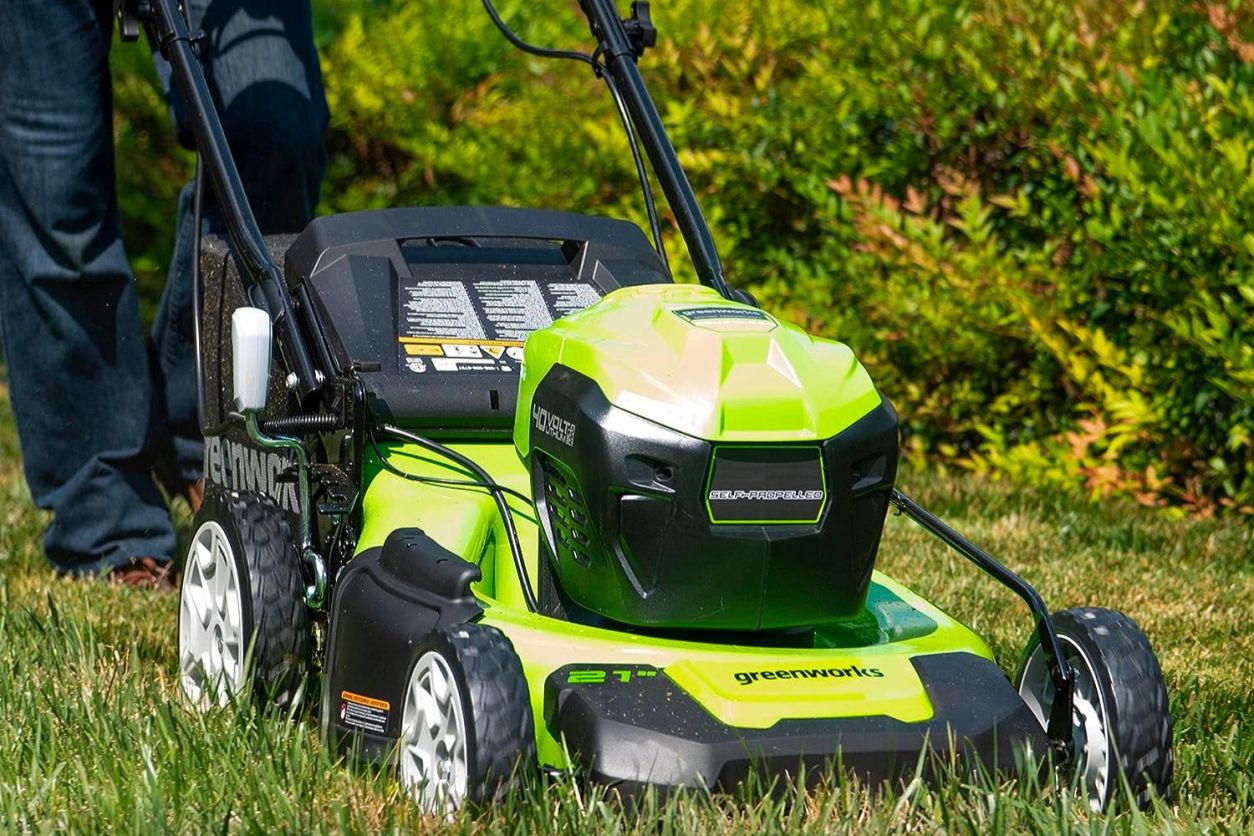
Self-propelled drive should reduce effort, not make the mower difficult to control. Test the handle position, drive lever, speed control, and wheel movement before you buy if possible.
Look for:
- Variable-speed control: Useful when moving between open grass, slopes, and tight areas.
- A smooth drive engagement: The mower should not lurch when the drive starts.
- An accessible bail or lever: You should not need to change your grip to stop the drive.
- Comfortable handle height: Your shoulders and wrists should stay relaxed.
- A folding handle: Helpful for garage or shed storage.
- Large rear wheels: Often helpful on uneven ground.
- A clear battery or fuel display: Useful for planning the job.
- A blade-brake feature, if offered: Some designs stop the blade while allowing the engine to remain running. Confirm the function in the manual.
Self-propelled does not mean self-steering. You still guide, stop, turn, and control the mower. On a slope, mow across the face only when the manufacturer permits it and the mower remains stable. Many safety guides advise avoiding mowing directly up and down slopes with a walk-behind mower because a loss of footing or traction can cause a dangerous slide.
Speed matters more than top speed
A high top speed is rarely the main goal. You need a low enough setting for obstacles and a faster setting for open lawn. If the mower moves faster than you can safely walk, the speed control is not helping.
Compare Weight, Wheels, and Storage
Weight affects both mowing and handling. A heavy mower may feel planted, but it can be tiring to lift, load, turn, or move when the drive is off. A light mower is easier to store but may bounce more on rough ground.
Consider your full routine:
- Can you lift or roll it into the storage area?
- Can it fit through the narrowest gate?
- Will you need to load it into a vehicle?
- Can you fold the handle without tools?
- Does the battery need to be removed for storage?
- Can the mower stand safely in the storage position?
- Is the fuel system suitable for your storage period?
Large wheels can help a mower cross uneven ground, but wheel size alone does not guarantee good traction. Tire tread, weight distribution, drive layout, and the surface all matter.
Keep the mower dry and protected from weather. Store fuel and batteries according to their labels and the manufacturer’s instructions. Do not block exits or store gasoline near ignition sources.

Use This Self-Propelled Mower Decision Guide
Use the following order to narrow your choices.
Step 1: Measure the lawn
Estimate the mowing area, not the total property size. Exclude the house, driveway, patio, beds, and areas you do not mow.
If the lawn is split into several sections, measure each section and add them together. A rough area estimate is enough for most mower decisions.
Step 2: Mark the difficult parts
Write down:
- The steepest slope.
- The narrowest gate.
- The longest mowing session.
- The thickest grass.
- The number of trees and obstacles.
- Your available storage space.
- Whether you collect or mulch clippings.
The hardest part of the yard should guide the mower choice.
Step 3: Pick the drive system
- Flat and crowded yard: front-wheel drive.
- Sloped yard: rear-wheel drive.
- Uneven, soft, or demanding terrain: all-wheel drive.
- Unsure between front and rear drive: rear-wheel drive is usually the more forgiving choice for mild slopes, while front-wheel drive is often easier to turn.
Step 4: Pick the power source
Choose battery if quiet use, low routine maintenance, and easy starting matter most. Choose gas if long runtime, heavy grass, and fast refueling matter most.
Step 5: Confirm fit and equipment
Check the mower’s:
- Cutting width.
- Minimum and maximum cutting height.
- Bag capacity.
- Mulching equipment.
- Mower width with the bag installed.
- Weight.
- Folded dimensions.
- Battery or fuel requirements.
- Warranty and parts support.
Step 6: Calculate the real cost
For a battery mower, include the mower, battery, charger, and any extra battery. For a gas mower, include fuel, oil, filters, spark plugs, blade maintenance, and possible service.
A lower purchase price does not always mean a lower ownership cost. The useful comparison is the cost of keeping the mower ready for your actual mowing season.
Common Buying Mistakes to Avoid
Buying by brand name alone
A trusted brand can still sell several mower types for different yards. Compare the exact model, drive layout, battery system, deck size, warranty, and included equipment.
Choosing the widest deck
A wide deck may save passes on open ground but can be awkward around trees or impossible to fit through a gate.
Ignoring battery replacement cost
Battery runtime is only one part of cordless ownership. Check the replacement price and warranty before selecting a platform.
Assuming self-propelled means effortless
You still need to control the mower and manage slopes, turns, wet grass, and obstacles. A mower that is too fast or heavy can increase fatigue.
Mowing wet or very tall grass without adjustment
Wet grass can clog the deck and make slopes slippery. Tall grass may require a higher deck setting, a slower pace, side discharge, and more than one pass.
Forgetting local repair support
A mower is easier to own when blades, belts, wheels, batteries, chargers, and engine parts are available. Check the manufacturer’s support network before buying an unfamiliar model.
Skipping the owner’s manual
Safety features, slope limits, battery storage, fuel procedures, and cleaning steps vary. Read the manual before the first use.
Key Takeaways
- Match the drive system to the terrain.
- Use front-wheel drive for flat, obstacle-filled yards.
- Use rear-wheel drive for hills and regular bagging.
- Consider all-wheel drive for uneven or difficult ground.
- Choose battery for quiet, low-maintenance mowing.
- Choose gas for long sessions and dense grass.
- Select a cutting width that fits both the lawn and the narrowest gate.
- Confirm the bag, mulching plug, battery, and charger are included.
- Compare weight, speed control, storage, service, and replacement parts.
- Follow the mower manual and U.S. safety guidance every time.
Frequently Asked Questions
Is a self-propelled mower worth it?
It can be worth the extra cost if your lawn is large, sloped, uneven, or tiring to mow. It may not be necessary for a small, flat lawn that takes little time to cut. The value comes from reduced walking effort and better control, not from the mower moving without guidance.
Is front-wheel drive or rear-wheel drive better?
Rear-wheel drive is usually better for slopes because the powered wheels remain at the back as the mower climbs. Front-wheel drive is often easier to turn and suits flat yards with many obstacles. The better choice depends on your terrain and mowing pattern.
Are battery mowers powerful enough for thick grass?
Many battery mowers can handle normal residential grass and moderate thick growth. Results depend on battery capacity, blade speed, grass height, moisture, and mowing frequency. For very large lawns or repeated heavy growth, a gas mower may provide longer continuous operation.
How long should a self-propelled mower last?
Service life depends on build quality, storage, cleaning, blade care, mowing conditions, and access to replacement parts. A mower used on rough ground and stored outdoors may wear faster than one used on a maintained lawn and stored indoors. Treat the warranty as a minimum support period, not a guaranteed service life.
Can you use a self-propelled mower on a steep hill?
Only if the mower’s manual permits the slope and you can keep secure footing and full control. Do not mow a slope when the grass is slippery or visibility is poor. Stop if the mower loses traction, begins to slide, or becomes difficult to turn.
Conclusion
The best self-propelled lawn mower is not the largest or most powerful model. It is the mower that fits your yard’s terrain, your mowing habits, and your storage and maintenance limits.
Start with the slope and lawn layout. Then choose front-wheel, rear-wheel, or all-wheel drive. Compare battery and gas ownership based on runtime, maintenance, noise, and fuel or battery costs. Finally, confirm the mower fits through your gate, supports your preferred mowing mode, and has controls you can use comfortably.
Before purchasing, measure the narrowest access point, identify the steepest section, check the full included equipment, and read the exact model’s manual and warranty terms.


