
How To Balance A Lawn Mower Blade: Easy Guide
Balancing a lawn mower blade is a small repair that can make a big difference. A balanced blade spins with less vibration, puts less strain on the mower deck, and can help the mower cut grass more evenly. An unbalanced blade may make the handle shake, leave uneven strips, loosen bolts, or damage the spindle and engine.
The job is suitable for many homeowners. It does not need advanced mechanical skills, but it does need care. You must remove the blade, check its condition, and use a reliable balancing method before putting it back on the mower. The same basic process works for many push mowers, self-propelled mowers, electric mowers, and some riding mower decks.
This guide explains how to balance a lawn mower blade safely. It also covers the tools you need, blade sharpening, common mistakes, costs, storage, replacement signs, and when a repair shop is the better choice.

Quick Answer: How Do You Balance a Lawn Mower Blade?
The best way to balance a lawn mower blade is to remove it, clean it, sharpen both cutting edges evenly, and hang it on a blade balancer or sturdy nail through the center hole. If one side drops, remove a small amount of metal from the higher side, not the low side. Recheck the blade until it stays level, then reinstall it with the correct bolt and torque from the owner’s manual.

A blade is balanced when both ends sit at the same height while it rests on its center point. Do not balance a blade by guessing its weight in your hand. The center hole, blade shape, and sharpening angle all affect balance.
For most homeowners, a cone-style blade balancer or a simple nail fixed level in a wall can work. A cone balancer is more precise and suits people who sharpen blades often. A nail method costs little and may be enough for a small yard and a basic push mower.
Why Blade Balance Matters
A balanced mower blade spins smoothly around the spindle. An unbalanced blade acts like a small weight tied to one side of a spinning wheel. That uneven force creates vibration each time the blade rotates.

Vibration can affect the mower in several ways:
- It can make the handle uncomfortable to hold.
- It may loosen the blade bolt or other fasteners.
- It can wear the spindle bearing.
- It may damage the deck or engine shaft.
- It can cause uneven mowing.
- It may increase noise.
- It can shorten the life of belts on some riding mowers.
A slightly uneven blade may not cause an immediate failure. Still, the problem can grow with each mowing session. If the mower shakes more at full throttle, stop using it and inspect the blade.
Balanced Blade Versus Sharp Blade
A sharp blade cuts grass with less tearing. A balanced blade spins with less vibration. These are different jobs, and a blade needs both.

Sharpening removes metal from the cutting edge. If you remove more metal from one end than the other, the blade can become unbalanced. This is why you should check balance after sharpening, even if the blade looked level before the work.
A dull blade may leave grass with ragged, pale tips. A badly balanced blade may cause shaking or a repeating thump. You can have a sharp but unbalanced blade, or a balanced but dull blade.
What the Vibration Tells You
The main difference between normal mower noise and blade vibration is the pattern. Normal engine noise stays fairly steady. Blade vibration often feels like a repeated pulse that rises with engine speed.

Stop the mower and inspect it if you notice:
- A new shaking handle.
- A loud hum or rhythmic thump.
- Grass cut at different heights.
- A blade that hits the deck.
- A loose blade bolt.
- Dark metal dust near the spindle.
- A cracked or bent blade.
Do not assume the blade is the only cause. A bent crankshaft, worn spindle, loose pulley, damaged deck, or bad engine mount can also create vibration.
Tools and Materials You Need
You can balance a lawn mower blade with a small set of common tools. The exact tools depend on the mower design, blade bolt size, and your chosen balancing method.

| Tool or material | Purpose |
|---|---|
| Work gloves and safety glasses | Protect hands and eyes from sharp edges and debris |
| Socket wrench or box wrench | Remove and tighten the blade bolt |
| Wood block or blade removal tool | Keep the blade from turning |
| Wire brush or scraper | Remove packed grass and rust |
| File or metal grinder | Sharpen or remove a small amount of metal |
| Blade balancer or level nail | Check blade balance |
| Torque wrench | Tighten the blade bolt to the manual’s specification |
| Penetrating oil | Help loosen a stuck bolt |
| Shop rag | Wipe the blade and spindle |
A blade balancer is the most useful special tool. It may use a cone, magnetic holder, or center post. Choose one that fits the center hole in your blade and sits on a stable, level surface.
A nail can work for a simple check. Drive it into a wall or workbench so it is straight and level. The blade must hang from the center hole without touching nearby surfaces.
💡 Pro Tip: Keep a spare blade bolt, washer, and the correct blade part number in your mower records. Some blades look similar but use different center holes, lifts, or mounting systems.
Safety and Preparation Before Removing the Blade
Blade service begins with preventing accidental startup. A mower can start or move when you least expect it if you skip this step.

Follow these safety steps:
- Park the mower on a flat, firm surface.
- Turn off the engine.
- Remove the ignition key if the mower has one.
- Let the engine and muffler cool.
- Disconnect the spark plug wire on a gas mower.
- Remove the battery on a battery mower when the manual permits it.
- Disconnect the power cord on a corded mower.
- Keep children and pets away from the work area.
- Wear eye protection, work gloves, and closed-toe shoes.
- Read the mower owner’s manual before removing the blade.
Never work under a riding mower that is supported only by a jack. Use approved jack stands and follow the manufacturer’s service procedure. If you are not sure where to place the stands, use a repair shop.
Disconnect the Power Source
On a gas push mower, pull the spark plug boot off the spark plug. Do not pull only on the wire. Grip the rubber boot and move it gently.

On a battery mower, remove the battery pack and store it away from the work area. Some models have a safety key or removable start button. Follow the manual because battery mower designs vary.
On a corded mower, unplug the cord from the mower and outlet. Do not trust the switch alone. On a riding mower, remove the key and disconnect the battery if the manual calls for it.
⚠️ Safety Warning: Never refuel a hot gas mower. Never place your hands near the blade unless the spark plug is disconnected or the battery is removed. Wear eye and hearing protection, clear debris first, and follow the owner’s manual.
Tilt the Mower the Right Way
Many walk-behind mowers can be tipped onto their side. For a gas mower, keep the air filter and carburetor side facing upward when possible. This can help prevent fuel or oil from entering the wrong parts of the engine.

Check the manual before tipping the mower. Some electric models have a different safe position. Never leave a mower balanced in an unstable position while you work.
Place a wood block against the blade before loosening the bolt. The block keeps the blade from spinning and protects your hand. A blade removal tool can make the job easier, especially on a self-propelled mower or a blade with a tight bolt.
Step-by-Step: How to Balance a Lawn Mower Blade
The best process is simple: remove, inspect, clean, sharpen evenly, test, correct, and reinstall. Work slowly because a small amount of metal can change the balance.

1. Remove the Blade
Use the correct socket or wrench on the blade bolt. Most mower blades use a standard right-hand thread, but do not assume. Check the manual before forcing the bolt.

Use a wood block to stop the blade. Turn the wrench in the direction shown by the manual. If the bolt is stuck, apply penetrating oil and wait several minutes. Do not heat a mower blade bolt near gasoline, plastic parts, or a battery.
As you remove the blade, note how it sits on the spindle. Take a photo if needed. The curved or raised side usually faces the mower deck, while the cutting edge faces the direction of rotation. Installing it upside down can produce poor airflow and a poor cut.
2. Inspect the Blade Closely
Clean the blade with a wire brush or scraper. Remove grass, soil, rust flakes, and built-up thatch. Thatch is a layer of dead stems and roots that can pack under the deck, but it is not the same as normal grass clippings.

Look for:
- Cracks near the center hole.
- Bent ends.
- Thin or deeply worn metal.
- Large chips.
- Severe rust.
- A stretched center hole.
- A damaged lift wing.
- A blade that is shorter than its original shape.
Do not balance a blade that is cracked, badly bent, or deeply worn. Replacement is safer and often cheaper than repairing damage. A replacement blade must match the mower model, deck width, center hole, mounting points, and part number.
3. Decide Whether to Sharpen or Replace It
A blade with light dullness can usually be sharpened. A blade with a crack, bend, or missing chunk should be replaced.

For a typical push mower, a replacement blade may cost less than a repair visit. A riding mower blade set can cost more, especially for a wide deck or zero-turn mower. Always check the latest product listing and your manual because blade prices and fit can change.
Do not weld a cracked mower blade. Welding can change the metal and may not restore safe strength at high speed. Do not try to straighten a badly bent blade with a hammer.
4. Sharpen Both Cutting Edges Evenly
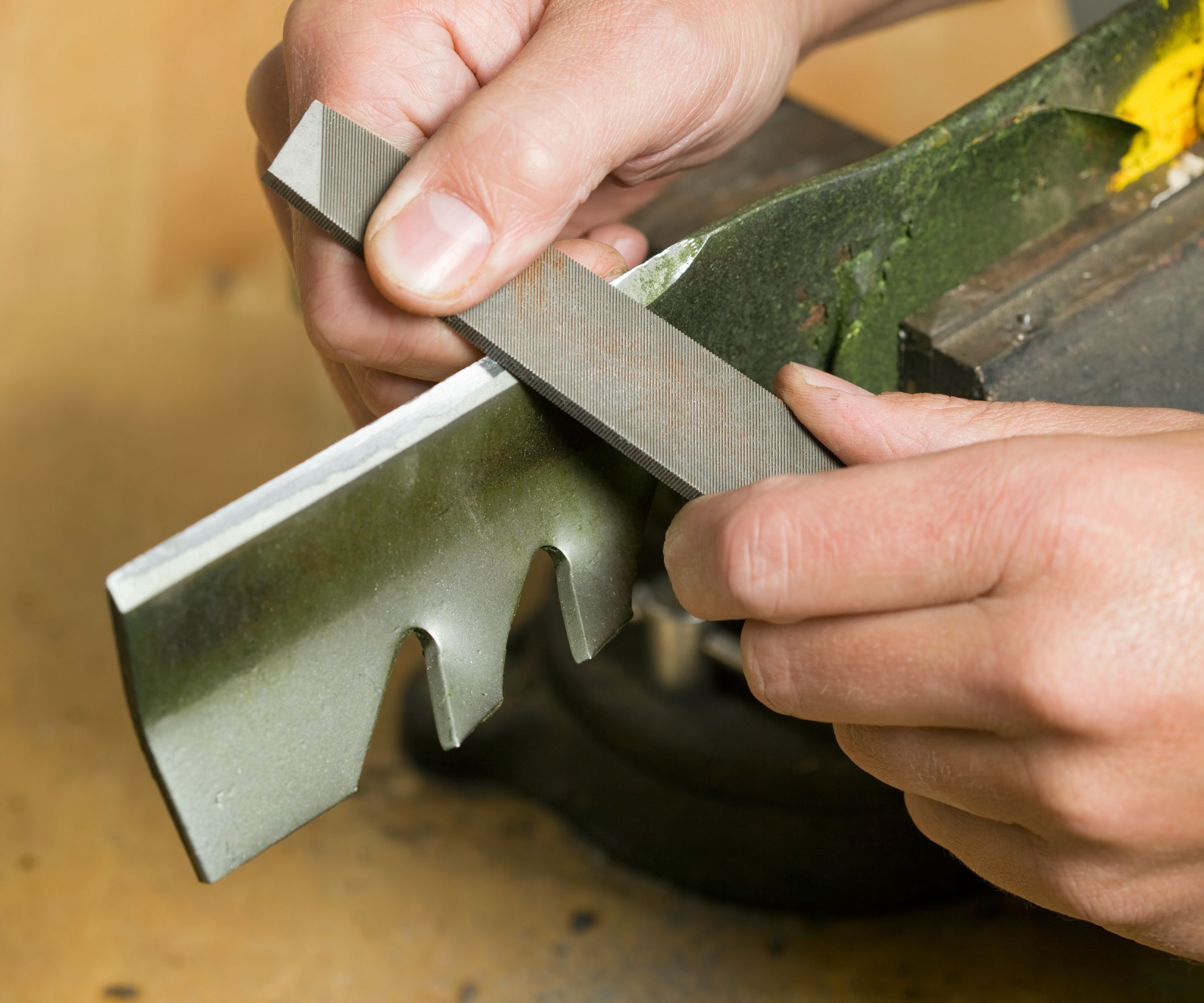
Clamp the blade in a vise. Use a flat file, mill file, or grinder. Follow the original cutting angle instead of creating a thin knife edge.

Remove the same number of strokes from each end. Work from the inner part of the cutting edge toward the tip. Keep the bevel even across the edge.
Do not sharpen the top lift wing unless the manual says to do so. The lift wing helps move air and grass under the deck. Removing too much material can change airflow and weaken the blade.
A file gives beginners more control. A grinder works faster but can remove metal too quickly and heat the blade. If you use a grinder, dip the blade in water often. Do not overheat the steel until it turns blue.
5. Place the Blade on a Balancer
Set the blade on a cone balancer, center post, magnetic balancer, or level nail. Make sure the balancer is stable and the blade sits on its center hole.
Let the blade stop moving. The heavier side will drop. The lighter side will rise. Mark the lighter side with chalk or a marker so you do not lose track.
A proper balancer checks the blade around its center hole. Do not balance it by placing a finger under one end. That method is too rough for reliable work.
6. Remove Metal From the High Side
If one end rises, remove a small amount of metal from the cutting edge or underside of the high side. Do not add random washers, tape, or other objects to the blade.
Use a file for better control. Remove a little at a time, then test the blade again. Keep the original blade shape and cutting angle. Do not grind into the center hole or remove metal from the lift wing unless the design requires it.
The goal is not to make both ends weigh the same by eye. The goal is to make the blade rest level on its center point. Patience matters here. A few careful passes are better than one heavy grind.
7. Recheck the Blade From More Than One Position
Turn the blade on the balancer and check it again. A blade that stays level in several positions is more likely to be balanced.
If the blade always drops on the same side, remove a little more metal from the high side. If the result changes from one position to another, check that the balancer is level and that the blade hole is clean.
Some blades have a complex shape or more than one mounting hole. If a blade cannot sit correctly on your balancer, use a model-specific tool or ask a mower repair shop to check it.
8. Reinstall the Blade Correctly
Clean the spindle, washer, and bolt. Place the blade in the same direction it came off. The raised lift wings normally face the mower deck, but confirm this in the manual.
Hold the blade with the wood block while tightening the bolt. Use a torque wrench if the manual gives a torque value. Correct torque helps prevent both a loose blade and damaged threads.
Do not use an impact wrench unless the manufacturer permits it. An impact tool can over-tighten the bolt or damage the spindle. Replace a damaged washer or bolt with the correct part.
9. Test the Mower Without Cutting Grass
Reconnect the spark plug wire or install the battery. Start the mower outdoors, away from people and loose objects. Let it run at normal operating speed for a short time.
Watch for:
- New or stronger vibration.
- A blade strike.
- A loose bolt.
- A burning smell.
- A belt squeal.
- Unusual deck noise.
- A blade that stops quickly or unevenly.
Shut the mower off and disconnect the power source before checking anything. If the vibration remains, the issue may be a bent blade, bent crankshaft, worn spindle, damaged deck, or engine problem.
Common Blade-Balancing Mistakes
Most blade problems come from rushing the job. A few simple errors can damage the blade or mower.
| Mistake | Why it causes trouble | Better approach |
|---|---|---|
| Testing a dirty blade | Grass and rust change the balance | Clean the blade first |
| Removing metal from the low side | This makes the heavy side worse | Remove small amounts from the high side |
| Sharpening one end more | The blade becomes uneven | Use equal strokes on both ends |
| Using a finger as a balancer | It gives a poor center point | Use a balancer or level nail |
| Reusing a damaged bolt | The fastener may fail or loosen | Install the correct replacement |
| Running with a bent blade | It can damage the spindle and deck | Replace the blade |
| Ignoring the manual | Mower designs differ | Follow model-specific instructions |
The most common error is removing metal from the low side. The low side is heavy, so removing more material there can increase the imbalance.
A second common error is sharpening only the part of the blade that looks dull. Both cutting edges must stay similar in shape and length.
Signs Your Mower Blade Needs Attention
A blade may need sharpening, balancing, or replacement when the mower changes how it sounds or cuts.
Look for these signs:
- The mower vibrates through the handle.
- The grass has torn, brown-looking tips.
- The mower leaves uncut strips.
- The deck shakes at full throttle.
- The blade makes a scraping sound.
- The mower struggles in normal grass.
- The blade has a visible bend.
- The blade bolt loosens during use.
- The mower cuts lower on one side.
A poor cut does not always mean a balance problem. Incorrect mowing height, wet grass, a clogged deck, a dull blade, low engine speed, or a damaged deck can produce similar results.
Wet Grass and Climate Effects
Wet grass can stick under the deck and change how the mower moves air. It can also hide a blade problem under a layer of clippings.
Avoid mowing wet grass, especially on slopes. Wet ground reduces traction and increases the risk of slipping. Wet clippings can also clog a mulching deck or grass catcher.
Cold weather can make gas engines harder to start. Old fuel, a dirty air filter, or a weak spark plug may be the cause, not blade balance. In hot, dry weather, use the mowing height recommended for your turfgrass and avoid cutting too much at once.
How Often Should You Balance a Mower Blade?
Check blade balance whenever you sharpen the blade, replace it, or notice new vibration. Many homeowners inspect the blade several times during the mowing season and sharpen it when the edge becomes dull.
The exact interval depends on your yard. A small lawn with clean turf may cause little wear. A rough lot with sticks, stones, sandy soil, or hidden debris can damage a blade quickly.
| Yard condition | Suggested check |
|---|---|
| Small, clean yard | Inspect at the start of the season and after sharpening |
| Yard with sticks or sandy soil | Inspect every few mowing sessions |
| Hilly or rough lawn | Check often for bends and loose fasteners |
| Commercial or large lawn | Check on a set maintenance schedule |
| Mower used after a strike | Stop and inspect at once |
These are general checks, not fixed rules. Follow the mower manual and inspect the blade after any strong impact.
A mower blade does not have a fixed life span. Some last several seasons in a clean yard. Others need replacement within one season when they hit rocks or hard objects.
Blade Balance and Different Mower Types
The basic balance idea is the same, but mower designs change the level of difficulty.
| Mower type | Balance considerations | Best fit for |
|---|---|---|
| Push mower | Usually has one easy-to-reach blade | Small yards and simple DIY service |
| Self-propelled mower | May have extra drive parts near the blade | Medium yards and users who want less pushing |
| Riding mower | Often uses two or more blades under a wide deck | Large lawns with enough storage space |
| Zero-turn mower | Uses multiple blades and spindles | Large open yards and experienced owners |
| Robotic mower | Blade design and access differ by model | Users who prefer automated mowing |
A push mower is usually the easiest place to learn. A riding mower or zero-turn mower can have several blades that must be removed, sharpened, balanced, and installed in the correct order.
Robotic mowers often use small pivoting blades rather than one large bar blade. Do not use the same balancing process unless the manual describes it.
Push Mowers and Self-Propelled Mowers
Push mowers suit small yards and flat lots. Self-propelled mowers can help on larger yards or gentle slopes, but they add drive parts and may cost more to maintain.
For a senior or a homeowner with limited strength, a self-propelled battery mower may reduce pushing effort. It still needs safe blade service and enough battery capacity for the yard. Check voltage, amp-hours, charger type, and replacement battery cost before buying.
A budget gas push mower can remain a sensible choice for a small yard with a shed and few noise restrictions. It may need oil, fuel, spark plug, and air filter service, while a battery mower avoids those engine tasks.
Riding and Zero-Turn Mowers
Riding mowers suit larger lawns where walking would take too long. Zero-turn mowers turn within their own footprint and can save time on open yards, but they need room, skill, and safe slopes.
Measure gate width, shed doors, and storage space before buying. Check the mower’s deck width and turning space. A 42-inch deck may suit a medium residential lawn, while a wider deck may be useful on a large, open lot but awkward around trees and narrow gates.
When a riding mower vibrates, stop quickly. Multiple blades can hide the source of the problem. A repair shop may be safer if you lack approved lifting equipment.
Cost, Time, and Skill Level
Balancing one blade often takes about 30 to 60 minutes for a first-time homeowner. An experienced DIYer may finish sooner, especially with a blade balancer and the correct socket.
| Service choice | Typical effort | Good choice for |
|---|---|---|
| DIY with a file | Low material cost, moderate time | Small yards and careful beginners |
| DIY with a grinder | Faster, higher risk of removing too much metal | Experienced DIY users |
| Local mower shop | Service fee plus parts | Bent blades, riding mowers, or uncertain owners |
The exact cost varies by blade type, location, labor rate, and whether the blade needs replacement. Check current local listings rather than relying on old prices.
A blade balancer is worth the money for people who maintain several mowers or sharpen blades often. For a one-time repair, a simple level nail may be enough if used carefully.
🎁 Gift-Buyer Note: A basic mower service kit can be a useful gift for a new homeowner or senior who enjoys DIY work. Include safety glasses, work gloves, a file, a blade balancer, and a gift card for a local repair shop. Skip a grinder unless the recipient already knows how to use one.
When to Replace the Blade Instead
Replacement is the safer choice when the blade is cracked, badly bent, deeply rusted, or worn thin. Do not try to balance a blade that no longer has its original shape.
Replace the blade if:
- A crack reaches the center hole.
- A tip is missing.
- The blade has a deep bend.
- The mounting hole is stretched.
- The lift wing is badly damaged.
- The cutting edge is too thin.
- The blade has been repaired by welding.
- It cannot sit safely on a balancer.
Confirm the replacement part number in the owner’s manual and on the manufacturer’s product page. Check the deck size, blade length, center hole, mounting holes, rotation direction, and lift design.
A universal-looking blade may fit the bolt but still be wrong for the mower. The wrong blade can hit the deck, create poor airflow, or place excess load on the spindle.
Features You Can Ignore When Choosing a Balancer
You do not need an expensive balancing system for a basic push mower. A stable, accurate center point matters more than flashy features.
Useful features include:
- A level base.
- A center cone that fits many holes.
- A strong metal body.
- Clear markings.
- A design that is easy to store.
- A stable stand that does not wobble.
You can usually ignore digital screens, complex clamps, or large shop stands for occasional home use. A simple tool may suit a renter with a small storage area better than a large professional setup.
For a homeowner who maintains a riding mower, spare blades, and several outdoor tools, a sturdier balancer may save time. Choose the tool for the blade size and hole design you actually use.
Related Mower Maintenance to Do at the Same Time
Blade service is a good time to check the rest of the mower. One repair session can prevent several small problems.
Inspect:
- The deck for packed grass and rust.
- The spindle for side-to-side movement.
- The blade bolt and washer.
- The belt on riding and self-propelled mowers.
- The air filter on a gas mower.
- The spark plug on a gas mower.
- The battery contacts on an electric mower.
- The grass catcher for tears.
- The wheels and height adjusters.
Do not spray water into the engine, battery compartment, or electrical controls. Scrape the deck with the mower powered down and disconnected. Keep the blade area clean so airflow stays steady.
A mulching kit can change how clippings move under the deck. A grass catcher adds weight and airflow demands. A side-discharge setup may behave differently from a mulching setup, so use the correct blade and deck parts for that configuration.
Mowing Height and Turfgrass Health
Blade balance helps the mower run smoothly, but it does not replace good mowing habits. Set the mower height for your grass type, season, and local climate.
Avoid cutting more than about one-third of the grass height at one time. Taller mowing can help shade soil during dry weather, while a lower setting may suit some turfgrass in cooler conditions. Ask a local extension office about your grass type.
Do not use a dull or damaged blade to compensate for poor mowing height. Keep string trimmers and edgers at the correct height near paths, trees, and beds. A leaf blower can clear clippings from hard surfaces, but never blow debris toward people, roads, or open water.
Storage After Blade Service
Good storage protects the blade and mower between uses. Store the mower in a dry shed or garage with the blade area away from standing water.
For a gas mower:
- Follow the manual for fuel storage.
- Use fuel stabilizer if recommended.
- Store gasoline in an approved container.
- Keep fuel away from heat and ignition sources.
- Check local fuel storage rules.
- Do not store a hot mower in a closed space.
For a battery mower:
- Remove the battery if the manual says to do so.
- Store the battery in a cool, dry place.
- Avoid extreme heat and freezing temperatures.
- Use only the approved charger.
- Keep the battery away from metal objects.
📜 Check Local Rules: Some cities and HOAs limit gas equipment, mowing hours, or noise. Confirm local noise ordinances, gas-equipment restrictions, fuel storage laws, and HOA rules before changing equipment or mowing times.
Environmental Disposal and Responsible Replacement
Old blades, gas, oil, and batteries need different disposal methods. Do not pour fuel or oil onto soil, into a drain, or into a storm sewer.
Take old gas and used oil to a household hazardous-waste site or another approved collection point. Recycle lithium-ion mower batteries at a designated battery drop-off. Do not place them in regular household trash.
A usable mower can be donated, sold, or recycled through a local program. Scrap metal centers may accept old blades, but wrap sharp edges and ask about their rules first.
When to Hire a Mower Repair Professional
A repair shop is the right choice when the blade is only part of a larger problem. Professional help can prevent damage when the repair involves lifting equipment, electrical systems, or a bent engine shaft.
Call a technician if:
- The mower still vibrates after a balanced blade is installed.
- The crankshaft looks bent.
- The spindle has side play.
- The deck is cracked.
- The blade bolt will not tighten.
- The mower was in a serious collision.
- You cannot safely lift a riding mower.
- The electric mower has smoke, heat, or a damaged battery.
- You are unsure which blade fits.
Do not keep mowing to “see if it gets better.” Vibration rarely fixes itself. Continued use can turn a blade replacement into a spindle, deck, belt, or engine repair.
FAQs About Balancing Lawn Mower Blades
Q: Can I balance a lawn mower blade with a nail?
A: Yes, for many basic blades. Drive a nail into a solid surface so it is straight and level, then hang the clean blade from its center hole. A cone or magnetic balancer is usually more precise.
Q: Which side of a mower blade is heavier?
A: You cannot know by looking at it. Place the blade on a balancer. The side that drops is heavier. Remove a small amount of material from the side that rises.
Q: Do I balance a blade before or after sharpening?
A: Balance it after sharpening. Sharpening can remove different amounts of metal from each end, which may change the balance.
Q: Can I balance a bent mower blade?
A: Do not rely on balancing to fix a bent blade. A bent blade can create vibration and may be unsafe. Replace it if it has a major bend or impact damage.
Q: Can I use a grinder to balance a mower blade?
A: Yes, but use care. Remove only a small amount of metal from the high side and avoid overheating the steel. A file gives beginners better control.
Q: How do I know if my mower vibration comes from the blade?
A: Inspect and balance the blade first. If vibration remains, check the spindle, crankshaft, deck, belt, pulley, and engine mounts. A repair shop can diagnose deeper problems.
Q: Should a mower blade be razor sharp?
A: No. It needs a clean, durable cutting edge, not a fragile knife edge. Follow the original bevel and leave enough metal to resist damage.
Q: Can I sharpen and balance a riding mower blade at home?
A: You can if you have safe lifting equipment, the right tools, and the manual. Multiple blades and wide decks make the job harder. Use jack stands, never rely on a jack alone, and hire a shop if the setup feels unsafe.
Q: How often should I sharpen a lawn mower blade?
A: Check it several times during the mowing season. Sharpen it when the edge is dull, grass tips look torn, or the mower struggles in normal conditions. Rough yards need more frequent checks.
Q: Is a blade balancer worth buying?
A: It can be worth buying for anyone who sharpens blades often, owns several mowers, or wants a repeatable check. A simple nail may suit a renter or homeowner with one small push mower.
Q: Can an unbalanced blade damage a battery mower?
A: Yes. Vibration can stress the spindle, deck, fasteners, and motor. Remove the battery before inspection and follow the electric mower’s service instructions.
Q: Does blade balance affect lawn striping?
A: Balance alone does not create lawn striping. Striping depends mainly on grass direction, mower rollers or deck design, mowing pattern, and turfgrass condition. A balanced blade can support a smoother cut.
Q: Can I put washers on one side to balance the blade?
A: No. Do not add washers, tape, or weights to a spinning blade. Use the correct blade or remove a small amount of metal from the high side.
Q: What should I do if the blade bolt keeps loosening?
A: Stop mowing. Check the bolt, washer, spindle, blade center hole, and manual torque value. A damaged fastener, wrong blade, or worn spindle may be the cause.
Q: How long does a mower blade last?
A: It depends on the yard, grass, debris, soil, mowing height, and blade metal. A clean residential lawn may allow several seasons of use, while rocks and sticks can ruin a blade quickly. Inspect it rather than relying on a calendar.
Final Advice
Balancing a lawn mower blade is a practical maintenance task that many careful homeowners can handle. The key steps are to disconnect the power source, inspect the blade, sharpen both edges evenly, use a real balance point, remove metal only from the high side, and reinstall the blade with the correct hardware.
Start with a push mower if you are new to repairs. A small yard, flat terrain, and simple single-blade deck make the work easier. For seniors, renters, or gift buyers, a blade balancer and safety gear can be more useful than a large power tool. Owners of riding mowers, zero-turn mowers, or hilly lawns should use extra care and hire a professional when safe lifting or diagnosis is uncertain.
A smooth-running mower is not just more pleasant to use. It can reduce stress on the machine and help maintain a cleaner cut. Inspect the blade after every serious impact, follow the manual, and never trade safety for a few minutes of saved work.
Affiliate disclosure: This article may contain affiliate links. If you buy a product through one of these links, we may earn a commission at no extra cost to you. Product availability, compatibility, specifications, and pricing can change, so confirm details with the manufacturer, product page, and mower owner’s manual before buying.



One Comment