
How Many Lawn Mowers Are In The US: Key Facts
The United States likely has about 90 million residential lawn mowers. When commercial machines, spare units, and equipment stored but not used are added, the total may be roughly 90 million to 100 million lawn mowers.
There is no official U.S. census of lawn mowers. The estimate comes from the number of American households, the share with private lawns, and the share that owns or uses a mower. Because these inputs change by source and year, the result should be treated as a range, not an exact count.
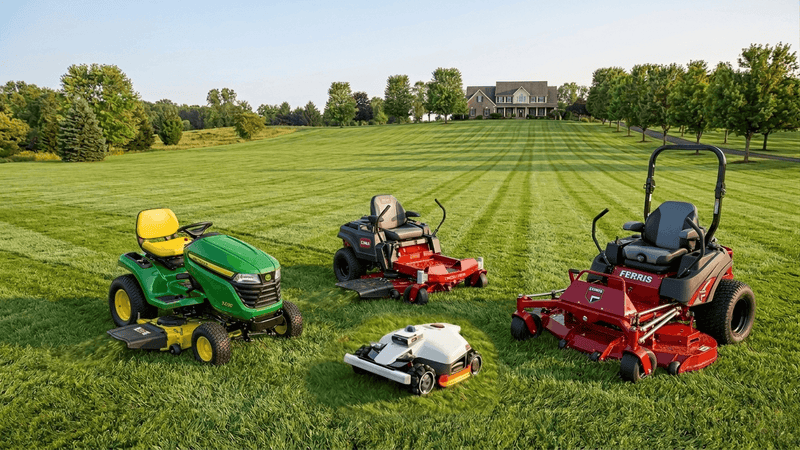
The best estimate: about 90 million residential lawn mowers
The most useful answer depends on what “in the US” means.
| Count | Reasonable estimate | What it includes |
|---|---|---|
| Residential lawn mowers | About 80–95 million | Mowers owned by households |
| All lawn mowers | About 90–100 million | Residential, commercial, spare, and stored machines |
| New mowers sold each year | Several million | New units sold, not the total fleet |
The best single-number estimate is about 90 million lawn mowers in American homes and businesses.
This estimate includes:
- Gas walk-behind mowers
- Electric walk-behind mowers
- Riding lawn tractors
- Zero-turn mowers
- Battery-powered mowers
- Robotic lawn mowers
- Older machines kept as backups
- Commercial mowers used by landscaping companies
It does not mean that 90 million machines run every week. Some are broken, stored for part of the year, or used only during the growing season.

How this lawn mower estimate is calculated
The estimate starts with the number of U.S. households. The U.S. Census Bureau reported about 131 million households in recent national estimates. Not every household has a lawn, and not every household with a lawn owns a mower.
A simple calculation looks like this:
U.S. households × households likely to need a mower × mower ownership rate
For example:
- 131 million U.S. households
- About 65% with a private yard that may need mowing
- About 100% of those households either owning or regularly sharing a mower
That produces:
131 million × 0.65 = about 85 million residential mowers
A higher estimate results when households with multiple mowers are included. A family may have:
- A walk-behind mower for narrow areas
- A riding mower for a large yard
- An older mower kept as a backup
- A battery mower and a gas mower
- A mower shared between more than one property
That is why a practical range of 80 million to 95 million residential machines is more useful than a single exact number.
Why the calculation cannot be exact
The U.S. government tracks households, housing units, businesses, and equipment sales. It does not maintain a public registry of every lawn mower.
Several data limits affect the estimate:
-
Lawn ownership is not measured in one national database.
A home may have grass, native landscaping, artificial turf, shared green space, or no yard. -
One household can own more than one mower.
A large property may need different machines for different areas. -
Many mowers are purchased used.
Used sales add machines without creating a new factory shipment. -
Mowers remain in service for years.
Annual sales measure additions and replacements, not the total number in use. -
Commercial fleets are hard to count.
Landscaping firms may own several machines, while some workers rent or share equipment.
The U.S. Census Bureau provides the household and housing data needed for the estimate. Industry groups such as the Outdoor Power Equipment Institute provide useful context about outdoor power equipment, but neither source publishes a complete national count of lawn mowers.

Residential mowers make up most of the U.S. total
Most lawn mowers in the United States are likely owned by households rather than large landscaping firms.
A typical residential mower may serve one home. A commercial mower may cut several properties each day and may be replaced sooner because of heavy use. Commercial operators also keep multiple machines to reduce downtime.
The commercial share is difficult to measure because it includes more than landscaping companies. It may also include:
- Golf courses
- Schools and colleges
- Parks departments
- Cemeteries
- Apartment and condominium managers
- Sports facilities
- Property maintenance contractors
- Farms and rural estates
Commercial machines are fewer in number than household machines, but they often represent a larger share of annual sales by value. A single commercial zero-turn mower can cost as much as several basic residential walk-behind models.
This distinction matters when reading market reports. A report about the lawn mower market may measure:
- Units sold
- Retail value
- Manufacturer shipments
- Replacement demand
- Commercial and residential equipment together
Those figures cannot be used as a direct count of every mower already operating in the country.

Why annual lawn mower sales do not equal the number of mowers
A common mistake is to treat yearly sales as the total number of lawn mowers in the United States.
If manufacturers and retailers sell 6 million mowers in one year, that does not mean the country has only 6 million mowers. Most existing machines remain in service. New sales mainly replace old units or add machines to homes and business fleets.
A simple stock calculation is:
Mowers already in use + new mowers added − discarded mowers = current mower stock
For example, if 8 million new mowers enter the market in a year but 7 million old machines are discarded, the total fleet grows by only 1 million.
Sales data also have several limits:
- A shipment may move between distributors before reaching a customer.
- One machine may be sold more than once as a used product.
- A retailer may report units by category rather than by final use.
- A mower may be exported after being assembled in the United States.
- A product may be sold as a lawn tractor, garden tractor, or zero-turn mower in different reports.
For this reason, the number of mowers sold each year is a flow, while the estimated 90 million machines are a stock.
What types of lawn mowers are included?
The term “lawn mower” covers several machine types. Each type affects the total estimate in a different way.
Walk-behind mowers
Walk-behind mowers are common on small and medium-sized residential lawns. They include:
- Gas push mowers
- Self-propelled gas mowers
- Corded electric mowers
- Battery-powered mowers
- Reel mowers
Many homes own only one walk-behind mower. Some households replace a gas mower with a battery mower but keep the old machine, which can temporarily increase the number of mowers stored in homes.
Riding lawn mowers
Riding mowers are more common on large lots. They include lawn tractors and smaller rear-engine riding mowers.
A riding mower may replace a walk-behind mower, but some owners keep both. The riding mower handles large open areas, while the smaller mower trims narrow paths and confined spaces.
Zero-turn mowers
Zero-turn mowers are widely used by landscaping companies and owners of large properties. They turn within their own footprint, which can reduce mowing time in open areas.
They are usually more expensive and less common in ordinary suburban homes. However, commercial operators may own several.
Robotic mowers
Robotic lawn mowers remain a small part of the U.S. mower fleet. They work within a defined cutting area and may use boundary wire, sensors, or mapping systems.
A robotic mower does not always replace another mower. Some owners keep a conventional mower for edges, tall grass, wet conditions, or areas outside the robot’s zone.
What changes the number of lawn mowers in the US?
The total number changes as housing, technology, and mowing habits change.
Housing and lot size
Detached homes with larger yards are more likely to need a private mower. Apartments, condominiums, and many townhomes may use shared landscaping services instead.
Suburban growth can increase mower ownership. Higher-density housing can reduce the number of household machines even when the total area of grass remains large.
Climate and grass growth
Mowing demand varies by region.
- Warm, wet areas may require mowing for much of the year.
- Northern states may have a short mowing season.
- Dry regions may use less grass or rely more on xeriscaping.
- Desert areas may have small lawns or no conventional lawn.
- Southern states may have several grass-growing periods in one year.
A home in Florida may use its mower far more often than a home in Minnesota, but both may own one.
Electric mower adoption
Battery mowers are becoming more visible in retail stores and residential yards. They can reduce fuel storage and local exhaust during use. However, replacing gas models with electric models does not automatically reduce the total number of physical mowers.
During the transition, a household may own both types.
Lawn care services
Some homeowners pay a landscaping company instead of mowing their own lawn. This shifts equipment from households to commercial fleets.
The mower still exists in the United States. It is simply counted as commercial equipment rather than household equipment.
Equipment life and repair
A mower that is repaired may remain in the national fleet for many years. A machine sent to a landfill or metal recycler leaves the active stock, although it may still be counted in some informal estimates.
Because product life varies by use, maintenance, and design, no single replacement rate applies to every mower.
A practical range by mower category
The following table shows how a national estimate might be organized. These figures are analytical ranges, not official government counts.
| Category | Approximate share of total | Possible number |
|---|---|---|
| Residential walk-behind mowers | Largest group | 55–70 million |
| Residential riding mowers | Smaller group | 15–25 million |
| Commercial walk-behind mowers | Smaller commercial group | 5–10 million |
| Commercial riding and zero-turn mowers | Smaller but higher-value group | 3–7 million |
| Robotic and specialty mowers | Small group | Less than 2 million |
| Estimated total | About 80–110 million |
The wide range reflects uncertainty about ownership, duplicate machines, stored equipment, and how sources classify riding mowers.
A narrower and more defensible public-facing answer is:
The United States probably has around 90 million lawn mowers, with a reasonable overall range of roughly 80 million to 100 million.
The upper end becomes more likely when inactive and backup equipment is included. The lower end is more likely when the count includes only actively used machines.
Common mistakes when estimating the U.S. mower fleet
Mistaking households for mowers
A household count is not a mower count. Some households have no grass, while others have two or more machines.
Counting only new sales
Annual shipments show market activity. They do not show the total equipment base.
Treating every mower as residential
Commercial landscaping, public agencies, golf courses, schools, and other organizations also use mowers.
Assuming every old mower is discarded
Many older mowers are repaired, sold, donated, or stored. A machine may leave one owner but remain in use elsewhere.
Mixing lawn mowers with all outdoor power equipment
Trimmers, chainsaws, leaf blowers, edgers, tillers, and snow blowers are not lawn mowers. A report about outdoor power equipment may include all of them.
Giving a false exact number
A claim such as “there are exactly 91,247,000 lawn mowers in the United States” suggests a level of measurement that does not exist. A range and a clear method are more credible.
Frequently asked questions
How many lawn mowers are sold in the U.S. each year?
The United States sells several million lawn mowers in a typical year, but the exact number changes with housing demand, weather, consumer spending, and product classification. Annual sales should not be confused with the estimated total fleet of about 90 million machines.
How many American households own a lawn mower?
There is no single current government statistic that records lawn mower ownership for every U.S. household. Based on household counts and typical yard patterns, many tens of millions of households likely own or share a mower.
Are there more gas or electric lawn mowers in the United States?
Gas-powered mowers have historically made up much of the installed fleet because they have been sold for many decades. Battery-powered and corded electric mowers are growing, but newer sales do not immediately replace the large number of older gas machines already in homes and businesses.
How many lawn mowers are used by landscaping companies?
No complete public national inventory is available. Landscaping companies use millions of commercial walk-behind, stand-on, riding, and zero-turn machines, but the exact number depends on how contractors, public agencies, and property managers are counted.
Does the estimate include broken lawn mowers?
It may, depending on the definition. An estimate of the total mower stock can include machines stored or awaiting repair. An estimate of active mowers should exclude equipment that has been permanently discarded.
Conclusion: the U.S. has roughly 90 million lawn mowers
The most responsible answer is that about 90 million lawn mowers are in the United States, with a broader plausible range of 80 million to 100 million.
That figure is an estimate, not an official count. It combines U.S. household data with reasonable assumptions about private yards, mower ownership, commercial equipment, spare machines, and equipment replacement.
For research, market analysis, or environmental work, define the count first. Decide whether you mean active residential mowers, all privately owned machines, annual sales, or the full residential and commercial fleet. That definition can change the answer by millions of units.


