
How Does A Roomba Lawn Mower Work: Simple Guide
A “Roomba lawn mower” is usually a casual name for a robotic lawn mower. Roomba is iRobot’s brand for robot vacuums, not a standard name for outdoor mowing machines. In the United States, robotic lawn mowers from brands such as Husqvarna, Segway, Worx, Mammotion, and Greenworks use sensors, software, electric motors, and a charging station to cut grass with little daily input.
A robotic mower first maps or learns the mowing area. It then moves over the lawn, trims small amounts of grass with spinning blades, avoids obstacles, and returns to its dock when the battery needs to charge. Some models use a buried boundary wire, while newer models may use GPS, RTK positioning, cameras, or a combination of sensors.

What Is a Robotic Lawn Mower?
A robotic lawn mower is a battery-powered machine that cuts grass on its own within a defined work area. It is similar to a robot vacuum in its basic idea, but it must handle uneven ground, outdoor weather, slopes, roots, toys, pets, and changing grass conditions.
Most robotic mowers use a random mowing pattern, a systematic pattern, or both. A random model changes direction when it reaches a boundary or obstacle. Over several mowing sessions, it gradually covers the full lawn. A mapping model records the yard and may mow in lines or planned zones.
The mower does not usually cut tall grass like a traditional riding mower. Instead, it runs often and removes a small amount from the grass blades each time. This method is called mulching. The tiny clippings fall back into the lawn and can return nutrients to the soil.
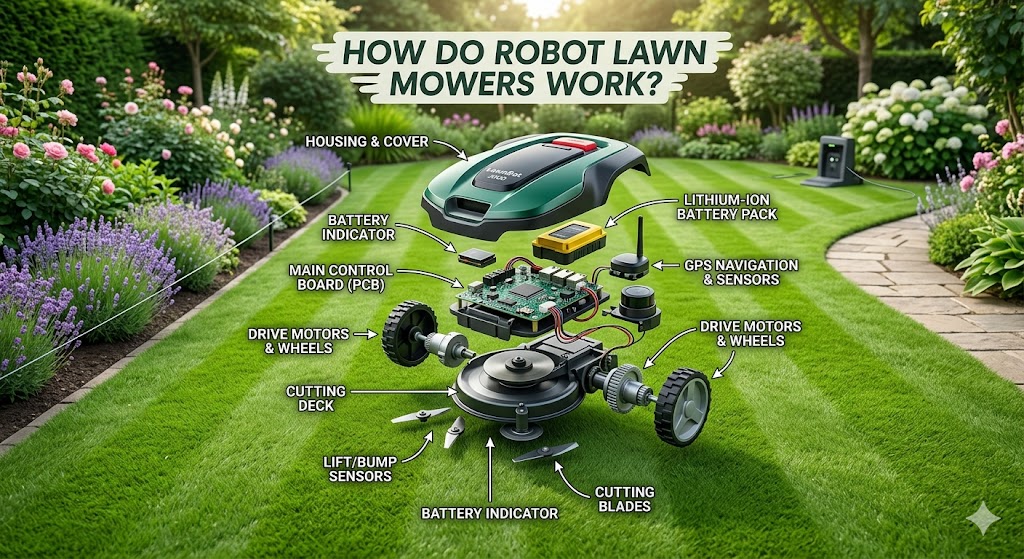
A robotic mower normally includes:
- A mower unit with electric drive motors
- One or more spinning cutting blades
- A rechargeable lithium-ion battery
- Boundary detection equipment
- Obstacle and lift sensors
- A charging station
- A control panel or smartphone app
- Safety software and emergency stop controls
The key difference from a manual mower is the work pattern. A person may mow once a week and remove a large amount of grass. A robotic mower usually cuts more often and takes less grass during each pass.

How Does a Robotic Lawn Mower Cut Grass?
A robotic lawn mower cuts grass with a small cutting deck under the body. Depending on the design, the deck may use a rotating disc with small pivoting blades or a larger fixed blade system.
When the mower starts, its drive wheels move it across the lawn. A separate motor spins the cutting blades. The mower travels slowly compared with a walk-behind mower, but repeated passes keep the grass near the selected height.
The cutting process works in four basic steps:
-
The mower enters the work area.
It leaves the charging station at a scheduled time or when the user starts it through the controls. -
The mower travels across the grass.
It follows its programmed route or changes direction when it detects a boundary or obstacle. -
The blades trim the grass.
The mower removes a small amount from the top of each blade. The clippings usually remain on the lawn. -
The mower repeats the process.
It may return to the dock when the battery is low, then resume mowing after charging.
Many models let the owner set a cutting height. The available range depends on the machine. Raising the height is often better during drought, heat, or periods of lawn stress. Cutting too low can expose soil, weaken turf, and increase the chance of scalping on uneven ground.
A robotic mower is not a brush cutter. It may struggle with tall weeds, thick vines, fallen branches, wet heavy grass, or lawns that have not been cut for a long time. A traditional mower or string trimmer may still be needed for neglected areas and edges.
How Does a Robotic Mower Know Where to Go?
A robotic mower uses one or more navigation systems to identify the safe mowing area. The exact method depends on the model and the property.
Boundary wire navigation
Many robotic mowers use a low-voltage boundary wire placed around the lawn. The wire creates a signal that the mower detects with onboard sensors.
The wire may be installed:
- On top of the soil and fixed with stakes
- A short distance below the soil
- Around flower beds, trees, ponds, play areas, and other no-go zones
- Along the edge of a connected mowing area
When the mower reaches the signal, it turns around or follows the edge. Some systems also use guide wires to help the mower find a narrow passage or return to the charging station.
Boundary wire systems can work well, but installation takes planning. A broken wire can stop the mower from working correctly. The wire must also be placed with suitable spacing from walls, drop-offs, fences, and paved edges. The correct distance varies by model, so the owner should follow the installation manual.
GPS and RTK navigation
Some newer mowers use GPS or RTK-GPS. RTK means real-time kinematic positioning. It can improve location accuracy by comparing satellite signals with correction data from a reference station or network.
RTK systems may allow the owner to create a digital boundary in an app instead of placing a physical wire. However, performance can change when the mower has a blocked view of the sky. Tall buildings, dense trees, steep terrain, and weak correction signals may reduce accuracy.
GPS-based mowing is not automatically better for every yard. A small, open lawn may work well with a boundary wire. A large or complex property may benefit from a wire-free system if the signal remains stable.
Cameras and other sensors
Some robotic mowers use cameras to recognize grass, objects, paths, or lawn edges. Other sensors may include:
- Ultrasonic sensors for nearby objects
- Bumper sensors for contact detection
- Inertial sensors for movement and slope changes
- Wheel sensors for detecting motion
- Rain sensors
- Tilt and lift sensors
- Current sensors that detect blocked blades
No sensor system can identify every hazard. A toy, garden hose, pet waste, wire, or small object may be missed. The lawn should be checked before each mowing session.

How Does a Robotic Mower Avoid Obstacles and Stay Safe?
Robotic mowers use layered safety systems, but they are not risk-free machines. The mower may slow down, change direction, stop its blades, or return to the dock when it detects a problem.
Common safety features include:
Bumper sensors
A bumper sensor detects physical contact. The mower may stop, reverse, and choose a new path. This feature can help with large objects, but it should not be treated as permission to leave toys, tools, or branches on the lawn.
Lift and tilt sensors
If the mower is lifted or tilted beyond a set limit, the cutting blades should stop. This helps reduce the chance of injury during a rollover or when someone picks up the mower.
Never place hands or feet under a mower that is turned on. Before cleaning or inspecting the cutting area, turn the mower off and follow the manufacturer’s procedure for removing the battery or disconnecting power.
Obstacle detection
Some models use cameras or ultrasonic sensors to detect objects before contact. These systems can reduce collisions, but they may have limits with:
- Small objects
- Dark objects
- Thin cords
- Tall grass
- Low sunlight
- Heavy rain
- Objects hidden by plants
Theft protection
Many models include an alarm, PIN code, GPS tracking, or app alerts. These features vary. A mower should still be secured against theft, especially if the charging station is in an open front yard.
Children and pets
A robotic mower should not operate around children or pets unless the manufacturer’s instructions specifically allow it and the area has been checked. Dogs may chase or attack the mower. Small children may touch the machine, place objects in its path, or approach it when it is docked.
A practical rule is to schedule mowing when the yard is empty. Store the mower indoors or in a locked area when it is not in use if theft or child access is a concern.

How Does the Charging Station Work?
The charging station provides a fixed location where the mower can recharge. The mower finds the station through its guide system, boundary wire, GPS map, or a combination of methods.
When the battery reaches a low level, the mower stops cutting and searches for the dock. It connects to metal charging contacts on the station. After charging, it may return to the lawn and continue its scheduled work.
The station usually needs:
- A level surface
- Adequate clearance in front of and beside the dock
- Access to a suitable outdoor power outlet
- Protection from standing water
- A reliable signal path for the mower’s navigation system
The exact clearance and installation rules differ by model. Poor dock placement can cause repeated failed returns, charging errors, or incomplete mowing.
Most robotic mowers are designed to avoid heavy rain, but weather behavior varies. Some models return to the dock when a rain sensor detects moisture. Others can operate in light rain but should not be used during storms, flooding, or very wet conditions.
Wet grass can also reduce mowing quality. Clippings may stick under the deck, and soft soil can develop wheel marks. The safest choice is to follow the mower manual and avoid operation when the lawn is saturated.
How Does the App Control a Robotic Lawn Mower?
A companion app may let the owner set schedules, define mowing zones, adjust cutting height, view mower status, and receive alerts. The app may connect through Bluetooth, Wi-Fi, cellular service, or a combination of technologies.
Common app controls include:
- Start or stop mowing
- Set mowing days and time windows
- Create restricted areas
- Divide the lawn into zones
- Change mowing priorities
- View battery status
- Receive blockage or boundary alerts
- Install software updates
- Locate the mower, where supported
An app does not replace physical setup. The mower still needs a correctly installed boundary, a usable charging station, and a lawn that is safe to mow.
Connectivity also matters. A mower may have limited remote control when it is outside Wi-Fi range. Cellular features may require a service plan or may not work in every location. Check the model’s current requirements before buying.

What Does a Robotic Mower Need Before It Can Work?
A robotic mower needs a prepared mowing area. Setup is often the hardest part of ownership.
Before the first mowing session:
-
Measure and inspect the lawn.
Look for slopes, narrow paths, soft soil, tree roots, ponds, stairs, retaining walls, and areas where the mower could become trapped. -
Choose the navigation method.
Decide whether the property suits a boundary wire, GPS, RTK, camera-based mapping, or a hybrid system. -
Install the charging station.
Follow the manufacturer’s requirements for level ground, power, clearance, and signal strength. -
Mark hazards and no-go zones.
Exclude pools, garden beds, steep drop-offs, play equipment, gravel, and areas where the blades could strike hard objects. -
Set the cutting height.
Start higher if the lawn is long, dry, or stressed. Lower the height gradually if needed. -
Run a supervised test.
Watch the mower travel around the lawn. Check its response near borders, slopes, paths, and narrow passages. -
Set a mowing schedule.
Choose times when people and pets are not using the yard.
A mower may work well on a simple, open lawn but struggle on a yard with many small sections. Some models handle multiple zones, while others require the user to move the mower between areas.
How Much Lawn Can a Robotic Mower Cut?
The stated coverage area is a planning guide, not a promise that every property will perform the same way. The mower’s practical capacity depends on battery life, charging time, mowing speed, grass growth, weather, layout, and schedule.
A simple planning estimate is:
Required daily mowing time = lawn area ÷ mower coverage rate
For example, if a mower is rated for a certain lawn size, it may need many hours of scheduled operation to cover that area. The mower may work for part of the day, charge, and then continue later.
Coverage is reduced by:
- Narrow passages
- Several separate zones
- Steep slopes
- Rough ground
- Frequent rain
- Thick grass
- Short operating windows
- Slow navigation around obstacles
Do not select a model based only on the maximum lawn-size number. Compare the mower’s recommended area with the actual usable grass area, then allow extra capacity for complex terrain and seasonal growth.
A practical fit guide
| Lawn condition | Likely result |
|---|---|
| Open, level lawn with clear borders | Usually the simplest setup |
| Lawn with several trees and beds | Requires careful mapping or exclusion zones |
| Narrow connecting paths | Needs a model that supports passages |
| Steep slopes | Check the maker’s slope limit and surface conditions |
| Multiple disconnected areas | May require zone support or manual transfer |
| Lawn beside a pond or drop-off | Needs a secure boundary and extra supervision |
| Rough or deeply uneven ground | May cause poor traction or incomplete coverage |
Maintenance: What Does a Robotic Mower Need?
A robotic mower needs regular inspection even though it runs by itself. Automation reduces mowing labor; it does not remove maintenance.
Use the maintenance schedule in the owner’s manual. Typical tasks include:
- Remove grass and soil from the underside
- Inspect and replace cutting blades
- Check wheel movement
- Clean charging contacts
- Inspect the boundary wire
- Check the charging station
- Review app alerts and error codes
- Update software when appropriate
- Store the mower and battery correctly during long periods of freezing weather
Always switch the mower off before cleaning the cutting deck. Do not spray water into motors, charging ports, control openings, or other areas that the manual does not identify as washable.
Blunt blades can tear grass instead of making a clean cut. Damaged blades can also create vibration and reduce mowing quality. Replace cutting parts with the correct type for the model.
What Are the Main Benefits and Limits?
The main benefit is regular, quiet grass trimming with less daily effort. A robotic mower can also help people who have limited time or difficulty pushing a conventional mower.
Other possible benefits include:
- No gasoline storage
- No engine oil changes
- Lower operating noise than many gas mowers
- Scheduled mowing
- Mulched clippings
- Reduced need to handle a heavy mower
- Electric operation at the point of use
The limits are just as important:
- Higher purchase and setup cost than some basic mowers
- Ongoing blade and battery replacement
- Possible boundary-wire repairs
- Weak performance in complex terrain
- Limited edge cutting along walls and fences
- Safety concerns around children and animals
- Need to clear the lawn before each session
- Possible dependence on Wi-Fi, GPS, RTK, or cellular service
- Theft risk when the mower is stored outdoors
A robotic mower is usually a good fit for a person who wants frequent automatic trimming and has a lawn that can be clearly mapped or enclosed. It may be a poor fit for a rough yard, a yard with many hidden objects, or a lawn that needs heavy cutting only once every week or two.
Common Problems and What to Check
The mower will not leave the dock
Check the battery, charging contacts, schedule, boundary signal, and error messages. Confirm that the dock has power and that the mower is seated correctly.
The mower stops in the middle of the lawn
Look for a blocked blade, trapped wheel, low battery, boundary problem, steep slope, wet soil, or an object under the mower. Turn it off before checking underneath.
The mower misses sections
Review the map, boundary placement, mowing schedule, and zone settings. Random-pattern models may need more time to reach every section. A narrow passage may be too tight or may need a guide wire.
The mower crosses the boundary
Stop the machine and inspect the boundary system. A broken wire, incorrect installation, weak signal, or mapping error may be responsible. Do not allow continued operation near a road, pond, or drop-off until the boundary is fixed.
The mower leaves an uncut strip at the edge
This is common near walls, fences, raised borders, and flower beds. The blade cannot always extend to the outer edge of the mower body. Some models include an edge-cutting mode, but a string trimmer may still be needed.
The grass looks uneven
Confirm that the mower is reaching all zones. Check the cutting height, blade condition, wheel traction, lawn slope, and mowing time. Long grass may need to be cut down gradually with a standard mower before robotic mowing begins.
Frequently Asked Questions
Is there an actual Roomba lawn mower?
“Roomba lawn mower” is usually a generic search phrase for an autonomous lawn mower. Roomba is associated with iRobot’s robot vacuums. Buyers should search for a robotic lawn mower and compare the model’s navigation, safety features, lawn-size rating, and service support.
Does a robotic mower collect grass?
Most robotic lawn mowers do not collect clippings. They cut small pieces and leave them on the lawn as mulch. This works best when the mower operates often and the grass is not excessively tall or wet.
Can a robotic lawn mower work without a boundary wire?
Yes, some models use GPS, RTK positioning, cameras, or other sensors to create a virtual boundary. Wire-free performance depends on signal quality, property layout, trees, buildings, and correct mapping.
Can a robotic mower cut wet grass?
Some models can operate in light rain, while others return to the dock when rain begins. Wet grass can reduce traction, clog the cutting deck, and cause poor results. Follow the exact weather instructions for the mower.
Can a robotic mower handle hills?
Some can handle moderate slopes, but the limit varies by model and surface. Wet grass, loose soil, roots, and steep transitions can reduce traction. Check the manufacturer’s slope rating and test the mower while supervised.
How often does a robotic mower need to run?
There is no single correct schedule. Many owners run the mower for several hours on selected days because it removes only a small amount of grass per pass. Growth rate, lawn size, weather, and mower capacity determine the schedule.
Key Takeaways
- A “Roomba lawn mower” usually means a robotic lawn mower, not a specific Roomba product.
- The mower trims grass with electric spinning blades and leaves small clippings on the lawn.
- It navigates with a boundary wire, GPS, RTK, cameras, sensors, or a combination of these tools.
- It returns to a charging station when the battery is low.
- It needs a prepared lawn, safe boundaries, regular inspection, and clear mowing schedules.
- It cannot replace a string trimmer for every edge or a traditional mower for very tall grass.
- Children, pets, toys, cords, branches, and standing water create safety risks.
Conclusion
A robotic lawn mower works by combining electric drive motors, rotating blades, sensors, navigation software, and an automatic charging dock. It does not mow like a riding mower. Instead, it trims a small amount of grass on a set schedule and repeats the process until the lawn stays near the chosen height.
Before buying one in the United States, measure the usable lawn area, inspect slopes and obstacles, compare boundary-wire and wire-free navigation, and check the model’s weather and safety limits. The right mower can reduce routine mowing work, but it still needs careful setup, clear grass, maintenance, and supervision.


