
How Wide Are Push Mowers: Standard Sizes Guide
Most push mowers in the United States are 20 to 22 inches wide at the cutting deck. Smaller models may be 16 to 19 inches wide, while some wide walk-behind mowers reach 23 inches or more.
The mower’s full outside width can be wider than its cutting deck. The grass chute, wheels, handles, and side guards may add several inches. For storage or gate access, measure the mower at its widest point—not just the blade or deck width.

Common Push Mower Widths
Push mower width depends on the deck size, mower type, and design. The deck width usually tells you how much grass the mower cuts in one pass.
| Push mower type | Common cutting width | Approximate cutting width in feet | Best fit |
|---|---|---|---|
| Compact electric mower | 16–19 inches | 1.3–1.6 feet | Small lawns and narrow gates |
| Standard push mower | 20–21 inches | 1.7–1.8 feet | Most U.S. residential lawns |
| Wide push mower | 22–23 inches | 1.8–1.9 feet | Larger open lawns |
| Commercial walk-behind mower | 21–30 inches or more | 1.8–2.5 feet or more | Large areas and professional work |
A 21-inch push mower is one of the most common sizes for home use. It offers a useful balance between cutting speed, maneuverability, storage space, and access through gates.
A mower with a wider deck cuts more grass with each pass. A narrower mower may take more passes, but it can turn more easily around trees, garden beds, posts, and other obstacles.

Cutting Width vs. Overall Mower Width
The cutting width and the total mower width are not always the same. This difference matters when you need to move the mower through a gate, shed door, basement door, or narrow side yard.
Cutting width
The cutting width is the approximate width of the mower deck or blade path. It describes how much grass the mower can cut in one pass.
For example, a mower with a 21-inch cutting deck may cut a path close to 21 inches wide. The actual cut can vary slightly because of the blade design, deck shape, and overlap between passes.
Overall width
The overall width is the widest outside measurement of the complete mower. It may include:
- The side-discharge chute
- Wheel housings
- Deck edges
- Side guards
- Bagging parts
- Folded or fixed handle parts
A 21-inch mower may have an overall width greater than 21 inches. The exact measurement depends on the model and whether the side-discharge chute is attached or folded.
How to measure a mower
Use a tape measure and check the mower in its normal operating setup.
- Place the mower on a flat surface.
- Measure from the farthest left point to the farthest right point.
- Include the discharge chute and wheel edges.
- If the handle folds, measure both the operating position and the folded position.
- Compare the measurement with the narrowest gate or doorway.
Leave extra clearance. A gate that is exactly the same width as the mower may still be difficult to use, especially on uneven ground.

How Wide Is a 21-Inch Push Mower?
A 21-inch push mower has a nominal cutting width of 21 inches, or about 1.75 feet. Its actual outside width may be slightly larger.
For a straight lawn, a 21-inch mower can cover more ground per pass than a 18-inch model. It can also reduce mowing time when the yard has few tight turns.
The difference is easy to estimate:
- An 18-inch mower cuts 1.5 feet per pass.
- A 21-inch mower cuts 1.75 feet per pass.
- A 22-inch mower cuts about 1.83 feet per pass.
These figures assume full blade coverage and do not account for overlap. In real use, most people overlap each pass slightly to avoid strips of uncut grass.
A wider mower is not always the better choice. If the mower must pass through a 22-inch gate, a model with a 22-inch deck may be too wide once the chute and other parts are included.
How Wide Is a 22-Inch Push Mower?
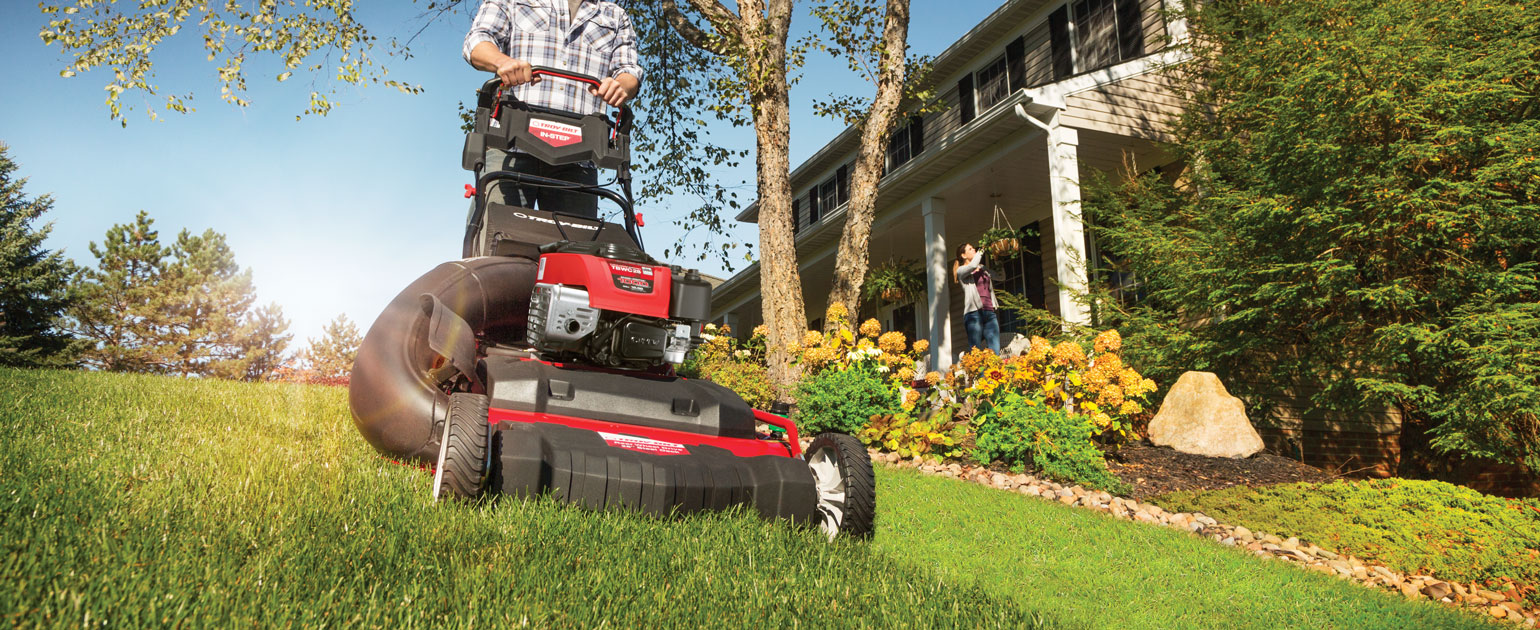
A 22-inch push mower cuts a path about 22 inches wide, or roughly 1.83 feet. The complete mower may measure more than 22 inches from side to side.
This size is common on larger residential walk-behind mowers. It may help reduce the number of passes on a broad, open lawn.
A 22-inch mower can be a good fit when:
- The lawn has wide access points.
- The yard is mostly open.
- The operator wants fewer passes.
- Storage space is not limited.
- Turning space is adequate.
It may be a poor fit for narrow yards with many obstacles. A wider deck can be harder to turn around small planting beds and may not fit between fences or shrubs.

How Wide Is a 20-Inch Push Mower?
A 20-inch push mower has a cutting width of about 20 inches, or 1.67 feet. It is slightly narrower than the common 21-inch class and may offer easier handling in tight spaces.
The one-inch difference does not seem large, but it can matter when access is limited. A mower with a 20-inch deck may fit through a narrow opening that does not accommodate a larger model.
Choose a 20-inch mower when you want:
- A standard residential cutting size
- Easier movement around obstacles
- A smaller storage footprint
- More access through narrow areas
The total mower width still needs to be checked. Deck size alone does not guarantee that the full mower will fit.

How Wide Is a 18-Inch Push Mower?
An 18-inch push mower cuts about 18 inches per pass, or 1.5 feet. These compact mowers are often suited to small lawns, townhome yards, and narrow side passages.
An 18-inch mower may be easier to push and turn than a larger model. It can also use less storage space, especially when the handle folds.
The trade-off is mowing time. Compared with a 21-inch mower, an 18-inch mower covers less ground in each pass. The difference is most noticeable on larger lawns or areas with few obstacles.
For a small lawn, the reduced width may not matter. Easy access and simple storage may be more valuable than maximum cutting width.

How Wide Is a Push Mower With the Handle Folded?
A folding handle can reduce the mower’s storage length and height, but it does not always reduce its side-to-side width.
When folded, a mower may still be as wide as the deck, wheels, or discharge chute. Some handles fold forward over the deck, while others fold to one side. The manufacturer’s storage dimensions are the best source for the folded size.
Before buying, check these measurements:
- Operating width
- Folded width
- Folded height
- Folded length
- Storage clearance around the mower
Do not assume that a folding handle makes any mower fit in a narrow closet. It mainly helps with height and depth.

What Width Push Mower Do You Need?
The right mower width depends on the lawn, access points, storage area, and number of obstacles. A simple rule is to choose the widest mower that can move comfortably through every required space.
| Lawn and access condition | Useful mower width |
|---|---|
| Very small lawn or narrow passage | 16–19 inches |
| Typical suburban yard | 20–21 inches |
| Open yard with wide gates | 21–23 inches |
| Many trees, beds, and tight turns | 18–21 inches |
| Commercial or large open area | 21 inches or wider |
For small lawns
A narrow mower can be easier to store and maneuver. If the lawn is small, the extra mowing time from a narrower deck may be minor.
For medium suburban lawns
A 20- or 21-inch mower is often a practical middle ground. It can handle common residential grass without taking up as much space as a larger commercial mower.
For large, open lawns
A 21- to 23-inch mower may reduce the number of passes. However, a riding mower, lawn tractor, or larger walk-behind machine may make more sense if the area is extensive.
For yards with narrow gates
Measure the gate at its narrowest usable point. Then compare it with the mower’s overall width, not just the advertised cutting width.
For yards with many obstacles
A narrower mower can save effort because it turns more easily. Cutting width is only one part of productivity. Maneuvering around obstacles also affects total mowing time.

How Much Time Does a Wider Mower Save?
A wider mower can reduce the number of passes, but the time saved depends on overlap, turns, terrain, and obstacles.
For a simple estimate:
Approximate passes = lawn width ÷ effective cutting width
The effective cutting width should be slightly less than the advertised deck width because adjacent passes usually overlap.
Hypothetical example
Suppose a lawn is 60 feet wide:
- A 18-inch mower cuts about 1.5 feet per pass.
- A 21-inch mower cuts about 1.75 feet per pass.
Without overlap:
- 60 ÷ 1.5 = 40 passes
- 60 ÷ 1.75 = about 34 passes
The 21-inch mower would need about six fewer passes across that section. In real mowing, the difference may be smaller because of turns, overlap, uneven edges, and areas that require a different direction.
A wider mower helps most on open, rectangular lawns. It helps less on small or complex yards.

Will a Push Mower Fit Through a Gate?
A push mower will fit through a gate only if the mower’s widest point is smaller than the gate’s usable opening. The advertised deck size is not enough to confirm this.
Measure the gate while it is fully open. Check for:
- Hinges that reduce the opening
- Fence posts
- Sloped or uneven ground
- A side-discharge chute
- Wheel alignment
- A gate that does not open to a full 90 degrees
Allow extra room for control. If the mower is nearly the same width as the opening, the operator may scrape the fence or damage the chute.
If access is too narrow, possible solutions include:
- Choosing a smaller mower
- Removing or folding a discharge chute when the manual allows it
- Using a rear-bagging design
- Widening the gate
- Carrying a lightweight mower only when safe and practical
Never remove a safety guard or alter the discharge system just to make the mower narrower.

How to Check the Width Before Buying
Product listings often show deck width, but they may not show every outside dimension. Use the following process before purchasing a mower.
-
Measure the narrowest access point.
Check gates, doors, paths, and storage openings. -
Find the manufacturer’s dimensions.
Look for overall width, not only deck size. -
Check the mower configuration.
A bagger, side chute, mulch plug, or handle position may change the size. -
Confirm the folded dimensions.
A folding handle may reduce height or length but leave the width unchanged. -
Allow clearance.
Leave several inches when possible so the mower can pass without scraping. -
Check the manual if dimensions conflict.
Product pages can list rounded numbers. The owner’s manual or technical specification sheet may provide a more exact measurement.
This process is more reliable than choosing by the advertised “20-inch” or “21-inch” label alone.

Common Mistakes When Comparing Mower Widths
Mistake 1: Treating deck width as total width
A 21-inch deck does not always mean the entire mower is exactly 21 inches wide. The chute and other parts may extend beyond the deck.
Mistake 2: Measuring only the gate
Measure the mower too. A gate may have a listed width that does not match its clear opening when hinges and posts are included.
Mistake 3: Choosing the widest mower for every lawn
A wide mower can save passes on an open lawn. It can also be harder to turn, store, and move around obstacles.
Mistake 4: Ignoring overlap
The mower’s rated width is not the same as the effective width during mowing. Slight overlap helps prevent missed strips of grass.
Mistake 5: Forgetting attachments
A grass bag, side chute, or other attachment may change the mower’s outside dimensions or storage needs.
Mistake 6: Assuming electric and gas models have the same shape
Two mowers with the same cutting width can have different wheel positions, deck shapes, handles, and chutes. Compare the complete dimensions of the exact model.

Push Mower Width and Safety
Width affects access and handling, but it does not determine whether a mower is safe by itself. Follow the owner’s manual for operation, maintenance, transport, and storage.
Before moving or servicing a mower:
- Turn off the engine or motor.
- Remove the ignition key when applicable.
- Disconnect the battery or spark plug wire when the manual directs it.
- Wait for the blade to stop.
- Keep hands and feet away from the blade.
- Do not bypass guards or discharge parts.
- Use care when lifting a heavy mower.
- Keep children and bystanders away during operation.
For battery models, also follow the manufacturer’s instructions for battery removal, charging, and storage. For gas models, follow the manual when tilting or transporting the mower because the wrong position may cause fuel or oil problems.

Frequently Asked Questions
Are all push mowers 21 inches wide?
No. Many residential push mowers have 20- or 21-inch cutting decks, but compact models may be 16 to 19 inches wide, and larger walk-behind mowers may exceed 22 inches.
Is a 22-inch mower much better than a 20-inch mower?
Not for every lawn. A 22-inch mower may reduce passes on an open yard, while a 20-inch mower may be easier to turn and fit through narrow spaces.
What is the narrowest push mower available?
Compact push mowers can have cutting widths around 16 to 18 inches. Exact availability varies by brand, power type, and model year.
Does the grass bag make a push mower wider?
Usually, the bag affects the mower’s rear profile more than its side-to-side width. A side-discharge chute is more likely to increase the mower’s overall width.
How much space should I leave around a push mower in storage?
Leave enough room to remove the mower without scraping nearby objects. The exact space depends on the mower, handle position, attachments, and storage surface. Use the manufacturer’s folded dimensions as the starting point.
Conclusion
Most push mowers sold for U.S. residential use are 20 to 22 inches wide at the cutting deck. Compact models may be narrower, while commercial walk-behind mowers can be wider.
For the best fit, compare the mower’s overall width with your narrowest gate, doorway, and storage area. Choose a wider mower for open lawns and fewer passes. Choose a narrower mower when access, tight turns, or compact storage matter more.


