
How Big Of A Lawn Mower Do I Need: Choose The Right Size
For most U.S. lawns, a 21-inch walk-behind mower is enough for yards up to about ¼ acre. A self-propelled mower with a 21- to 22-inch deck suits many lawns from ¼ to ½ acre, while a riding mower with a 42- to 48-inch deck is usually more practical for lawns larger than ½ acre.
The right size depends on more than lawn area. Your yard’s slope, trees, flower beds, gates, storage space, grass type, and preferred mowing time can change the best choice.

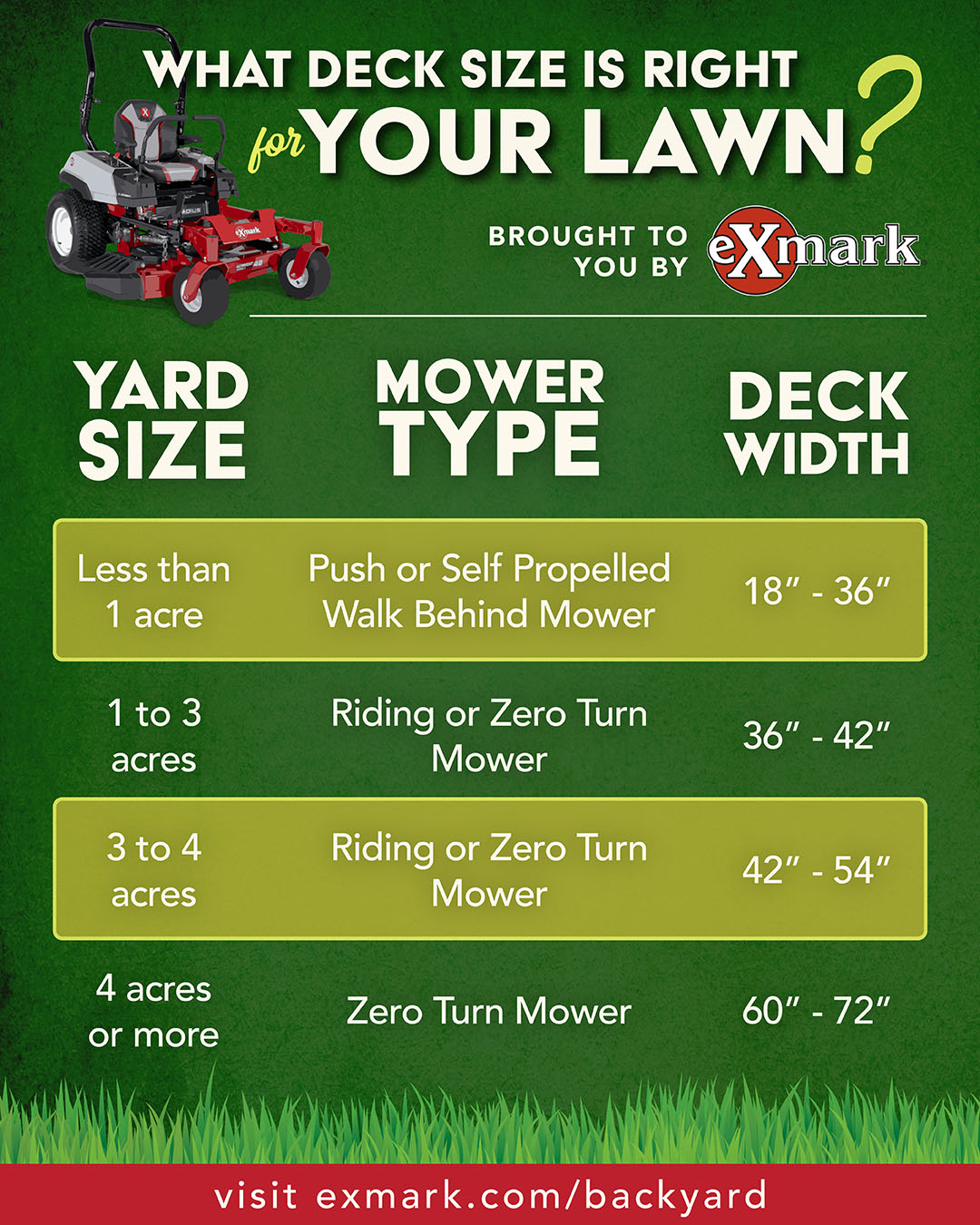
Quick mower size guide
Use this table as a starting point. These are practical ranges, not strict rules.
| Lawn size | Best starting point | Typical cutting width | Why it fits |
|---|---|---|---|
| Under ⅛ acre | Push mower or small cordless mower | 16–21 inches | Low cost and easy to store |
| ⅛ to ¼ acre | Push or self-propelled mower | 18–22 inches | Good balance of control and speed |
| ¼ to ½ acre | Self-propelled mower or small riding mower | 21–42 inches | Reduces walking time |
| ½ to 1 acre | Riding mower or lawn tractor | 42–48 inches | A wider deck covers ground faster |
| 1 to 2 acres | Riding mower or lawn tractor | 46–54 inches | Better for long, open areas |
| More than 2 acres | Lawn tractor, zero-turn, or garden tractor | 48–72 inches | Built for large mowing areas |
A walk-behind mower can cut more than ¼ acre. A riding mower can cut less than ½ acre. The table simply shows where each type tends to become more useful.
The best choice is the smallest mower that can finish your lawn in a reasonable time without struggling with terrain or access.
How to measure your lawn before buying
Measure the area you actually mow, not the full size of your property. A house, driveway, patio, shed, garden, and wooded area do not count as lawn.
Step 1: Divide the lawn into simple shapes
Break the yard into rectangles, squares, and triangles.
For a rectangle:
Length × width = square feet
For a triangle:
Length × width ÷ 2 = square feet
Add the areas together. Subtract spaces that you do not mow.
Step 2: Convert square feet to acres
One U.S. acre contains 43,560 square feet.
Square feet ÷ 43,560 = acres
For example, a lawn measuring 10,890 square feet equals:
10,890 ÷ 43,560 = 0.25 acre
That is a quarter-acre lawn.
Step 3: Measure gates and storage areas
Measure the narrowest gate, path, shed door, and storage opening. A mower may have a suitable cutting width but still be too wide to reach part of the lawn.
Remember to measure the mower’s full outside width, not only its advertised deck width. Chutes, wheels, handles, and foot platforms may extend beyond the deck.
Step 4: Mark slopes and obstacles
Count trees, poles, garden edges, play equipment, drainage areas, and tight corners. A large mower saves time in open grass but may waste time when you must make many short turns.
A lawn with many obstacles may need a smaller mower even when the total area is large.

Choose mower size by lawn area
lawn size gives you the first answer, but the mower type matters just as much as the deck width.
Under ⅛ acre: choose a small walk-behind mower
A push mower is usually enough for a small front yard, townhome lot, or compact city lawn. A 16- to 21-inch deck can reach narrow strips and fit through most gates.
A battery mower may be convenient if you want low noise and simple starting. A corded electric mower can work for a very small yard, but the cord limits movement and requires careful handling.
Choose a push mower when:
- The lawn is mostly flat.
- The mowing area is small.
- You do not mind walking.
- You want low purchase and maintenance costs.
- You have limited storage space.
⅛ to ¼ acre: use a 19- to 22-inch mower
This is the most common range for a standard American suburban lawn. A 21-inch mower offers a useful balance of cutting width, maneuverability, and storage size.
A self-propelled mower can help if the lawn has slopes, thick grass, or soft ground. It is not always needed on a flat quarter-acre lawn, because the drive system adds weight, cost, and maintenance.
For a quarter-acre lawn, focus on:
- A deck between 19 and 22 inches.
- A handle that adjusts to your height.
- Easy height adjustment.
- A bagger only if you regularly collect clippings.
- A battery or fuel system that can finish the full lawn.
¼ to ½ acre: compare self-propelled and riding mowers
A half-acre lawn can take much longer with a walk-behind mower, especially if it has slopes or thick growth. A self-propelled mower remains practical when the property has gates, narrow areas, or many trees.
A small riding mower may save time on an open, mostly flat lawn. However, the mower also needs a place to park, fuel or charging access, and enough room to turn.
Choose a self-propelled mower when:
- The lawn is divided into several sections.
- You must pass through narrow gates.
- Trees and beds require close trimming.
- You want to avoid a trailer or large storage area.
- The terrain is manageable on foot.
Choose a riding mower when:
- The lawn is open and fairly smooth.
- You want to reduce mowing time.
- You have a safe storage area.
- The mower can reach every section without difficult backing or sharp turns.
½ to 1 acre: a riding mower often makes sense
For a half-acre to one-acre lawn, a riding mower with a 42- to 48-inch deck is a common starting point. A lawn tractor often suits properties where you want to mow, tow a small cart, or use attachments.
A zero-turn mower can reduce time around trees and beds because it turns within its own footprint. It may not be the best choice for steep slopes, rough ground, or yards with many uneven areas. Always follow the model’s operating manual for slope limits.
A riding mower is not automatically better because it has a wider deck. A deck that is too wide may miss narrow strips, scrape fences, or make it hard to maneuver around trees.
More than 1 acre: match the mower to the terrain
Large lawns need more than a wide deck. Consider engine power, fuel capacity or battery capacity, deck design, tire grip, suspension, seat comfort, and service access.
For open, maintained grass, a 48- to 54-inch deck may provide a good balance. A 60-inch or wider deck can reduce mowing time on broad, flat areas, but it needs more room to turn and transport.
For rough or varied property, a lawn tractor or garden tractor may be more suitable than a high-speed zero-turn mower. If the property includes fields, brush, or tall weeds, a regular lawn mower may be the wrong tool. Those areas may require a rough-cut mower or different equipment.

How cutting width affects mowing time
A wider deck usually cuts more grass per pass. It does not always reduce total work by the same amount because you lose time at turns, trees, gates, slopes, and overlaps.
A simple planning formula is:
Theoretical acres per hour = deck width in feet × mowing speed in miles per hour ÷ 8.25
Real mowing speed is lower than the theoretical result. Turning, emptying the bag, overlap, and obstacles often reduce practical output to roughly 60% to 75% of the theoretical rate.
Example: 21-inch walk-behind mower
A 21-inch deck is 1.75 feet wide. At a walking speed of 3 miles per hour:
1.75 × 3 ÷ 8.25 = about 0.64 theoretical acres per hour
At 60% to 75% practical efficiency, the mower may cover about 0.38 to 0.48 acre per hour in open conditions. A complex lawn may take longer.
Example: 42-inch riding mower
A 42-inch deck is 3.5 feet wide. At 5 miles per hour:
3.5 × 5 ÷ 8.25 = about 2.12 theoretical acres per hour
At 60% to 75% practical efficiency, the result is about 1.27 to 1.59 acres per hour in open conditions.
These are planning estimates, not guaranteed mowing times. Wet grass, hills, tall growth, poor blade condition, and frequent turns can reduce performance.
Why a bigger deck may not help
A wider mower may be slower overall when:
- The lawn has many small sections.
- Gates are narrower than the mower.
- Trees are close together.
- The ground is rough.
- You must make repeated three-point turns.
- The mower cannot safely use its full speed.
- The deck leaves uncut strips near fences or beds.
For a simple rectangular lawn, deck width matters a lot. For a complex yard, maneuverability may matter more.
Account for terrain, grass, and obstacles
The same lawn size can require very different mower sizes.
Slopes
Slopes affect traction, control, and rollover risk. A riding mower’s safe slope limit depends on the model and the direction of travel. Read the owner’s manual before mowing a hill.
As a general safety rule:
- Do not use a riding mower on a slope beyond the manufacturer’s stated limit.
- Avoid sharp turns on hills.
- Keep the discharge side pointed away from people, roads, and buildings.
- Use a walk-behind mower only where you can keep stable footing and control.
- Never mow wet slopes if the tires or your shoes may lose traction.
Do not rely on a generic angle chart in place of the manual. Slope safety also depends on soil, grass moisture, tire condition, speed, and mower design.
Thick or fast-growing grass
Tall, wet, or dense grass places more load on the engine and blade. A small mower may still work, but you may need to mow more slowly or make two passes.
If you often let the grass grow high, look for:
- A strong cutting system.
- Adjustable deck height.
- A side-discharge option.
- A blade that stays sharp.
- Enough battery capacity or engine power for the lawn.
Do not remove too much grass at once. Many extension services, including guidance from the University of Minnesota Extension, recommend following the one-third rule: avoid removing more than about one-third of the grass blade at one mowing.
Trees, beds, and tight spaces
A smaller mower is easier to guide around obstacles. A riding mower may leave more trimming work around posts, fences, and beds.
Measure turning space, not only passage width. A mower may fit through a gate but still lack room to turn at the far end.
Wet or soft soil
Large riding mowers are heavy. Their tires may leave ruts in soft soil, especially after rain. Wait until the lawn is firm enough to support the mower without deep tracks.
Wet grass can also clump, clog the deck, reduce traction, and produce an uneven cut.

Pick the right power source and drive system
Deck size does not tell you whether the mower can finish the job. Match the power system to the lawn and your routine.
Push or self-propelled
A push mower relies on your effort. It is simple and often lighter.
A self-propelled mower drives its wheels. It can reduce effort on slopes and larger lawns, but it adds weight and cost. Front-wheel drive can help with frequent turns, while rear-wheel drive may provide better traction on slopes. All-wheel drive can help with varied terrain, but the exact benefit depends on the model.
Gasoline
Gas mowers can suit larger lawns and long mowing sessions. They do require fuel, oil changes, air-filter care, spark-plug service, and winter storage steps.
Use fuel according to the owner’s manual. Never refuel a hot engine, and store gasoline only in an approved container in a suitable location.
Battery electric
Battery mowers are often quieter and need less routine engine maintenance. The key limit is runtime. Manufacturers’ runtime figures may depend on grass height, blade setting, battery size, and mowing conditions.
To choose a battery mower:
- Check the battery’s stated capacity and included battery.
- See whether the manufacturer rates runtime for mowing or no-load operation.
- Confirm whether a second battery is available.
- Check charger time and storage temperature guidance.
- Keep the battery and charger dry and use them as directed.
A battery mower that barely finishes the lawn may become inconvenient as the battery ages or grass conditions change. Leave a reasonable reserve rather than selecting a system that runs empty every time.

Avoid these common mower-sizing mistakes
Buying by acreage alone
A ¾-acre lawn with open grass may favor a riding mower. A ¾-acre property split by fences and gardens may be easier with a walk-behind mower.
Choosing the widest deck available
The widest deck is useful only when it fits the property. If it cannot pass through gates or turn near obstacles, the claimed time savings disappear.
Ignoring storage
Measure the mower, then add room to walk around it and perform basic maintenance. Riding mowers may need a shed, garage, ramp, or trailer.
Forgetting trimming time
A large mower may leave more edges to trim. Include the time needed for a string trimmer around fences, trees, beds, and buildings.
Mowing too low
Cutting height depends on grass type and season. Follow local extension guidance and the mower manual. Cutting too low can stress turf, expose soil, and increase weed pressure.
Using a mower on unsafe slopes
A mower that works well on flat ground may be unsafe on a hill. When in doubt, use a method designed for the slope or ask a qualified lawn-care professional to assess it.

Key takeaways
- A 21-inch walk-behind mower fits many U.S. lawns up to ¼ acre.
- A self-propelled mower is useful for ¼- to ½-acre lawns, slopes, and thick grass.
- A 42- to 48-inch riding mower often suits open lawns from ½ to 1 acre.
- A wider deck saves the most time on open, flat grass.
- Gates, trees, slopes, storage, and turning space can matter more than acreage.
- Choose enough battery capacity or fuel range to finish the lawn with reserve.
- Follow the mower manual for slope limits, maintenance, and safe operation.
Frequently asked questions
Is a 21-inch mower big enough for half an acre?
It can be, but it may take a long time. A 21-inch self-propelled mower can handle half an acre when the lawn is accessible and reasonably flat. A riding mower becomes more appealing when the lawn is open or when you want to reduce mowing time.
What size riding mower do I need for one acre?
A 42- to 48-inch riding mower is a reasonable starting point for one acre of maintained lawn. Choose a wider deck only if the property is open enough to use it safely and efficiently.
Is a zero-turn mower better for a large lawn?
A zero-turn mower can be efficient on large, open lawns with many trees or beds. It may be less suitable for steep slopes, rough ground, or areas where controlled low-speed mowing is more important than turning speed.
Do I need a self-propelled mower for a quarter acre?
Not always. A push mower is usually enough for a flat quarter-acre lawn. Self-propulsion is most useful when the lawn slopes, the grass is thick, or pushing the mower feels difficult.
How wide should a mower deck be?
Choose a deck that fits the lawn’s open areas and access points. A 21-inch deck works for many residential lawns. A 42- to 48-inch deck suits many medium and large open lawns. Measure gates and turning areas before choosing a wider model.
Conclusion
For most homeowners, start with the lawn area, then adjust for terrain and access. A flat lawn under ¼ acre usually needs only a standard walk-behind mower. A larger or sloped lawn may justify self-propulsion, while an open lawn over ½ acre often benefits from a riding mower.
Before buying, measure the mowable area, narrowest gate, storage space, slopes, and obstacles. Then select the smallest mower that can finish the job safely and comfortably. That approach usually delivers better results than choosing the largest deck by acreage alone.


