
How Many Watts Does An Electric Lawn Mower Use: Watt Guide
An electric lawn mower in the United States typically uses 500 to 1,500 watts while cutting grass. A corded mower often draws about 1,000 to 1,800 watts from a 120-volt outlet. A battery mower may use less or more power at a given moment, depending on grass height, blade load, slope, and mower size.
The most accurate answer depends on the mower type:
- Corded electric mower: usually 1,000–1,800 watts while running
- Battery-powered mower: often about 500–1,500 watts while cutting
- Battery charger: commonly 100–300 watts while charging
- Idling or light cutting: less power than thick, wet, or tall grass
A mower rated at 1,500 watts does not always use 1,500 watts for every minute of operation. The motor draws more power when the blade meets resistance.
Introduction
For a typical American homeowner, watt use depends on whether the mower plugs into a standard 120-volt, 60-hertz household outlet or runs on a rechargeable battery. Corded models show their electrical demand in amps or watts. Battery models usually show voltage and amp-hours instead.
This guide explains how to estimate electric lawn mower wattage, calculate energy cost, compare corded and cordless models, and avoid common mistakes. It also explains why a battery mower marked “40 volts” or “56 volts” cannot be compared directly with a corded mower without converting the battery’s stored energy.

Typical Wattage for an Electric Lawn Mower
Most electric lawn mowers use between 500 and 1,800 watts, but the range changes by mower type and cutting conditions.
| Mower type | Typical power while cutting | Main factor |
|---|---|---|
| Small battery mower | 400–800 watts | Smaller deck and blade |
| Standard battery mower | 600–1,200 watts | Grass load and battery system |
| Large battery mower | 900–1,500+ watts | Wide deck and stronger motor |
| Corded mower | 1,000–1,800 watts | Motor rating and grass load |
| Battery charger | 100–300 watts | Charger size and battery state |
These are useful planning ranges, not universal limits. The exact figure depends on the motor, blade speed, cutting width, and grass.
A mower may also have a higher starting surge. The motor can briefly draw more power when it starts the blade. This matters when selecting a generator, inverter, or portable power station.
Watts, amps, volts, and watt-hours
These terms describe different things:
- Volts (V): electrical pressure
- Amps (A): electrical current
- Watts (W): power used at a moment in time
- Watt-hours (Wh): energy used or stored over time
The basic formula is:
[
\text{Watts} = \text{Volts} \times \text{Amps}
]
For example, a 120-volt mower drawing 12 amps uses:
[
120 \times 12 = 1,440\text{ watts}
]
Watt-hours measure total energy. A 1,000-watt mower running for 30 minutes uses about:
[
1,000 \times 0.5 = 500\text{ watt-hours}
]
In real use, the mower may draw less than its rated maximum.
How Many Watts Does a Corded Electric Mower Use?
A corded electric mower commonly uses 1,000 to 1,800 watts while operating. Many models use a 120-volt circuit and list their motor demand in amps, often around 10 to 15 amps.
Use the mower’s amp rating to estimate wattage:
[
\text{Watts} = 120 \times \text{Amps}
]
| Motor rating | estimated power at 120 volts |
|---|---|
| 10 amps | 1,200 watts |
| 12 amps | 1,440 watts |
| 13 amps | 1,560 watts |
| 15 amps | 1,800 watts |
This calculation gives the approximate electrical load. It does not prove that the mower consumes that amount continuously.
A 12-amp mower may draw close to 1,440 watts in thick grass but much less in short, dry grass. The motor works like a person pushing a cart: an easy path takes less effort, while a heavy load takes more.
Does a corded mower use its full rated wattage?
Usually, no. The listed wattage or amp rating often represents the motor’s maximum or rated demand. Actual use changes with:
- Grass height
- Grass moisture
- Blade sharpness
- Cutting width
- Mowing speed
- Slope and wheel resistance
- Clogged deck airflow
- Extension cord length and size
A dull blade can increase the cutting load. Wet grass can also force the motor to work harder and may clog the deck.
Use an outdoor-rated extension cord that matches the mower manufacturer’s instructions. A long or undersized cord can cause voltage drop, heat, poor motor performance, and possible damage. The U.S. Consumer Product Safety Commission advises using outdoor extension cords for outdoor equipment and checking cords for damage before use.
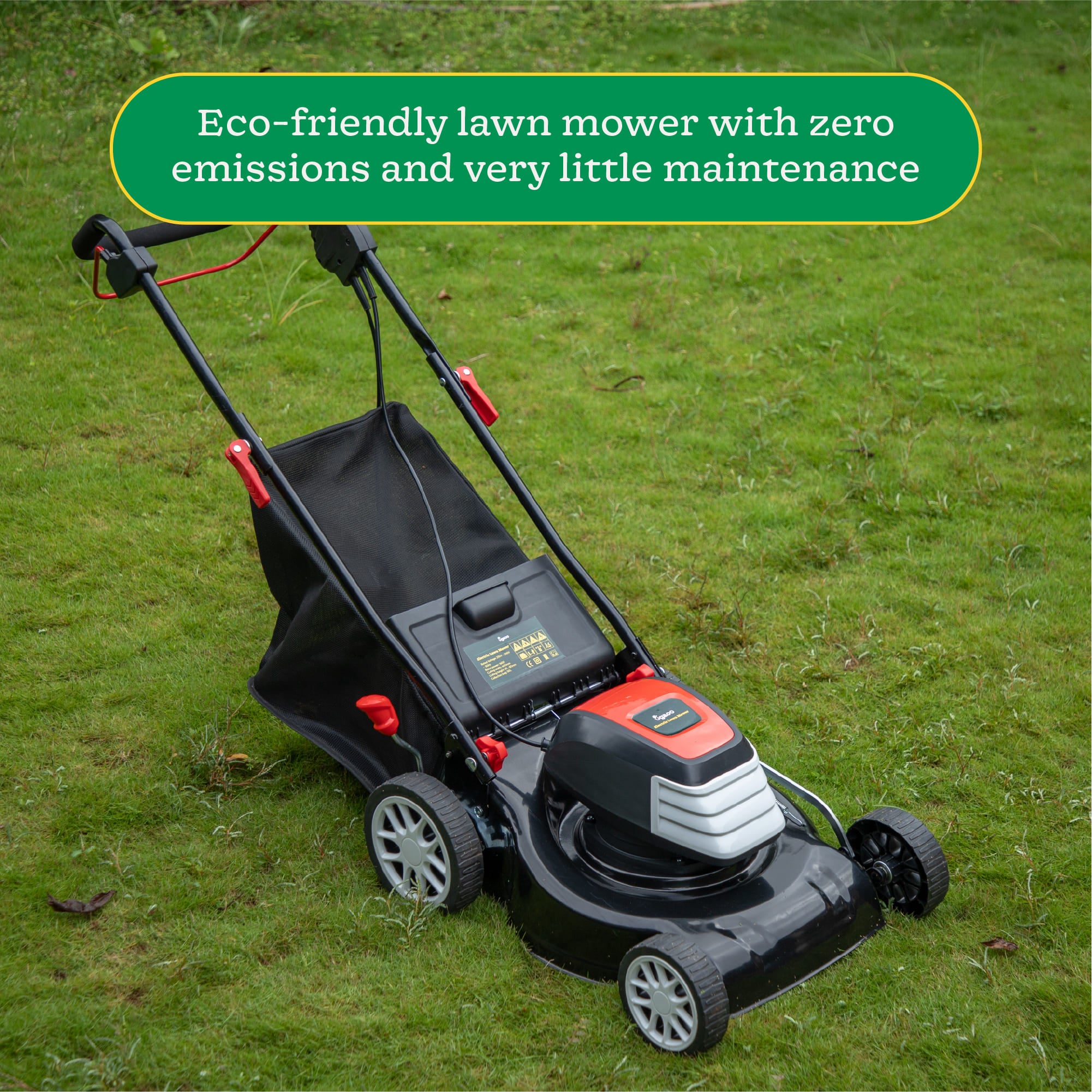
How Many Watts Does a Battery Lawn Mower Use?
A battery lawn mower often uses about 500 to 1,500 watts while cutting, although the actual draw may move above or below that range.
Battery mower labels usually show:
- Battery voltage, such as 40V, 48V, or 56V
- Battery capacity in amp-hours, such as 4.0Ah, 5.0Ah, or 10.0Ah
- Charger input or output information
The battery’s stored energy can be estimated with this formula:
[
\text{Watt-hours} = \text{Volts} \times \text{Amp-hours}
]
For example, a 40-volt, 5-amp-hour battery stores approximately:
[
40 \times 5 = 200\text{ watt-hours}
]
A 56-volt, 7.5-amp-hour battery stores approximately:
[
56 \times 7.5 = 420\text{ watt-hours}
]
Manufacturers may use nominal voltage, maximum voltage, or a platform-specific rating. Therefore, the result is an estimate rather than a lab measurement.
Why battery runtime does not give exact wattage
Suppose a 200-Wh battery runs a mower for 30 minutes. A simple estimate is:
[
200 \div 0.5 = 400\text{ watts}
]
That does not mean the mower always used 400 watts. The estimate is affected by:
- Battery and motor losses
- Battery temperature
- Charging efficiency
- Remaining battery reserve
- Automatic blade-speed control
- Grass and terrain
- Battery age
A mower may use 400 watts in easy conditions and 1,000 watts or more in dense grass. The average over the full mowing session may still be much lower than the highest momentary draw.
How to Calculate Electric Lawn Mower Energy Use
To estimate energy use, multiply power by operating time:
[
\text{Watt-hours} = \text{Watts} \times \text{Hours}
]
Example: corded mower
Assume a 1,440-watt corded mower runs for 30 minutes:
[
1,440 \times 0.5 = 720\text{ watt-hours}
]
That equals:
[
720 \div 1,000 = 0.72\text{ kilowatt-hours}
]
If the mower runs for 45 minutes:
[
1,440 \times 0.75 = 1,080\text{ watt-hours}
]
or 1.08 kilowatt-hours.
These figures assume the mower draws its full estimated load for the entire mowing period. Actual energy use may be lower.
Example: battery mower
Assume a mower uses a 40V, 5Ah battery:
[
40 \times 5 = 200\text{ Wh}
]
If the battery is fully used during one mowing session, the mower receives about 200 watt-hours of stored energy. The charger will draw more than 200 watt-hours from the wall because charging creates electrical and heat losses.
Energy-use table
| Estimated mower load | Runtime | Estimated energy |
|---|---|---|
| 600 watts | 30 minutes | 300 Wh |
| 1,000 watts | 30 minutes | 500 Wh |
| 1,440 watts | 30 minutes | 720 Wh |
| 1,000 watts | 45 minutes | 750 Wh |
| 1,500 watts | 45 minutes | 1,125 Wh |
The table uses hypothetical calculations. It is not a measurement of every mower.

How Much Does It Cost to Run an Electric Lawn Mower?
The electricity cost is usually low. Calculate it with:
[
\text{Cost} = \text{Kilowatt-hours} \times \text{Electricity rate}
]
For example, a mower using 0.72 kWh during one session at $0.20 per kWh would cost:
[
0.72 \times $0.20 = $0.144
]
That is about 14 cents per mowing session.
At 26 mowing sessions per year:
[
$0.144 \times 26 = $3.74
]
This example excludes battery charging losses, maintenance, and any demand or time-of-use charges. Your local electricity rate may differ by state, utility, and plan. The U.S. Energy Information Administration publishes residential electricity price data for the United States.
A practical estimate should use the mower’s actual runtime and your electric rate. The motor’s label alone cannot predict the annual bill.
What Changes an Electric Mower’s Wattage?
The largest change usually comes from grass resistance. The mower uses more power when the blade must cut dense material or maintain speed under load.
Grass and weather
Tall, wet, thick, or overgrown grass can increase power demand. Wet clippings may also stick beneath the deck and restrict airflow.
For better efficiency, mow when the grass is dry and avoid cutting more than the mower manufacturer recommends in one pass.
Blade condition
A sharp blade cuts with less resistance. A damaged or dull blade may increase energy use and produce a poor cut.
Disconnect the power source before inspecting or cleaning the blade:
- Unplug a corded mower.
- Remove the battery from a battery mower.
- Follow the owner’s manual before tipping or servicing the mower.
Cutting width
A wider deck can cover more lawn per pass, but it may require a larger motor and more power under load. A smaller mower may use fewer watts at any moment but take longer to finish the same lawn.
The best comparison is often total energy per job, not just watts while running.
Mowing speed
Pushing too fast can overload the blade. Moving at a steady pace lets the motor maintain blade speed and can reduce repeated passes.
Battery temperature and age
Lithium-ion batteries may perform differently in very hot or cold conditions. Battery capacity also declines over time and with repeated use.
Store and charge batteries according to the manufacturer’s instructions. Do not use a swollen, cracked, wet, or visibly damaged battery.

Can a Portable Power Station Run an Electric Lawn Mower?
A portable power station may run some electric mowers, but the power station must handle both continuous wattage and startup surge.
For a corded mower, check:
- The mower’s rated watts or amps.
- The power station’s continuous AC output.
- The power station’s surge or peak output.
- The battery’s usable watt-hours.
- Whether the power station supports the mower’s motor type.
A 1,440-watt mower should not be paired with a power station rated for only 1,000 watts. Even if the mower starts, the inverter may shut down or overheat.
A power station’s battery capacity also limits runtime. A 1,000-Wh unit will not necessarily provide 1,000 Wh to the mower because inverter losses and reserve capacity reduce usable energy.
Do not connect a mower to a vehicle, generator, or power station unless the equipment instructions allow that use. Keep gasoline generators outdoors and far from doors, windows, and vents because carbon monoxide can build up indoors.
What Size Extension Cord Does a Corded Mower Need?
The correct extension cord depends on the mower’s current draw and cord length. Use a cord marked for outdoor use and rated for the mower.
A longer cord has more electrical resistance. If the cord is too light, it may become warm and cause voltage drop. Follow the mower manual and the extension-cord manufacturer’s rating rather than relying only on color or appearance.
Safe practice includes:
- Inspecting the cord before each use
- Replacing cords with cuts, exposed wires, or damaged plugs
- Keeping the connection away from wet ground when possible
- Using a ground-fault circuit interrupter, or GFCI, where required
- Keeping the cord behind the mower
- Never mowing over the cord
- Unplugging the mower before clearing a blockage
The Occupational Safety and Health Administration provides general electrical safety guidance, while the mower manual gives model-specific instructions.

Common Mistakes When Estimating Mower Wattage
Mistake 1: Treating voltage as wattage
A 56V mower does not automatically use 56 watts. Voltage is only one part of the calculation.
Mistake 2: Multiplying battery voltage by motor runtime
Runtime must be expressed in hours, and battery capacity must be included. Use:
[
\text{Wh} = \text{V} \times \text{Ah}
]
Mistake 3: Assuming the rated wattage is constant
A mower’s listed maximum or estimated wattage may not equal its average demand during normal mowing.
Mistake 4: Ignoring the charger
A cordless mower does not use wall power while cutting, but its charger uses electricity afterward. Charging losses make wall energy higher than the battery’s stored energy.
Mistake 5: Comparing watts without comparing job time
A 700-watt mower that runs for one hour may use more energy than a 1,400-watt mower that runs for 20 minutes.
Mistake 6: Using an indoor extension cord outdoors
Indoor cords may not have the insulation, moisture resistance, or durability needed for outdoor lawn equipment.
How to Find the Exact Wattage of Your Mower
Use this process for the most reliable estimate:
- Read the data label. Look for watts, amps, voltage, or charger specifications.
- Check the owner’s manual. It may list the motor rating, cord requirements, or battery information.
- Calculate corded input power. Multiply the mower’s amps by 120 volts.
- Calculate battery energy. Multiply battery volts by amp-hours.
- Measure real use if needed. A plug-in watt meter can measure a corded mower, but only use one that is rated for the mower’s load and intended for the environment.
- Compare several mowing sessions. One session may include unusual grass, slopes, or wet conditions.
Never place a household watt meter where it can get wet. Do not modify mower wiring or battery packs to obtain a measurement.

Frequently Asked Questions
Does an electric mower use more electricity than a refrigerator?
It depends on operating time and the refrigerator’s duty cycle. An electric mower may draw more watts while running, but it usually operates for a short period. A refrigerator uses fewer watts at a moment but runs on and off all day.
How many watts does a 40V lawn mower use?
A 40V label does not show the mower’s full wattage. If the mower uses a 40V, 5Ah battery, the battery stores about 200 Wh before losses. Actual motor power varies with the grass and operating conditions.
How many amps does a 1,500-watt mower use?
At 120 volts:
[
1,500 \div 120 = 12.5\text{ amps}
]
The actual current may change while mowing, and the motor may have a brief startup surge.
Is a battery mower cheaper to run than a corded mower?
The electricity cost may be similar for a comparable mowing job. A battery mower adds charging losses and battery replacement costs, while a corded mower requires a suitable extension cord and a nearby outlet. Purchase price, lawn size, and maintenance often matter more than the small difference in electricity cost.
Can solar panels run an electric lawn mower?
Solar panels can contribute to charging a battery mower or power station, but direct operation is more complex. Sunlight varies, and the inverter must handle the mower’s continuous and startup demand. A properly sized battery and inverter are usually needed for stable operation.
Key Takeaways
- Most electric lawn mowers use about 500–1,800 watts while operating.
- Corded models commonly use 1,000–1,800 watts at a 120-volt U.S. outlet.
- Battery models often use about 500–1,500 watts, but voltage alone does not reveal wattage.
- Estimate battery energy with volts × amp-hours = watt-hours.
- Estimate electricity cost with kilowatt-hours × your utility rate.
- Tall, wet grass, dull blades, slopes, and fast pushing can increase power use.
- Choose extension cords, inverters, and power stations by their rated load and safety instructions.
Conclusion
A typical electric lawn mower uses roughly 500 to 1,800 watts, with corded models near the upper end and battery models varying more widely. The best estimate comes from the mower’s amp rating, battery watt-hours, or a properly rated power meter.
For a quick household estimate, use 1,200 to 1,500 watts for a corded mower and 600 to 1,200 watts for a standard battery mower. Then multiply by operating time to find watt-hours and by your local electricity rate to estimate cost. Always follow the mower, battery, charger, and extension-cord instructions before use.


