
How Big Is A Lawn Mower: Size Guide
A typical walk-behind lawn mower in the United States is about 20 to 24 inches wide, 55 to 75 inches long, and 36 to 44 inches tall when ready to use. Its cutting deck may be 20 to 22 inches wide, while the full mower can be wider because of the wheels, handle, and side discharge chute.
Riding mowers are much larger. A lawn tractor often measures 60 to 75 inches wide, 70 to 85 inches long, and about 40 to 50 inches tall. Zero-turn mowers may be 60 to 80 inches wide and need extra space to turn and store safely.
The exact size depends on the mower type, deck width, handle design, bagger, chute, battery, and whether the handle folds. Always check the model’s owner’s manual or product specification sheet before planning storage or transport.

What Does “Mower Size” Mean?
“Mower size” can mean several different measurements. The most useful measurements are cutting width, total width, length, and height.
- Cutting width: The width of grass cut in one pass. This is also called deck width.
- Total width: The widest point of the complete mower. This may include wheels, a discharge chute, or a grass bag.
- Length: The distance from the front of the mower to the back of the handle or seat.
- Height: The distance from the floor to the highest point, often the handle or steering wheel.
- Storage size: The space needed when the handle is folded, removed, or placed upright.
A 21-inch mower does not usually measure only 21 inches from side to side. The number normally refers to the blade or cutting deck. The complete machine may be 22 to 26 inches wide.
Deck width versus total mower width
Deck width helps you estimate mowing speed. Total width helps you decide whether the mower will fit through a gate, shed door, or vehicle opening.
For example, a mower with a 21-inch deck may have:
- A 21-inch cutting path
- A 23-inch body
- A 25-inch width with the side chute attached
- A greater length when the handle is extended
This difference matters when measuring a narrow passage. Measure the widest part of the mower, not only the deck.
How Big Is a Walk-Behind Lawn Mower?
Most walk-behind mowers used in American yards measure 20 to 24 inches wide and 55 to 75 inches long when the handle is open. Their height is often 36 to 44 inches, depending on the handle and control bar.
The following ranges are practical estimates, not fixed industry standards.
| Walk-behind mower type | Common deck width | Approximate full width | Approximate length | Approximate height |
|---|---|---|---|---|
| Small push mower | 16–20 in. | 18–23 in. | 50–65 in. | 35–43 in. |
| Standard gas mower | 20–22 in. | 22–26 in. | 55–75 in. | 36–44 in. |
| Self-propelled mower | 20–22 in. | 22–27 in. | 60–78 in. | 38–46 in. |
| Wide-deck walk-behind mower | 24–30 in. | 26–34 in. | 65–85 in. | 40–48 in. |
| Battery mower with folded handle | 19–24 in. | 21–27 in. | Often 30–45 in. | Often 14–30 in. |
Gas mowers often have longer handles and larger engines. Battery mowers may store more easily because many models have folding handles. The battery itself usually adds little to the outside width, but it can add weight and may need separate storage.
Push mowers
Push mowers are often the smallest full-size mowers. A small model may fit through a 24-inch gate, but the fit can be close. If the mower has a side discharge chute, measure with the chute in its normal position.
Self-propelled mowers
Self-propelled mowers are usually close in size to push mowers. They may be slightly longer or heavier because of the drive system. Their width still depends mainly on the deck and wheel layout.
Folding-handle mowers
A folding handle can reduce storage length by about one-third to one-half, depending on the design. The mower body still needs floor space. Some models can stand vertically, but only do this when the manufacturer says vertical storage is safe.
The engine, fuel system, battery, and oil position can affect whether a mower may be stored upright. Never guess. Use the owner’s manual.
How Big Is a Riding Lawn Mower?
A riding lawn mower is commonly 60 to 75 inches wide, 70 to 85 inches long, and 40 to 50 inches tall. Smaller rear-engine riders may be narrower and shorter. Larger lawn tractors with wide decks, large tires, or grass collectors can be much bigger.
| Riding mower type | Common deck width | Approximate full width | Approximate length | Approximate height |
|---|---|---|---|---|
| Rear-engine rider | 26–38 in. | 35–45 in. | 60–75 in. | 38–45 in. |
| Small lawn tractor | 38–42 in. | 45–55 in. | 65–80 in. | 40–48 in. |
| Standard lawn tractor | 42–54 in. | 50–65 in. | 70–85 in. | 42–50 in. |
| Large lawn tractor | 54–60 in. | 60–72 in. | 75–90 in. | 44–52 in. |
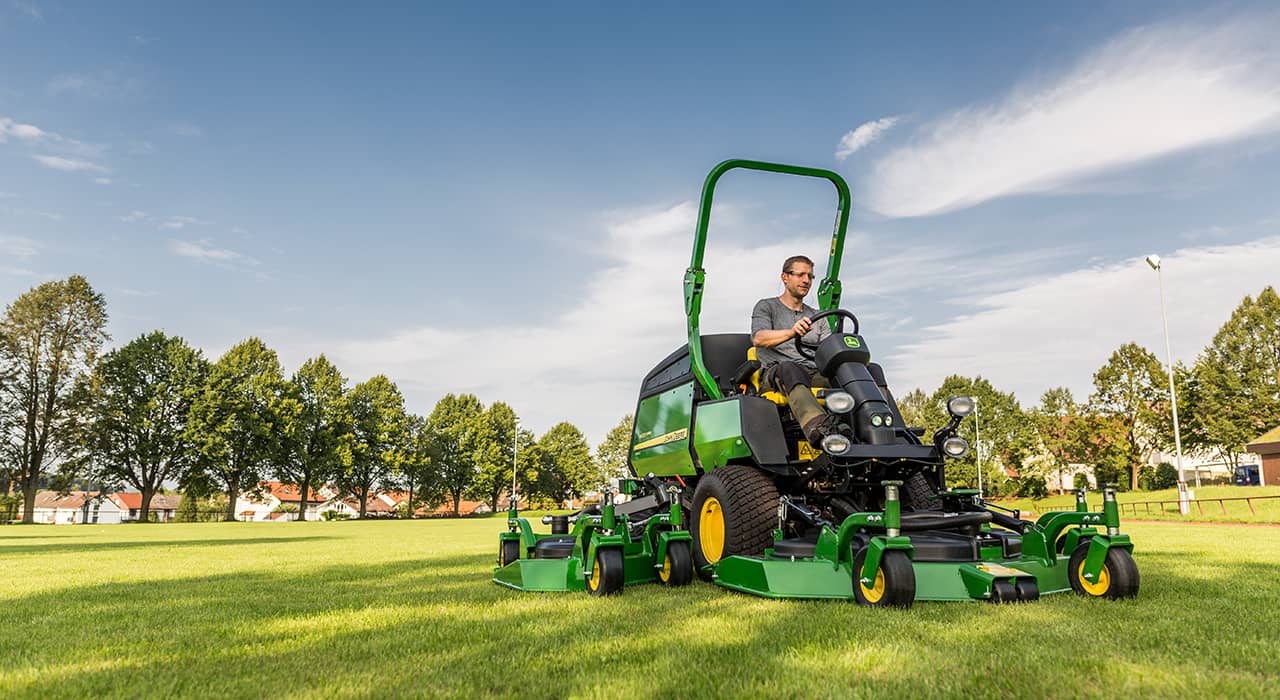
| Residential zero-turn mower | 42–54 in. | 48–65 in. | 65–85 in. | 40–50 in. |
| Wide zero-turn mower | 60–72 in. | 60–80 in. | 75–95 in. | 45–55 in. |
These ranges exclude some attachments. A rear grass catcher, snow blade, front scoop, or large discharge system can increase the mower’s working footprint.
Lawn tractor size
A lawn tractor usually has a front-mounted engine, steering wheel, hood, and rear seat. The deck sits below the frame. Its stated deck width may be 42 inches, but the full mower can be more than 50 inches wide.
Zero-turn mower size
A zero-turn mower may have a similar length to a lawn tractor but a wider rear body. Its rear tires and control levers can affect the total width.
Zero-turn mowers also need more open space than their parked size suggests. They turn by changing the speed of each drive wheel. A narrow route may be possible, but the mower may not have room to turn around without touching a fence, tree, or wall.
Compact riding mower size
Compact riding mowers can suit small properties, but “compact” does not mean car-sized. Check the full width, not just the deck. A mower that fits through a gate may still need extra room to turn inside the yard.
How Much Space Does a Lawn Mower Need for Storage?
For storage, allow more room than the mower’s exact dimensions. You need space to move the machine in and out, reach the controls, and perform basic maintenance.
Walk-behind mower storage
A walk-behind mower with the handle open may need an area about:
- 3 feet wide
- 6 to 7 feet long
- 4 feet high
A folded-handle mower may fit in a space about 2 to 3 feet deep, but this depends on the model. The wheels, handle joints, grass bag, and discharge chute can change the folded shape.
A 24-inch-wide shed door may not be practical for every mower. Leave clearance on both sides so the mower does not scrape the frame.
Riding mower storage
A riding mower often needs:
- At least 6 feet of door width
- About 8 to 10 feet of depth
- About 5 to 6 feet of vertical clearance
A large tractor or zero-turn mower may need a door wider than 6 feet. Add space for the mower deck, steering levers, and attachments.
The shed must also have a floor strong enough for the mower’s weight. A level entrance helps prevent the mower from rolling backward or sideways during storage.
A simple storage calculation
Use this method:
- Measure the mower at its widest point.
- Add at least 6 inches of side clearance on each side.
- Measure the mower’s full length.
- Add 12 to 24 inches for movement and access.
- Measure the highest point.
- Add enough height for the door frame, lighting, and safe handling.
For example, a mower that is 25 inches wide needs at least:
25 + 6 + 6 = 37 inches of useful door width
That is a minimum working estimate. A wider opening will be easier and safer to use.

Will a Lawn Mower Fit Through a Gate or Door?
A lawn mower will fit through a gate only when the narrowest opening is wider than the mower’s widest point. Measure the clear opening with the gate fully open. Do not measure from post to post if hinges, latches, or trim reduce the usable space.
Use this checklist:
- Measure the gate at its narrowest point.
- Measure the mower with the side chute attached.
- Include the wheels and handle.
- Check whether the handle folds.
- Account for sloped ground or a raised threshold.
- Leave room to steer without hitting the posts.
A mower that is 24 inches wide may technically pass through a 25-inch opening. In practice, that leaves only half an inch on each side. That is difficult on uneven ground and increases the chance of damage.
For regular use, aim for at least 2 to 4 inches of total extra width. More clearance is better if the path is sloped, rough, or hard to see from the operator’s position.
How Big Is a Lawn Mower for Transport?
A walk-behind mower can often fit in a pickup bed, minivan, SUV, or utility trailer. A riding mower usually needs a trailer or a pickup with a suitable loading system.
Before transport, check the mower manual. The correct position depends on the mower type.
Transporting a walk-behind mower
For a gas mower:
- Remove loose items.
- Empty or secure the grass bag.
- Let the engine cool.
- Turn off the fuel valve if the mower has one.
- Keep the mower stable.
- Follow the manual for tipping or folding.
- Use strong straps to prevent movement.
Do not place a gas mower in a closed passenger area while it contains fuel. Gasoline fumes can collect and create a fire hazard.
For a battery mower:
- Remove the battery if the manual directs you to do so.
- Protect the battery from water and extreme heat.
- Keep the blade area from contacting other items.
- Secure the mower so it cannot roll or fall.
Transporting a riding mower
Use ramps rated for the mower’s weight. The ramp angle should be manageable, and the ramp must lock or stay firmly in place.
Before loading:
- Clear the trailer or truck bed.
- Keep bystanders away.
- Drive slowly.
- Center the mower.
- Lower the deck when appropriate.
- Set the parking brake.
- Turn off the engine.
- Remove the key.
- Use straps rated for the load.
Never rely only on the parking brake. A mower can move during travel even when it seems secure.
What Mower Size Is Best for Your Yard?
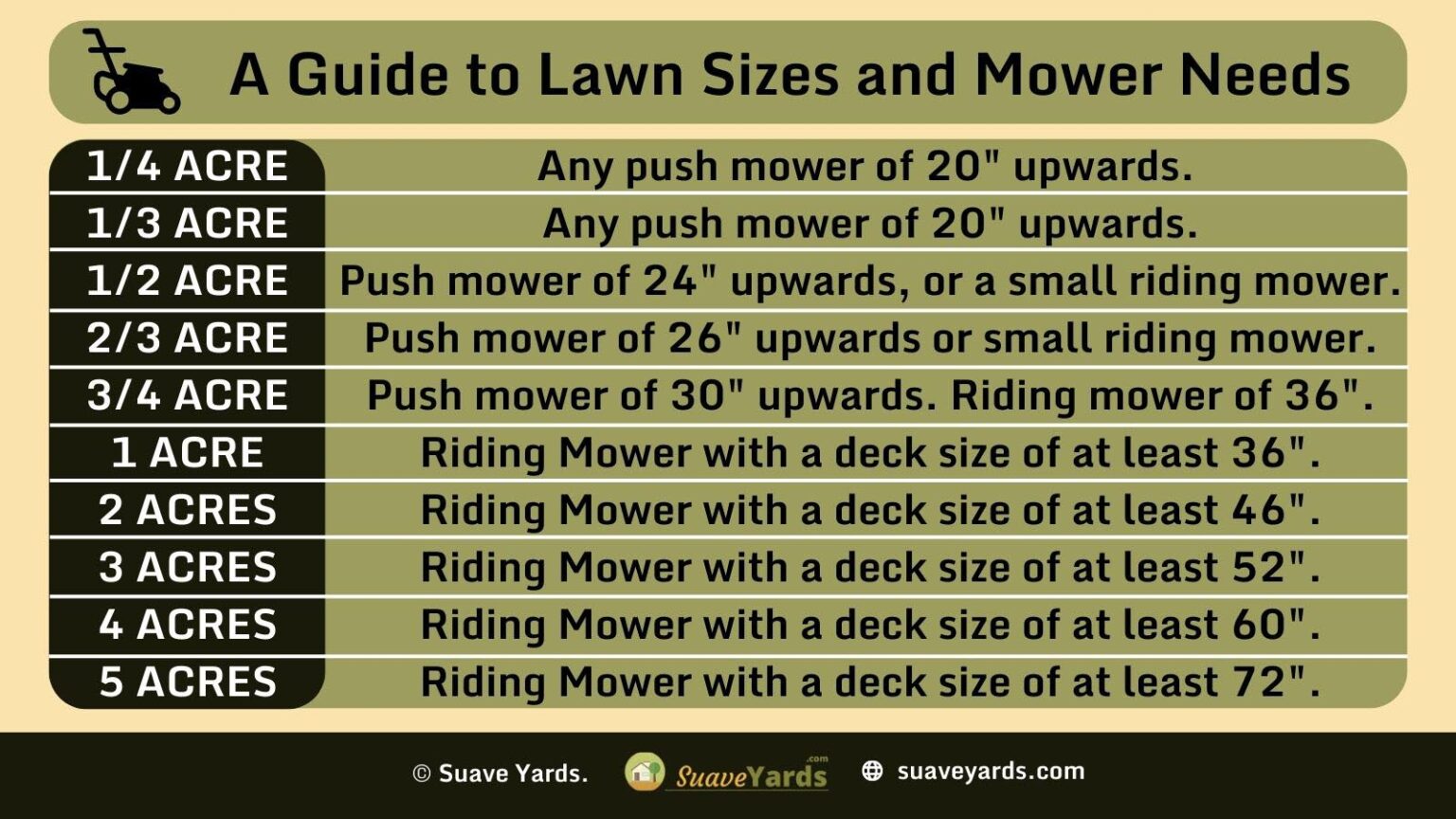
The best mower size depends on lawn area, gate width, storage, slopes, and obstacles. A wider deck covers more grass per pass, but it may be harder to store and maneuver.
| Yard condition | Practical mower size |
|---|---|
| Small yard with narrow gates | 16–20 in. walk-behind mower |
| Typical suburban lawn | 20–22 in. walk-behind mower |
| Large open lawn | 22–30 in. walk-behind or riding mower |
| One-half to about one acre | Riding mower may save time |
| Larger open property | Lawn tractor or zero-turn mower |
| Many trees, beds, and tight corners | Smaller deck and shorter body |
| Sloped or uneven yard | Choose a model approved for that terrain |
These are planning guidelines, not strict limits. Lawn shape often matters as much as lawn size.
A 42-inch riding mower may cut an open lawn quickly. It may be frustrating in a yard with narrow paths and many trees. A 21-inch walk-behind mower may take longer but reach places a riding mower cannot.
Estimating mowing passes
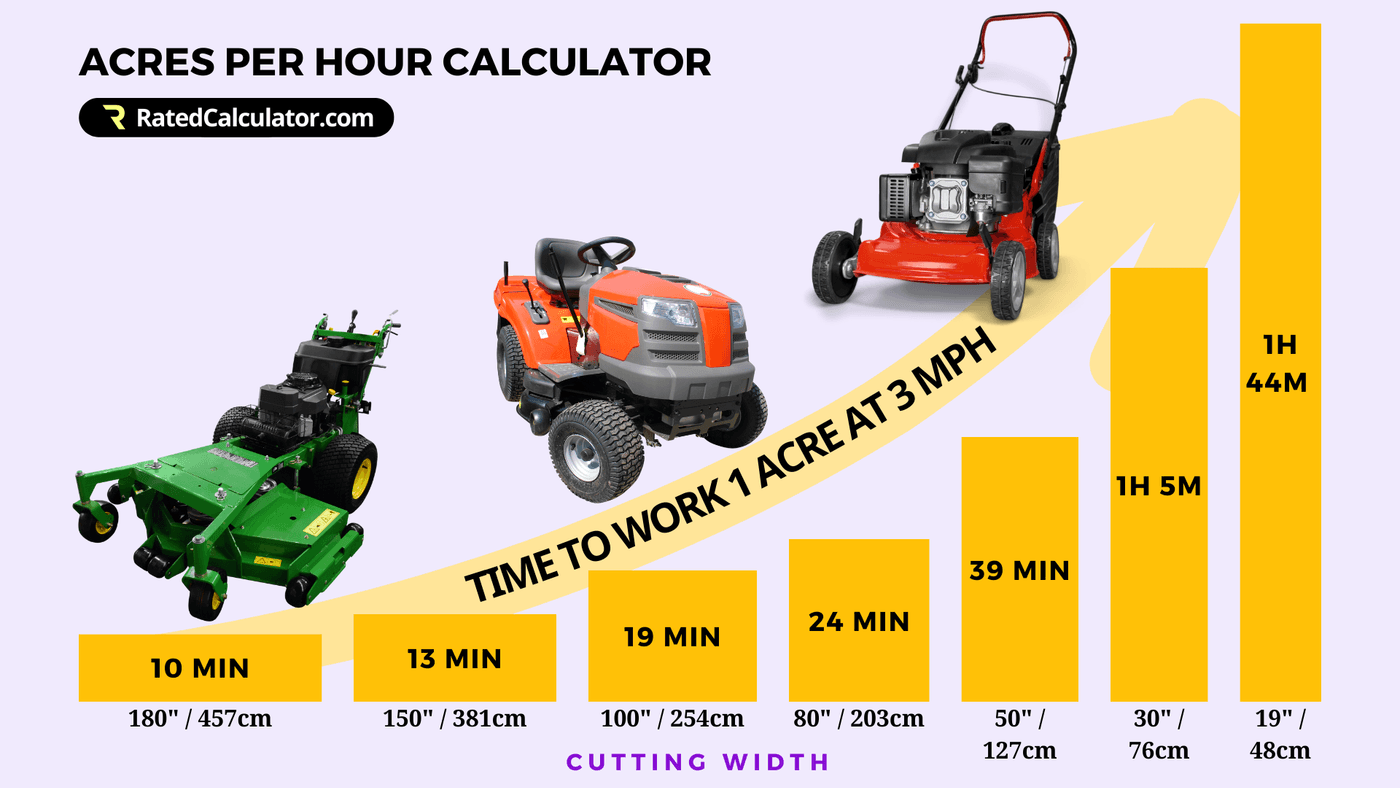
A wider deck covers more grass in each pass. For a simple estimate:
Number of passes = lawn width ÷ cutting width
This is only a rough calculation. Overlap, turns, trees, and uneven edges add time.
For example, a 60-foot lawn width divided by a 20-inch deck is not a perfect real-world count because 20 inches equals 1.67 feet:
60 ÷ 1.67 ≈ 36 passes
A 42-inch deck is 3.5 feet wide:
60 ÷ 3.5 ≈ 17 passes
The larger mower may reduce straight passes, but it still needs room to turn and may not reach narrow areas.

What Changes a Lawn Mower’s Size?
Several parts can make the mower larger than its advertised deck size.
Side discharge chute
A side chute may extend several inches beyond the deck. Measure with it installed if the mower will pass through a gate or door.
Grass catcher
A rear bag can add length. A hard catcher or tow-behind collection system may add even more space behind a riding mower.
Handle and controls
A long handle increases storage length. Control levers on a zero-turn mower can affect width and may need protection during transport.
Battery and charger
The battery usually does not change the mower’s outer dimensions much. It does affect lifting weight and storage needs. Store removable batteries in the temperature range given by the manufacturer.
Attachments
Mulching plugs, baggers, snow blades, trailers, and front-mounted tools can change the machine’s overall size. Measure the mower in the exact setup you plan to use.
Common Lawn Mower Size Mistakes
The most common mistake is using the deck width as the full mower width. The deck tells you the cutting path, not the exact space needed to move the mower.
Other errors include:
- Measuring a gate without opening it fully
- Forgetting the discharge chute
- Ignoring a folded handle’s hinges or controls
- Measuring a riding mower without its rear bagger
- Assuming a mower can turn in the same space in which it can drive straight
- Storing a gas mower upright without checking the manual
- Using a ramp that is too narrow or weak
- Leaving no room for maintenance
- Measuring the shed door but not the path leading to it
If the mower barely fits, choose a wider opening or a smaller mower. A tight fit can damage the mower, the building, or the operator.

How to Find the Exact Dimensions of a Lawn Mower
Use the manufacturer’s specification sheet or owner’s manual for the exact model. Look for separate values for:
- Width with the chute installed
- Width with the chute removed
- Length with the handle open
- Length with the handle folded
- Height
- Weight
- Deck width
- Dimensions with a bagger or other attachment
If the manufacturer lists only deck width, measure the complete mower yourself. Place the mower on level ground and measure the widest, longest, and highest points.
For a riding mower, measure the mower with the deck in the position used for storage. If you use a grass collector or rear attachment, measure that setup too.
Manufacturer specifications are the best starting point, but model revisions can change dimensions. Confirm the model number, not just the product name.
Key Takeaways
- Most walk-behind mowers are about 20–24 inches wide and 55–75 inches long.
- Most riding mowers are about 45–75 inches wide and 60–90 inches long.
- A mower’s deck width is not always its full width.
- Measure the chute, wheels, handle, bagger, and attachments.
- Add clearance for gates, sheds, turning, and maintenance.
- Check the owner’s manual before storing a mower upright or transporting it.
Frequently Asked Questions
How wide is a standard lawn mower?
A standard walk-behind lawn mower is often 22 to 26 inches wide from its widest point. Its cutting deck is commonly 20 to 22 inches wide. The exact width depends on the wheels, chute, handle, and mower design.
How long is a lawn mower with the handle up?
Many walk-behind mowers measure about 55 to 75 inches long with the handle fully extended. Self-propelled models and long-handle designs may be longer.
Can a lawn mower fit through a 24-inch gate?
Some small mowers can fit through a 24-inch gate, but the fit may be too tight for easy use. Measure the mower’s widest point with the chute attached. A few inches of extra clearance makes steering safer.
How much room does a riding mower need in a shed?
A riding mower commonly needs about 6 feet of door width and 8 to 10 feet of depth. Large tractors, zero-turn mowers, and bagger systems may need more room.
Can I store a lawn mower vertically?
Some walk-behind mowers are designed for vertical storage, but not all are. Check the owner’s manual first. Gas, oil, battery, and engine designs can affect whether upright storage is safe.
Is a wider mower always better?
No. A wider mower can reduce mowing time on open ground, but it may not fit through gates or move well around trees and flower beds. Choose the largest deck that fits your access routes and storage space.
Conclusion
A lawn mower’s size depends on more than its cutting deck. For most American homeowners, a walk-behind mower takes up roughly 2 feet of width and 5 to 6 feet of length, while a riding mower may need 5 to 6 feet of width and 7 to 8 feet of length.
Measure the complete mower in its real storage or transport setup. Include the chute, bagger, handle, wheels, and any attachments. Then add clearance for safe movement. This simple check can prevent a mower that will not fit through the gate, into the shed, or onto the trailer.


