
How Wide Are Lawn Mowers: Size Guide
Introduction
Most lawn mowers sold in the United States are 14 to 72 inches wide, depending on the type. A small push mower may measure about 20 inches across, while a residential riding mower often spans 42 to 54 inches. Large zero-turn mowers can be 60 inches wide or more.
The key measurement is usually the cutting width, also called the deck width. The mower’s full outside width can be wider because of the wheels, discharge chute, handles, or side guards.
If you need a mower to fit through a gate, shed door, trailer, or narrow path, check the manufacturer’s overall width, not only the advertised cutting width.

Lawn Mower Widths at a Glance
The following ranges cover common mower types sold in the U.S. They are general ranges, not limits. Exact dimensions vary by brand, model, deck, and attachments.
| Lawn mower type | Common cutting width | Common overall width | Best suited for |
|---|---|---|---|
| Reel mower | 14–20 inches | 18–24 inches | Small, level lawns |
| Electric or gas push mower | 16–22 inches | 20–25 inches | Small to medium yards |
| Self-propelled mower | 20–22 inches | 22–26 inches | Medium yards and slopes |
| Robotic mower | Not usually listed as deck width | 8–26 inches | Small to large lawns, based on model |
| Walk-behind brush mower | 22–30 inches | 26–36 inches | Tall grass and rough ground |
| Lawn tractor | 42–54 inches | 48–66 inches | Medium and large properties |
| Rear-engine riding mower | 30–42 inches | 36–48 inches | Smaller riding areas |
| Zero-turn mower | 42–72 inches | 44–76 inches | Large, open lawns |
| Stand-on mower | 36–60 inches | 40–64 inches | Fast mowing on larger properties |
| Commercial walk-behind mower | 32–60 inches | 36–64 inches | Large lawns and landscaping work |
A mower with a 21-inch deck does not always measure exactly 21 inches from its widest point. The discharge chute may add several inches when it is extended. Folding the chute, if the design allows it, may reduce storage width but not operating width.
What Does Lawn Mower Width Mean?
Lawn mower width can refer to three different measurements:
- Cutting width: The width of grass cut in one pass.
- Deck width: The width of the mower deck that covers the blades.
- Overall width: The widest outside measurement of the complete mower.
Manufacturers often use cutting width in product names. For example, a mower may be called a 21-inch mower because its blade and deck cut a strip about 21 inches wide. The full machine may be wider.
Overall width matters when you need to move the mower through a fixed space. Common obstacles include:
- Backyard gates
- Shed doors
- Garage doors
- Fence openings
- Narrow side yards
- Trailer ramps
- Storage aisles
- Walkways between landscaping beds
When space is tight, look for a specification labeled “width,” “overall width,” or “maximum width.” Check whether the listed value includes the discharge chute, grass catcher, armrests, wheels, or other parts.

How Wide Are Push and Walk-Behind Lawn Mowers?
Most residential push and self-propelled lawn mowers are 20 to 22 inches wide at the cutting deck. Their overall width is often about 22 to 26 inches, depending on the wheels and side discharge chute.
Common push mower sizes
- Compact reel mowers: about 14 to 18 inches
- Small electric mowers: about 16 to 20 inches
- Standard gas or battery mowers: about 20 to 22 inches
- Wide-deck walk-behind mowers: about 22 to 30 inches
A 21-inch walk-behind mower is a common U.S. choice because it balances cutting speed with easy storage. It can usually pass through a standard backyard gate, but the gate may need to open fully and the discharge chute may need attention.
How much lawn does width change?
A wider deck can reduce the number of passes needed. Consider this simple example:
- A 21-inch mower cuts about 1.75 feet per pass.
- A 30-inch mower cuts about 2.5 feet per pass.
- A 30-inch deck is about 43% wider than a 21-inch deck.
That does not mean mowing time always falls by 43%. Speed, turning, overlap, obstacles, grass height, and bagging all affect the result.
For small or irregular lawns, a narrower mower may be easier to turn and store. For open lawns, a wider walk-behind mower can reduce travel time.

How Wide Are Riding Lawn Mowers?
Most residential riding lawn mowers are 36 to 54 inches wide overall. Their cutting decks commonly range from 30 to 54 inches.
Rear-engine riding mowers
Rear-engine riders often use decks around 30 to 42 inches wide. They are made for homeowners who want a riding position but have limited storage space or a smaller lawn.
Their narrow design can help with:
- Gates around 36 inches wide
- Narrow side yards
- Small sheds
- Lawns with many trees or beds
The deck may still extend beyond the rear wheels, so measure the full machine before buying.
Lawn tractors
Lawn tractors commonly use 42-, 46-, 48-, or 54-inch decks. The overall mower may be several inches wider than the deck.
A lawn tractor with a 42-inch deck may fit through some 48-inch gates, but the available clearance can be smaller than expected because of:
- Side discharge chutes
- Deck lift parts
- Tire bulge
- Armrests
- Snow blades or other attachments
A tractor that barely fits can scrape fence posts or damage the mower. Aim for extra clearance rather than an exact match.
Garden tractors
Garden tractors may use decks from about 46 to 54 inches, although some models are larger. They are built for heavier work than many basic lawn tractors, so their frames and attachments may increase total width.

How Wide Are Zero-Turn Mowers?
Residential zero-turn mowers are commonly 42 to 54 inches wide, while larger residential and commercial models may measure 60 to 72 inches or more.
Typical deck sizes include:
- 42 inches
- 48 inches
- 50 inches
- 54 inches
- 60 inches
- 72 inches
The mower’s overall width may be wider than the cutting deck, especially when the discharge chute is extended. Some zero-turn mowers have a removable or folding chute. That can help with storage, but the mower still needs its full working width during normal use.
Choosing a zero-turn width
A 42- or 48-inch zero-turn mower may suit a medium-sized residential lawn with gates and trees. A 54- or 60-inch deck can cover open ground faster but needs more turning room and a wider path.
A wide deck is not always faster on a complex lawn. Many obstacles can force a wide mower to make short turns and repeated passes. In those areas, a smaller deck may be easier to control and may leave less uncut grass around trees and beds.

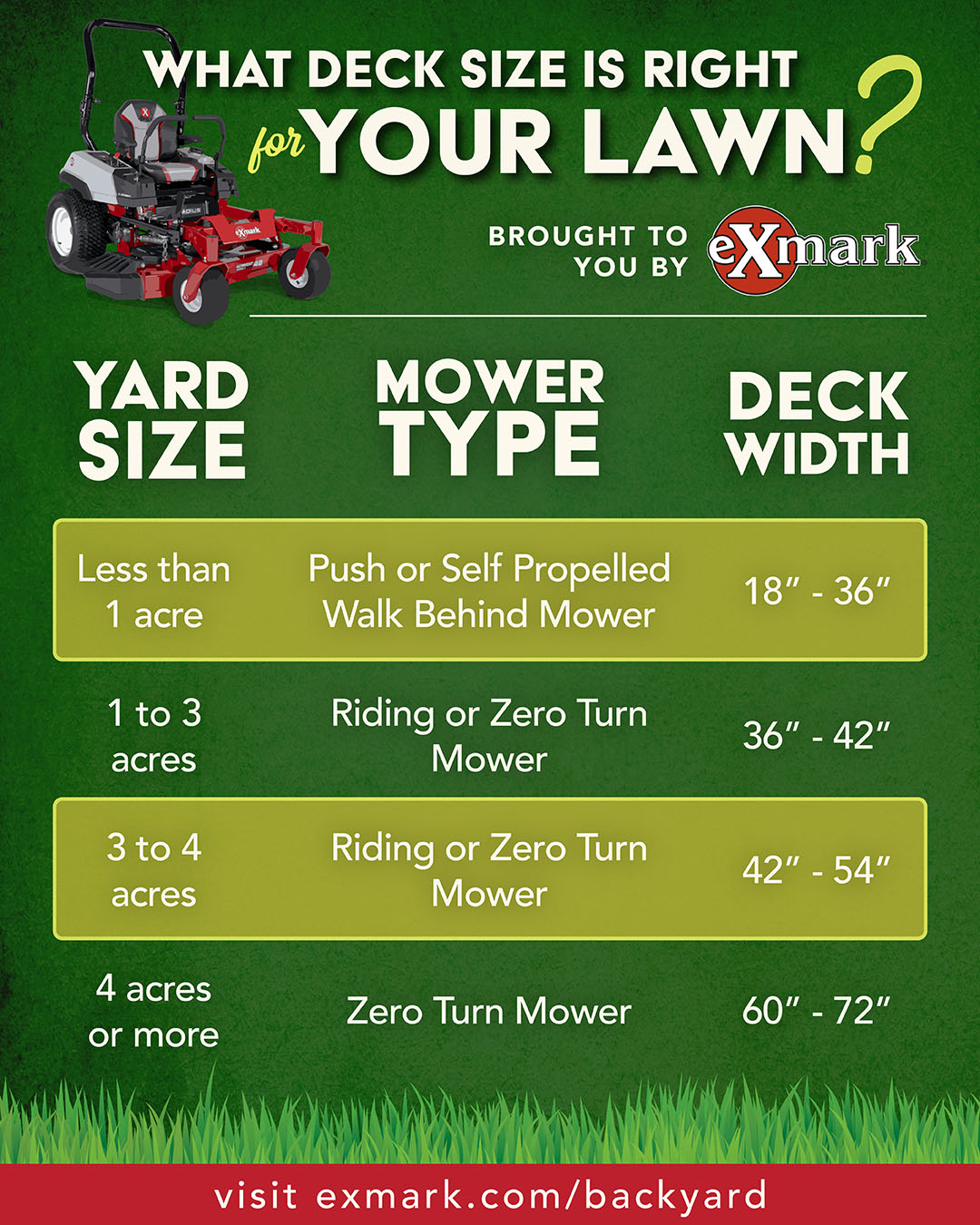
How Wide Should a Lawn Mower Be for Your Yard?
Choose mower width based on lawn size, layout, access, storage, and terrain. Lawn size alone does not determine the best width.
| Yard condition | Practical mower range |
|---|---|
| Very small lawn with tight paths | 14–20 inches |
| Small to medium open lawn | 20–22 inches |
| Medium lawn with some obstacles | 21–30 inches |
| Larger lawn with wide access | 42–48 inches |
| Large, open residential lawn | 48–54 inches |
| Large property or commercial work | 54–72 inches |
These ranges are starting points. A narrow gate can rule out a large riding mower, while steep slopes may make a walk-behind mower safer than a riding machine.
A useful rule
Choose the widest mower that fits your narrowest access point and remains easy to control.
Do not measure only the lawn. Measure the complete route from the storage area to the grass. Include every gate, turn, ramp, and doorway.

How to Measure a Mower and Your Gate
Measure both the mower and the route before you buy.
Measure the access point
- Open the gate or door as far as it normally opens.
- Measure the narrowest clear space.
- Check posts, hinges, latches, slopes, and nearby walls.
- Measure sharp turns, not only straight openings.
- Allow extra space for steering and safe handling.
Measure the mower
Check the official specification sheet or owner’s manual for:
- Overall width
- Width with the discharge chute down
- Width with the chute removed or folded
- Width with a grass catcher attached
- Width with armrests or side attachments
- Width with the deck in its normal operating position
If you already own the mower, measure from the widest fixed point. For a discharge chute, measure both the stored and operating positions.
Compare the numbers
Use this calculation:
Available clearance − mower width = spare clearance
For example:
- Gate opening: 42 inches
- Mower overall width: 38 inches
- Spare clearance: 4 inches
Four inches may be enough on a straight path, but it can feel tight around a turn. More clearance is useful when the ground is uneven or the mower is difficult to steer.

Does the Cutting Deck Width Equal the Mower Width?
No. Cutting deck width and overall mower width are different measurements.
A 42-inch mower may have a 42-inch cutting deck but an overall width near 48 inches. The difference can come from the wheels, deck shape, side discharge chute, and frame.
The listed width may also change with the mower setup. A manufacturer may publish one width for the mower with the chute raised and another for the mower with the chute in its working position.
Before relying on a specification, ask:
- Is this the deck width or the full width?
- Does it include the side discharge chute?
- Is the grass catcher included?
- Are the measurements for the current model year?
- Does an attachment make the mower wider?
This distinction is one of the most common causes of failed gate and shed fits.

How Wide Should a Mower Be for a 36-Inch Gate?
A mower should be noticeably narrower than a 36-inch gate. A mower measuring exactly 36 inches may not pass through safely because the gate opening may be smaller at the hinges or blocked by hardware.
For a 36-inch gate:
- A 20- or 21-inch walk-behind mower usually has ample width.
- A 30-inch walk-behind mower may fit, but measure first.
- A 36-inch riding mower may be too close for comfort.
- A 42-inch tractor or zero-turn mower will usually not fit without a wider opening or a different access route.
A gate’s advertised size may describe the gate panel, not the true clear opening. Measure the opening after installation.

What Mower Width Is Best for Slopes and Uneven Ground?
A narrower mower is often easier to control around tight spaces, but width alone does not determine slope safety.
For sloped yards, review the mower’s owner’s manual. Manufacturers set different limits for:
- Side-to-side slopes
- Up-and-down slopes
- Wet grass
- Uneven ground
- Towing or attachments
Riding mower stability depends on the center of gravity, tire grip, slope direction, speed, and surface condition. A wide deck does not automatically make a mower safe on a hill.
General safety practices include:
- Keep both hands on the controls.
- Avoid wet or slippery grass.
- Do not turn sharply on a slope.
- Follow the manual’s slope guidance.
- Keep people and pets away from the mowing area.
- Stop if the mower feels unstable or loses traction.
When a slope is too steep or uncertain, use a safer mowing method or ask a qualified local lawn-care professional to assess it.

How Mower Width Affects Cutting Time
A wider mower can reduce the number of passes, but its real advantage depends on the lawn.
A simplified calculation is:
Approximate passes = lawn width ÷ cutting width
For a hypothetical 60-foot-wide open lawn:
- With a 21-inch deck, divide 60 feet by 1.75 feet.
- With a 42-inch deck, divide 60 feet by 3.5 feet.
The 42-inch deck needs roughly half as many straight passes before overlap and turns are considered. Real mowing time will be longer because of trees, beds, slopes, overlap, emptying the bag, and repositioning.
A wider deck works best when:
- The lawn is open.
- The ground is fairly even.
- The mower can turn without repeated backing.
- The access route is wide enough.
- The operator can maintain control.
A smaller deck may work better when the lawn has narrow strips, many obstacles, soft ground, or tight corners.

Common Mistakes When Comparing Lawn Mower Widths
Mistake 1: Using the advertised deck size as the full width
The deck number describes cutting capacity, not always the widest part of the machine. Always find the overall width.
Mistake 2: Forgetting the discharge chute
A side chute can add several inches. It may also swing outward while mowing.
Mistake 3: Measuring the gate panel instead of the opening
Posts and hinges reduce clear space. Measure the open passage.
Mistake 4: Ignoring the turning path
A mower may pass through a gate but fail to turn toward the lawn. Measure the space beyond the gate.
Mistake 5: Assuming a folding handle solves every storage problem
A folded handle reduces length and height more than width. Wheels, deck parts, or the handle frame may still set the minimum width.
Mistake 6: Buying the widest possible mower
A large deck can save time on open grass, but it may be harder to maneuver near trees, beds, fences, and slopes.
Mistake 7: Trusting an old specification
Manufacturers may change deck designs and frame dimensions while keeping a similar model name. Confirm the exact model number and model year.

How to Find the Exact Width of a Lawn Mower
The most reliable source is the manufacturer’s specification page or owner’s manual for the exact model.
Use this order:
- Find the model number on the mower or product listing.
- Open the current manufacturer specification page.
- Check the owner’s manual for dimensional details.
- Look for “overall width,” not only “cut width.”
- Check whether the width includes the chute or attachments.
- Measure the narrowest access point at home.
- Contact the manufacturer if the specification is unclear.
Retail listings can contain rounded or incomplete dimensions. Use them for comparison, but confirm a tight fit with the manufacturer’s document.

Frequently Asked Questions
Are all 21-inch lawn mowers the same width?
No. Most have a cutting width near 21 inches, but their full widths can differ because of the deck, wheels, handle frame, and discharge chute.
Will a 42-inch riding mower fit through a 42-inch gate?
Usually, not safely. The mower’s overall width may exceed the deck width, and the gate’s clear opening may be smaller than its stated size. Measure both before buying.
Is a wider lawn mower always better?
No. A wider mower can reduce passes on open ground, but a narrower model may be easier to control around obstacles, gates, trees, and tight turns.
How wide is a commercial lawn mower?
Commercial walk-behind and zero-turn mowers commonly range from about 32 to 72 inches, depending on the design and deck. Exact width varies by model.
Can a lawn mower deck be made narrower?
Some mower decks can be replaced with a different size made for the same machine. Do not assume decks are interchangeable. Use only parts approved for the exact mower model and follow the manufacturer’s instructions.
Conclusion
Most U.S. push mowers are about 20 to 22 inches wide, while riding mowers commonly measure 36 to 66 inches wide. Zero-turn models may range from 42 to more than 72 inches.
The best measurement for storage and access is the mower’s overall width, including the discharge chute and any attached equipment. Before you buy, measure your narrowest gate or doorway, check the exact manufacturer specification, and leave enough room for safe steering.
If you are choosing a mower now, start by measuring your smallest access point. Then select the widest mower that fits comfortably and matches the shape and terrain of your lawn.


