
How Big Is A Riding Lawn Mower: Size Guide
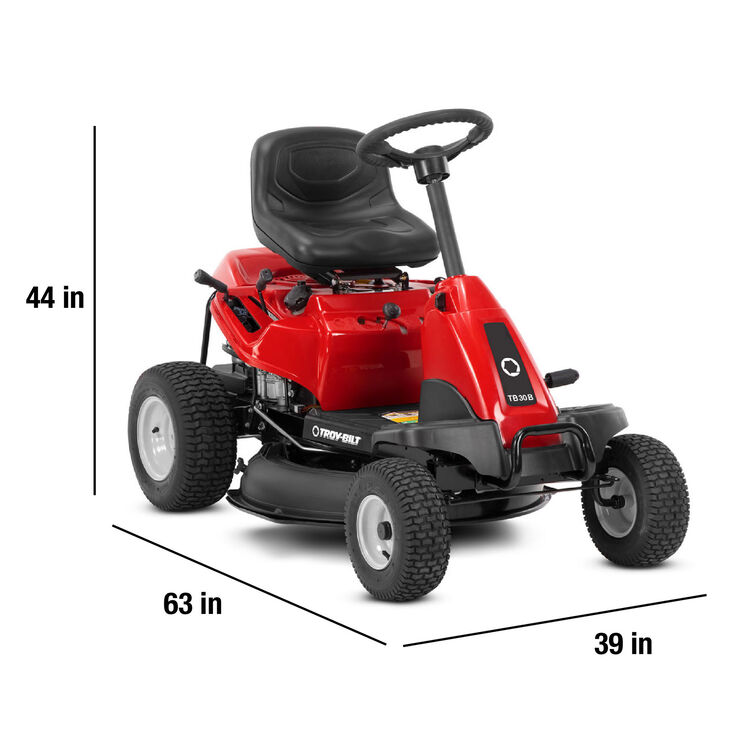
For most homeowners in the United States, a riding lawn mower is about 4.5 to 6 feet wide, 5.5 to 7 feet long, and 3.5 to 4.5 feet high. Typical residential models weigh between 400 and 900 pounds.
The exact size depends on the mower type, cutting deck, seat position, tires, and attachments. A small rear-engine rider may fit through a 36-inch gate, while a large zero-turn mower can need more than 60 inches of clearance.
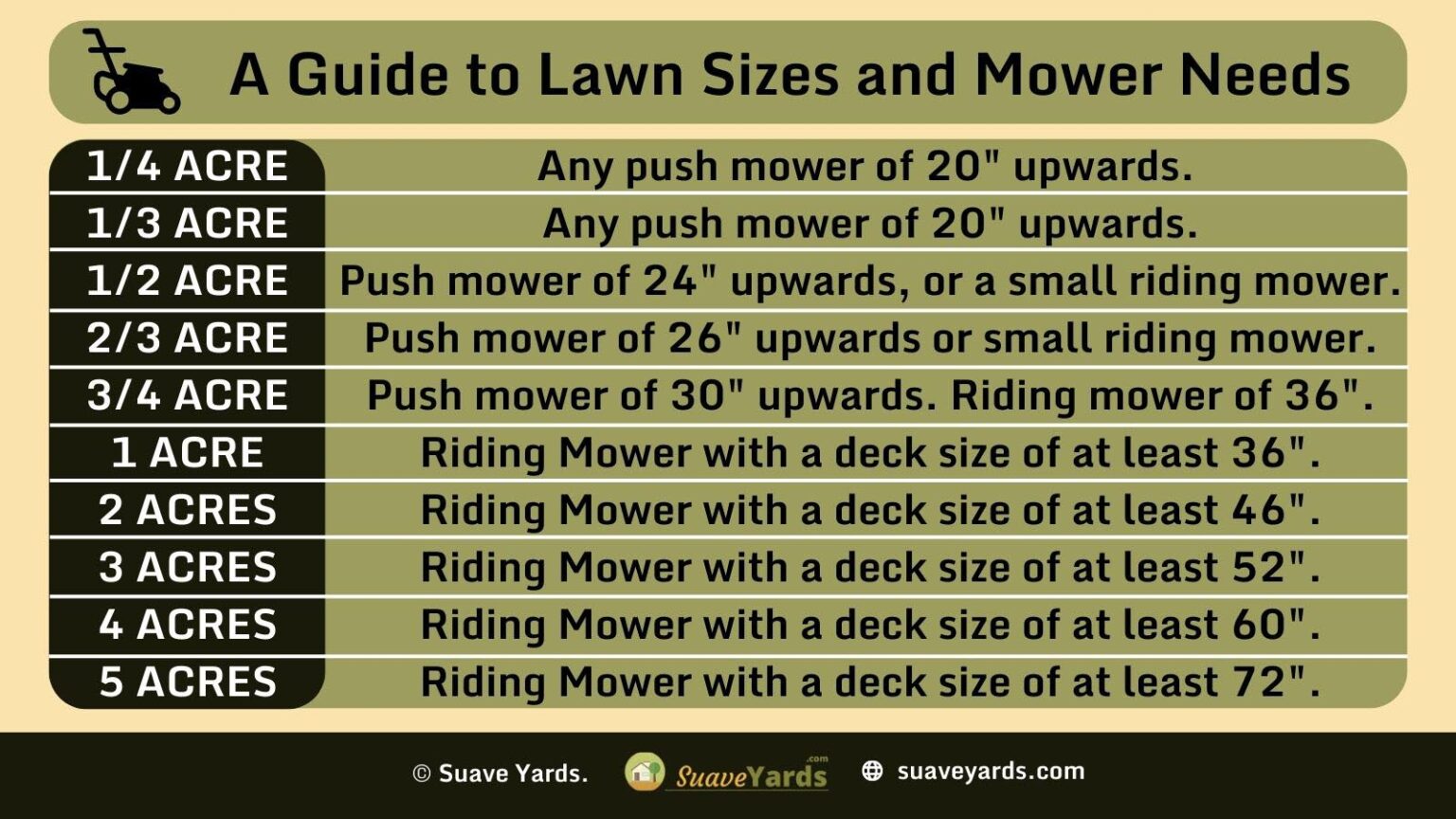
Typical Riding Lawn Mower Dimensions
A common riding mower is roughly 60 to 72 inches long and 36 to 54 inches wide. Its height is often between 40 and 48 inches when measured to the top of the seat or steering wheel.
These measurements describe the mower itself. A grass catcher, mulch plug, discharge chute, front blade, or snow attachment can make the machine wider or longer.
| Mower type | Typical cutting deck | Approximate width | Approximate length | Approximate height |
|---|---|---|---|---|
| Rear-engine riding mower | 26–33 inches | 30–40 inches | 60–72 inches | 38–45 inches |
| Small lawn tractor | 38–42 inches | 42–50 inches | 65–75 inches | 40–48 inches |
| Standard lawn tractor | 42–54 inches | 48–60 inches | 65–80 inches | 42–50 inches |
| Residential zero-turn mower | 42–54 inches | 48–62 inches | 65–80 inches | 40–50 inches |
| Large zero-turn mower | 54–72 inches | 60–75 inches | 75–90 inches | 42–55 inches |
These are useful planning ranges, not universal specifications. Manufacturers measure overall dimensions in different ways. Some include the discharge chute, while others measure the frame without removable parts.
The cutting deck is not always the widest part. On some tractors, the rear tires or discharge chute extend farther than the deck. On a zero-turn mower, the rear drive tires and control levers may determine the true clearance.
Why the deck size does not equal mower width
A mower with a 42-inch deck does not usually measure exactly 42 inches across. The deck is only the part that cuts grass. The frame, wheels, chute, and guards add width.
For example, a mower with a 42-inch deck may need about 46 to 52 inches of open space. A 54-inch deck may require close to 60 inches, depending on the model.
Always use the manufacturer’s listed overall width, not the deck width, when checking a gate, shed, trailer, or garage door.

How Big Is a Riding Mower by Type?
The mower’s design has a major effect on its size, turning space, and storage needs. Rear-engine riders are usually the smallest. Lawn tractors are longer and more traditional. Zero-turn mowers often have a wide rear stance and large cutting deck.
Rear-engine riding mowers
Rear-engine riding mowers are often the most compact option for small American lawns. Many have a cutting deck between 26 and 33 inches and an overall width near 30 to 40 inches.
Their smaller frame can help with:
- Narrow gates
- Small sheds
- Tight side yards
- Short transport trailers
- Simple storage spaces
They may have less power, a smaller fuel tank, and a smaller deck than a lawn tractor. That can mean more mowing passes on a large property.
Lawn tractors
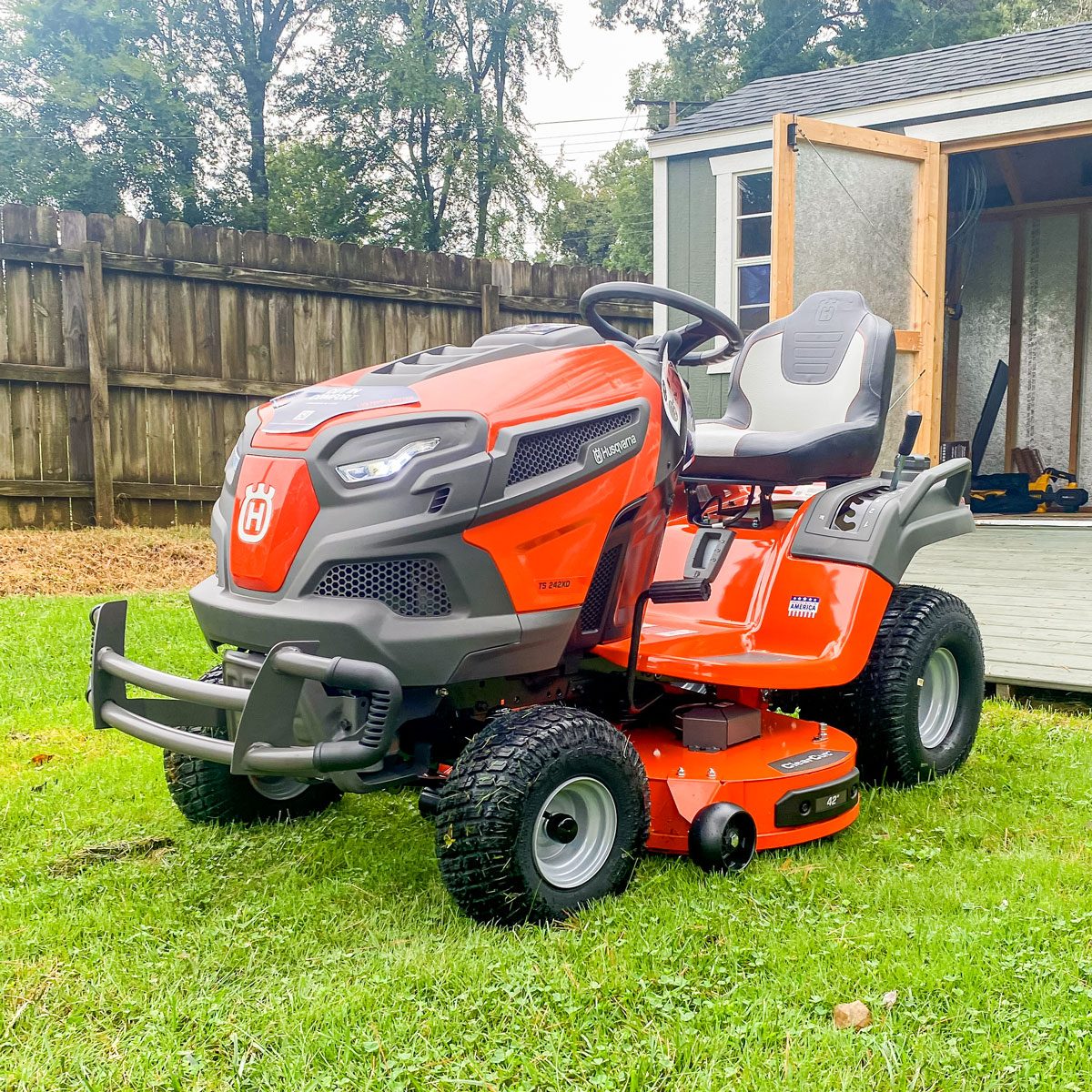
lawn tractors commonly have decks from 38 to 54 inches. They are often about 5.5 to 6.5 feet long and 3.5 to 5 feet wide.
The hood, engine, steering wheel, front axle, and rear tires create a longer shape than a rear-engine rider. A lawn tractor also may need extra room at the front for the hood and extra room at the rear for a grass bagger.
Lawn tractors are often useful for homeowners who need to mow and perform light pulling tasks. Their size makes them less convenient in narrow yards, but they can cover open lawns efficiently.
Zero-turn mowers
Residential zero-turn mowers commonly use decks from 42 to 54 inches. Larger homeowner and commercial-style models may use decks from 60 to 72 inches.
A zero-turn mower can be about 4 to 6 feet wide and 5.5 to 7.5 feet long. The rear tires are often wide, and the control levers can add to the required storage width.
Zero-turn mowers turn within their own footprint. That feature can reduce the space needed to turn around trees and garden beds, but it does not make the mower physically smaller.
Garden tractors
Garden tractors are generally heavier and more robust than basic lawn tractors. They may weigh more than 700 pounds and can require a wider, stronger trailer or storage floor.
Their larger frames may support ground-engaging tools and heavier attachments. That extra strength usually increases length, weight, and turning space.

How Much Space Do You Need to Store a Riding Lawn Mower?
For storage, plan for more room than the mower’s published dimensions. A practical storage area should allow the mower to enter, exit, and be serviced without scraping walls or obstacles.
Use this rule:
Storage width = mower width + at least 12 inches of working clearance
For example, if the mower is 52 inches wide, a storage space about 64 inches wide gives roughly 6 inches on each side. More space is better if you need to open a hood, remove a battery, or attach a grass catcher.
A useful storage guide is:
| Mower width | Suggested clear storage width |
|---|---|
| 36 inches | About 48 inches |
| 42 inches | About 54 inches |
| 48 inches | About 60 inches |
| 54 inches | About 66 inches |
| 60 inches | About 72 inches |
| 72 inches | About 84 inches |
These figures are planning estimates. They do not replace the mower’s manual or local building requirements.
Shed size
A compact riding mower may fit in a shed with an interior width of 6 feet and a depth of 8 feet. A larger tractor or zero-turn mower is more comfortable in a shed that is at least 8 by 10 feet.
A 10-by-12-foot shed gives better room for:
- The mower
- Fuel approved for small-engine equipment
- A battery charger
- Hand tools
- A mower lift
- Seasonal attachments
Do not store gasoline in an unapproved container or near an ignition source. Follow the fuel-storage instructions in the mower manual and local fire rules.
Garage storage
Measure the garage opening, not only the garage interior. The door frame, trim, tracks, shelving, and parked vehicles may reduce the usable width.
Leave room to walk around the mower. Crowding the machine against a wall can make routine checks harder and may damage controls or body panels.
Will a Riding Lawn Mower Fit Through a Gate?
A riding mower will fit through a gate only when the gate opening is wider than the mower’s true maximum width. Measure the opening at its narrowest point.
Use this method:
- Measure the gate opening between the posts.
- Measure the mower at its widest point.
- Include the side-discharge chute, if it cannot be removed.
- Allow at least 2 to 4 inches of total extra clearance.
- Check the ground for slopes, lips, rocks, and soft soil.
- Confirm that the mower’s turning path will clear the posts.
A 36-inch gate may accept a compact rear-engine rider but will not fit many 42-inch tractors. A 48-inch gate may work for some narrow tractors, but it may be too tight for a model with a wide chute or rear tire stance.
If the mower is only slightly narrower than the gate, the fit may still be impractical. Tires can slip toward a post, and a slope can change the mower’s position. A wider opening reduces the chance of damage.
Can you remove the mower deck to make it narrower?
Sometimes, but removing the deck is not always a useful solution. The deck may be difficult to remove, and the frame, tires, or discharge system may still be wider than the opening.
Check the operator’s manual before removing any deck. Shut off the engine, remove the key, disconnect the spark plug wire when the manual directs it, and block the mower securely. Never place hands under a deck unless the mower is fully secured and the manufacturer’s procedure allows the work.

How Much Does a Riding Lawn Mower Weigh?
Most residential riding lawn mowers weigh about 400 to 900 pounds. Heavy garden tractors and large zero-turn mowers can exceed that range.
Approximate weight ranges include:
- Rear-engine rider: 300–600 pounds
- Small lawn tractor: 400–650 pounds
- Standard lawn tractor: 500–800 pounds
- Residential zero-turn mower: 500–900 pounds
- Large or commercial-style zero-turn mower: 700–1,200 pounds or more
The listed shipping weight may be higher than the operating weight. Shipping packaging, ramps, fluids, accessories, and an installed grass catcher can change the total.
Weight matters when you plan to:
- Load the mower onto a trailer
- Use a ramp
- Store it on a raised platform
- Move it across a lawn
- Transport it in a pickup
- Select a mower lift or jack
Never rely on a homemade ramp without checking its load rating. The ramp must support the mower, fuel, operator, and any uneven force caused by loading.
Trailer sizing
A riding mower usually needs a trailer wider and longer than the mower. Measure the deck, chute, tires, and any control levers before choosing a trailer.
The trailer’s rated payload must exceed the mower’s actual loaded weight. Also check:
- Ramp width
- Ramp weight rating
- Tie-down points
- Wheel wells
- Bed length
- Trailer axle rating
- Vehicle towing capacity
Secure the mower according to the mower and trailer instructions. Set the parking brake, remove the key, and use properly rated tie-downs. Do not depend on the transmission or parking brake alone.
How to Measure a Riding Lawn Mower Correctly
Measure the mower in the same condition in which you will use or store it. If you plan to keep the grass catcher attached, measure with the catcher installed.
Measure the width
Measure the widest fixed point from left to right. Check the following parts:
- Deck edge
- Discharge chute
- Rear tires
- Front tires
- Zero-turn control levers
- Side guards
- Bagger frame
Measure with the wheels straight. Then turn the steering wheel or control levers to see whether the machine becomes wider during entry.
Measure the length
Measure from the farthest front point to the farthest rear point. Include:
- Front bumper
- Hood
- Seat
- Rear hitch
- Grass catcher
- Rear attachment
For a garage or shed, add extra length in front of the mower. This gives you room to walk around the machine and inspect the engine.
Measure the height
Measure from the floor to the highest fixed point. Depending on the design, this may be:
- Steering wheel
- Seat back
- Roll-over protection structure
- Discharge chute in its raised position
- Warning beacon or accessory
Measure the height with the seat in its normal position. If the seat folds, record both the operating and storage heights.
Check the manual
The owner’s manual and official product specification sheet are the best sources for a particular model. Manufacturer dimensions may identify whether the measurement includes the discharge chute, bagger, or other equipment.
Product pages from manufacturers such as John Deere, Cub Cadet, Toro, Husqvarna, and Craftsman commonly list deck size, overall dimensions, weight, and shipping details. Compare the exact model number, because similar-looking mowers may have different frames and decks.

What Size Riding Mower Is Right for Your Yard?
The right mower size depends on the lawn’s open area, narrow points, slope, storage, and transport needs. A larger deck can reduce mowing time on open grass, but it may be harder to maneuver and store.
| Lawn condition | Practical starting point |
|---|---|
| Small, level lawn with narrow access | 26–38-inch rear-engine rider |
| Medium lawn with open sections | 38–46-inch lawn tractor |
| Large, mostly open residential lawn | 42–54-inch tractor or zero-turn mower |
| Very large open lawn | 48–72-inch zero-turn or garden tractor |
| Many trees, beds, and tight turns | Smaller deck or zero-turn design |
| Narrow gate or shed | Measure access first; prioritize overall width |
Deck width is only one factor. A 54-inch mower may cut faster in an open yard, but a 42-inch mower may be the better choice if the wider machine cannot reach part of the lawn.
Avoid choosing a large deck for a yard with many narrow passages. The mower may require repeated backing and repositioning, which can erase the time saved by the wider cutting path.
A simple area calculation
A mower with a 42-inch deck does not cut 42 inches on every pass. Overlap, uneven ground, turning, and obstacles reduce the effective width.
For a rough estimate:
Mowing time depends on lawn area ÷ effective cutting width ÷ travel speed
This is only a planning formula. It does not account for trimming, emptying a bagger, turns, slopes, or wet grass.
A wider deck can improve productivity on open ground. It does not automatically make mowing faster on a small or complex lawn.

Common Mistakes When Measuring a Riding Mower
The most common error is using the deck size as the mower’s overall width. A 48-inch deck does not mean the machine will fit through a 48-inch opening.
Other mistakes include:
- Measuring the shed’s outside dimensions instead of its inside clearance
- Forgetting a side-discharge chute
- Ignoring a bagger or rear attachment
- Measuring a garage door without its trim
- Forgetting the height of a roll bar
- Assuming the seat folds when it does not
- Using shipping weight as operating weight without checking the manual
- Ignoring slopes at gates and ramps
- Choosing a trailer based only on deck width
- Failing to allow room for maintenance
Measure the full route from delivery point to storage area. Include sidewalks, gates, turns, fence posts, tree limbs, steps, and changes in grade.
If the mower must cross a public sidewalk or roadway, follow local rules and use safe transport practices. Do not drive an unregistered or unsuitable machine on public roads unless local law and the mower’s design allow it.

Frequently Asked Questions
How wide is a 42-inch riding lawn mower?
A riding mower with a 42-inch cutting deck is often about 46 to 52 inches wide, but the exact measurement depends on the frame, tires, and discharge chute. Check the manufacturer’s overall-width specification before measuring a gate.
How wide is a riding mower with a 48-inch deck?
A 48-inch deck mower commonly needs about 52 to 60 inches of width. Some models may be narrower or wider, especially when the side-discharge chute is installed.
Can a riding mower fit in a 6-foot shed?
Many compact tractors and residential zero-turn mowers can fit in a shed with a 6-foot interior width. A 60-inch mower may fit tightly, but the available space may be too small for safe walking or maintenance. Measure the mower and the shed’s actual interior clearance.
Can a riding mower fit through a 4-foot gate?
Some narrow rear-engine riders and small tractors can fit through a 48-inch opening. Many 42-inch-deck tractors will be too wide once the tires and discharge chute are included. Measure the mower’s widest point rather than relying on the deck label.
How much space should be left around a riding mower?
Leave about 6 inches on each side at minimum, plus room at the front and rear for movement and maintenance. More clearance is helpful if the mower has a bagger, attachments, or a tall seat or roll bar.
Conclusion
A typical riding lawn mower is about 36 to 60 inches wide, 60 to 80 inches long, and 40 to 50 inches high. Compact rear-engine riders take the least space, while large zero-turn mowers and garden tractors need wider storage and transport equipment.
Before buying or moving one, measure the mower’s overall width, length, height, and weight. Then compare those figures with the narrowest gate, garage door, shed opening, ramp, and trailer.
The safest next step is simple: find the exact model number, download its official specification sheet, and measure your complete access route before purchase.


