How Well Do Robotic Lawn Mowers Work: Real Results
Introduction
Robotic lawn mowers work well for many U.S. homeowners, but they are not a full replacement for every lawn mower. They are best at keeping a maintained lawn short through frequent, light cuts. They are less effective on very steep slopes, rough ground, tall weeds, deep leaves, and yards with many separate sections.
A robotic mower can reduce weekly mowing work. It cannot remove all lawn care. You still need to trim edges, clear toys and branches, manage weeds, and check the mower from time to time. The right result depends on the mower, lawn shape, weather, grass type, and setup.
How Does a Robotic Lawn Mower Work?
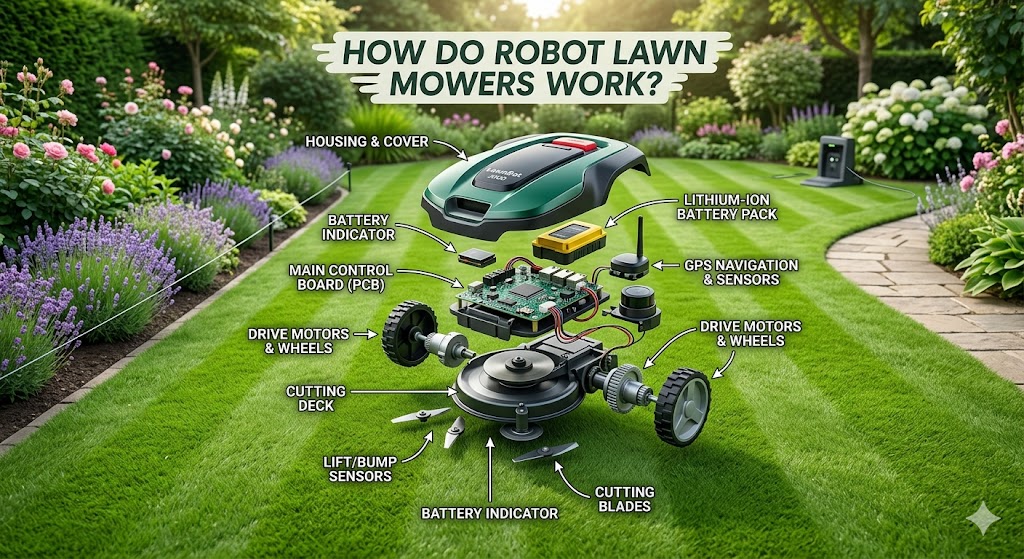
A robotic lawn mower uses small blades, electric motors, sensors, and a control system to mow without a person walking behind it. Most models return to a charging station when the battery is low. They then resume mowing later.
Many robotic mowers use one of two navigation systems:
- Boundary wire: A low-voltage wire marks the lawn’s edge and keeps the mower inside the work area.
- Wire-free navigation: GPS, satellite positioning, cameras, radar, radio beacons, or mapping sensors help the mower identify the work area.
The mower usually cuts only a small amount of grass at a time. This is called mulching. The fine clippings fall back into the lawn instead of collecting in a bag.
What the mower does during a normal cycle
A typical cycle looks like this:
- The mower leaves its charging station.
- It travels through the programmed mowing area.
- Sensors help it avoid obstacles or detect the boundary.
- Its blades cut small amounts of grass.
- It returns to the station when the battery is low or the schedule ends.
- It charges and starts again at the next planned time.
The mower does not usually cut in straight, uniform rows like a riding mower. Some models use random paths. Others use GPS-guided or mapped routes that create more orderly patterns.
The practical effect is simple: the lawn stays short because the mower visits often, not because it cuts large amounts of grass in one session.

How Effective Are Robotic Lawn Mowers?
Robotic lawn mowers are effective when the lawn is fairly clear, the grass is maintained, and the mower’s capacity matches the property. They can maintain a consistent height with little daily effort.
They are less effective when the mower must handle conditions outside its design limits. Tall, wet, thick, or tangled grass can reduce cutting quality and battery life. A lawn with many narrow passages may also take longer to cover.
Performance by lawn condition
| Lawn condition | Expected performance | Why |
|---|---|---|
| Flat, open grass | Usually very good | Easy navigation and few obstacles |
| Mild slopes | Often good | Most models can handle some incline |
| Steep slopes | Model-dependent | traction and safety limits matter |
| Narrow passages | Fair to good | Depends on mower width and navigation |
| Many separate lawn areas | Fair | Some areas may need manual placement |
| Rough or uneven ground | Fair or poor | Wheels may lose traction or scalp grass |
| Tall weeds | Poor | Robotic mowers are lawn maintainers, not brush cutters |
| Heavy leaves | Poor to fair | Leaves can block sensors or cover grass |
| Wet grass | Model-dependent | Some mowers pause; others may clog or slip |
| Complex landscaping | Model-dependent | Setup and mapping become more important |
The most important distinction is between maintenance mowing and recovery mowing. A robotic mower is designed to maintain grass that is already near the desired height. It is not the best tool for cutting an overgrown lawn back down.
How Much Work Do Robotic Mowers Really Save?
A robotic mower can save the time spent pushing, riding, or supervising a conventional mower. The time savings are greatest for people who mow often or manage a large lawn.
However, the mower does not eliminate all yard work. You may still need to:
- Trim around fences, walls, trees, and garden beds.
- Move toys, hoses, tools, and branches.
- Clear pet waste before mowing.
- Inspect the blades and wheels.
- Clean grass from the underside.
- Fix boundary wire or navigation problems.
- Adjust schedules during periods of rapid growth.
- Mow manually after long periods of rain or neglect.
Most robotic mowers use small cutting decks. They may need several hours, or repeated sessions, to cover an area that a riding mower can cut in one trip. That longer schedule is normal. The mower is designed to work in short cycles while you do other tasks.
For a small suburban lawn, the main benefit may be convenience rather than a dramatic reduction in total lawn-care time. For a larger property, the benefit can be more noticeable if the mower can cover the whole area without frequent intervention.
What Types of Lawns Work Best?
The best lawn for a robotic mower is open, reasonably level, and divided into clear mowing zones. The grass should already be cut at a normal height, with few objects left on the ground.
A robotic mower can work on many common U.S. lawn types, including cool-season grasses such as Kentucky bluegrass, perennial ryegrass, and tall fescue. It can also maintain warm-season grasses such as bermudagrass, zoysiagrass, and St. Augustine grass when the mower supports the required cutting height and conditions.
Grass type matters because mowing height varies. Some warm-season grasses are kept shorter than many cool-season lawns. Check the mower’s height range before buying it.
Lawns that may need extra planning
Slopes
A mower’s maximum slope rating is not the same as a promise of reliable performance on every slope. Wet grass, loose soil, roots, and worn tires can reduce traction.
Measure the steepest slope and compare it with the exact model’s manual. Do not assume that two models from the same brand have the same climbing ability.
Narrow paths
A mower may struggle to pass between a fence and a garden bed. Measure the narrowest path, including room for the mower to turn. Some models need a minimum corridor width that is greater than the mower’s physical width.
Separate lawn areas
A property may have a front lawn, side strip, and backyard separated by a sidewalk or driveway. Some systems support multiple zones. Others require you to move the mower by hand or install separate boundary arrangements.
Trees and garden beds
Trees, mulch, gravel, ponds, and raised beds must be mapped or protected. A mower may avoid large objects but still strike small objects, low branches, or exposed roots.
Boundary Wire or Wire-Free Navigation: Which Works Better?
Neither system is best for every U.S. lawn. Boundary wire systems can provide a clear, reliable perimeter when installed correctly. Wire-free systems can reduce installation work but may depend more on satellite signals, cameras, network service, or correct digital mapping.
Boundary wire systems
Boundary wire is a physical loop around the mowing area. The mower detects the signal and stays inside the loop.
Advantages include:
- A clear physical mowing boundary.
- No dependence on satellite visibility.
- Proven operation on many simple lawns.
- Good control around beds and driveways.
Limitations include:
- Installation takes time.
- The wire can break.
- Future landscaping may require changes.
- Poor installation can cause missed areas or boundary crossings.
The wire may be placed on the ground, secured with stakes, or buried according to the manufacturer’s instructions. If it is cut, the mower may stop, leave the zone, or report a boundary fault.
Wire-free systems
Wire-free models may use GPS, RTK satellite positioning, cameras, radio signals, or a combination of sensors. Some let you create a digital map in an app.
Advantages include:
- Less physical installation.
- Easier changes to mapped zones.
- Useful for properties where wire installation is difficult.
Limitations include:
- Trees and buildings may weaken satellite signals.
- Cameras can be affected by poor light, dirt, or visual clutter.
- Mapping errors can create missed strips.
- Some functions may need a smartphone, Wi-Fi, cellular service, or subscription.
A wire-free mower is not automatically more accurate. Its performance depends on the technology used, the local environment, and the quality of the setup.
Are Robotic Lawn Mowers Safe?
Robotic lawn mowers are designed with safety features, but they still contain moving blades. Treat them as powered outdoor equipment, not as toys.
Common safety features may include:
- Lift sensors.
- Tilt sensors.
- Obstacle detection.
- Automatic blade stops.
- PIN codes or app locks.
- Schedules that avoid certain hours.
- Rain or weather sensors.
- Theft alerts or GPS tracking on some models.
Safety features differ by model. Read the owner’s manual before operation. The U.S. Consumer Product Safety Commission has published recalls and safety notices for outdoor power equipment, so check the exact model and model number before purchase or use. You can search its recall database at CPSC.gov.
Basic safety rules
- Remove toys, tools, hoses, and loose branches before mowing.
- Keep children and pets away during setup and maintenance.
- Turn the mower off before touching the blades.
- Disconnect power before clearing a blockage.
- Do not carry or service the mower while it is running.
- Keep the charging station and power supply dry as directed.
- Do not operate it in conditions that exceed the manual’s limits.
- Use a qualified electrician for any required outdoor electrical work.
Do not rely only on obstacle sensors to protect a child, pet, or foot. Sensors can miss low objects, soft items, or objects hidden in grass.
What Are the Main Problems With Robotic Lawn Mowers?
The main problems are not usually the cutting motor. They are setup, navigation, obstacles, weather, and maintenance.
The mower misses sections
Possible causes include poor mapping, a narrow passage, a blocked route, weak positioning signals, or an incorrectly installed boundary wire.
Check the map or boundary first. Then inspect the route for low spots, blocked paths, and areas that the mower cannot physically reach.
The mower gets stuck
Common causes include:
- Soft soil.
- Deep ruts.
- Tree roots.
- Loose gravel.
- Steep transitions.
- A low edge around a garden bed.
- A narrow turning area.
Fill holes, remove loose material, and improve transitions where practical. If the mower repeatedly stops in one location, exclude that area rather than allowing repeated failed cycles.
The grass looks uneven
Uneven grass can result from a dull blade, a cutting height set too low, poor coverage, or grass that grew too tall between cycles.
Replace or sharpen blades according to the manual. Raise the cutting height if the mower is scalping the lawn. Then check whether the mower reaches every zone often enough.
The mower leaves wheel marks
Wheel marks may appear when the mower follows the same route often, especially on wet soil. Reduce operation on saturated ground if the manual allows schedule changes. Improve drainage and vary routes when the system supports that function.
The mower stops in rain
Some models can operate in light rain. Others return to the station. Wet grass can also reduce traction and cause clumps beneath the deck.
Follow the model’s weather guidance. A rain sensor is not a guarantee that every storm condition is safe or suitable.
How Much Maintenance Does a Robotic Mower Need?
Robotic mowers need less hands-on work than many traditional mowers, but they still need routine care.
A simple maintenance plan includes:
- Check the blades often during the growing season.
- Replace blades when they become dull or damaged.
- Remove packed grass from the underside.
- Clean wheels and sensors.
- Inspect the charging contacts.
- Check boundary wire and stakes.
- Keep the charging area clear.
- Store the mower as directed during long freezes.
- Keep software and app systems updated when required.
Always follow the manufacturer’s maintenance instructions. Blade service is not safe while the mower is powered or able to start.
The charging station also needs a suitable location. It should have a stable surface, enough clearance, and access to the required power supply. Poor placement can create charging failures or navigation problems.
What Does a Robotic Lawn Mower Cost to Own?
The purchase price is only one part of ownership cost. Include installation, replacement blades, battery replacement, repairs, power use, and possible connectivity fees.
A simple ownership estimate is:
Total ownership cost = mower price + setup + maintenance parts + repairs + battery replacement + service fees
Electricity use is often a smaller cost than the mower itself, but the exact amount depends on battery size, mowing time, charging efficiency, and local utility rates.
A hypothetical example:
- Mower and setup: $1,200
- Blades and small parts over four years: $160
- Battery replacement: $250
- Connectivity fees: $0
- Estimated four-year total: $1,610
This example is not a typical price claim. It shows how to compare a mower with the cost of your current mowing method. Prices and battery costs vary by brand, model, region, and service plan.
Before buying, check:
- The warranty term and battery coverage.
- Whether the battery is user-replaceable.
- The cost of blades and wheels.
- Local repair options.
- Required app or cellular services.
- Whether installation is included.
- Whether the mower can handle your lawn without extra equipment.
Robotic Mower vs. Push Mower vs. Riding Mower
A robotic mower is not always the best replacement for a conventional mower. Each tool solves a different problem.
| Mower type | Best for | Main strength | Main limitation |
|---|---|---|---|
| Robotic mower | Regular lawn maintenance | Low routine labor | Setup and navigation limits |
| Push mower | Small or simple lawns | Low purchase cost and direct control | Requires your time and effort |
| Self-propelled mower | Medium lawns or slopes | Easier manual mowing | Still requires supervision |
| Riding mower | Large open properties | Fast area coverage | Higher cost, storage, fuel, and maintenance |
| String trimmer | Edges and obstacles | Reaches places mowers miss | Does not replace mowing |
A robotic mower often works best alongside a string trimmer. The robot handles the main lawn, while the trimmer finishes edges and tight spots.
How to Choose the Right Robotic Lawn Mower
Choose by lawn conditions, not by advertised battery size alone.
1. Measure the actual mowing area
Exclude patios, driveways, sheds, ponds, garden beds, and other areas the mower cannot cut. Compare the usable area with the manufacturer’s recommended capacity, not only the maximum marketing figure.
2. Measure the steepest slope
Check both the slope rating and the surface. A dry, firm slope is easier than a wet or loose slope at the same angle.
3. Count lawn zones
Identify separate areas, narrow paths, gates, and areas that the mower cannot reach on its own.
4. Decide between wire and wire-free navigation
Boundary wire may suit a simple lawn where reliability matters. Wire-free navigation may suit a property where installation changes often or digging is difficult.
5. Check cutting height
Make sure the mower supports the height recommended for your grass. A mower that cuts too low can stress the lawn and increase the risk of scalping.
6. Review service and replacement costs
Check battery, blade, wheel, and repair prices before buying. A low purchase price may not be low-cost over several years.
7. Plan for pets and children
Consider when the mower will run, where it will park, and whether your yard contains pet waste or small toys. No sensor can replace basic yard checks.

Common Mistakes to Avoid
The most common mistake is buying a mower based only on lawn size. Capacity, shape, slope, and obstacles matter just as much.
Avoid these errors:
- Choosing the maximum rated area for a complex lawn.
- Leaving toys, hoses, or branches in the mowing zone.
- Expecting the mower to cut tall weeds.
- Ignoring edge trimming.
- Installing boundary wire too close to hazards.
- Skipping slope measurements.
- Running the mower over wet, soft soil without checking guidance.
- Assuming obstacle sensors detect every small object.
- Forgetting winter storage.
- Treating app-based mapping as a substitute for checking the lawn.
Start with a conservative schedule and inspect the result. Increase mowing time only if the grass remains healthy and the mower operates without repeated faults.
Frequently Asked Questions
Do robotic lawn mowers cut grass well?
Yes, they can cut grass well when used often on a suitable lawn. They work best as maintenance mowers. They may perform poorly on tall, wet, rough, or heavily overgrown grass.
Can a robotic lawn mower replace a regular mower?
It can replace much of the routine mowing on some properties. You may still need a regular mower for overgrown grass, steep areas, separate zones, or lawn recovery after long periods without mowing.
Do robotic lawn mowers work on hills?
Some do, but the answer depends on the exact slope rating, tire grip, grass condition, and surface. Check the manual and measure the steepest area before purchase.
Are robotic lawn mowers safe around dogs?
They include safety features, but they are not risk-free. Keep pets away during setup, supervise early use, and remove pet waste before the mower runs. Follow the manufacturer’s instructions for animal safety.
Can a robotic mower work without boundary wire?
Some models can. They may use GPS, RTK positioning, cameras, radar, radio beacons, or other sensors. Wire-free performance depends on the exact system and the property’s signal and visibility conditions.
What happens when it rains?
The mower may keep working, return to its station, or stop, depending on its design and settings. Wet grass can reduce traction and cause buildup. Follow the model’s weather instructions rather than assuming all robotic mowers behave the same way.
Conclusion: Are Robotic Lawn Mowers Worth It?
Robotic lawn mowers work well for homeowners who want steady grass maintenance with less manual mowing. They are especially useful on open, established lawns where the mower can move freely and return to a reliable charging station.
They are less suitable for rough land, tall weeds, very steep slopes, cluttered yards, and properties with many disconnected zones. The best buying decision comes from measuring the lawn, checking navigation needs, reviewing safety limits, and calculating long-term costs.
Next step: map your usable lawn area, measure its narrowest paths and steepest slope, and list the obstacles the mower must avoid. Use that information to compare models instead of relying on lawn-size claims alone.