
How To Clean Grass Buildup Under Mower Deck: Fast Guide
Grass buildup under a mower deck is common, but it should not be ignored. A thick mat of wet clippings can block airflow, reduce mowing quality, strain the engine, and cause uneven cuts. It can also trap moisture against the deck, which may lead to rust.
The good news is that cleaning a mower deck is usually a simple home task. You need a few tools, a safe work area, and the right method for your mower type. This guide explains how to clean grass buildup under push mowers, self-propelled mowers, riding mowers, and zero-turn mowers.

Quick answer: the safest way to clean grass under a mower deck
The best way to clean grass buildup is to park the mower on a flat surface, shut it off, disconnect the spark plug wire or remove the battery, and scrape away dried clippings with a plastic or wooden tool. Then brush and rinse the deck if the owner’s manual allows it. Dry the deck fully, inspect the blade, and avoid mowing wet grass to slow future buildup.

Tools and materials you may need
Cleaning a mower deck does not require a large tool kit. The right items depend on whether you have a walk-behind mower, riding mower, or zero-turn mower. A plastic scraper is safer for painted decks, while a stiff nylon brush helps remove packed grass from corners.
The table below covers useful tools for most home lawn care jobs.
| Tool or material | Main use | Best choice for |
|---|---|---|
| Plastic scraper | Lifts packed, dry grass | Painted steel or plastic decks |
| Wooden putty stick | Removes buildup without sharp edges | First-time users and seniors |
| Stiff nylon brush | Cleans corners and discharge openings | Light to medium buildup |
| Work gloves | Protects hands from sharp grass and blade edges | Every mower type |
| Safety glasses | Blocks dirt and rust flakes | Scraping and brushing |
| Garden hose | Rinses loose residue | Mowers approved for deck washing |
| Shop vacuum | Removes dry debris | Electric and battery mowers |
| Drop cloth or cardboard | Protects the floor | Garage or shed cleaning |
Use tools that match your deck. A steel putty knife can remove hard grass, but it may scratch paint or remove a protective coating. Avoid using your bare hands under the deck, even when the mower appears to be off.
Two items matter most: a safe scraper and good eye protection. If you plan to sharpen or remove the blade, add the correct socket, a block of wood, and a torque wrench if your manual lists a blade torque value.

Choosing a cleaner
Plain water is enough for most fresh clippings. For sticky residue, use warm water with a small amount of mild dish soap on a cloth or brush. Do not spray degreaser into the engine, battery area, belt housing, bearings, or electrical controls.
Avoid strong oven cleaner unless the mower maker approves it. Harsh chemicals can damage paint, rubber belts, plastic parts, and seals. They can also run into soil or storm drains.

Safety and preparation come first
The most important step is making the mower unable to start. Turn off the engine, remove the ignition key if it has one, and wait for all moving parts to stop. For a gas mower, disconnect the spark plug wire and keep the connector away from the plug. For a battery mower, remove the battery pack before putting your hands near the deck.
Wear safety glasses, work gloves, and closed-toe shoes. Clear the work area of children, pets, tools, and loose objects. Never clean a mower while the blade is turning or while the engine is hot.

⚠️ Safety Warning: Never rely only on the mower’s safety bar, ignition switch, or battery control. Disconnect the spark plug wire or remove the battery before servicing. Follow the owner’s manual because some mower designs have special steps for tilting, lifting, or washing the deck.
Put the mower in a safe position
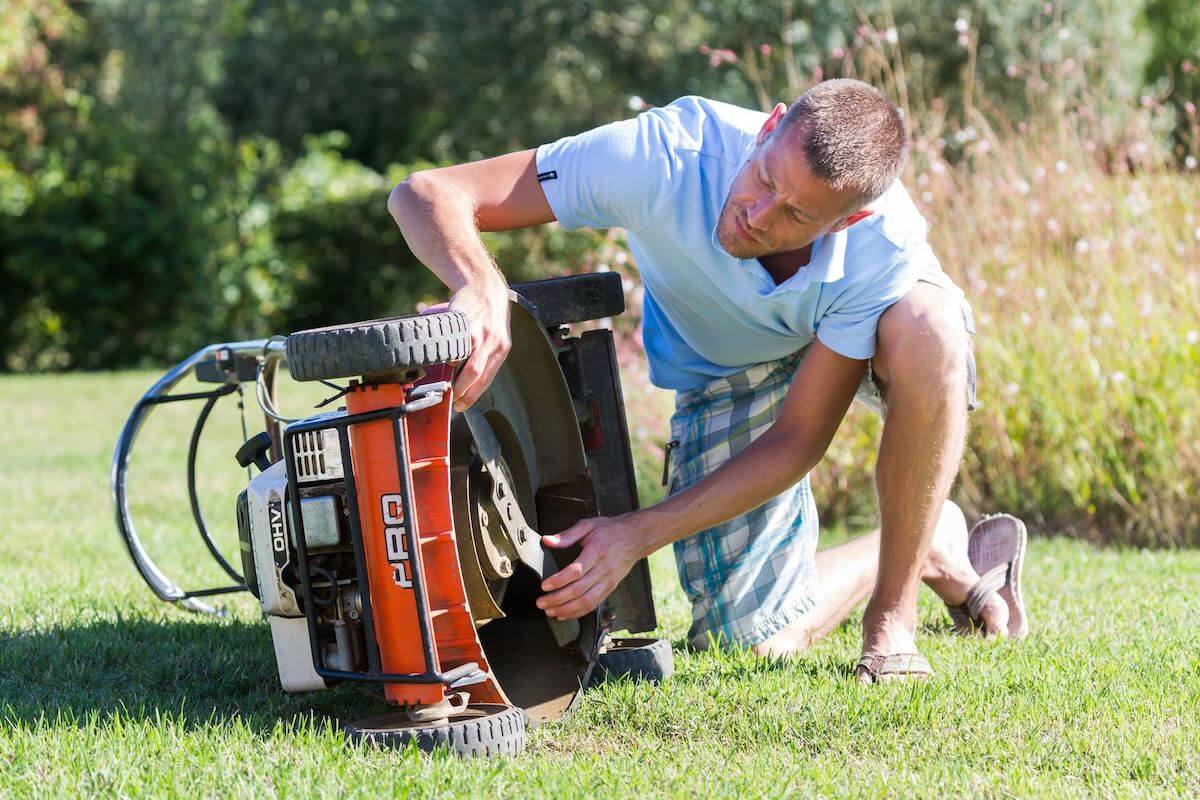
A walk-behind mower can often be tilted with the air filter and carburetor side facing up. This helps keep fuel and oil away from the filter and engine. Check the manual before tilting a gas mower because the wrong direction can cause an oil leak or hard starting.
Never place your body under a riding mower or zero-turn mower unless it is supported by equipment made for that weight. A mower jack, approved lift, or sturdy service ramp is safer than improvised blocks. Wheel chocks can help prevent movement, but they do not replace a proper lift.

Know the difference between dry and wet buildup
Dry clippings are easier to scrape. Wet grass is heavier, stickier, and more likely to form a thick layer around the blade and discharge chute. If the deck is wet, let it dry when possible before scraping.
Grass that contains soil can become almost as hard as clay. Do not attack it with a screwdriver or knife. Sharp tools can slip and damage the deck, blade, belt, or your hand.
Step-by-step: how to clean grass buildup under a push mower
A push mower includes a basic walk-behind mower that you move by hand. This group includes gas, battery, electric, self-propelled, and some small commercial models. The same cleaning process works for most, but the power source changes the safety steps.

1. Empty the fuel tank when the manual calls for it
You may not need to drain fuel for a quick cleaning. However, if the mower must be tilted sharply, check the owner’s manual first. Some gas mowers can be tilted safely with the carburetor side up, while others should remain level.
Do not drain gasoline onto the ground. Store fuel only in an approved container, and keep it away from flames, heaters, and direct sun. Never refuel a hot engine.

2. Disconnect the power source
Turn off the mower and wait for the blade to stop. Remove the battery from a battery mower or unplug a corded mower. On a gas mower, disconnect the spark plug wire.
If the mower has a removable battery, keep it indoors and dry while you work. Do not place a lithium-ion battery near water, metal tools, heat, or a wet floor.

3. Remove loose grass by hand
Put on work gloves. Pull away loose clumps from the deck rim, discharge chute, and wheels. Do not reach toward the blade area with force.
Use a brush or scraper to loosen grass from the underside. Work from the outer edge toward the center. This approach keeps your hand farther from the blade and lets the debris fall away from you.

4. Scrape the deck with a plastic tool
Hold the scraper at a low angle. Push under the grass mat in short strokes. If a clump does not move, soften it with a damp cloth rather than forcing the tool.
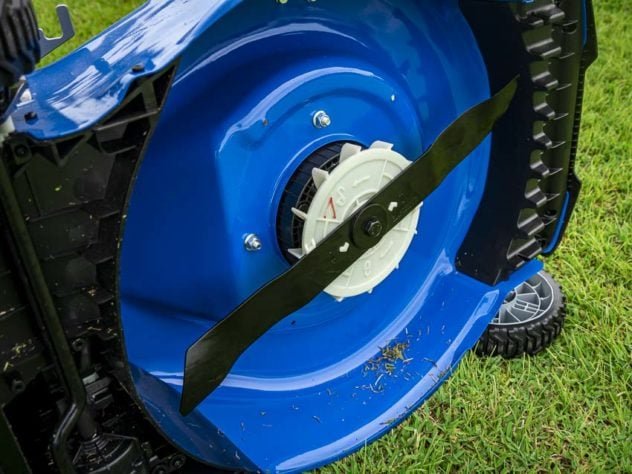
Pay close attention to the area near the blade tip, discharge opening, and deck baffles. Baffles are the raised parts inside the deck that guide air and grass. Packed clippings near these parts can affect airflow and discharge.

5. Brush away the remaining residue
Use a stiff nylon brush to clean corners and seams. A narrow bottle brush can help with small discharge openings. Do not use a wire brush on painted steel unless the manual permits it, since wire can scratch the finish.
For a battery mower, keep water away from the motor housing, controls, charging port, and battery contacts. A damp cloth is often safer than a hose.

6. Rinse only if the mower allows it
Some walk-behind mowers have a wash port. A wash port is a fitting that connects to a garden hose while the blade spins under controlled conditions. Use this feature only as the manual directs.
If there is no wash port, avoid spraying water directly into the engine, air filter, belt cover, electrical parts, or battery area. A small amount of water on the deck is usually easier to control than a strong spray.
7. Dry the deck completely
Wipe the underside with an old towel. Then leave the mower in a dry, shaded place until all moisture is gone. Do not store it in a closed shed while the deck is still wet.
Moisture trapped under a steel deck can start rust near scratches, welds, and bolt holes. A light coating of a mower-safe protectant may help, but do not spray the blade belt, pulleys, brakes, or friction surfaces.

8. Inspect the blade and deck
With the power source still disconnected, check the blade for bends, deep nicks, cracks, or heavy rust. Look at the deck for holes, loose hardware, damaged baffles, and worn paint.
A dull mower blade can tear grass instead of cutting it cleanly. A bent blade can create vibration. If you see a crack in the blade, replace it rather than trying to straighten it.
Cleaning grass from riding mower and zero-turn decks
Riding mowers and zero-turn mowers hold more grass because their decks are wider and often have several blades. A riding mower usually uses a steering wheel, while a zero-turn mower uses two control levers and can turn within a small area.
These machines need more care during cleaning. Their decks are heavier, and the belt, pulleys, spindle housings, and discharge system are close to the buildup. A deck lift or mower jack may be needed.
Lower the deck before cleaning loose debris
Park on a level surface, set the parking brake, shut off the engine, remove the key, and disconnect the battery or spark plug connection as the manual directs. Lower the deck to its service position if the mower has one.
Use a leaf blower or shop vacuum to remove loose dry clippings from the top of the deck. This reduces the amount of debris that can fall into the belt area when you inspect the underside.
Use a proper mower lift
A riding mower deck can weigh a great deal. Never crawl under a raised mower that is supported only by a hydraulic system. Hydraulic pressure can drop without warning.
Use a mower lift rated for the machine’s weight. Follow the lift instructions and place the machine on a level, hard surface. If you lack the right lift, clean only the areas you can safely reach or ask a repair shop for service.
Scrape around the blades and baffles
Once the mower is secure, scrape the underside with a plastic or wooden tool. Remove buildup from each blade chamber, the discharge tunnel, and the deck edges.
Do not place your hand near a blade spindle. The spindle is the shaft and bearing assembly that turns the blade. It can have sharp edges, trapped energy, or damaged parts that move during service.
Check the belt and pulleys
Grass buildup can hold moisture against the belt. It can also hide a cracked belt or a pulley that does not spin freely. Look for frayed belt edges, shiny glazed areas, missing belt chunks, and packed debris around the pulleys.
Do not spray water or cleaner on the belt. Clean it with a dry brush or cloth if the manual allows. Replace a damaged belt with the correct part number for your mower.
Clean the discharge chute
A blocked discharge chute can make the mower leave clumps or throw grass unevenly. Remove the grass with a scraper from the outside. Never reach into the chute while the blades are connected to power.
If the mower uses a grass catcher or mulching kit, inspect those parts as well. A full catcher, blocked screen, or poorly fitted mulch plug can increase buildup under the deck.
Why grass sticks under a mower deck
Grass buildup usually comes from moisture, mowing height, blade condition, deck design, and mowing speed. The problem is not always a sign of a poor mower. Even a well-built deck can collect grass when lawn conditions are damp.
The most common cause is mowing wet turfgrass. Turfgrass is the living grass used to form a lawn. When it is wet, the clippings stick together and cling to the metal or plastic deck.
| Cause | What you may notice | Helpful response |
|---|---|---|
| Wet grass | Thick, sticky mats | Mow after the lawn dries |
| Dull blade | Ragged tips and clumps | Sharpen or replace the blade |
| Deck set too low | Heavy discharge and engine load | Raise mowing height |
| Fast ground speed | Long trails of clippings | Slow down in thick grass |
| Clogged chute | Grass stays under the deck | Clear the chute safely |
| Full grass catcher | Poor collection and buildup | Empty catcher often |
| Damaged baffle | Uneven discharge | Inspect and replace damaged parts |
The main takeaway is simple: wet grass and a low cutting height create the most buildup. A sharp blade, a clean deck, and a slower pace can reduce the load.
Low mowing height
Mowing height is the distance between the soil and the blade’s cutting line. Cutting too low removes a large amount of leaf tissue at once. The mower must then move more grass through the deck, which can cause clumps.
Most cool-season lawns do better when they are not scalped. Warm-season grasses may have different needs. Set the height based on your grass type, local climate, and seasonal growth.
Dull or damaged mower blades
A sharp blade helps cut grass into smaller pieces. A dull blade may bend and tear the grass, leaving long strands that collect under the deck. A blade with a bend or deep nick can also cause vibration.
Check the blade after hitting a rock, root, sprinkler head, or hidden object. Do not keep mowing if the mower vibrates badly. Stop it, disconnect the power, and inspect the blade and mounting hardware.
Mowing too fast
Self-propelled mowers can move faster than the deck can process heavy grass. Riding mowers and zero-turn mowers can also leave buildup when driven quickly through tall or wet turf.
Slow down in thick areas. For very tall grass, use a first pass at a higher setting, then mow again after the lawn recovers. Do not remove more than about one-third of the grass height in one cut unless your grass-care plan says otherwise.
How to prevent grass buildup after cleaning
Cleaning solves the current problem, but mowing habits control what happens next. The best prevention plan is to mow dry grass, keep the blade in good condition, and avoid cutting too much at one time.
Your yard also matters. Small yards may need only a light battery push mower and routine brushing. Large lawns, hilly lawns, or thick turf may need a self-propelled mower, riding mower, or zero-turn model with a deck that matches the grass volume.
Mow when the lawn is dry
Wait until morning dew has dried. After rain, give the lawn time to drain and dry. Wet mowing can create ruts, spread disease, compact soil, and increase buildup.
Never mow wet grass on a slope. A wet slope reduces traction and raises the chance of a slide. This rule matters for walk-behind mowers and riding equipment.
Keep the blade sharp
Inspect the blade during the mowing season. Many homeowners check it every 20 to 25 hours of use, but sandy soil, rough lots, and hidden debris may require more frequent checks.
A blade should be balanced after sharpening. An unbalanced blade can cause vibration and stress the spindle. If you do not have the tools or skill to sharpen it, a local mower shop can do the work.
Use the correct mowing height
Raise the deck slightly during drought, heat, or heavy stress. Taller grass can shade the soil and reduce moisture loss, depending on the grass type. Do not change height without considering your local turfgrass variety.
Check each wheel or deck adjustment. Uneven settings can create an uneven cut and cause one side of the deck to carry more grass.
Follow the one-third rule
The one-third rule means removing no more than one-third of the grass blade in a single mowing. For example, if the lawn is 3 inches tall, cutting it to 2 inches removes one-third.
If the grass has grown too tall, raise the deck first. Then lower it during a later cut if needed. This reduces stress on the mower and lowers the chance of a thick mat under the deck.
Clean after difficult mowing
You do not need to deep-clean the deck after every short, dry mowing session. Still, brush it when you finish mowing wet, tall, sandy, or leafy grass.
A two-minute cleanup can prevent a hard layer that takes much longer to remove later. It also gives you a chance to spot a loose bolt, damaged blade, or clogged chute.
Products and methods that can help
Some products are useful, but none replaces safe mowing habits. Deck sprays may reduce how strongly grass sticks, while a wash port can make cleaning easier. A lawn scraper can help seniors or homeowners who want to avoid bending over with a metal tool.
Always check compatibility before buying. Confirm deck material, mower model, blade type, battery voltage, and replacement part numbers on the product page and in the manual.
| Option | Advantages | Limitations |
|---|---|---|
| Plastic deck scraper | Low cost and gentle on paint | Takes more time on hard buildup |
| Deck coating spray | May reduce sticking | Must be safe for the deck material |
| Wash-port adapter | Can speed up rinsing | Not suitable for every mower |
| Mower lift | Safer access to riding decks | Needs storage space and weight rating |
| Battery shop vacuum | Quiet and useful for dry debris | Does not remove wet, packed grass |
| Professional cleaning | Saves time and reduces lifting | Costs more than DIY work |
A plastic scraper suits first-time homeowners and gift buyers helping a senior with a walk-behind mower. A mower lift suits experienced DIYers with a riding mower and enough garage space. A shop vacuum is useful for battery mowers because it avoids water near electrical parts.
Do deck sprays really work?
Some mower deck coatings are designed to make grass less likely to stick. Results vary with grass moisture, deck condition, mowing height, and product formula. A coating cannot fix a dull blade or a clogged discharge chute.
Use only a product labeled for mower decks. Follow the drying time. Keep any spray away from belts, blades, pulleys, brakes, tires, and electrical contacts.
Is a pressure washer a good idea?
A pressure washer can remove grass quickly, but it can also force water into bearings, electrical parts, seals, and engine areas. It may strip paint from a steel deck and spread dirty water into the yard or driveway.
For most homeowners, a scraper, brush, cloth, and gentle hose are safer. If you use a pressure washer, keep the spray away from bearings and electrical components, and follow the mower manual.
Common cleaning mistakes to avoid
Most mower cleaning damage comes from rushing. People forget to disconnect power, tilt a gas mower the wrong way, or use a sharp tool that damages the deck. A few simple habits make the job safer and easier.
The table below shows common errors and a better approach.
| Mistake | Why it causes trouble | Better approach |
|---|---|---|
| Reaching under a connected mower | Blade can move unexpectedly | Disconnect the spark plug or battery |
| Using a knife as a scraper | It can slip or cut the deck | Use plastic or wood |
| Blasting bearings with water | Water may remove grease | Use a cloth or soft brush |
| Storing the mower wet | Moisture can cause rust | Dry the deck first |
| Mowing wet slopes | Traction can fail | Wait for dry conditions |
| Tilting without checking the manual | Oil or fuel may enter the wrong area | Follow the tilt direction |
| Ignoring vibration | Blade or spindle may be damaged | Stop and inspect the machine |
Do not use an air compressor near your face without eye protection. Dry grass and rust flakes can travel fast. Do not burn grass buildup or use an open flame to dry the deck.
Do not scrape against the blade edge
The blade edge is sharp even when the blade is dull. Scrape from the side of the deck and work around the blade. If you need to remove the blade, use a block of wood to hold it and the correct socket.
Never hold the blade with your hand while loosening the bolt. Replace the blade if it is cracked, bent, or deeply worn.
Do not coat the underside with oil
Oil may seem like an easy way to stop grass from sticking. It can attract dust, contaminate clippings, and create a slippery surface. It may also reach the belt or blade.
Use a mower-safe deck product only if the manufacturer allows it. A clean, dry deck and proper mowing conditions often do more than a heavy coating.
Maintenance schedule for a cleaner mower deck
A simple schedule keeps buildup under control. The exact timing depends on lot size, grass type, climate, and how often you mow. A large yard in a humid region may need more care than a small, dry yard.
This schedule is a starting point, not a replacement for the owner’s manual.
| Task | Suggested timing | What to check |
|---|---|---|
| Brush loose clippings | After wet or tall mowing | Deck edges and chute |
| Inspect the blade | Every few mowing sessions | Nicks, bends, rust, balance |
| Deep-clean the deck | Several times per season | Baffles, discharge path, rust |
| Check belt condition | Monthly on riding mowers | Fraying, glazing, cracks |
| Check deck hardware | Monthly | Loose bolts and missing parts |
| Sharpen or replace blade | As needed | Cut quality and vibration |
| Service engine or battery | Manual schedule | Oil, spark plug, filters, contacts |
Gas mowers also need attention to oil, spark plugs, air filters, and fuel stabilizer. Fuel stabilizer is a chemical added to gasoline to help it remain usable during storage. Use it only as directed and follow local fuel-storage rules.
Battery mowers need clean battery contacts and dry storage. Store batteries according to the maker’s instructions. Very hot or cold storage can affect battery life.
When to repair, replace, or call a professional
Some buildup is a cleaning job. Other signs point to a repair issue. Call a mower repair shop if the machine has severe vibration, a cracked deck, a bent crankshaft, a smoking motor, repeated belt failure, or a blade that will not stay tight.
A riding mower should also receive professional help if the deck will not level, the lift system fails, or the machine moves while the brake is set. These issues can create serious risks.
Signs the mower blade needs attention
Stop using the mower if you see a crack, major bend, missing section, or deep damage on the blade. Replace it with the correct blade for the model. Confirm the part number and blade length before ordering.
A blade that looks acceptable may still be unbalanced. Strong vibration after blade service is a reason to stop and inspect the blade, adapter, spindle, and mounting bolt.
Signs the deck is too damaged to clean
A small paint chip is usually easy to monitor. A hole, split weld, loose baffle, or severe rust-through is more serious. These defects can change airflow and allow debris to escape.
Do not patch a structural deck with random sheet metal or hardware. Ask a repair shop whether the deck is safe to use or whether replacement is more practical.
Signs the engine or motor needs service
A dirty deck alone does not usually cause smoking, hard starting, or severe power loss. Those symptoms may involve the air filter, spark plug, fuel system, battery, motor controller, or belt.
If the mower runs poorly after cleaning, check the manual for basic service steps. Do not open sealed battery packs or electrical controls. Take those repairs to a qualified technician.
🎁 Gift-Buyer Note: If you are helping a senior or new homeowner, a lightweight plastic scraper, safety glasses, work gloves, and a simple mower-cleaning kit can be more useful than a complex power tool. Choose tools with large grips and avoid products that require lifting a heavy riding mower.
Environmental and storage notes
Grass clippings are useful when left on the lawn in thin layers. They can return nutrients to the soil when the mower cuts them finely and the lawn is not smothered. Thick wet clumps should be spread, composted, or removed rather than left in piles.
Do not wash oily water, fuel, or chemical residue into a storm drain. Collect old gasoline and used oil and take them to a local household hazardous-waste site. Many auto parts stores and recycling centers accept used motor oil, but rules differ by location.
🌿 Eco or Disposal Note: Recycle lithium-ion mower batteries at a designated battery drop-off. Never place them in household trash or curbside recycling unless your local program specifically accepts them. Donate or recycle a usable old mower instead of abandoning it.
Store the mower in a dry place
A garage is often better than an outdoor shed because it offers steadier temperature and less moisture. Still, leave room around the mower for airflow. Do not cover a hot engine.
For gas mowers, follow the manual for fuel storage. Some manufacturers advise using fresh fuel with stabilizer, while others recommend draining the tank for long storage. Never store gasoline in an unapproved container.
Protect the mower during winter
Clean the deck before long storage. Remove grass, soil, and leaves. Service the engine or battery as the manual directs, and keep the blade dry.
Cold weather can affect batteries, fuel, tire pressure, and plastic parts. Do not charge a battery pack in a wet or extremely cold area unless the maker says it is safe.
📜 Check Local Rules: Confirm local rules before storing fuel, operating gas equipment, or running a loud mower early in the morning. Some cities, neighborhoods, and HOAs have noise limits, quiet hours, or restrictions on gas-powered equipment.
Frequently asked questions
Q: Can I use a garden hose to clean under my mower deck?
A: Sometimes. Use a hose only if the owner’s manual permits it or the mower has a designed wash port. Keep water away from the engine, air filter, battery, motor housing, bearings, belts, and electrical controls. Dry the deck fully before storage.
Q: How often should I clean grass from under my mower?
A: Brush the deck after wet or tall mowing. Deep-clean it several times during the mowing season, or whenever buildup becomes thick. Sandy soil, humid weather, and fast-growing grass may require more frequent cleaning.
Q: Can I clean the mower deck without removing the blade?
A: Yes. You can scrape and brush most buildup without removing the blade. Keep the power source disconnected and avoid the blade edge. Remove the blade only when you need to sharpen, replace, or inspect it closely.
Q: Should I clean a mower deck while it is hot?
A: No. Let the engine, muffler, and deck cool before cleaning. A hot engine can burn you, ignite fuel vapors, or damage a cloth or plastic tool.
Q: Why does grass stick to my mower deck after I clean it?
A: Wet grass, a dull blade, low mowing height, tall turf, and fast ground speed are common causes. Mowing dry grass and removing no more than one-third of the grass height can help reduce buildup.
Q: Is it safe to turn a gas mower on its side?
A: It depends on the mower design. Check the owner’s manual for the correct tilt direction. Tilting the wrong way can let fuel or oil enter the air filter, carburetor, or muffler.
Q: Can I use a pressure washer under a riding mower?
A: It is usually better to avoid high pressure near bearings, spindles, belts, electrical parts, and seals. A scraper, brush, and gentle rinse are safer for many machines. Follow the riding mower manual.
Q: Does a dirty mower deck affect the cut?
A: It can. Buildup may block airflow, restrict discharge, and cause clumps. A dirty deck can also hide a damaged blade or baffle. Cleaning is one part of good mower maintenance, not a substitute for blade service.
Q: What is the best scraper for a painted mower deck?
A: A plastic scraper or wooden putty stick is a good starting choice. It can remove grass without the sharp edge of a metal knife. For very hard buildup, soften the area first and work slowly.
Q: How do I clean a battery mower safely?
A: Remove the battery first. Use a dry brush, shop vacuum, or damp cloth. Keep water away from the battery contacts, charging port, motor housing, and controls. Never open the battery pack.
Q: Can mower deck buildup cause rust?
A: Yes. Wet grass can hold moisture against steel. Rust often begins near scratches, welds, bolt holes, and deck edges. Clean and dry the deck, then monitor small paint chips before they spread.
Q: Should I use a mulching kit to prevent buildup?
A: A mulching kit changes how the deck recirculates and cuts grass. It may work well in dry, regularly mowed turf, but it can increase clumping in wet or tall grass. Confirm that the kit fits your exact mower model.
Q: When should I replace the mower deck?
A: Consider replacement when the deck has a hole, cracked weld, loose baffle, severe rust-through, or damage that affects blade clearance. A repair shop can tell you whether a deck repair is safe and cost-effective.
Final thoughts
The best way to keep grass from building under a mower deck is to clean it before clippings harden. Disconnect the power, use a plastic scraper, brush the deck, rinse only when approved, and dry the machine before storage. Then address the cause by mowing dry grass, keeping the blade sharp, using the right cutting height, and slowing down in thick turf.
A small push mower may need only a few minutes of care after a damp mowing session. A riding mower or zero-turn mower needs more planning, safe lifting equipment, and closer inspection of belts and spindles. If the deck, blade, or engine shows serious damage, stop using the mower and seek professional service.
Affiliate disclosure: This article may contain affiliate links. If you buy a product through one of these links, we may earn a commission at no extra cost to you. Product features, prices, compatibility, and safety instructions can change, so confirm current details on the manufacturer’s product page and in your mower’s owner’s manual.




2 Comments