
How Long Do Electric Lawn Mowers Run: Battery Life Guide
Most battery-powered electric lawn mowers run for about 30 to 60 minutes on one charge. Some compact models may run for 20 to 30 minutes, while larger mowers with high-capacity batteries can run for 60 to 90 minutes under light conditions.
A battery mower’s real runtime depends on the battery size, grass height, mowing speed, terrain, blade load, and weather. The runtime printed on a box is often measured in light mowing conditions. Thick, wet, or tall grass can reduce it.
For many U.S. homeowners, one charged battery is enough for a small to medium lawn. Larger yards may need a spare battery, a second battery slot, or a short recharge break.

Typical Runtime for Battery-Powered Electric Mowers
A cordless electric mower usually runs for 20 to 75 minutes per charge, depending on its design and battery system.
| Mower type | Common runtime range | Approximate mowing area* |
|---|---|---|
| Compact push mower | 20–40 minutes | ⅛ to ¼ acre |
| Standard 20–21-inch mower | 30–60 minutes | ¼ to ½ acre |
| High-capacity push mower | 45–90 minutes | ½ to ¾ acre |
| Battery self-propelled mower | 25–50 minutes | ¼ to ½ acre |
| Battery riding mower | 60–120 minutes | 1 to 2 acres |
*These are broad estimates, not guarantees. Mowing area changes with blade width, speed, grass conditions, overlap, and battery capacity.
A push mower often runs longer than a self-propelled model with the same battery. The self-propel system uses part of the battery’s energy to drive the wheels. Hills and soft ground can increase that energy use.
Battery riding mowers may cover more land per charge because they use larger battery packs. Their total runtime also depends on deck width, cutting height, terrain, and whether the blades run continuously.
Many manufacturers publish runtime estimates for light, normal, or heavy mowing. Those terms are not always measured in the same way. Compare battery capacity and test conditions rather than comparing minutes alone.
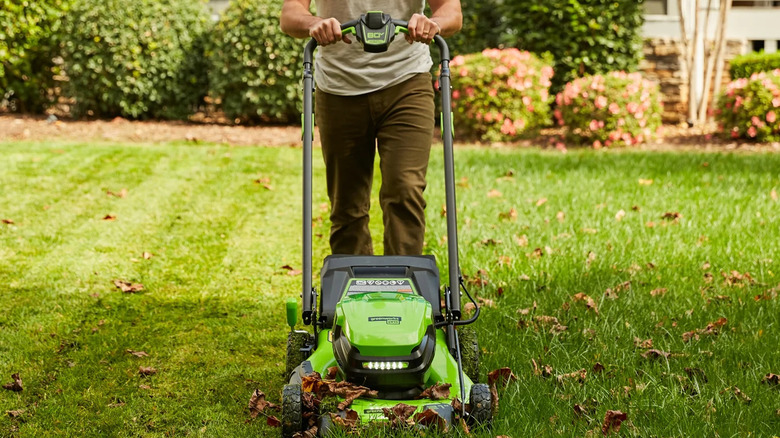
What Determines How Long an Electric Mower Runs?
Battery capacity is the main factor, but it is not the only one. The mower uses more power when the blade meets strong resistance.
Battery voltage and amp-hours
Battery labels usually show voltage and amp-hours, or Ah. You can estimate stored energy with this formula:
Watt-hours (Wh) = volts (V) × amp-hours (Ah)
For example:
- A 40-volt, 5-Ah battery stores about 200 Wh.
- A 56-volt, 5-Ah battery stores about 280 Wh.
- A 80-volt, 6-Ah battery stores about 480 Wh.
This calculation gives an estimate of battery energy. It does not predict exact runtime because the motor does not use power at one constant rate.
A higher-voltage battery is not automatically better. The battery’s total watt-hours, the mower’s motor, and the cutting conditions all matter.
Grass height and density
Tall grass makes the blade work harder. Dense turf also creates more resistance than thin or dry grass. If you let grass grow too long, the mower may slow down and use much more power.
A good rule is to cut no more than one-third of the grass blade at a time. This reduces motor strain and helps the battery last longer.
Wet grass
Wet grass can shorten runtime. It clumps under the deck, adds cutting resistance, and may force you to move more slowly.
Wet mowing can also create safety risks. Follow the mower manual, keep hands and feet away from the deck, and avoid mowing during rain or when the mower is not rated for wet conditions.
Self-propelled drive
Self-propelled mowers use battery power to move the wheels. Runtime drops faster when you:
- Mow on hills
- Use a high drive speed
- Pull the mower through soft soil
- Carry extra load in the grass
- Use the drive system when walking on level ground
On a flat lawn, you can often extend runtime by releasing the drive trigger and pushing the mower yourself where practical.
Blade condition and deck blockage
A dull blade needs more energy to cut grass. Grass packed under the deck can also increase load and restrict airflow.
Remove the battery before cleaning or servicing the mower. Check the owner’s manual for the correct method. Never reach under the deck while the battery is installed.

How to Calculate Electric Mower Runtime
You can estimate runtime by dividing battery energy by the mower’s average power use:
Runtime in hours = battery watt-hours ÷ average mower watts
For example, suppose a mower has:
- A 56-volt, 5-Ah battery
- About 280 Wh of stored energy
- An average power draw of 700 watts
The basic estimate is:
280 Wh ÷ 700 W = 0.4 hours
That equals about 24 minutes of continuous blade operation.
This is only a planning estimate. Battery systems have energy loss, and mower power use changes from moment to moment. The motor may use little power in short grass and much more in thick grass.
You can also estimate the battery size needed for a yard:
- Estimate how many minutes you need to mow.
- Convert minutes to hours.
- Multiply hours by the mower’s estimated average watt draw.
- Add a practical reserve for heavy grass, hills, and battery aging.
For example, a 40-minute mowing session equals about 0.67 hours. At an estimated 700 watts, it would require roughly 469 Wh before adding a reserve.
Because mower makers do not always publish average watt draw, the most useful real-world check is the manufacturer’s area or runtime estimate for the exact mower and battery combination.

How Much Lawn Can an Electric Mower Cut on One Charge?
A typical battery push mower can often cut ¼ to ½ acre on one charge. That estimate assumes normal grass, fairly level ground, and a fully charged battery.
The mower’s cutting width affects the result. A wider deck covers more ground with each pass, but it may also need more power. A narrow mower may run longer but require more passes.
To estimate your mowing area, use this simple method:
- Measure or estimate the lawn’s size.
- Subtract areas that do not need mowing, such as patios, beds, and driveways.
- Check the mower’s published coverage for the included battery.
- Reduce the estimate if the yard has hills, thick grass, or frequent obstacles.
A 21-inch mower does not cut a full 21 inches on every pass. You need some overlap between rows. Trees, fences, gates, and tight corners also increase mowing time.
If your lawn is close to the mower’s stated limit, choose a larger battery or a model that accepts two batteries. Running out of power near the end of the lawn is more frustrating than making one planned battery change.
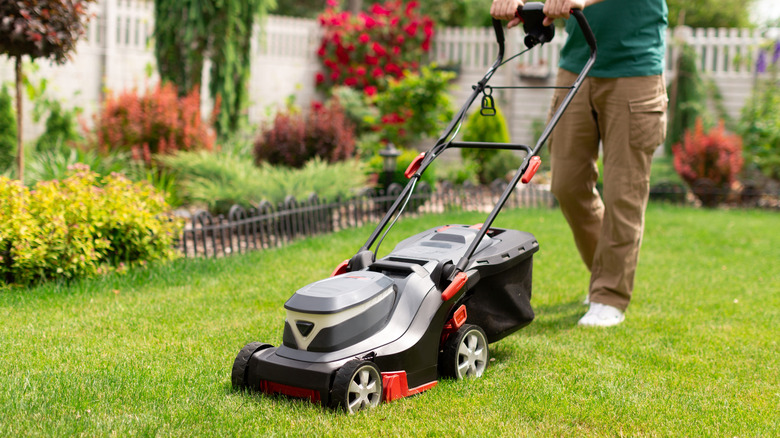
How Long Does It Take to Charge an Electric Mower Battery?
A mower battery commonly takes 30 minutes to several hours to charge. The exact time depends on battery capacity, charger output, battery temperature, and the charger model.
A small battery on a rapid charger may recharge in less than an hour. A larger battery on a standard charger may need several hours.
Charging time generally increases when:
- The battery has a higher Ah rating.
- The battery is deeply discharged.
- The charger has a lower output.
- The battery is too hot or too cold.
- The charger reduces current near full charge.
Use only the charger approved for that battery system. Do not connect a battery to a charger from another brand or voltage platform unless the manufacturer specifically says it is compatible.
Place the charger on a dry, stable surface with ventilation. Do not charge a swollen, cracked, leaking, or visibly damaged battery. Contact the manufacturer for instructions on a damaged battery, and follow local rules for lithium-ion battery recycling. The U.S. Environmental Protection Agency provides battery disposal guidance for households and businesses.

How to Make an Electric Lawn Mower Battery Last longer
You can improve mowing time by reducing the load on the motor and caring for the battery correctly.
Use the correct cutting height
Raise the deck when the grass is tall or dry. A higher setting removes less grass and usually reduces motor load. After the first cut, lower the deck gradually if needed.
Mow on a regular schedule
Regular mowing prevents thick, overgrown grass from placing a heavy load on the blade. Avoid removing more than one-third of the grass height at one time.
Keep the blade sharp
A sharp blade cuts more cleanly. It can also reduce the time and energy needed to finish the lawn. Follow the mower manual for blade removal, sharpening, and replacement.
Clear the deck safely
Grass buildup can make the mower work harder. Turn the mower off and remove the battery before inspecting or cleaning the deck.
Use self-propel only when needed
On flat ground, push the mower manually if you can do so safely and comfortably. Use the drive system for hills or when the mower’s weight makes pushing difficult.
Store the battery correctly
Keep the battery in a clean, dry place away from extreme heat and cold. Do not store it where metal objects can bridge the contacts. Follow the manufacturer’s instructions for long-term storage and charge level.
Battery care instructions vary by system. The owner’s manual is the controlling source for storage temperature, charging, and maintenance.
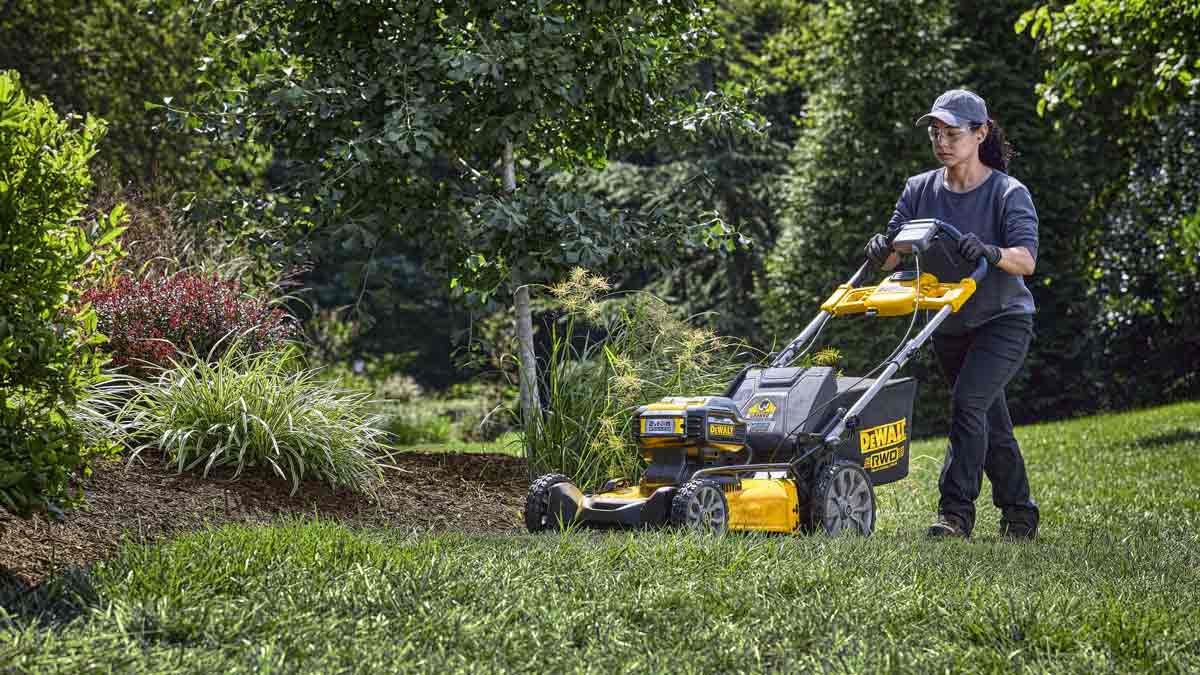
Why Does My Electric Mower Run for Less Time?
A sudden drop in runtime usually has a practical cause. Check the easiest and safest items first.
| Symptom | Possible cause | Useful check |
|---|---|---|
| Runtime drops during tall grass | Heavy blade load | Raise the deck and mow more often |
| Mower slows or stops | Battery is low or overloaded | Let the motor stop, inspect safely, and recharge |
| Runtime is low in all conditions | Aging battery or poor charge | Try the approved charger and another compatible battery |
| Battery feels very hot | Heavy load or temperature issue | Stop using it and follow the manual |
| Mower leaves uncut strips | Dull blade or slow blade speed | Inspect the blade after removing the battery |
| Mower loses power after storage | Battery was stored incorrectly or is deeply discharged | Follow the maker’s storage and charging steps |
Do not keep using a battery that is swollen, cracked, leaking, smoking, or unusually hot. Move away from the mower and battery if there is smoke or a strong burning smell. Call emergency services if a battery fire starts. Do not handle a damaged lithium-ion battery unless the manufacturer or local emergency guidance tells you how to do so.
If the mower stops repeatedly in short grass with a fully charged battery, contact the manufacturer or an authorized repair provider. Do not bypass a safety switch or open a battery pack.

Do Electric Mowers Run Longer Than Gas Mowers?
Electric mowers do not need fuel stops or engine warm-up, but their cutting time is limited by the battery. A gas mower can usually continue running after a quick fuel refill.
Electric models may be more convenient for smaller U.S. lawns because they start with a button, make less operating noise, and do not require gasoline storage. Battery charging adds planning, especially for large properties.
Gas and electric mower runtime is not a direct one-to-one comparison. A gas mower’s runtime depends on its fuel tank and engine load. An electric mower’s runtime depends on watt-hours and motor demand.
For a large lawn, compare:
- Total mowing time
- Battery capacity and replacement cost
- Availability of spare batteries
- Charging time
- Terrain and grass type
- Storage space
- Local noise and fuel-use preferences
An electric mower can be a good fit when the lawn can be finished on one charge or when spare batteries are easy to obtain. A gas mower may be more practical when continuous mowing for a large area is the main requirement.
Should You Buy a Spare Battery?
A spare battery can make sense if one charge does not cover your lawn. It may be more useful than buying a higher-capacity battery if you already own other tools in the same battery system.
Before buying, check:
- Battery voltage
- Ah rating
- Mower compatibility
- Charger compatibility
- Whether the mower accepts two batteries
- Warranty terms
- The battery’s cost compared with a replacement mower
A second battery does not always double runtime if the mower has a two-battery system that draws from both packs. Read the mower’s instructions to learn how it manages batteries.
If your lawn takes 45 minutes and the mower runs for 30 minutes, a second battery gives you a practical way to finish. If the mower needs 90 minutes for a large, demanding lawn, two small batteries may still be less convenient than a model designed for larger properties.

Frequently Asked Questions
How long does a cordless lawn mower run on one charge?
Most cordless lawn mowers run for about 30 to 60 minutes on one charge. Small batteries, thick grass, hills, and self-propelled drive can reduce that time.
Can an electric mower cut half an acre?
Many standard battery mowers can cut about half an acre with a suitable battery and normal lawn conditions. Check the manufacturer’s coverage estimate for the exact mower, battery, and cutting conditions.
Does a higher-voltage battery last longer?
Not by itself. Runtime depends on total watt-hours. Multiply voltage by amp-hours to compare battery energy. A lower-voltage battery with more amp-hours can store more energy than a higher-voltage battery with fewer amp-hours.
How long do electric mower batteries last?
Battery life depends on use, storage, charging habits, temperature, and the battery design. A battery that loses much of its original runtime, will not charge, or shows physical damage may need professional evaluation or replacement.
Can I leave my mower battery on the charger?
Follow the battery and charger manual. Many modern chargers manage the charging cycle, but that does not mean every charger or storage setup is suitable for indefinite connection. Store and charge the battery only as the manufacturer directs.
Final Answer: How Long Should You Expect an Electric Mower to Run?
Expect 30 to 60 minutes of practical mowing time from a typical cordless electric mower. Light grass and a large battery may produce more time. Tall grass, wet conditions, hills, and self-propelled drive may cut that estimate sharply.
To choose the right mower, compare watt-hours, stated lawn coverage, charging time, and the cost of a spare battery. For the most accurate estimate, use the exact battery recommended for the mower and plan for less runtime than the best-case figure printed on the package.


