
How Much Does A Robot Lawn Mower Cost: 2026 Price Guide
A robot lawn mower costs about $600 to $4,000 for most U.S. homes. Basic models often cost $600–$1,000, mid-range models usually cost $1,000–$2,000, and premium GPS or all-terrain models can cost $2,000–$4,000 or more.
The mower is only part of the budget. You may also pay for boundary wire, a charging station, installation, replacement blades, battery service, and a cellular or app subscription. A realistic total cost for a typical American yard is often $800 to $3,500, depending on the lawn’s size, slope, layout, and navigation system.
Quick answer: robot lawn mower price ranges
| Robot mower type | Typical U.S. price | Best for |
|---|---|---|
| Basic boundary-wire model | $600–$1,000 | Small, simple lawns |
| Mid-range wire-guided model | $1,000–$1,800 | Medium yards with several zones |
| GPS or RTK model | $1,500–$3,000 | Larger or more complex lawns |
| Premium all-terrain model | $2,500–$4,000+ | Slopes, rough ground, and large yards |
| Commercial-grade mower | $3,000–$10,000+ | Large properties and grounds care |
These are practical retail ranges, not fixed prices. Sales, package size, accessories, shipping, and regional availability can change the final amount.
What determines the cost of a robot lawn mower?
The main price factors are lawn size, navigation technology, terrain, cutting performance, and installation needs. A mower for a flat quarter-acre lot needs less hardware than one designed for a large, sloped property.
Lawn size and rated mowing area
Manufacturers rate robot mowers by the maximum lawn area they can maintain. The rating may be listed in square feet, acres, or both.
Common categories include:
- Small lawns: Up to about 5,000 square feet
- Medium lawns: About 5,000 to 15,000 square feet
- Large lawns: More than 15,000 square feet
- Very large or commercial areas: One acre or more
A manufacturer’s maximum area is not always a comfortable operating limit. The mower may need to run longer when the yard has narrow passages, slopes, several mowing zones, or frequent obstacles.
For example, a mower rated for 10,000 square feet may be a better fit for a 7,000-square-foot yard than for a yard that is exactly 10,000 square feet and divided into several sections.
Navigation technology
Navigation is one of the largest price differences between models.
Boundary-wire navigation
These mowers use a low-voltage wire around the lawn’s edge. The wire tells the mower where it can and cannot travel.
Typical price: $600–$1,800
Advantages include:
- Lower purchase price
- Predictable lawn boundaries
- No satellite signal required
- Good performance under trees and near buildings
Drawbacks include:
- Installation takes time
- The wire can break or become buried
- Changes to the yard may require moving the wire
GPS, RTK, and vision-based navigation
Some newer models use GPS, RTK satellite positioning, cameras, sensors, or a combination of systems. RTK, or real-time kinematic positioning, can improve location accuracy when the mower has a clear signal and a properly placed reference station.
Typical price: $1,500–$4,000+
Advantages can include:
- Less physical boundary wire
- Easier lawn mapping
- App-based zone control
- Better support for multiple mowing areas
Potential limits include:
- Higher purchase price
- Signal problems near tall buildings or dense trees
- Possible setup of a reference antenna
– Subscription fees on some connected models - More dependence on software and app support
A GPS mower is not automatically better for every lawn. A simple suburban yard may cost less and work more reliably with a well-installed boundary wire.
Slope and rough terrain
A mower built for flat grass may struggle on a steep hill or loose soil. Models with stronger wheel motors, better traction, and larger drive wheels usually cost more.
Before buying, check:
- Maximum slope rating
- Whether the rating applies to straight travel or side-to-side travel
- Performance on wet grass
- Wheel traction
- Clearance beneath the mower
- The location of the charging station
A slope rating is a specification, not a guarantee for every yard. Wet leaves, loose soil, tree roots, and worn tires can reduce traction.
Cutting width and operating time
A wider cutting deck may reduce the number of passes needed. A larger battery may help the mower cover more ground before charging.
However, a larger battery and wider deck often increase the price. More cutting capacity is useful only if the mower can safely navigate the yard and reach all areas.
Smart features and sensors
Features that can increase the price include:
- Automatic lawn mapping
- Smartphone control
- Multi-zone mowing
- Rain detection
- Theft alerts
- Camera-based obstacle recognition
- Lift and tilt sensors
- Anti-collision sensors
- Cellular tracking
- Voice assistant support
Some features are useful every day. Others may add cost without solving a real problem on your property.
Weather protection and build quality
Most robot mowers are designed for outdoor use, but water resistance varies. A weather-resistant mower may cost more than a basic unit. You may also need a separate shelter for the charging station.
A shelter can protect the station from sun, rain, snow, and falling debris, but it is not always required. Check the manufacturer’s storage and charging instructions before leaving a mower outdoors through freezing weather.
What does installation add to the total cost?
Robot mower installation can cost $0 to $1,500 or more, depending on the mower and lawn. A simple do-it-yourself setup may cost almost nothing beyond the mower. Professional installation for a complex property can add several hundred dollars.
DIY boundary-wire installation
A do-it-yourself installation may require:
- Boundary wire
- Wire stakes
- Connectors
- A wire cutter or crimp tool
- A map of the lawn
- Time to bury or secure the wire
Some mower packages include enough wire for a basic lawn. Larger yards may need extra wire and connectors.
The wire does not always need to be buried deeply. Many installation guides allow the wire to rest on the grass and become covered naturally. Follow the mower’s manual, especially near sidewalks, garden borders, driveways, and sprinkler lines.
Professional installation
Professional installation may be worth considering when the property has:
- Multiple lawn sections
- Narrow paths
- Steep slopes
- Retaining walls
- Several garden beds
- Pools or ponds
- Decorative gravel
- Complex property boundaries
A professional installer may also help place the charging station and guide wire. Ask whether the quoted price includes wire, connectors, mapping, testing, and future service.
GPS or RTK setup
A GPS or RTK mower may avoid most boundary-wire work, but it can still need careful setup. The reference station must have a suitable position, and the mower may need a clear path between mowing areas.
Some systems use a subscription for cellular data, cloud mapping, or theft tracking. Confirm whether the subscription is optional, included for a limited time, or required for a specific feature.

Ongoing robot lawn mower costs
The yearly running cost is usually lower than the purchase price, but it is not zero. Plan for about $50 to $300 per year for routine supplies and service on a typical residential mower. Heavy use, professional service, and battery replacement can raise that figure.
Replacement blades
Robot mowers use small blades that become dull over time. Many manufacturers recommend inspecting the blades often and replacing them at a set interval.
Typical blade costs are:
- $10–$30 for a small replacement pack
- $30–$80 or more per year for regular replacement
- More for proprietary or multi-blade systems
Dull blades can tear grass instead of making a clean cut. This may leave ragged tips and increase stress on the grass.
Battery replacement
Battery life depends on charging cycles, heat, storage, and use. A replacement battery may cost $100–$400 or more, depending on the model.
Do not assume every battery is user-replaceable. Some models require a service center. Before buying, check:
- Battery price
- Battery availability
- Replacement procedure
- Warranty coverage
- Winter storage instructions
A mower with a low purchase price may be less economical if its battery is expensive or difficult to replace.
Subscriptions
Some connected robot mowers may offer optional or required plans for:
- Cellular connection
- GPS theft tracking
- Cloud services
- Remote control
- Advanced mapping
- Fleet management
Subscription prices vary by brand and feature. Check the current terms before purchase. A mower that requires an ongoing fee may have a higher five-year cost than a similar model with local control.
Maintenance and repair
Routine care may include:
- Cleaning grass from the underside
- Checking the wheels
- Inspecting blades
- Checking boundary-wire connections
- Cleaning sensors and cameras
- Updating software
- Storing the mower in freezing weather
Professional repairs can cost more when parts must be shipped or when the mower is outside its warranty period.
Electricity
Electricity use is usually a small part of ownership cost. The mower charges from a low-voltage power supply, and its energy use depends on battery size, mowing hours, weather, and local electricity rates.
For most homeowners, electricity is less significant than blades, batteries, repairs, installation, and subscriptions.

A realistic total-cost example
Suppose a homeowner in the United States buys a robot mower for a 7,000-square-foot lawn.
Hypothetical three-year budget
| Expense | Estimated cost |
|---|---|
| Robot mower | $1,400 |
| Extra boundary wire and stakes | $75 |
| Charging-station shelter | $100 |
| Replacement blades | $90 |
| Electricity | $45 |
| Optional subscription | $0–$180 |
| Professional repair allowance | $150 |
| Estimated three-year total | $1,860–$2,040 |
This is a hypothetical example, not a quote. The final cost may be lower if you install the system yourself and avoid a subscription. It may be higher if the lawn needs professional installation or the battery must be replaced during the period.
Five-year ownership calculation
Use this formula to compare models:
Five-year cost = purchase price + installation + accessories + subscriptions + maintenance + expected repairs + battery replacement − resale value
For example:
- Mower: $1,500
- Installation: $300
- Accessories: $100
- Five years of blades: $150
- Subscription: $0
- Battery replacement: $250
- Repairs: $200
Estimated five-year cost: $2,500
This calculation helps prevent a common mistake: comparing only the sticker price.
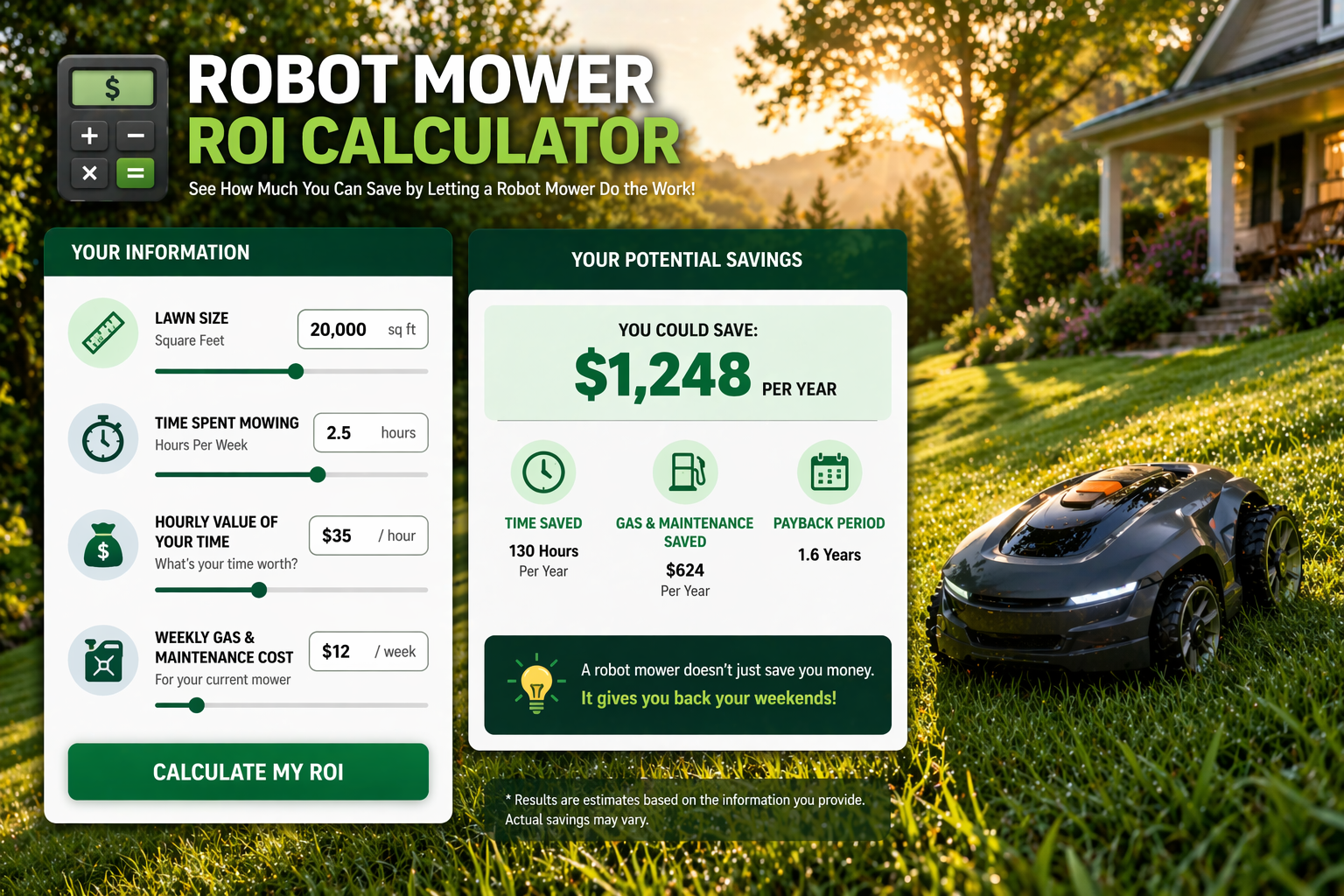
Is a robot lawn mower cheaper than hiring a lawn service?
A robot mower can cost less than regular lawn service over several years, but the answer depends on local prices and what the service includes.
A lawn service may include:
- Mowing
- Edging
- Trimming
- Blowing clippings from hard surfaces
- Seasonal scheduling
- Equipment maintenance
A robot mower usually handles only the mowing task. You may still need to edge sidewalks, trim around trees, clear leaves, and manage seasonal yard work.
Simple break-even example
Assume:
- Robot mower and setup: $2,000
- Lawn service: $60 per visit
- Service frequency: 30 visits per year
Annual mowing cost would be:
$60 × 30 = $1,800 per year
In this example, the robot mower could reach its break-even point quickly. But this does not mean it replaces all lawn care. It also ignores repairs, winter storage, edging, and the value of your time.
If a local service charges $35 per visit and mows only 20 times per year, annual mowing costs would be $700. In that case, a robot mower may take much longer to recover its cost.

What price should you pay for your lawn?
The right price depends more on the lawn than on the mower’s feature list.
A basic mower may be enough when:
- The lawn is under 5,000 square feet
- The ground is mostly flat
- There is one open mowing area
- You do not need remote control
- You are comfortable installing boundary wire
A reasonable budget is $600–$1,000.
A mid-range mower may fit when:
- The lawn is 5,000–15,000 square feet
- There are several obstacles
- You need more than one mowing zone
- You want app control
- The yard has moderate slopes
A reasonable budget is $1,000–$1,800.
A premium mower may be justified when:
- The property is large
- The lawn has steep slopes
- You want wire-free mapping
- The mower must cross several zones
- You need stronger traction
- You want advanced obstacle detection or tracking
A reasonable budget is $2,000–$4,000 or more.
Do not pay for premium navigation if your yard is small, flat, and easy to outline. The extra money may not improve the result.

Robot lawn mower costs by leading feature
| Feature | Often found in | Cost effect |
|---|---|---|
| Boundary wire | Entry and mid-range models | Lowers purchase price but adds setup work |
| App control | Mid-range and premium models | Small to moderate increase |
| Multi-zone mapping | Mid-range and premium models | Moderate increase |
| GPS or RTK navigation | Premium models | Moderate to large increase |
| Camera-based obstacle detection | Premium models | Moderate increase |
| Strong hill performance | Premium and specialty models | Moderate to large increase |
| Cellular tracking | Some connected models | May add a recurring fee |
| Commercial duty cycle | Commercial models | Large increase |
Feature names can vary by brand. Read the manual and specifications rather than relying only on advertising terms such as “smart,” “wire-free,” or “AI-powered.”

Common mistakes that increase the cost
The most expensive mistake is buying a mower that cannot handle the lawn. Measure and inspect the property before choosing a model.
Buying for the wrong lawn size
Use the actual mowable grass area, not the total lot size. A half-acre property may contain a house, driveway, patio, pool, and planting beds. The robot only needs to maintain the grass.
Ignoring narrow passages
A mower may be rated for a large area but unable to pass between a fence and garden bed. Measure narrow paths and compare them with the mower’s required clearance.
Forgetting separate lawn zones
A detached side yard may require a guide path, a second charging station, manual relocation, or a model that supports multiple zones. Confirm the exact method before purchase.
Treating “wire-free” as installation-free
Wire-free models still need mapping, charging-station placement, software setup, and boundary checks. Trees, walls, and tall buildings may affect positioning systems.
Skipping winter storage
Freezing temperatures can damage batteries or reduce battery life. Follow the manufacturer’s instructions for storing the mower, charger, and power supply.
Choosing a model without local support
Check whether replacement blades, batteries, wheels, and service are available in the United States. A low price is less useful if a small failure leaves the mower unusable for weeks.
Safety and yard preparation
Robot mowers use moving blades and should be treated as powered equipment. Keep children and pets away during setup, maintenance, and troubleshooting.
Before use:
- Read the U.S. version of the owner’s manual.
- Keep hands away from the cutting deck.
- Turn the mower off and disconnect power before cleaning or servicing it.
- Remove toys, hoses, sticks, and loose objects from the lawn.
- Mark ponds, drop-offs, gravel, and other hazards.
- Keep the charging station away from standing water.
- Follow the manufacturer’s guidance for rain, snow, and severe weather.
- Use the mower’s theft protection and PIN features when available.
Do not modify the cutting system or bypass safety sensors. If a boundary wire, charger, or power supply appears damaged, stop using the mower and follow the manufacturer’s service instructions.

How to compare robot mower prices
Use this five-step process before buying.
1. Measure the grass area
Exclude the house, driveway, patios, planting beds, and other surfaces the mower will not cut.
2. Map the lawn
Mark slopes, narrow passages, separate zones, trees, ponds, retaining walls, and charging-station options.
3. Select the navigation type
Choose boundary wire for lower cost and predictable boundaries. Consider GPS, RTK, or vision-based navigation when wire installation is difficult or the property needs advanced zone control.
4. Calculate the five-year cost
Add installation, accessories, blades, battery replacement, subscriptions, and likely repairs to the purchase price.
5. Verify support and restrictions
Confirm the mower’s area rating, slope rating, weather limits, warranty, replacement parts, app requirements, and service availability in the United States.
The best deal is not always the mower with the lowest sale price. It is the mower that can maintain the entire lawn without costly workarounds.
Frequently asked questions
Are robot lawn mowers worth the money?
They can be worth the money for homeowners who want frequent mowing with less weekly labor. They are less attractive when the lawn is very small, sharply divided, highly uneven, or already inexpensive to maintain with a local service.
Do robot lawn mowers need boundary wire?
Some do, while others use GPS, RTK, cameras, or sensors. Boundary wire remains common because it offers clear limits and can work well near trees and buildings. Wire-free models may cost more and still require careful setup.
How long do robot lawn mowers last?
Service life varies by model, weather exposure, use, maintenance, and parts support. A mower with replaceable blades, an available battery, and a strong service network may be easier to keep running than a cheaper model with limited parts.
Can a robot mower handle hills?
Some models can handle moderate or steep slopes, but the exact limit differs. Check the manufacturer’s slope rating and consider wet grass, loose soil, roots, and the direction of travel.
Do robot lawn mowers work in the rain?
Some are designed to operate in light rain, while others return to the charging station when rain is detected. Heavy rain, standing water, lightning, and wet slopes can create safety and traction concerns. Follow the manual for the exact model.
Do robot lawn mowers cut grass every day?
Many are designed to make frequent short cuts. This can keep the grass at a steady height, but the schedule should match the mower’s limits, local weather, grass growth, and the manufacturer’s instructions.
Is a robot lawn mower cheaper than a riding mower?
Not always. A riding mower may cost less for a large, open property, especially when you already own one. A robot mower can reduce fuel use and labor, but its purchase price, setup, battery, and repair costs must be included.
Key takeaways
- A robot lawn mower usually costs $600–$4,000 in the United States.
- Most homeowners should budget $800–$3,500 after setup and accessories.
- Boundary-wire models generally cost less than GPS, RTK, or camera-based models.
- Installation, blades, batteries, subscriptions, and repairs affect the real ownership cost.
- A mower’s lawn-area and slope ratings matter more than its advertised feature count.
- Compare the total five-year cost, not only the initial sale price.
- Check U.S. parts, warranty, app, subscription, and service support before buying.
Conclusion
The average U.S. homeowner should expect to spend around $1,000 to $2,000 for a capable residential robot lawn mower, with premium systems costing more. Add installation and ownership costs before deciding whether the investment makes sense.
For a small, flat lawn, a basic boundary-wire model may provide the best value. For a large or difficult property, a GPS, RTK, or all-terrain mower may justify its higher price. Measure the lawn, check the terrain, calculate five-year costs, and choose the simplest system that can safely cover the entire property.


