
How Wide Are Riding Lawn Mowers: Standard Size Guide
Introduction
Riding lawn mowers sold in the United States are usually 28 to 72 inches wide, depending on the mower type and cutting deck. A small rear-engine mower may be about 30 inches wide. A common lawn tractor with a 42- to 54-inch deck often needs about 50 to 60 inches of storage space. Large zero-turn mowers can be 60 to 72 inches wide or more.
The cutting deck size is not always the same as the mower’s total width. The discharge chute, tires, axles, and body panels can add several inches. If you need to fit a mower through a shed door, gate, trailer, or garage, use the manufacturer’s listed overall width rather than the deck size alone.

Typical Riding Lawn Mower Widths
The mower type is the best first guide to width. Small rear-engine riders take up the least space, while wide zero-turn and garden tractors need more room.
| Mower type | Common cutting deck | Typical overall width |
|---|---|---|
| Rear-engine riding mower | 28–36 inches | 30–40 inches |
| Small lawn tractor | 38–42 inches | 42–50 inches |
| Standard lawn tractor | 42–54 inches | 48–60 inches |
| Garden tractor | 48–54 inches | 55–65 inches |
| Small zero-turn mower | 34–42 inches | 36–48 inches |
| Medium zero-turn mower | 46–54 inches | 48–60 inches |
| Large zero-turn mower | 60–72 inches | 60–75 inches |
These are useful planning ranges, not exact measurements. The same deck size can have different overall widths from one brand or model to another.
Common examples
- A 30-inch rear-engine rider may be close to 30 to 36 inches wide.
- A 42-inch lawn tractor may need about 45 to 50 inches of space.
- A 48-inch lawn tractor may be around 52 to 58 inches wide.
- A 54-inch lawn tractor may need about 56 to 62 inches.
- A 42-inch zero-turn mower may be roughly 42 to 48 inches wide.
- A 60-inch zero-turn mower may need about 60 to 66 inches.
For a precise answer, find the model’s specification sheet or owner’s manual. Look for “overall width,” “width with chute,” or “width with discharge chute.”
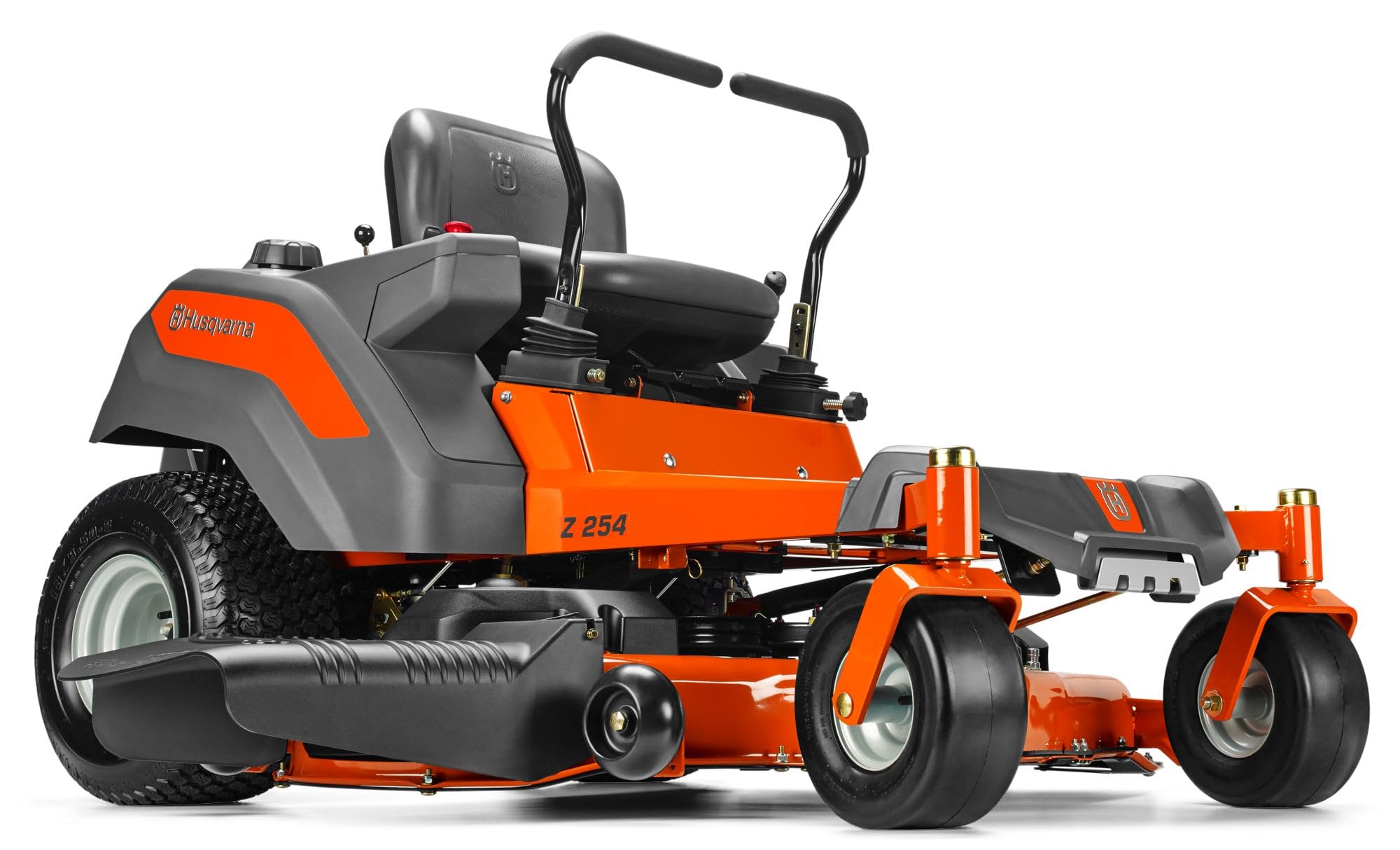
Is a Riding Mower as Wide as Its Deck?
Usually, no. The deck measures the mower’s cutting path, while the overall width measures the widest part of the machine.
A 42-inch deck does not mean the mower is exactly 42 inches wide. The mower may have:
- A discharge chute that sticks out on one side
- Wide rear tires
- A wider frame
- Deck brackets or support arms
- Side panels or footrests
- Anti-scalp wheels outside the deck shell
Some specifications list width with the discharge chute raised. Others list width with the chute in its normal mowing position. This difference can affect whether the mower fits through a doorway.
Width with the chute raised or removed
Many side-discharge mowers are narrower when the chute is lifted or removed. However, the chute is a safety part. Do not mow without it unless the manufacturer specifically allows that setup and the correct mulch plug or bagger is installed.
For storage, the chute may fold upward. For transport, it may still be necessary to measure the mower in its normal operating configuration.
The widest point matters
Measure the widest point from left to right. Do not measure only the metal deck.
For example, a mower may have:
- A 42-inch cutting deck
- A 45-inch body
- A 48-inch width with the chute installed
If the available doorway is 46 inches wide, the mower may not fit even though the deck is only 42 inches.

How Wide Is a Riding Mower by Mower Type?
Rear-engine riding mowers
Rear-engine riding mowers are often the narrowest full-size riding mowers. Many have decks from about 28 to 36 inches and an overall width near 30 to 40 inches.
They can work well for:
- Small suburban lawns
- Narrow gates
- Compact sheds
- Properties with tight turns
Their smaller decks require more passes across a lawn. They also may have less power and fewer attachments than larger lawn tractors.
Lawn tractors
Lawn tractors are the most common choice for many American homeowners. Their decks often range from 42 to 54 inches.
A lawn tractor with a 42-inch deck may be close to 48 inches wide. A 54-inch model may need around 60 inches of clearance. Exact width depends on the frame, tire size, and discharge chute.
Lawn tractors are useful when you want to mow grass and use basic attachments, such as a cart, spreader, or snow blade.
Garden tractors
Garden tractors have heavier frames and are built to handle demanding attachments. They are often wider than basic lawn tractors, even when their cutting decks are similar in size.
Many garden tractors measure roughly 55 to 65 inches wide. Their greater weight also affects ramps, trailers, garage floors, and storage space.
Zero-turn mowers
Zero-turn mowers can be narrow or very wide. Small residential models may be about 36 to 48 inches wide. Larger models can measure 60 to 75 inches wide.
The rear steering wheels do not always define the mower’s maximum width. The deck and side discharge chute often extend farther.
Zero-turn mowers need extra clearance around door frames and posts because their control levers can also stick out from the main body.

How Much Clearance Does a Riding Mower Need?
A mower should have more space than its listed width. Exact clearance depends on how straight you can drive and whether the doorway has a raised threshold.
Use this simple planning rule:
Required opening width = mower’s widest measurement + at least 4 to 6 inches of clearance
For example, if the mower is 54 inches wide:
- Tight fit: 56 inches
- More practical fit: 58 to 60 inches
- Easier entry with less risk of scraping: 60 inches or more
A skilled driver may pass through a smaller opening, but a tight fit can damage the mower, door frame, siding, or chute. It also makes loading more difficult.
Clearance for a shed or garage
For storage, allow space on both sides of the mower. A 60-inch-wide mower should not be placed in a 61-inch-wide shed opening if you need to turn it or remove the mower later.
Also allow room for:
- Opening the hood
- Removing the seat or battery
- Checking tire pressure
- Servicing the deck
- Walking around the mower
- Connecting a battery charger
A narrow door may fit the mower but still make maintenance frustrating.
Clearance for a gate
Measure the narrowest part of the gate opening. Hinges, posts, latch hardware, and sloped ground can reduce usable space.
If the gate opens only partway, measure the actual gap while it is open. Do not rely on the gate’s advertised width.
Clearance for a trailer or ramp
A trailer must be wider than the mower’s tire track and overall body. The ramp should also support the full tire width without allowing a wheel to drop beside the ramp.
Before loading:
- Confirm the trailer’s inside width.
- Check the ramp’s rated capacity.
- Center the mower.
- Drive slowly and straight.
- Set the parking brake.
- Secure the mower with rated tie-downs.
Follow the mower and trailer manuals. Never rely only on the parking brake during transport.

How to Measure a Riding Lawn Mower
Measure the mower yourself when the fit is important. Manufacturer dimensions can use different conditions.
What you need
Use:
- A tape measure
- A straight edge or helper
- A level surface
- The mower’s manual or specification sheet
Measurement steps
- Park the mower on a level surface.
- Turn off the engine and remove the key.
- Lower the cutting deck to its normal mowing position.
- Put the discharge chute in the position used during mowing.
- Measure from the farthest point on the left to the farthest point on the right.
- Repeat the measurement with the chute raised or removed only if storage requires it.
- Measure the doorway or gate at its narrowest point.
- Subtract the mower width from the opening width.
- Divide the remaining space between both sides to find the side clearance.
Example calculation
Suppose:
- Mower width: 52 inches
- Door opening: 60 inches
The remaining space is:
60 − 52 = 8 inches
That gives about 4 inches of clearance on each side if the mower is centered. This may be workable, but a wider opening is easier and safer.
If the door opening is 55 inches, the remaining space is only 3 inches. That leaves about 1.5 inches per side, which is a risky fit.

What Changes a Riding Mower’s Width?
Several design details can change the measurement by a few inches.
Discharge chute
A side-discharge chute is often the widest removable part. Check whether the manufacturer lists width with the chute installed, folded, or removed.
Cutting deck
A wider deck normally means a wider mower, but not always by the same amount. Deck hangers, wheels, and the frame can change the final measurement.
Tire size
Large rear tires may extend beyond the deck or frame. This is more common on garden tractors and heavy-duty models.
Bagger systems
A rear bagger usually increases length, not width. Still, its mounting frame may affect movement through tight spaces. Side-mounted accessories can make the mower wider.
Mulching kits
A mulch plug may remove the need for a side discharge chute. It can reduce the mower’s storage width, but only if the manufacturer approves the setup and the plug is installed correctly.
Replacement parts
Non-original decks, tire changes, and aftermarket attachments can change the mower’s dimensions. Measure the actual machine after modifications.

Choosing a Riding Mower Width for Your Property
The best width depends on both the lawn and the route to the lawn.
A wider mower can reduce mowing time because it cuts more grass per pass. A narrower mower can fit through gates and around obstacles more easily.
| Property condition | Practical starting point |
|---|---|
| Narrow gate or small storage door | Rear-engine rider or narrow compact mower |
| Small, open suburban lawn | 30–42-inch mower |
| Medium lawn with open access | 42–48-inch lawn tractor |
| Large open lawn | 48–60-inch tractor or zero-turn mower |
| Many trees, beds, and tight turns | Narrower deck with good maneuverability |
| Very large open areas | Wider zero-turn mower, if access allows |
A 60-inch mower is not always faster on a small lawn. It may be harder to turn, store, and move between areas. A smaller mower may be the better choice if the property has narrow paths or many obstacles.
Use the narrowest route
Before buying, trace the full route from delivery point to storage area and lawn:
- Sidewalk or driveway
- Gate
- Fence opening
- Shed door
- Garage door
- Narrow path
- Sloped section
- Bridge or lawn edging
Measure every bottleneck. The narrowest point controls the mower size you can use.

Common Mistakes When Checking Mower Width
Mistake 1: Using deck size as total width
A 48-inch deck does not guarantee a 48-inch mower. Always check overall width.
Mistake 2: Measuring the doorway at its widest point
Door frames often taper, and hardware can reduce the opening. Measure the smallest usable gap.
Mistake 3: Forgetting the discharge chute
The chute may be the widest part. Check it in the position needed for storage and mowing.
Mistake 4: Ignoring the control levers
Zero-turn control levers can add width. Measure from the outer edge of one lever to the other when they are in the normal position.
Mistake 5: Allowing no steering room
A mower may fit through a door only when perfectly straight. If you must turn as you enter, add more clearance.
Mistake 6: Trusting an online listing without checking the model
Manufacturers can offer several versions of a mower with different decks, tires, and frames. Confirm the full model number and deck configuration.

Key Takeaways
- Most riding lawn mowers in the United States are about 28 to 72 inches wide.
- Rear-engine riders are often the narrowest.
- Common lawn tractors usually need about 48 to 60 inches of width.
- Large zero-turn mowers may need 60 to 75 inches.
- A mower’s deck width is not always its overall width.
- Measure the widest point, including the discharge chute.
- For easier access, allow at least 4 to 6 inches of extra opening width.
- Check the exact manufacturer specification before buying or building storage.
Frequently Asked Questions
Will a 42-inch riding mower fit through a 48-inch gate?
It may, but the answer depends on the mower’s overall width. A 42-inch deck can have an overall width near 46 to 50 inches. Measure the mower with the chute and compare it with the gate’s narrowest opening.
What is the narrowest riding lawn mower?
Small rear-engine riding mowers are often the narrowest full-size options. Some have overall widths near 30 to 36 inches. Small zero-turn models can also be narrow, but their exact widths vary by model.
How wide should a shed door be for a riding mower?
Use the mower’s actual overall width, then add at least 4 to 6 inches. For a mower that is 52 inches wide, a door opening of about 56 to 58 inches is a practical starting point. More room makes entry and maintenance easier.
Are zero-turn mowers wider than lawn tractors?
Often, but not always. Small zero-turn mowers may be similar in width to compact tractors. Large zero-turn models with 54- to 72-inch decks are commonly wider than standard lawn tractors.
Can I remove the discharge chute to make a mower narrower?
Some chutes can be folded or removed for storage. Do not operate the mower without the required chute, deflector, mulch plug, or bagging system. Follow the model’s owner’s manual and local safety requirements.
Does a riding mower fit in a pickup truck?
Most riding mowers do not fit safely in a standard pickup bed without specialized equipment. The mower’s width, weight, ramp angle, and tie-down points all matter. A suitable trailer is often safer. Follow the mower manufacturer’s transport instructions.
Conclusion
Riding lawn mower width depends on the mower type, deck, tires, chute, and frame. A useful general range is 28 to 72 inches, but the exact model specification is what determines whether the mower will fit through a gate, shed door, garage, or trailer.
Before buying, measure the mower’s widest point and compare it with the narrowest part of your route. Add several inches of clearance rather than planning for a tight squeeze. That small step can prevent delivery problems, property damage, and an expensive return.


