Best Time Of Day To Mow Lawn: Best Mowing Guide
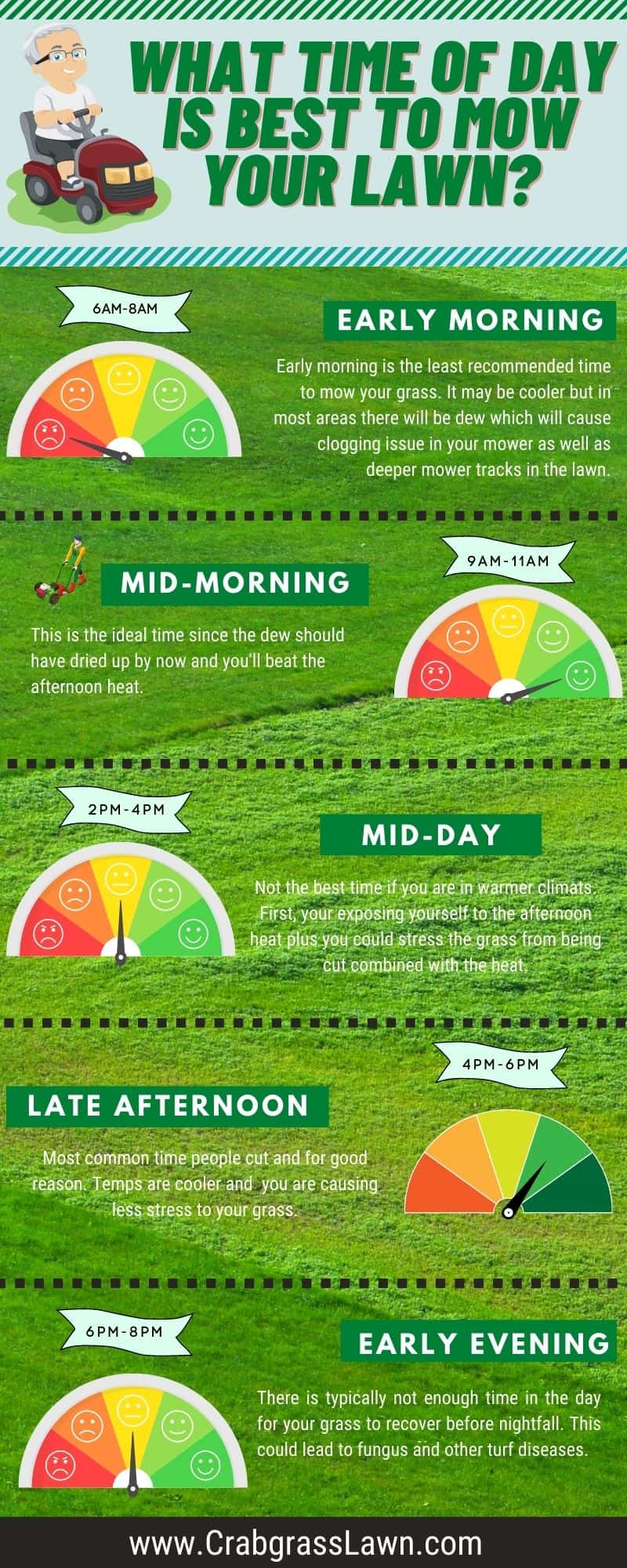
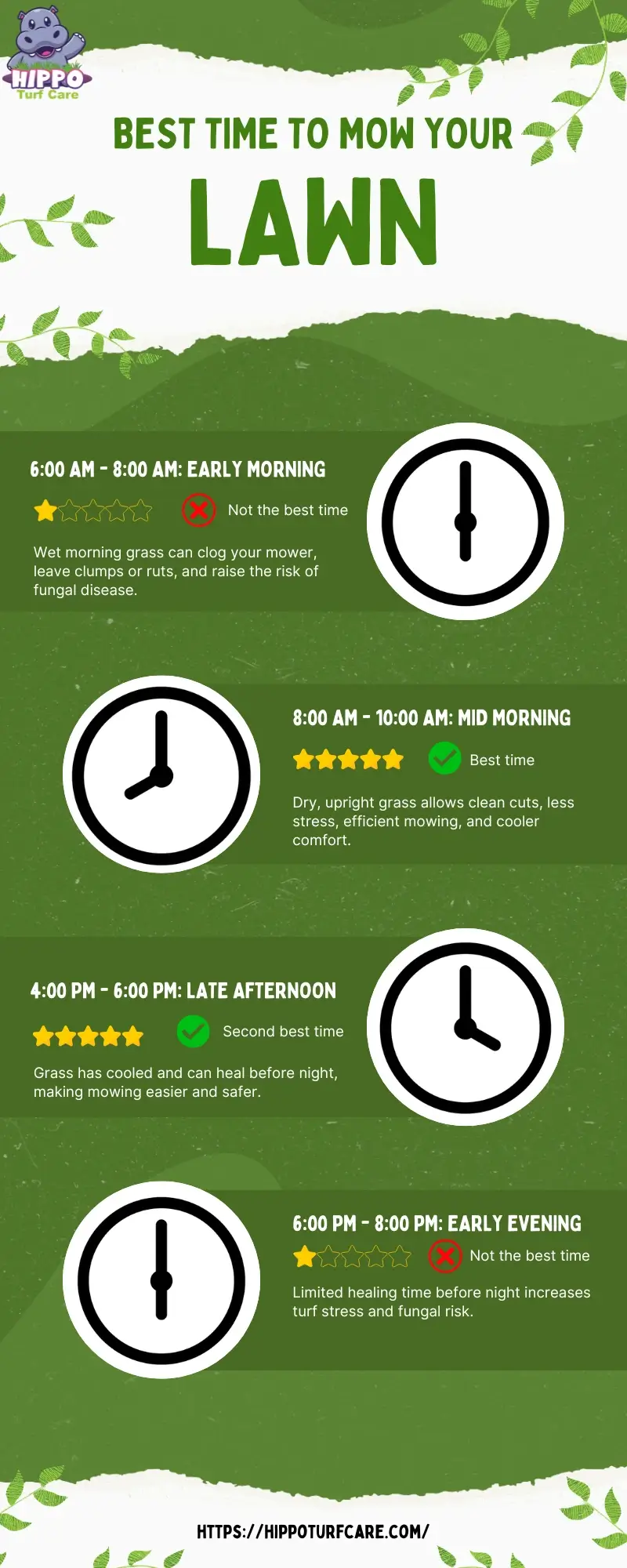
The best time of day to mow your lawn is usually mid-morning, after the dew has dried but before the strongest heat arrives. In many yards, this means about 8 to 10 a.m. A second good window is late afternoon, around 4 to 6 p.m., when the grass is dry and the sun is less intense. The right time also depends on weather, grass type, slope, noise rules, and your mower.

Quick answer: when should you mow?
The best time to mow is mid-morning, once the lawn is dry and the air is still fairly cool. Late afternoon also works well. Avoid mowing at dawn, during the hottest part of the day, right after rain, or late at night. Dry grass gives a cleaner cut, protects the turfgrass, and helps prevent clumps, ruts, disease, and mower damage.

A simple rule is to check three things before you start:
- The grass blades are dry.
- The soil is firm enough to support the mower.
- At least a few hours of daylight remain for the lawn to recover.
Mowing is more than cutting green blades. It is a small stress event for the plant. A clean cut at a good time can help the lawn recover. A rough cut on wet or heat-stressed grass can leave damage that lasts for days.
Why mowing time affects your lawn
The time of day changes how dry, firm, hot, and stressed your lawn is. These factors affect the cut, the mower, the soil, and the turfgrass. The same mower can work well at 9 a.m. and struggle at 1 p.m. after a week of drought.
Mid-morning is the best choice for most yards
Mid-morning is often the safest and most useful mowing window. By then, morning dew has usually dried. The grass is still cooler than it will be in the afternoon, and the soil may still have enough firmness for a push mower or self-propelled mower.
Dry blades stand upright. This helps mower blades cut rather than bend the grass. Dry clippings also spread more evenly when you use a mulching kit, which chops clippings into small pieces and returns them to the soil.
Mid-morning works well for:
- Small and medium yards
- First-time homeowners
- Push mowers and battery mowers
- Lawns with light slopes
- Neighborhoods with common daytime noise rules
If your area has heavy morning dew, wait until the top of the grass feels dry. Do not use the clock alone. A shaded lawn may stay wet long after a sunny lawn is ready.
Late afternoon is a good backup
Late afternoon can be a strong second choice. Around 4 to 6 p.m., the worst heat has often passed, yet there is still enough daylight for the grass to dry before night.
This time works well for people who work during the day. It also suits lawns that dry slowly in the morning. Avoid waiting too late, though. Grass cut just before sunset may remain damp for hours. That can increase the chance of fungal disease, especially in humid climates.
Late afternoon is useful for:
- Dry lawns that missed the morning window
- Warm regions with strong midday heat
- Homeowners who need to mow after work
- Electric mowers that are quiet enough for daytime neighborhood use
A late-afternoon cut is less useful after a cool, cloudy day. Use your hand and your eyes. If the blades feel damp, wait.
Early morning is often too wet
Dawn may seem like a cool and pleasant time to mow, but it is often a poor choice. Dew coats the grass, and wet clippings can stick beneath the mower deck. The mower may leave clumps instead of an even spread.
Wet grass also bends away from the mower blades. This can create an uneven cut. On a slope, wet grass adds a serious slip risk, even with a self-propelled mower.
If you must mow early, wait until the dew has dried. A light breeze and rising sun can help, but do not rush the process.
Midday heat can stress the lawn
The hottest part of the day is usually the least helpful mowing time. In many regions, this is from late morning through mid-afternoon. Strong sun and high heat can increase water loss from freshly cut leaf tips.
Mowing at noon is not always harmful. A healthy, well-watered lawn may handle it. But it is a poor choice during drought, heat waves, or water restrictions. It is also harder on the operator, battery, engine, and mower deck.
If midday is your only option, raise the mowing height, keep the blades sharp, and avoid removing more than one-third of the grass height.
Best mowing times by weather and season
Weather matters more than the calendar. A cool, dry afternoon can be better than a wet morning. A mild spring day may allow a longer mowing window than a hot summer day.
The table below gives a practical starting point. Local humidity, shade, soil type, and grass type can change the answer.
| Condition | Better mowing window | Main reason |
|---|---|---|
| Cool, dry spring day | Mid-morning or afternoon | Grass is dry and not heat-stressed |
| Hot summer day | Early mid-morning or late afternoon | Reduces heat stress |
| Humid morning | Late morning after dew dries | Lowers clumping and disease risk |
| Dry, mild fall day | Mid-morning or early afternoon | Good visibility and firm soil |
| Recent rain | Wait until the lawn is dry and firm | Prevents ruts and clumps |
| Drought or heat wave | Skip or mow high during a cool window | Protects stressed turf |
The main takeaway is simple: dry grass and firm soil matter more than a fixed hour. During hot weather, choose the coolest dry window. During wet weather, wait.
Spring mowing timing
Spring grass can grow fast after rain and mild temperatures. You may need to mow more often, but the lawn may still be soft. Wait until the soil does not hold footprints or tire marks.
Cool-season grasses, such as Kentucky bluegrass, tall fescue, perennial ryegrass, and fine fescue, often grow strongly in spring. Mid-morning is usually a good time to mow them. Keep the first cuts light if the grass has grown tall.
Do not scalp the lawn after winter. Scalp means cutting so low that much of the stem and crown becomes exposed. This can weaken grass and invite weeds.
Summer mowing timing
Summer mowing calls for more care. Warm-season grasses, such as bermudagrass, zoysiagrass, St. Augustinegrass, and centipedegrass, may grow quickly in warm weather. Yet heat and drought can still slow growth and weaken the plant.
Mow in mid-morning or late afternoon. Raise the deck if the lawn looks dry, gray, thin, or wilted. A higher mowing height gives the grass more leaf area for shade and water use.
Never mow a lawn that is badly wilted just because it is on your schedule. Water restrictions may also limit irrigation, so adjust your mowing plan to local conditions.
Fall mowing timing
Fall brings cooler air and longer dew periods. Midday can be a good mowing time if the grass dries late. Keep mowing while the grass continues to grow, but reduce frequency as growth slows.
Remove heavy leaf cover before mowing. A mower can mulch a light layer of leaves, but thick leaves can block light and trap moisture. Use a grass catcher, leaf blower, or rake when needed.
Winter mowing timing
Many lawns stop growing in winter. Do not mow frozen grass. Frozen blades can break under the mower, and tire traffic can damage the crown and soil.
In mild climates, winter grass may continue to grow. Wait for a dry, frost-free window. Never mow when the lawn is soft from winter rain.
Grass type changes the best time to mow
Different grasses have different growth patterns, mowing heights, and stress limits. Knowing your turfgrass helps you choose both the time of day and the mower height.

| Grass type | Common region or season | Useful mowing approach |
|---|---|---|
| Kentucky bluegrass | Cool-season regions | Mow after dew dries; keep a moderate height |
| Tall fescue | Transition and cool-season regions | Avoid heat stress; mow high during dry periods |
| Bermudagrass | Warm-season regions | Mow during active growth; avoid wet turf |
| Zoysiagrass | Warm-season regions | Use sharp blades and avoid cutting too low |
| St. Augustinegrass | Warm, humid regions | Mow high and avoid heat or drought stress |
| Fine fescue | Cool, shaded areas | Mow gently and avoid wet soil |
These are general guidelines, not a substitute for local extension advice. Your county extension office or turf specialist can help identify the grass in your yard.
Cool-season grass
Cool-season grass grows best in cooler spring and fall weather. It may struggle in hot summer conditions. If your lawn contains tall fescue or Kentucky bluegrass, avoid mowing during the hottest part of the day.
Tall fescue benefits from a higher mowing height in many yards. Check local guidance and the grass seed label if you know the variety. A sharp blade is especially important because torn tips turn pale and dry.
Warm-season grass
Warm-season grass grows best in heat and sunlight. It can often handle summer mowing better than cool-season grass, but it still suffers when cut during extreme heat or drought.
Mow after the lawn dries. Do not cut wet St. Augustinegrass or zoysiagrass with dull blades. These grasses can mat and show wheel tracks when the soil is soft.
The best time depends on your mower
Your mower affects noise, traction, cutting speed, and cleanup. A lightweight battery mower may be easy to use in mid-morning. A riding mower may require more space, more storage, and more planning around neighbors.

Push mowers
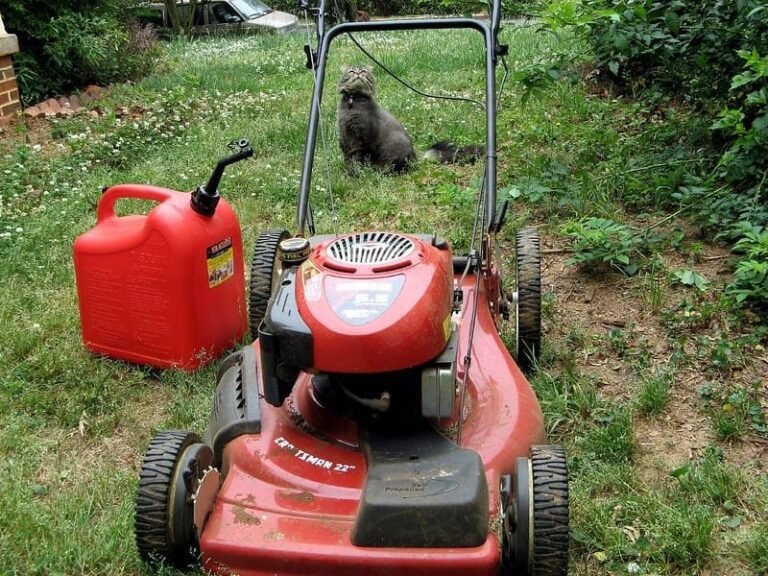
Push mowers suit small yards and flat lots. They can be gas, corded electric, or battery powered. A typical walk-behind mower may have a deck around 20 to 22 inches wide, but confirm the actual specification before buying.
A push mower is a good fit for:
- Small yards
- Flat or gently sloped lawns
- Renters who need a simple tool
- Homeowners with limited storage
The main drawback is operator effort. Thick or wet grass makes the mower harder to push. A narrow gate may favor a push mower over a riding mower.
Self-propelled mowers
A self-propelled mower uses a drive system to move the mower while you guide it. This can help on larger yards and moderate slopes. Some models use front-wheel drive, rear-wheel drive, or all-wheel drive.
Self-propelled mowers suit:
- Medium yards
- Hilly lawns
- Older adults who can walk but should reduce pushing effort
- Users who want a walk-behind mower without full riding-mower storage
They cost more and have more parts to maintain. Drive belts, cables, gears, and wheels may wear before the mower body does. Read the manual before using one on steep slopes.
Riding mowers
Riding mowers save time on larger lots. They need a clear route, a wide gate, and protected storage. A riding mower may have a deck from roughly 30 inches to more than 50 inches, depending on the model.
Use a riding mower only when the yard and slope match the manual. Wet slopes can be dangerous. A riding mower is not automatically safer than a walk-behind mower.
Zero-turn mowers
Zero-turn mowers use two drive wheels to turn in a very tight radius. They suit large, open yards with many obstacles. They are usually excessive for a small suburban lawn.
Zero-turn mowers can cut mowing time, but they require more skill. They may also be a poor choice for steep slopes, narrow gates, or limited storage. Check the slope limit in the owner’s manual.
Battery, gas, corded, reel, and robotic mowers
Battery mowers are quieter and avoid fuel storage. Voltage and amp-hours, or Ah, describe the battery system and its charge capacity. Runtime varies with grass height, speed, blade condition, temperature, and battery size.
Gas mowers can run for long periods with refueling. They need oil, spark plugs, air filters, fuel care, and seasonal maintenance. A cold engine may start poorly in cool weather, and hot weather can make fuel handling unpleasant.
Corded mowers work for small yards near an outdoor outlet. The cord can limit movement and must stay clear of the blade.
Reel mowers use a cylinder of blades and suit small, flat yards with short grass. They need more frequent mowing and may struggle with tall or tough growth.
Robotic mowers can suit homeowners who want frequent, light cuts on a prepared lawn. They require setup, boundary planning, charging space, and protection from theft or weather. Confirm slope limits, wire requirements, and local rules before buying.
A practical mowing schedule by yard type
The best schedule is the one that keeps the grass from becoming too tall while fitting your time, terrain, and equipment. Mowing frequency changes with rainfall, fertilizer, shade, and season.

| Yard type | Best mowing window | Mower fit |
|---|---|---|
| Small, flat yard | Mid-morning or late afternoon | Push, reel, corded, or battery mower |
| Medium yard | Mid-morning after dew dries | Battery, gas, or self-propelled mower |
| Hilly yard | Dry mid-morning; avoid wet slopes | Rear-drive or all-wheel-drive mower |
| Large open lot | Dry morning or late afternoon | Riding or zero-turn mower |
| Shaded, damp yard | Late morning after full drying | Sharp-blade walk-behind mower |
| Senior’s yard | Cool, dry daylight hours | Lightweight self-propelled mower or service |
For a small flat yard, a simple push mower may be all you need. For a hilly lawn, traction and control matter more than raw cutting width. For a senior or gift recipient, a mower that reduces pushing effort may be more useful than a larger deck.
Mowing for seniors
A senior homeowner may prefer a lightweight battery mower or a self-propelled model. Look for easy controls, a simple height adjustment, a handle that folds without tools, and a battery shared with other yard tools.
Avoid choosing a large riding mower without checking storage, comfort, slope, and physical ability. A mower that is hard to start, lift, charge, or clean is not a thoughtful gift.
🎁 Gift-Buyer Note: Before buying, measure the gate and storage area. Ask whether the recipient already owns batteries from a tool brand. Battery compatibility can matter more than a small difference in deck width.
Mowing for a hilly lawn
Dry conditions are essential on slopes. Wet grass reduces traction and may cause a walk-behind mower to slide. Mow across a slope only when the manual allows it; some manufacturers advise mowing up and down on certain slopes, while others set strict limits.
Never rely on a mower’s self-propelled drive as a substitute for safe footing. Wear closed-toe shoes with good grip. Keep both hands on the handle and avoid sudden turns.
How high should you mow?
Mowing height affects shade, roots, water use, and weed pressure. The best height depends on your grass type and local conditions. In general, avoid cutting more than one-third of the blade length at one time.

A high setting is often helpful during heat or drought. A lower setting may suit some warm-season grasses, but cutting too low can expose soil and weaken the lawn. Check the mower’s height range and your turfgrass guidance.
Why the one-third rule helps
Grass stores energy in its leaf blades. Removing too much at once can shock the plant. It also creates more clippings than the mower can spread or discharge well.
If the grass is tall, raise the deck first. You may need a second cut a few days later. Do not force a low deck through tall growth.
Mowing height and lawn striping
Lawn striping is the light-and-dark pattern caused by bending grass in different directions. A mower roller or the mower’s wheels can create stripes, but striping is not the main goal of healthy turf.
Change mowing direction from week to week. This reduces repeated wheel tracks and can help prevent soil compaction. Do not chase stripes by mowing too low.
What to do before mowing
Good preparation improves safety and cut quality. It also prevents many mower problems that people blame on the engine or battery.

Clear the lawn
Walk the area before mowing. Remove:
- Sticks and stones
- Toys and sports gear
- Wire and garden hoses
- Pet waste
- Loose edging material
- Hidden tools
- Branches and pine cones
A mower blade can throw debris at high speed. Clearing the lawn protects you, nearby people, windows, and the mower.
Check the mower
Before each use, inspect:
- Blade condition
- Tire pressure
- Deck buildup
- Battery charge
- Fuel level
- Oil level
- Air filter
- Spark plug wire
- Grass catcher
- Drive cable or belt
A dull blade tears grass. A damaged blade can create vibration and harm the spindle. Never keep using a mower that vibrates badly.
Plan the route
Start with a simple route that keeps the mower away from people and objects. Overlap each pass slightly. Avoid sharp turns on soft ground.
For a riding mower, check the full route before starting. Confirm the gate width, slope, low branches, and places where the deck could strike a curb.
⚠️ Safety Warning: Wear eye protection, hearing protection, work gloves when handling debris, and closed-toe shoes. Keep children and pets away. Never mow wet grass on a slope. Follow the owner’s manual.
How wet grass changes mowing
Wet grass is one of the main reasons a lawn looks uneven after mowing. Moisture makes the blades bend, clippings clump, and soil lose strength.

Signs the lawn is too wet
Wait if:
- Your shoes leave deep prints.
- The grass shines with dew.
- Clippings stick in heavy mats.
- The mower tires sink.
- The soil feels soft underfoot.
- The mower deck fills quickly.
A light morning dampness may clear in a short time. Heavy rain needs longer. Clay soil may stay soft for a day or more, while sandy soil may firm up sooner.
Why wet grass can damage the mower
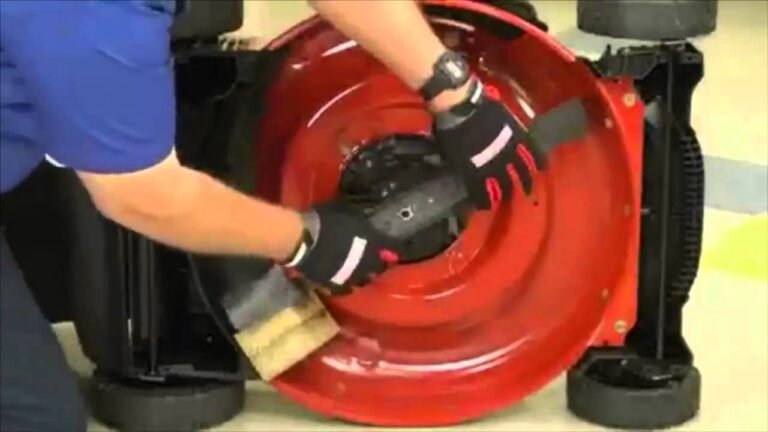
Wet clippings can stick below the deck and restrict airflow. They may also block the discharge chute. On a gas mower, wet buildup can make the engine labor. On a battery mower, thick wet grass can reduce runtime.
Never reach under the deck while the mower is running. Shut it off, remove the battery or disconnect the spark plug, and follow the manual before cleaning.
Heat, drought, and mowing stress
A lawn under heat or drought stress may look gray, dull, or folded. Mowing during this period can add stress, especially if the blade is dull or the cut is too low.
Mow less often when growth slows. Set the deck higher and avoid removing large amounts of leaf tissue. If local water rules allow irrigation, water at the correct time and depth for your grass rather than watering lightly every day.
Do not mow simply because the calendar says it is time. Mow when the grass needs it and when conditions are safe.
Cold weather and cold-start problems
Gas mowers may be harder to start in cold weather. Old fuel, a dirty air filter, a worn spark plug, or thick oil can contribute to cold-start trouble. Use the oil grade and fuel guidance in the manual.
Battery mowers may also lose performance in very cold conditions. Store batteries in the temperature range listed by the manufacturer. Do not charge a damaged or swollen lithium-ion battery.
Equipment care after mowing
The best mowing time does not protect a neglected mower. A few minutes of care can reduce wear on blades, belts, batteries, and engines.

| Part or task | Check or service | Why it matters |
|---|---|---|
| Mower blade | Inspect and sharpen as needed | Helps reduce tearing |
| Deck | Remove packed clippings when safe | Supports airflow and discharge |
| Battery | Store dry and charge as directed | Helps protect battery life |
| Spark plug | Inspect on the manual schedule | Supports reliable starting |
| Air filter | Clean or replace as specified | Helps the engine breathe |
| Fuel system | Use fresh fuel and stabilizer if advised | Reduces stale-fuel problems |
| Wheels and belt | Check for wear or damage | Supports safe movement |
Disconnect the spark plug wire on a gas mower or remove the battery on an electric mower before servicing. Do not spray water into electrical parts. Let the mower cool before cleaning or storing it.
🔧 Quick Fix: If the mower leaves a strip of uncut grass, first check the blade sharpness, deck height, wheel height, and mowing speed. A slow pass with a sharp blade often helps more than lowering the deck.
Noise, neighbors, and local rules
Mowing time is also a courtesy issue. Gas mowers, riding mowers, string trimmers, and leaf blowers can be loud. Battery and reel mowers are often quieter, but the exact sound level varies by model and use.
📜 Check Local Rules: Confirm city noise ordinances, HOA quiet hours, rental rules, and any gas-equipment restrictions before mowing. Some communities also regulate fuel storage, outdoor equipment use, or leaf-blower operation.
In many neighborhoods, mid-morning is a safer choice for noise. Avoid dawn, late evening, and quiet hours. If you have a large lot, plan loud work for a single daytime block rather than starting several times.
Environmental and disposal notes
Lawn care creates waste, but much of it can be handled responsibly. Grass clippings can often stay on the lawn when they are short and spread evenly. They can return nutrients to the soil and reduce bag use.

Do not leave thick clumps on the grass. Spread them with another pass or collect them for composting if local rules allow it. Keep clippings out of storm drains, streams, and streets.
🌿 Eco or Disposal Note: Recycle lithium-ion batteries at a designated battery drop-off. Take old gas and oil to a hazardous-waste site. Donate or recycle usable mowers instead of dumping them.
Fuel should stay in an approved container and away from heat. Follow local fuel-storage laws and the mower manual. Never refuel a hot engine.
Common mowing mistakes to avoid
Most mowing problems come from timing, height, speed, or poor preparation. The good news is that these errors are easy to correct.

| Mistake | What can happen | Better choice |
|---|---|---|
| Mowing wet grass | Clumps, ruts, poor traction | Wait for dry blades and firm soil |
| Cutting too low | Stress, bare soil, weak roots | Raise the deck |
| Using a dull blade | Torn, pale-looking tips | Sharpen or replace the blade |
| Mowing in peak heat | More stress and water loss | Use a cooler window |
| Ignoring debris | Injury or blade damage | Walk the lawn first |
| Storing stale fuel | Hard starting and fuel-system issues | Follow fuel and stabilizer guidance |
| Cutting too fast | Uneven height and missed strips | Slow down in thick grass |
Do not assume a bigger mower is better. A wide riding mower may be inefficient in a small yard with trees and narrow beds. A small mower may be a poor fit for a large property where the work takes too long.
How long does a mower last?
A mower’s life depends on build quality, use, storage, maintenance, and climate. A basic mower used on a small flat yard may last for many seasons with care. A heavily used mower on rough ground will wear faster.
The parts that often need attention first are:
- Blades
- Belts
- Wheels
- Cables
- Spark plugs
- Air filters
- Batteries
- Spindles
- Fuel-system parts
A metal deck may resist impact better than some plastic decks, but it can rust if stored wet. Battery mowers avoid oil changes but still need blade care and battery replacement planning. Gas mowers can be repaired for many years, but fuel systems need regular attention.
Signs it may be time to replace a mower
Consider replacement when the mower has repeated safety faults, severe deck rust, major frame damage, unavailable parts, or repair costs that approach the value of a suitable replacement. Do not replace a mower just because it is older if it remains safe and reliable.
Before buying, confirm the deck size, cutting height range, blade type, battery voltage, amp-hours, replacement part numbers, gate width, slope needs, and storage space.
Is mowing in the evening a good idea?
Early evening can work if the grass is dry and several hours of daylight remain. Late evening is usually a poor choice. The lawn may stay damp overnight, and noise may bother neighbors.
If you mow after work, aim for the earlier part of the evening. Keep the blade sharp so the job ends quickly. Avoid cutting during heavy dew, fog, or cool damp weather.
Best time of day to mow lawn FAQs
Q: Is it better to mow in the morning or evening?
A: Mid-morning is usually better because dew has dried and the lawn has time to recover before night. Early evening can also work when the grass is dry. Avoid mowing late at night or when the lawn is wet.
Q: Can I mow at 7 a.m.?
A: You can if the grass is dry, the soil is firm, and local noise rules allow it. In many yards, 7 a.m. is too early because dew is still present. Check the lawn instead of relying only on the clock.
Q: Should I mow before or after rain?
A: Mow before rain only if the grass is not already wet and the forecast allows enough time. After rain, wait until the blades are dry and the soil is firm. This reduces clumps, ruts, and slipping.
Q: What is the best time to mow in hot weather?
A: Mow in mid-morning after dew dries or in late afternoon after the strongest heat passes. Raise the mowing height and avoid cutting drought-stressed grass too short.
Q: Is it bad to mow in full sun?
A: Full sun is not automatically harmful, but peak heat can stress the lawn and the operator. A cooler, dry window is usually better, especially during drought or heat waves.
Q: Can I mow wet grass with a battery mower?
A: A battery mower may run through damp grass, but that does not make it a good idea. Wet grass can clump, reduce traction, block the deck, and create a shock or damage risk if water reaches electrical parts. Follow the manual.
Q: What is the best mower for a small yard?
A: A push battery mower, corded mower, or reel mower can suit a small, flat yard. Choose based on storage, noise, grass height, outlet access, and whether you want to push. Measure gates and confirm deck width first.
Q: What is the best mower for hills?
A: A self-propelled mower with suitable traction may help on moderate slopes. The right choice depends on slope grade, surface, grass type, and the manual’s limits. Do not mow wet slopes.
Q: Is a self-propelled mower worth it?
A: It can be worth the extra cost for medium yards, slopes, or users who want less pushing effort. It may not be worth it for a tiny flat yard. Drive systems add parts that can wear and need repair.
Q: How often should I mow?
A: Mow when the grass reaches about one-third higher than your target height. Growth changes with rain, temperature, fertilizer, shade, and grass type. Weekly mowing is common, but it is not a rule for every lawn.
Q: Should I bag or mulch grass clippings?
A: Mulching can return small clippings to the lawn when the grass is dry and not too tall. Bagging helps when clippings are wet, excessive, diseased, or covering leaves. Use the mower’s approved mulching kit and blade.
Q: Can I mow at night?
A: It is best to avoid night mowing. Visibility is poor, dew may be heavy, and noise can disturb neighbors. Mow during daylight so you can see debris, slopes, pets, and obstacles.
Q: What should I do if the mower leaves clumps?
A: Stop and check for wet grass, a dull blade, a blocked deck, a full catcher, or mowing speed that is too fast. Turn off the mower and remove the battery or disconnect the spark plug before inspecting underneath.
Q: How can I buy a mower as a gift?
A: Ask about yard size, slope, gate width, storage, grass type, noise limits, and existing battery tools. A lightweight battery mower may suit a new homeowner or senior, while a reel mower may fit a small flat yard.
Q: When should I hire a lawn service?
A: Hire a professional when the yard has steep slopes, unsafe terrain, very large areas, difficult access, or physical limits that make mowing risky. A professional can also help identify grass type, mowing height, and thatch problems.
Final advice for choosing your mowing window
For most homeowners, start with mid-morning after the dew dries. If that is not possible, use a dry late-afternoon window with enough daylight left. Skip mowing when the lawn is wet, the soil is soft, the heat is extreme, or the slope feels unsafe.
Match the time to your yard and mower. A small flat lawn may need only a simple push mower and a short dry window. A hilly lawn may need a self-propelled mower, careful traction, and a strict no-wet-grass rule. A large property may justify a riding or zero-turn mower, but only if storage, slope, gate access, and local rules support it.
Keep the blade sharp, cut no more than one-third of the grass height, clear debris first, and protect your eyes and ears. Good timing will not solve every lawn problem, but it gives your grass, mower, neighbors, and body a better chance.
Affiliate disclosure: This article may contain affiliate links. If you buy through one of these links, we may earn a commission at no extra cost to you. Always confirm current specifications, compatibility, safety instructions, and local requirements on the manufacturer’s product page and in the owner’s manual before buying or using lawn equipment.