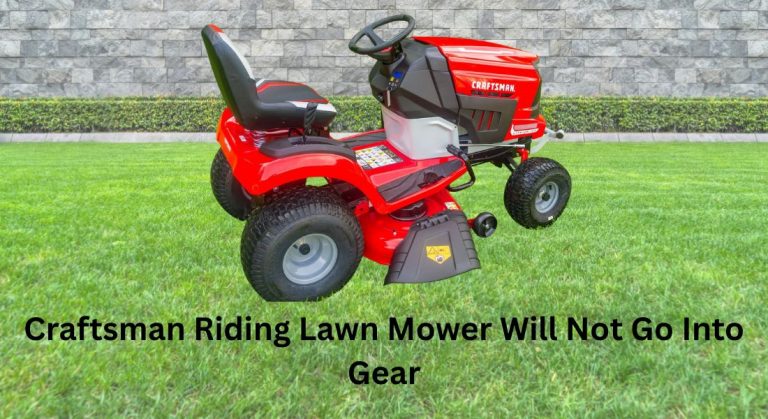
Craftsman Riding Lawn Mower Will Not Go Into Gear: Quick Fix
A Craftsman riding lawn mower that will not go into gear can turn a simple mowing job into a frustrating driveway repair. The good news is that the cause is often simple: the brake pedal is not fully released, the shift lever is out of alignment, the parking brake is still set, or the transmission bypass lever is in the wrong position.
Other problems need more care. A worn drive belt, damaged pulley, low hydrostatic fluid, stuck clutch, or failing transaxle can also keep the mower from moving. This guide explains how to find the cause, what you can safely fix at home, and when a repair shop is the better choice.
The steps apply to many Craftsman lawn tractors and riding mowers, but designs vary by model. Always check your owner’s manual for the correct belt, fluid, linkage, fuse, and replacement part numbers.

Why a Craftsman Riding Mower Will Not Go Into Gear
The main reason a Craftsman riding mower will not go into gear is that the transmission is not receiving a proper shift, drive, or clutch signal. The problem may be mechanical, electrical, or related to a safety interlock.
A gear-drive mower uses a clutch and shift linkage to send engine power through a transmission. A hydrostatic mower uses a pedal or lever to control hydraulic drive power. Both types can refuse to move, but their symptoms are different.
A mower that starts but will not move often has a drive-control issue. A mower that grinds when shifted may have a clutch or gear problem. A mower that moves in reverse but not forward may have a damaged linkage or transmission control.
First, identify the transmission type
Look at the controls near the seat and steering column.
- Manual transmission: Often has a numbered gear selector, such as 1 through 6 and reverse.
- Hydrostatic transmission: Usually has a forward and reverse pedal or a single motion-control lever.
- Automatic transmission: May have a selector marked with speed ranges instead of individual gears.
Hydrostatic means the mower uses hydraulic fluid and a pump to control movement. It does not shift between gears in the same way as a manual lawn tractor.
A hydrostatic Craftsman mower can sit still if the freewheel, or transmission bypass, rod is pulled out. This rod lets you push the mower by hand. It must be returned to the drive position before the transmission can move the tractor.
A quick safety reminder
Park the mower on level ground before testing it. Set the parking brake, turn off the engine, remove the key, and wait for all moving parts to stop.
Wear safety glasses, hearing protection, work gloves, and closed-toe shoes. Clear children, pets, and bystanders from the work area. Disconnect the spark plug wire or remove the battery before working near belts, pulleys, or blades.
⚠️ Safety Warning: Never reach under a running mower. Never test a mower on a slope. If you must lift the tractor, use approved jack stands on firm, level ground. A floor jack alone is not enough support.

Quick Answer: Craftsman Mower Won’t move
if a Craftsman riding mower will not go into gear, check the parking brake, brake pedal, shift lever, clutch, and transmission bypass rod first. On a hydrostatic model, press the brake fully, start the engine, release the parking brake, and move the bypass rod to the drive position. If the mower still will not move, inspect the drive belt and linkage with the engine off. Do not force the gear selector.
Common Symptoms and What They Mean
The symptom often points to the faulty part. Listen, watch the controls, and note whether the mower moves in any direction.
A mower that makes no sound may have a control or interlock problem. A mower that grinds, squeals, or moves slowly may have a belt, pulley, clutch, or transmission issue.

| Symptom | Likely area | First check |
|---|---|---|
| Lever will not move | Brake, clutch, or linkage | Press the brake fully and inspect linkage |
| Lever moves, but mower stays still | Drive belt or bypass rod | Check belt path and freewheel control |
| Mower moves only in reverse | Linkage or hydrostatic control | Inspect the forward control linkage |
| Mower grinds when shifted | Clutch or manual transmission | Stop shifting and inspect clutch operation |
| Mower moves slowly | Belt, fluid, or transmission | Check belt tension and hydrostatic fluid |
| Mower stopped after hitting an object | Belt, pulley, axle, or transaxle | Inspect for bent or broken parts |
The first takeaway is simple: do not assume the transmission has failed. Small control problems are more common and often cost less to repair.

The engine runs, but the mower does not move
This usually points to the drive system. The engine can run normally while the drive belt is broken, off its pulley, or too loose to transfer power.
On a hydrostatic mower, the bypass rod is one of the first things to check. It may have been pulled during storage or while moving the mower into a garage.
The mower will not select a gear
A manual Craftsman mower may refuse to shift because the clutch is not fully disengaged. The belt can keep the transmission spinning, which makes the gears hard to engage.
Do not force the lever. Forcing it can bend the shift fork or damage the transmission. Press the clutch and brake fully, let the mower stop, and try again.
The mower goes into gear but stalls
This may be a seat safety switch, clutch safety switch, or brake interlock issue. It can also happen when the engine is under heavy load from a plugged deck, wet grass, or a damaged blade.
Test the mower only as described in the owner’s manual. Never bypass a safety switch with a wire or jumper.

Main Causes and Quick Checks
Most Craftsman riding mower drive problems fall into a few groups. Work from the simplest check to the most expensive one.
The table below helps you choose a sensible order. It is not a substitute for the model manual, since belt routing and control layouts differ.

| Possible cause | What you may notice | Basic action |
|---|---|---|
| Parking brake still set | Mower starts but will not move | Release it fully |
| Brake pedal not returning | Gear lever is locked or stiff | Check return spring and pedal travel |
| Transmission bypass rod out | Mower rolls easily by hand | Push rod into the drive position |
| Loose shift linkage | Lever moves without resistance | Inspect pins, clips, and rods |
| Drive belt off or broken | Engine revs but wheels do not turn | Inspect belt with engine off |
| Clutch not releasing | Grinding or hard shifting | Check clutch pedal and cable |
| Hydrostatic fluid problem | Weak or slow movement | Check manual for fluid inspection |
| Faulty switch or fuse | Mower stops when shifted | Test the safety circuit properly |
| Damaged transaxle | Noise, leaks, or no drive | Seek professional diagnosis |
Start with controls and linkages. They are visible, easy to inspect, and less costly than a transmission.
Parking brake and brake pedal
The brake pedal must often be fully depressed before the mower can start or shift. If the pedal does not return all the way, the mower may remain in a locked state.
Look for grass, mud, or rust around the pedal pivot. Check whether the return spring is attached. A bent pedal or stretched spring can keep the brake switch engaged.
With the engine off, press and release the pedal several times. It should move smoothly and return without sticking. Do not spray oil onto a brake surface or belt.

Transmission bypass or freewheel control
A hydrostatic riding mower has a bypass control that allows the tractor to roll without the engine driving the wheels. It may be a rod, lever, or knob near the rear axle.
If the control is pulled out, the mower may roll freely but will not drive. Push it fully into the normal operating position. Then sit in the seat, start the mower, release the brake, and test the drive pedal.
If the rod will not return, do not force it. Dirt, a bent bracket, or a damaged release cable may be blocking it.
💡 Pro Tip: Take a photo of the bypass control before moving it. This gives you a reference for the correct position and helps you explain the problem to a repair shop.

Shift linkage and selector
The shift linkage connects the gear lever to the transmission. It may use rods, bushings, clips, and cotter pins. Over time, a clip can fall out or a bushing can wear.
Ask a helper to move the selector while you watch the linkage from a safe position. Keep the engine off. The rod should move as the lever moves.
If the lever moves but the transmission arm does not, the linkage needs repair or adjustment. Use the exact adjustment method in the Craftsman manual. A small change can affect every gear.

Drive belt and pulleys
The drive belt transfers power from the engine pulley to the transmission pulley. Heat, age, oil, grass, and poor tension can damage it.
Signs of a drive belt problem include:
- The engine runs at normal speed.
- The mower does not move.
- The belt hangs loose under the frame.
- The belt is cracked, glazed, frayed, or missing.
- The mower moves only when the belt catches briefly.
- A pulley spins but the belt does not transfer power.
Never install a belt by guessing the route. Use the deck label, owner’s manual, or model-specific parts diagram. A belt with the wrong length or profile may slip or damage the pulleys.

Step-by-Step Diagnosis
The best way to find the fault is to test one system at a time. Begin with the controls, then inspect the belt and linkage, and only then consider the transaxle.
This process suits a careful beginner with basic hand tools. If the mower must be lifted or the transmission must be opened, a repair shop may be safer.
1. Park and secure the mower
Move the mower to a flat, dry surface. Turn off the engine, remove the key, and set the parking brake.
Disconnect the spark plug wire on a gas mower. Keep the wire away from the plug so the engine cannot start. For a battery mower, remove the battery if the manual allows it.

2. Confirm the control position
Check that the gear selector is in neutral before starting. On a hydrostatic mower, make sure the forward and reverse pedal is centered.
Check the parking brake. Then find the transmission bypass control and return it to the drive position.
Do not test the mower indoors. Gas engines produce carbon monoxide, an odorless gas that can build up quickly in a garage or shed.
3. Test the brake and clutch
Press the brake or clutch pedal fully. Watch for smooth movement. The pedal should return when released.
Inspect the clutch cable, spring, and pivot. A cable that is broken, stretched, or frozen may not release the drive system.
On a manual transmission, shift only with the clutch fully depressed. On a hydrostatic model, do not treat the drive pedal like a gear lever.
4. Inspect the drive belt
With the engine off and spark plug disconnected, look under the frame. Check the belt from the engine pulley to the transmission pulley.
Look for:
- A missing belt.
- A belt sitting outside a pulley groove.
- Frayed edges.
- Shiny or glazed rubber.
- Burn marks.
- Oil contamination.
- A loose or bent pulley.
- Grass packed around the pulley.
Do not turn the belt by hand near sharp pulleys unless the manual permits it and the ignition system is fully disabled.
5. Inspect the shift or drive linkage
Follow the rod or cable from the control to the transmission. Look for disconnected clips, bent rods, worn bushings, and loose mounting bolts.
A linkage may look connected but still have too much play. If the selector moves several inches before the transmission arm moves, the bushing or adjustment may be worn.
Take photos before removing any part. Label clips and washers in a small container.
6. Check the hydrostatic system
Hydrostatic transmissions need the correct fluid and cooling airflow. Some units have a service reservoir. Others are sealed and should not be opened by the owner.
Check the manual before adding fluid. The wrong oil can damage the pump. Do not assume all Craftsman hydrostatic units use the same fluid.
Inspect the cooling fan and area around the transaxle. Grass and dust can block airflow and raise operating heat.
7. Test forward and reverse
After the basic checks, start the mower outside on level ground. Keep the deck disengaged. Sit fully on the seat, press the brake, and follow the normal start procedure.
Release the parking brake. Try forward at low speed, then return to neutral. Test reverse only if the mower and manual allow it.
If the mower moves in one direction but not the other, stop using it. That pattern may point to a control or internal transmission fault.
Fixes You Can Try at Home
Many owners can correct a bypass control, loose linkage clip, or misplaced belt. More complex repairs need model-specific instructions.
A first-time homeowner should stop when the repair requires working under an unsupported mower. An experienced DIYer may handle belt and linkage work with the right manual, tools, and safety equipment.
Return the bypass rod to drive mode
Pulling the bypass rod is a common reason a hydrostatic Craftsman mower will not move. Find the rod near the rear axle and compare its position with the manual.
Push it fully inward or turn it to the operating position, depending on the design. Then try the mower on level ground.
If it moves only after you wiggle the rod, the release mechanism may be sticking. Clean the area and inspect the bracket. Do not bend the rod to make it fit.
Reconnect a loose linkage clip
If a cotter pin, retaining clip, or washer is missing, replace it with the correct part. Do not use a random nail or loose wire as a permanent repair.
The clip must hold the linkage while allowing the joint to pivot. A rigid connection can bind the control.
After the repair, test every gear with the engine off. Then test forward and reverse outside, away from people and property.
Reinstall or replace the drive belt
A belt that has simply jumped off may be reusable if it is not damaged. Still, find out why it came off. A bent pulley, worn idler, weak spring, or incorrect routing may cause the same failure again.
For replacement, confirm:
- Craftsman model number.
- Transmission type.
- Belt length and profile.
- Belt part number.
- Pulley arrangement.
- Whether the belt is for drive or deck operation.
Never use a deck belt as a drive belt unless the manufacturer lists it for that application.
Adjust the clutch or brake linkage
Some Craftsman models allow clutch or brake adjustment. The manual may list a required spring length, pedal position, or clearance.
Make small changes. Test the pedal after each adjustment. Too much tension can keep the clutch engaged or cause belt wear.
If the mower grinds after adjustment, stop. Grinding can damage the transmission gears.
Replace a blown fuse only after finding the cause
A fuse may fail because of a shorted wire, stuck safety switch, or damaged clutch component. Replace it only with the same type and rating listed in the manual.
A larger fuse can allow wiring to overheat. Do not bypass the fuse.
Electrical diagnosis may require a multimeter. If you are not comfortable reading voltage or continuity, ask a technician for help.
Problems That Need More Than a Simple Fix
A broken belt is often manageable. Internal transmission damage is different. Knowing the limit can save money and prevent injury.
The following signs mean you should stop repeated testing and arrange professional service.
| Sign | What it may indicate | Recommended action |
|---|---|---|
| Loud grinding in every gear | Internal gear or bearing damage | Stop using the mower |
| Oil leaking from transaxle | Seal or housing problem | Check manual and seek service |
| Belt keeps coming off | Bent pulley or bad tension system | Inspect the drive system |
| No forward or reverse after belt repair | Pump, axle, or transaxle failure | Get a professional diagnosis |
| Wheel turns but axle does not | Broken key, hub, or axle part | Do not operate the mower |
| Transmission becomes very hot | Low fluid, overload, or failure | Stop and let it cool |
A repair shop can inspect pressure, pulley alignment, axle movement, and internal parts. This may cost less than replacing several parts by trial and error.
Hydrostatic transmission failure
A hydrostatic unit can lose drive because of low fluid, air in the system, a worn pump, or internal damage. Some units are sealed and are not designed for home rebuilding.
A mower that moves slowly in both directions may have a hydrostatic problem. So can a mower that improves for a few minutes and then loses power as it heats up.
Use only the fluid and bleeding method listed for your model. Do not open a sealed transaxle without the proper service information.
Manual transmission damage
A manual gearbox may suffer from worn gears, a bent shift fork, or a damaged input shaft. Grinding is a warning sign.
A broken clutch can also make every gear hard to select. If the clutch will not release, the transmission may keep spinning even when the pedal is down.
Avoid repeated force. Metal chips can spread through the gearbox and increase the repair cost.
Electrical interlock faults
Riding mowers use safety switches for the seat, brake, clutch, reverse, and deck. These switches help prevent unintended movement or blade operation.
A faulty switch can stop the mower from engaging. Check wires for cuts, loose connectors, corrosion, and rodent damage.
Never remove a safety switch from the system. The correct fix is to test and replace the failed component.
Tools and Parts for the Job
Most basic checks need simple tools. A repair shop may use a multimeter, belt gauge, jack stands, pressure tools, and model-specific service data.
The correct parts matter more than a large tool collection. Confirm every number in the owner’s manual or official parts listing.
| Task | Useful tools | Possible parts |
|---|---|---|
| Inspect controls | Flashlight, gloves, brush | Spring, clip, bushing |
| Inspect belt | Safety glasses, socket set | Drive belt, idler pulley |
| Check wiring | Multimeter, small brush | Fuse, switch, connector |
| Adjust linkage | Wrenches, pliers, ruler | Rod, pin, washer |
| Service hydrostatic unit | Drain pan, approved fluid | Fluid, filter, seal |
| Lift mower safely | Floor jack, jack stands | None unless damaged |
A phone camera is also useful. Photograph belt routing and linkage before removal.
Prevention and Maintenance
The best way to prevent a Craftsman riding mower from refusing to go into gear is to keep the drive system clean, correctly adjusted, and protected from moisture.
Maintenance also depends on the yard. Wet grass, steep hills, heavy clay soil, and long mowing sessions place more stress on belts and transmissions than short runs on a dry, level lawn.
Before each mowing session
Use this short check:
- Walk the yard and remove sticks, wire, rocks, and toys.
- Check the tires and look for leaks.
- Confirm the bypass control is in drive mode.
- Check that the brake and clutch move freely.
- Look for loose parts under the frame.
- Make sure the deck is clear before engaging blades.
Wet grass can clog the deck and increase load. Avoid mowing wet slopes. A riding mower can lose traction or slide.
Every 25 hours or as the manual states
Inspect the drive belt, idler pulleys, linkage, springs, and electrical connectors. Grease only the points listed by the manufacturer.
Check the mower deck for packed grass and thatch. Thatch is a layer of dead roots and stems near the soil surface. It is not the same as loose clippings, but both can build up under a deck.
Keep the air filter clean and the spark plug in good condition. An engine that loses power may feel like a transmission problem when it is actually struggling under load.
At the end of the season
Clean the mower before storage. Let it dry fully. Store it in a dry garage or shed with good airflow.
For a gas mower, use fresh fuel and fuel stabilizer as directed. Never store gasoline in an unapproved container. Follow local rules for fuel and oil storage.
Remove or maintain the battery according to the manual. Keep lithium-ion batteries in a cool, dry place away from heat and metal objects.
🌿 Eco or Disposal Note: Take old gas and oil to a hazardous-waste collection site. Recycle lithium-ion batteries at a designated drop-off. Usable old mowers may be donated or recycled instead of sent to a landfill.
When a Different Mower Makes More Sense
A riding mower may not be the right tool for every yard. A small, flat lawn may be easier to maintain with a push mower, battery mower, or self-propelled mower.
A self-propelled mower uses its own drive wheels. It suits medium yards where walking is manageable but pushing is tiring. A push mower is often simpler to store and repair.
A zero-turn mower can save time on large, open lawns, but it needs more storage space and careful use on slopes. A robotic mower may suit a fenced, fairly even yard, but installation and local rules matter.
| Yard and user | Mower type to consider | Main limitation |
|---|---|---|
| Small, flat yard; new homeowner | Battery push mower | Limited battery runtime and width |
| Medium yard; user dislikes pushing | Self-propelled mower | Still requires walking |
| Large, open yard; experienced user | Riding or zero-turn mower | More maintenance and storage |
| Steep or uneven yard | Walk-behind mower designed for slopes | Riding mower rollover risk |
| Fenced, simple yard; tech-friendly user | Robotic mower | Setup, boundary wire, and cost |
| Narrow storage area | Compact electric mower | May not suit large turf areas |
The best mower for small yards is often not a riding mower. Measure the lawn, gates, slope, and storage area before buying or gifting equipment.
Is repairing the Craftsman worth the money?
Repair is often worth considering when the engine starts well, the frame is solid, the deck is not badly rusted, and the transaxle is healthy.
Replacement may make more sense when the mower has several problems at once. Worn blades, belts, tires, battery, deck bearings, and a failed transmission can add up quickly.
Compare the repair estimate with a suitable replacement. Do not compare only sticker prices. Include delivery, assembly, disposal, maintenance, and storage needs.
Is a riding mower a good gift for a senior?
It can be, but only if the recipient can safely mount, steer, brake, and control the mower. A riding mower is not automatically easier than a walk-behind model.
Look for a stable seat, clear controls, easy access, a wide step-through area, and a yard without dangerous slopes. A family member may prefer a lawn service, battery mower, or supervised help.
🎁 Gift-Buyer Note: Measure the garage door, storage space, and gate before buying. Confirm the recipient’s yard size and terrain. A mower that cannot fit through the gate is not a useful gift.
Buyer and Owner Mistakes to Avoid
Small errors can create large repair bills. These mistakes are common among first-time owners and rushed DIY repairs.
| Mistake | Why it causes trouble | Better choice |
|---|---|---|
| Forcing the gear lever | Can bend linkage or damage gears | Stop and inspect the clutch |
| Using the wrong belt | Causes slipping or pulley wear | Match the exact part number |
| Adding random fluid | May damage hydrostatic parts | Follow the manual |
| Bypassing safety switches | Creates an injury risk | Test and replace the switch |
| Mowing wet slopes | Reduces traction and control | Wait for dry conditions |
| Storing untreated fuel | Can cause hard starts and deposits | Use approved storage and stabilizer |
Do not judge a mower by engine size alone. Deck width, terrain, parts support, seat comfort, and storage space matter just as much.
Maintenance Schedule
The schedule below is a general guide. Your Craftsman manual takes priority, especially for oil, belts, filters, grease, and hydrostatic service.
| Interval | Check or service |
|---|---|
| Before each use | Debris, tire pressure, controls, bypass rod |
| Every 10 hours | Clean deck and inspect belt area |
| Every 25 hours | Check linkage, pulleys, fasteners, and air filter |
| Every 50 hours | Inspect belt wear and grease listed points |
| Seasonal | Change oil as directed and inspect spark plug |
| Before storage | Clean, dry, stabilize fuel, protect battery |
Record repairs in a notebook or phone. Include the model number, date, part number, and symptoms. This helps with future service.
When to Call a Repair Shop
Call a professional when the mower has internal grinding, an oil leak from the transaxle, repeated belt failure, electrical faults you cannot trace, or no drive after basic checks.
Professional help is also wise if you lack a safe way to lift the mower. A riding mower is heavy. A falling tractor can cause severe injury even when the engine is off.
Ask the shop for a written diagnosis. Confirm whether the estimate includes parts, labor, fluid, disposal, and testing. Ask whether the replacement part is new, rebuilt, or used.
FAQs
Q: Why does my Craftsman riding mower start but not move?
A: Check the transmission bypass rod, parking brake, drive belt, and linkage. A hydrostatic mower will not move if its freewheel control is still pulled out. A broken or loose drive belt can also leave the engine running while the wheels stay still.
Q: Why will my Craftsman mower not go into gear unless I turn it off?
A: The clutch may not be fully releasing. The clutch cable, pedal, spring, or belt may be keeping the transmission input shaft spinning. Do not force the selector. Inspect the clutch system and follow the adjustment procedure in the manual.
Q: Where is the transmission release lever on a Craftsman riding mower?
A: It is often near the rear axle or transaxle, but the location varies. Look for a rod, knob, or lever marked for freewheel, bypass, or pushing. Check the owner’s manual before moving it.
Q: Can a bad battery keep a riding mower from going into gear?
A: Yes, on some models. A weak battery or charging fault may affect safety switches, electric clutches, or control systems. However, a mower that starts and runs may still have a mechanical belt or linkage problem.
Q: Why does my mower move slowly after it warms up?
A: Possible causes include a slipping drive belt, low or incorrect hydrostatic fluid, blocked cooling airflow, or an aging hydrostatic transmission. Stop if the transaxle becomes very hot or movement continues to weaken.
Q: Can I push a hydrostatic Craftsman mower?
A: Usually, yes, after setting the transmission bypass control to freewheel. Return the control to the drive position before operating the mower. Never tow the mower unless the manual allows it.
Q: How long does a Craftsman riding mower last?
A: Service life depends on model quality, hours, storage, terrain, mowing habits, and maintenance. Belts, blades, batteries, tires, spark plugs, and pulleys wear before the frame. A clean, well-serviced mower can last much longer than one stored outdoors and run on wet, heavy grass.
Q: Should I replace the drive belt myself?
A: A careful DIYer can often replace a drive belt with the correct manual and tools. A beginner should stop if the mower must be lifted, the routing is unclear, or a pulley is bent. Confirm the exact belt part number first.
Q: Why does my Craftsman mower go in reverse but not forward?
A: The forward linkage, pedal, control arm, or hydrostatic section may be damaged or out of adjustment. Stop using the mower until the cause is found. Do not keep testing it on a hill.
Q: What should I do if the mower grinds when shifting?
A: Stop shifting and turn off the engine. Grinding can mean the clutch is not releasing or the transmission has internal damage. Repeated grinding can turn a small adjustment into a major repair.
Q: Is a zero-turn mower better than a Craftsman riding mower?
A: A zero-turn mower suits a large, open yard where fast turns save time. A traditional riding mower may suit a smaller or more varied yard with obstacles. Neither is the right choice for every slope or storage area.
Q: Can I use any hydraulic oil in a Craftsman hydrostatic transmission?
A: No. Use only the fluid listed for your exact transmission and model. Some units are sealed, while others have a specific service fluid. Check the manual or an authorized parts source.
Q: What safety gear should I wear while checking the mower?
A: Wear safety glasses, hearing protection, work gloves, and closed-toe shoes. Clear debris first. Keep children and pets away. Disconnect the spark plug or remove the battery before servicing, and never refuel a hot engine.
Final Thoughts
A Craftsman riding mower that will not go into gear is often suffering from a control, belt, bypass, or linkage problem rather than a ruined transmission. Start with the parking brake, clutch, bypass rod, and drive belt. Use the manual for every model-specific adjustment and part number.
Work on level ground and never defeat a safety switch. If the mower grinds, leaks, overheats, or still will not move after basic checks, a repair shop can prevent further damage.
For a homeowner with a large, mostly flat yard, repairing a sound Craftsman riding mower may be practical. For a small yard, steep lawn, tight storage area, or older user, a walk-behind, battery, or professional lawn-care option may be safer and easier.
Affiliate disclosure: This article may contain affiliate links. If you buy through a link, we may earn a commission at no extra cost to you. Product details, compatibility, prices, and availability can change, so confirm current information on the manufacturer’s product page and in your owner’s manual.